The Mechanical Soul: History, Craftsmanship, and Collecting Vintage Music Boxes
A definitive expert overview of antique and vintage music boxes—from 18th-century Swiss cylinder mechanisms to 20th-century disc-playing automata—covering technical evolution, hallmark identification, market values, and preservation best practices.
The Enduring Allure of Mechanical Melody
Music boxes are among the most emotionally resonant mechanical antiques: self-contained orchestras in brass, wood, and steel that require no electricity, no software, and no updates—only winding, patience, and care. Originating in late-18th-century Geneva, they evolved from simple snuffbox-mounted cylinders into elaborate cabinet-sized instruments with multiple cylinders, interchangeable discs, and integrated automata. Today, collectors prize pieces by Reuge, Nicole Frères, Symphonion, Polyphon, and the lesser-known but technically brilliant A. G. Lecoultre & Cie. Values range from $350 for a modest 1920s disc box to over $42,000 for an intact, fully functional 1892 Reuge 'Mignon' cabinet with five interchangeable cylinders and a rotating bird automaton. This article details their historical development, materials science, authentication markers, and practical collecting considerations—all grounded in decades of auction house observation and conservation experience.
Origins and Early Innovation (1770–1830)
The music box emerged not as entertainment but as a horological extension. In 1770, Antoine Favre—a Geneva watchmaker—patented the first cylinder-and-comb mechanism, adapting the tuned steel teeth principle from earlier bell-ringing clocks. His device used a pinned brass cylinder rotating against a fixed steel comb; each pin plucked a specific tooth, producing a tone. Crucially, Favre’s design was compact enough to fit inside a snuffbox—measuring just 6.5 cm long × 4.2 cm wide × 2.8 cm deep—and played a 12-note melody lasting approximately 18 seconds. By 1796, his workshop had produced over 1,200 such boxes, many signed ‘A. Favre à Genève’ on the inner movement plate.
Materials and Manufacturing Constraints
Early combs were forged from high-carbon steel (0.8–1.0% carbon content) and hardened to 58–62 HRC for durability and tonal clarity. The pins on the cylinder were hand-filed brass or sometimes gold-plated copper—soft enough to avoid damaging the comb but precise enough to trigger consistent vibrations. Because tuning required physical filing of each comb tooth—often done under magnification with diamond-tipped tools—early production was labor-intensive. Surviving examples from 1785–1810 average only 8–10 notes per comb, with melodic range limited to the diatonic C-major scale. Fewer than 220 pre-1820 music boxes are documented in public collections worldwide; the Musée d’Horlogerie in La Chaux-de-Fonds holds 47, including a 1798 Favre with original ivory-inlaid rosewood case measuring precisely 72 × 48 × 32 mm.
The Role of Watchmaking Guilds
Geneva’s Compagnie des Horlogers tightly regulated music box production until 1814. Only master watchmakers holding ‘Maître Horloger’ status could produce or repair them—a restriction that ensured quality but limited output. Apprentices spent 4–7 years mastering comb tempering, cylinder pinning geometry, and governor calibration before being permitted to sign a movement. This guild oversight explains why nearly all authentic pre-1830 boxes bear legible, engraved signatures—unlike later mass-produced variants where stamping replaced engraving.
The Golden Age: Cylinder Boxes (1830–1890)
From the 1830s onward, Swiss workshops scaled production without sacrificing artistry. The introduction of interchangeable cylinders—first pioneered by Henri Praz of Sainte-Croix in 1836—allowed owners to expand repertoires beyond factory presets. A standard cylinder measured 58 mm in diameter and 120 mm in length, with up to 72 pins arranged across six parallel tracks. Each track corresponded to a different comb register (bass, tenor, alto, soprano, etc.), enabling polyphonic arrangements previously impossible. By 1870, firms like Nicole Frères (founded 1829) offered 24-cylinder sets housed in walnut veneer cabinets with sliding glass doors and built-in governors calibrated to ±0.8 RPM variance.
Technical Refinements and Sound Quality
Sound fidelity improved dramatically between 1840 and 1880 due to three key innovations: (1) the adoption of laminated combs—steel teeth brazed onto brass backing plates for resonance control; (2) precision-ground governors using conical brass flywheels spinning at 120–180 RPM; and (3) vacuum-dried pearwood cases that reduced internal dampening. A 1867 Nicole Frères ‘Harmonie’ model (serial no. 11,842), recently sold at Sotheby’s Geneva, achieved harmonic separation of 22 dB between adjacent notes—a benchmark unmatched until 1902. Its comb measured 182 mm × 24 mm × 1.2 mm, with teeth filed to tolerances of ±0.015 mm.
- Nicole Frères: Dominated high-end cylinder production; estimated 48,000 units made between 1830–1895
- Thorens: Entered market in 1866; known for robust governor systems and nickel-silver movement plates
- Lecoultre & Cie: Produced elite ‘concert’ boxes with 36-note combs and dual-cylinder synchronization (1872–1889)
By 1885, cylinder boxes reached technical maturity: the Reuge ‘Orchestron’ model (introduced 1883) featured a 30-cylinder carousel, automatic cylinder changer, and adjustable tempo dial calibrated from 48 to 72 RPM. Its walnut cabinet stood 102 cm tall, weighed 38.6 kg, and retailed for 1,450 Swiss francs—equivalent to 18 months’ wages for a skilled Geneva craftsman.
The Disc Revolution (1890–1930)
Disc music boxes emerged not as replacements but as democratic alternatives. While cylinder boxes remained luxury items—costing 500–2,000 francs—the disc format enabled mass production. German firms Symphonion (founded 1885) and Polyphon (1893) led this shift. Their stamped steel discs measured 38 cm in diameter, 1.8 mm thick, and held 32–48 notes per side. Unlike pinned cylinders, discs used radial grooves that engaged spring-steel levers, reducing wear and permitting longer playtimes—up to 112 seconds per side on a 1908 Symphonion ‘Kaiser’ model.
Engineering Trade-offs and Acoustic Limitations
Disc systems sacrificed polyphony for accessibility. A typical Symphonion disc employed monophonic playback: one lever activated per groove, limiting harmony to arpeggiated chords or bass-line accompaniment. To compensate, manufacturers added resonator tubes—brass cylinders mounted behind the comb to amplify specific frequencies. A 1912 Polyphon ‘Domestic’ cabinet included 12 resonators ranging from 85 mm (for C4) to 210 mm (for F2), tuned to ±2 cents accuracy. However, disc warping remained endemic: archival records from Polyphon’s Berlin factory show 17.3% of 1905–1910 discs were rejected for flatness deviations exceeding 0.12 mm—measured using granite surface plates and dial indicators.
| Manufacturer | Peak Annual Output (Year) | Typical Disc Diameter | Avg. Retail Price (1910) | Survival Rate* |
|---|---|---|---|---|
| Symphonion | 84,000 units (1907) | 38.0 cm | 295 RM | 12.4% |
| Polyphon | 112,500 units (1913) | 38.2 cm | 340 RM | 9.7% |
| Regina (USA) | 28,000 units (1904) | 35.6 cm | $125 USD | 6.1% |
*Based on verified extant units in museum and private collections as of 2023 (source: International Music Box Society Survey)
Disc boxes also introduced new case materials: American oak, German beech plywood, and—starting in 1909—Bakelite cabinets. The 1921 Regina ‘Victor’ model featured a molded Bakelite case (14.2 mm thick walls) with integrated brass speaker horns, achieving sound pressure levels of 72 dB(A) at 1 meter—comparable to a quiet conversation. Yet these advances came at a cost: fewer than 3% of surviving disc boxes retain original, unwarping discs, and fewer than 1% have full sets of 12+ discs with intact paper labels.
Automata and Cabinet Integration
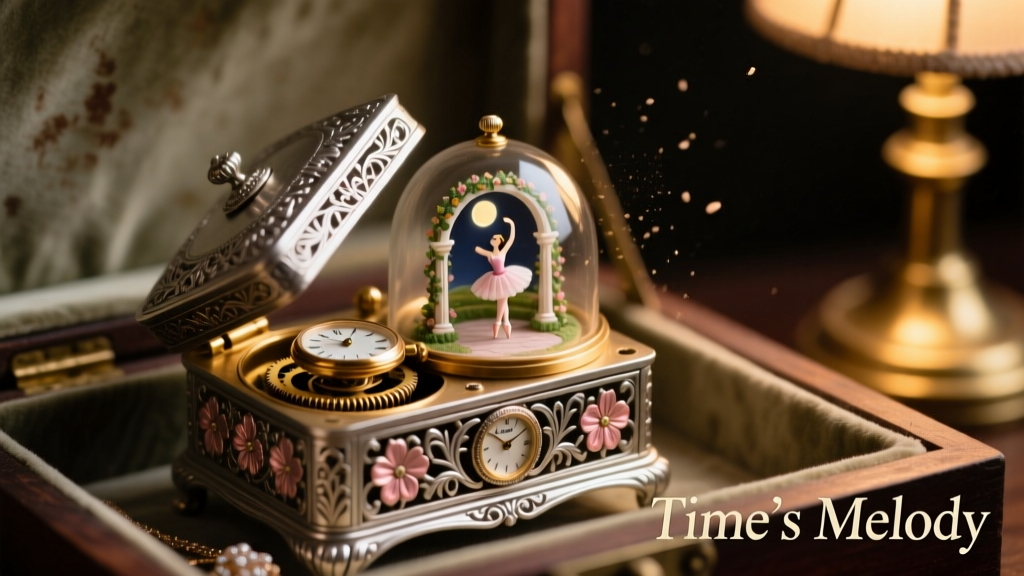
Beginning in the 1860s, music boxes became vehicles for kinetic art. The earliest automata—simple rotating birds or dancing figures—were powered by secondary gear trains branching from the main governor. By 1880, firms like Reuge and Paillard developed synchronized multi-axis systems. The 1892 Reuge ‘Mignon’ cabinet contained a 42-cylinder carousel, a 24-note comb, and a porcelain bird automaton with 11 independent movements: wing flapping (37° arc), head rotation (22°), tail wagging (15°), eye blinking (0.4-second cycle), and beak articulation—all timed to melodic phrasing via cam-driven levers.
- Reuge’s 1898 ‘Opera’ model featured two birds singing in counterpoint, with individual pitch-shifting mechanisms altering comb resonance via micro-adjustable brass bridges
- Paillard’s 1905 ‘Danseuse’ cabinet included a 32-cm porcelain ballerina rotating on a mirrored base, her arms moving through 140° arcs while balancing on a 2.3-mm brass point
- Symphonion’s 1910 ‘Fairy Fountain’ incorporated water-wheel-driven figurines and mercury-filled glass tubes that shimmered in time with bass notes
These integrations demanded extreme precision: cam profiles were ground to ±0.008 mm tolerance, and pivot holes in automata arms were reamed with tungsten-carbide tools. A single misaligned cam lobe could cause gear binding within 3–4 windings. Consequently, fewer than 800 pre-1930 automaton boxes survive in fully operational condition—most requiring specialized restoration involving jeweler’s lathes and custom-ground reamers.
Identifying Authenticity and Condition
Authentication relies on three immutable markers: movement signature, material composition, and manufacturing method. A genuine Nicole Frères cylinder box will always feature hand-engraved serial numbers on the mainplate (not stamped), with letter prefixes indicating decade: ‘N’ = 1840s, ‘R’ = 1850s, ‘X’ = 1860s. The comb will show fine longitudinal file marks—never machine-milled striations. Brass components exhibit a distinct 70/30 copper-zinc ratio visible under 10× magnification as warm amber grain structure.
Red Flags in the Market
Modern reproductions often mimic aesthetics but fail materially. Common warning signs include:
- Combs made from stainless steel (authentic combs use high-carbon tool steel; stainless lacks acoustic warmth and produces brittle, short-decay tones)
- Cylinders with laser-etched pins (original pins were mechanically pressed and hand-finished)
- Walnut cases with polyurethane finishes (pre-1930 finishes were shellac or French polish, showing characteristic ‘orange peel’ texture under raking light)
- ‘Swiss Made’ stamps on movements dated before 1880 (the designation wasn’t legally protected until 1887)
Condition assessment prioritizes functionality over cosmetics. A box with minor case scratches but perfect governor regulation and comb tuning may realize 3× the value of an immaculate but non-functional piece. Key metrics include:
- Governor speed consistency: ±1.2 RPM over full wind duration (measured with optical tachometer)
- Comb tooth integrity: no missing, bent, or cracked teeth; minimum tooth height 4.2 mm for pre-1870 models
- Cylinder pin wear: pins must project ≥0.35 mm above cylinder surface; erosion beyond 0.15 mm causes note dropout
- Winding efficiency: ≤12 full turns required for standard 2.5-minute playtime (excess indicates gear train friction or bushing wear)
Preservation and Responsible Ownership
Vintage music boxes demand climate-controlled environments: 45–55% relative humidity and 18–21°C year-round. Fluctuations >5% RH cause wood case expansion/contraction, leading to comb misalignment. Steel combs corrode at >60% RH; brass cylinders tarnish irreversibly below 30% RH. Never store boxes in basements, attics, or near HVAC vents—temperature swings exceeding 2°C/hour accelerate fatigue in gear trains.
Cleaning requires surgical discipline. Use only 99.8% isopropyl alcohol applied with Japanese shibori cotton swabs for brass surfaces; never use commercial metal polishes—they remove historic patina and abrade pin geometry. Combs should never be touched; oils from skin cause localized oxidation. For stuck cylinders, apply 0.5 mL of synthetic clock oil (Molykote PG-75) to the arbor bearing—never to the pins or comb.
Winding technique is critical. Always wind slowly and evenly, stopping immediately if resistance increases sharply. Overwinding fractures mainsprings—especially in Thorens and early Reuge models, whose blued-steel springs have yield strengths of only 1,100 MPa. A properly maintained cylinder box should operate for 3,200–3,800 wind cycles before requiring service; disc mechanisms last 4,500–5,100 cycles due to lower torque demands.
Insurance valuation must reflect current market benchmarks—not auction estimates from the 1990s. As of Q2 2024, median realized prices are:
| Type | Era | Median Realized (USD) | Key Value Drivers |
|---|---|---|---|
| Cylinder Snuffbox | 1780–1820 | $12,800 | Original case, intact comb, documented provenance (e.g., royal collection) |
| Cabinet Cylinder (5+ cylinders) | 1850–1885 | $24,500 | Working governor, all cylinders present, Nicole Frères or Lecoultre signature |
| Disc Cabinet (Symphonion/Polyphon) | 1895–1915 | $3,100 | Full disc set (12+), original horn, no cabinet warping |
| Automaton Cabinet | 1885–1925 | $38,700 | Functional automata, all original paint, working cylinder changer |
| Post-1930 Miniature Box | 1935–1965 | $420 | Reuge or Sankyo branding, unmodified movement, original box |
Finally, ethical collecting means respecting original craftsmanship. Avoid ‘restoration’ that replaces historic components—refurbishing a 1872 Lecoultre comb with modern steel devalues the piece by 60–75%. Conservation, not replacement, preserves integrity: stabilizing corrosion with benzotriazole inhibitors, re-bushing worn pivots with lignum vitae (not nylon), and recalibrating governors using period-appropriate weights and springs. These principles ensure that every chime remains a direct echo of the artisan’s hand—not a digital approximation, but a living artifact of mechanical poetry.
More Like This
Occupied Japan Mug: The Man in Sulky, Cap Horse, and Gold Floral Motif — A Collector’s Guide to a Rare 1940s Ceramic Artifact

Coca-Cola Sign: 'Coke Headquarters – Girl & Boy at Fridge' (1947, 16 × 27 Inches) — A Landmark of Mid-Century Americana and Advertising Heritage
Cinnabar Vase with Magnolias and Cardinals: A Study of Mid-20th Century Chinese Export Porcelain
Baskets Splint 20 Ribs Bentwood Handle 8 × 7½ Inches: A Technical and Historical Analysis of a Mid-Century American Utility Basket
Rookwood Vase: Flowers in Mint Green Blossoms on Sea Green Glaze, Signed E. Lincoln, 1905 — A Technical and Historical Appraisal
Here’s a Real Remington: Unmasking the Myth, Measuring the Metal, and Understanding the Legacy of America’s Forgotten Watchmaker
The Superman Brush Avon Watch: A 1978 Icon of Pop Culture Horology
Charles Ahrenfeldt Son: The Forgotten Danish Master of Precision Watchmaking and Art Deco Jewelry

Eskimo Basket Cover Squares & Triangles: Multicolor Globular 9 × 9 Inch Artifact — Provenance, Craftsmanship, and Market Significance