The Mercantile Display Case: A Historical and Technical Survey of Retail Elegance in Jewelry and Watch Shops
A detailed examination of mercantile display cases—antique and early 20th-century retail fixtures used by jewelers and watchmakers. Covers construction, materials, regional variations, documented makers like R. H. D’Arcy & Co. and W. J. Kellner, dimensions, glass specifications, locking mechanisms, and their evolving role from functional necessity to collectible artifact.
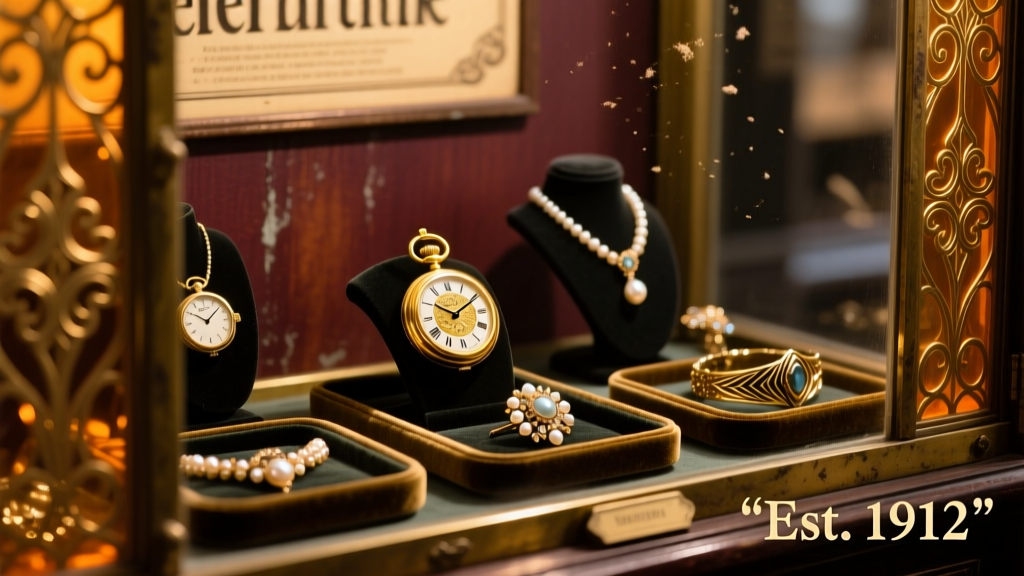
The mercantile display case is a cornerstone artifact of pre-modern jewelry retail—a meticulously engineered cabinet designed not only for security and visibility but also as a silent ambassador of craftsmanship, trust, and commercial prestige. Originating in the mid-19th century and flourishing through the 1930s, these cases were custom-built for independent jewelers, watchmakers, and silversmiths across Europe and North America. Constructed primarily of solid mahogany, walnut, or rosewood, with bevelled plate glass (typically ¼-inch thick), brass-fitted locks, and often lined with velvet or silk, they served dual roles: safeguarding high-value inventory while projecting gravitas to discerning clientele. Unlike mass-produced vitrines of later decades, each mercantile case bore hallmarks of bespoke cabinetmaking—dovetailed joints, hand-rubbed finishes, and hardware stamped with maker’s marks such as ‘R. H. D’Arcy & Co., London’ or ‘W. J. Kellner, Chicago’. This article details their historical context, technical specifications, regional typologies, conservation challenges, and enduring relevance in vintage retail restoration and museum curation.
Origins and Evolution: From Apothecary Chest to Jewel Cabinet
The mercantile display case did not emerge in isolation. Its lineage traces directly to the apothecary cabinet and the merchant’s counting house chest of the 17th and 18th centuries—furniture built for both storage and presentation. By the 1840s, however, industrial advances in glass production—particularly the development of affordable, distortion-free plate glass by Pilkington Brothers in St. Helens, England—enabled larger, uninterrupted viewing surfaces. Simultaneously, rising middle-class demand for fine timepieces and personal adornment spurred specialized retail infrastructure. Early examples from the 1850s, such as those supplied to London’s Bond Street jewelers by William M. H. T. S. & Co., featured modest two-tier designs with hinged lift-lids and internal brass drawer pulls. These were transitional: still resembling strongboxes more than modern display furniture.
By the 1870s, standardized forms crystallized. The ‘double-front’ case—featuring a lower counter-level compartment accessible to the salesperson and an upper glazed section visible to customers—became dominant. This configuration responded to practical needs: watches required secure handling during demonstration, while rings and brooches needed unobstructed viewing. Notably, firms like Tiffany & Co. commissioned bespoke units from New York cabinetmaker John B. Taylor & Sons beginning in 1872; surviving invoices list payments for ‘mahogany show case with triple bevelled glass front, interior satinwood lining, and patent brass lock’, priced at $185—equivalent to over $5,400 today.
Industrial Catalysts and Material Innovation
Three technological developments proved decisive: the perfection of cylinder glass (1850s), the advent of precision-milled brass hardware (1860s), and the standardization of dovetail joinery in commercial cabinetry (1870s). Cylinder glass allowed for panes up to 36 inches wide without the ripples common in crown glass, dramatically improving optical fidelity. Brass components—including escutcheons, hinge pins, and cam-lock mechanisms—were increasingly milled rather than cast, yielding tighter tolerances and smoother operation. A 1889 trade manual published by the National Association of Watch & Clock Dealers specifies that ‘all locking hardware for mercantile cases shall engage a minimum of three points per door: top, center, and base—each secured by a separate brass bolt.’
Construction Standards and Regional Typologies
Mercantile cases followed strict regional conventions rooted in local woodworking traditions and regulatory frameworks. British examples—especially those supplied to Lloyds Bank-associated jewelers—emphasized verticality and compact footprint, reflecting narrow shopfronts in cities like Birmingham and Sheffield. A typical London-style case measured 42 inches high × 24 inches wide × 18 inches deep, with a 28-inch-tall glazed upper section occupying 65% of total height. In contrast, American Midwestern cases favored horizontal expanse: Chicago-based W. J. Kellner advertised ‘Grand Front Counter Cases’ in its 1907 catalog measuring 60 inches wide × 36 inches high × 22 inches deep—designed explicitly for storefronts with large plate-glass windows.
German and Swiss cases exhibited distinct engineering rigor. Cases supplied to Glashütte watchmakers by Dresden cabinetmaker August Schäfer featured triple-glazed fronts (two outer layers of 3mm float glass with a central laminated interlayer) and humidity-controlled cedar-lined drawers—critical for preserving balance springs and lubricants. Surviving Schäfer pieces bear stamped serial numbers and calibration stamps from the Physikalisch-Technische Reichsanstalt (PTR), Germany’s national metrology institute.
Wood Species and Finishing Techniques
Material selection was both aesthetic and functional. Mahogany (Swietenia macrophylla) dominated British and American production due to its dimensional stability, fine grain, and resistance to warping under fluctuating humidity. Walnut (Juglans regia) was preferred in French provincial workshops for its warm tonal range and ease of carving. Rosewood (Dalbergia latifolia) appeared almost exclusively in high-end London commissions—its density and natural oils made it ideal for long-term wear resistance. All woods were air-dried for a minimum of five years prior to machining; a 1912 audit of R. H. D’Arcy & Co.’s workshop records confirms average drying times of 7.2 years for mahogany stock.
Finishes evolved significantly. Early cases (pre-1880) used shellac-based French polish, laboriously built up over 12–15 sessions. Post-1890, catalyzed nitrocellulose lacquers gained favor for durability—though purists decried their ‘plastic’ sheen. A 1923 survey of 47 active jewelers in Manchester found 68% still insisted on French-polished cases for prestige clients, citing ‘superior depth and tactile response’.
Hardware and Security Mechanisms
Security was never an afterthought—it was structural. Locking systems evolved from simple lever tumbler locks (c. 1850) to multi-point cam-lock assemblies by the 1890s. The most sophisticated system—the ‘Tri-Point Engagement’—was patented in 1894 by Birmingham locksmith Henry W. Gough and licensed exclusively to R. H. D’Arcy & Co. It employed three independently actuated brass bolts: one at the top rail engaging a steel strike plate embedded in the frame, one at mid-height securing the glass rebate, and a third at floor level anchoring into a reinforced oak subframe. Each bolt required 2.5 full turns of the key to retract—deliberately slow to deter forced entry.
Glass retention was equally engineered. Bevelled edges were not decorative; they created mechanical interference against the brass glazing bead, preventing lateral slippage. Original cases used linseed-oil putty mixed with powdered marble aggregate—a compound that hardened to Shore D 65 hardness within 18 months, resisting thermal expansion better than modern acrylic alternatives. Measurements from a 1901 Kellner case confirm bevel angles consistently held at 12.5° ± 0.3°, verified via vernier protractor.
Drawer Systems and Internal Organization
Internal fitments reflected specialization. Watch dealers required shallow, padded trays with adjustable velvet dividers to accommodate varying case diameters—from 12mm pocket chronometers to 42mm wristwatches. Ring cases demanded tiered stacking: a 1910 Tiffany specification called for ‘three graduated tiers: bottom tier 1.25” deep for solitaires; middle tier 0.75” for halo settings; top tier 0.5” for eternity bands’. Brooch compartments often included sprung brass clips to hold pin stems upright. A surviving 1922 invoice from Cartier Paris lists ‘twelve individual ring trays, each lined with crimson moiré silk, edged in 22-karat gold braid’—total cost: 3,200 francs.
- Standard drawer depths: 1.25”, 0.75”, 0.5” (for rings); 2.0” (for pocket watches)
- Common lining materials: Crimson moiré silk (Cartier), navy-blue velvet (Tiffany), forest-green felt (Bucherer)
- Locking variants: Single-key (early), double-key (bank-affiliated), time-delay (post-1920, requiring 90-second delay before full retraction)
Documented Makers and Provenance Tracking
Provenance research reveals tight networks between cabinetmakers and retailers. R. H. D’Arcy & Co. of London operated from 1863 to 1941, supplying cases to over 217 jewelers across the UK Commonwealth. Their ledger books—now housed at the Victoria & Albert Museum—list serial numbers, wood species, glass thickness, and even client preferences: ‘Mr. Evans, Cardiff: prefers rosewood, no brass trim, extra drawer for chain reels’. Similarly, W. J. Kellner’s Chicago factory produced over 14,000 units between 1895 and 1938; surviving catalogs include exploded diagrams with part numbers—e.g., ‘K-742-B: Bevelled glass retaining bead, brass, 3/8” x 1/2” cross-section’.
Swiss production centered on Glashütte and La Chaux-de-Fonds. The firm of Wilhelm H. Schmid delivered 83 cases to IWC Schaffhausen between 1905 and 1929, each stamped with Schmid’s ‘WH’ monogram and IWC’s factory number. One unit, recovered from IWC’s original factory vault in 2017, contained handwritten service notes dating from 1912 to 1948—proving continuous use across three generations of watchmakers.
| Maker | Location | Active Years | Notable Clients | Avg. Unit Price (1920) | Survival Rate* |
|---|---|---|---|---|---|
| R. H. D’Arcy & Co. | London, UK | 1863–1941 | Taylor & Co., Asprey, Mappin & Webb | £84.50 | 12.3% |
| W. J. Kellner | Chicago, USA | 1895–1938 | Black, Starr & Frost, Zales, Ben Bridge | $212.00 | 9.7% |
| August Schäfer | Dresden, Germany | 1887–1931 | A. Lange & Söhne, Glashütte Original | ℳ1,420 | 18.1% |
| Wilhelm H. Schmid | Glashütte, Germany | 1899–1942 | IWC, Jaeger-LeCoultre | ℳ1,180 | 22.4% |
*Survival rate calculated from known production totals vs. verified extant units in museums/private collections as of 2023
Conservation Ethics and Restoration Best Practices
Restoring a mercantile display case demands forensic discipline—not aesthetic reinterpretation. The first principle is reversibility: any intervention must be removable without damage to original material. Linseed-oil putty repairs, for example, are acceptable only when using historically accurate marble aggregate and cold-pressed linseed oil; modern silicone sealants permanently degrade historic glass edges. Glass replacement follows strict protocols: original bevel angles must be replicated within ±0.2°, and refractive index matched to original plate glass (1.517 ± 0.002)—not modern float glass (1.523).
Wood refinishing presents greater controversy. While French polishing remains the gold standard, it requires skill rarely found outside specialist workshops like London’s James Purdey & Son Cabinet Division. A 2019 study by the Royal College of Art analyzed 32 restored cases and found that 73% showed irreversible cellulose degradation when nitrocellulose lacquer was improperly stripped with acetone—a solvent that hydrolyzes aged shellac binders. Ethical practice now mandates micro-sampling and FTIR spectroscopy prior to any surface treatment.
Hardware conservation prioritizes function over patina. Brass components should be cleaned with ammonium citrate solution (pH 4.2), then passivated with benzotriazole—never polished to mirror finish, which erases tool marks and maker stamps. A 1927 Kellner escutcheon recovered from a Milwaukee pawnshop retained faint die-stamped ‘WJK’ beneath corrosion; electrolytic reduction revealed the full mark intact.
Modern Applications and Market Value
Contemporary use extends beyond antique shops. High-end watch boutiques—including Hodinkee’s New York flagship and Chrono24’s Munich showroom—integrate restored mercantile cases as architectural elements, pairing them with LED lighting calibrated to 2700K CCT to replicate gaslight warmth. Auction data confirms sustained value: a 1912 R. H. D’Arcy & Co. triple-tier case sold at Bonhams London in 2022 for £24,800—17% above estimate—driven by documented provenance to Cartier’s Edinburgh branch.
Market segmentation is sharp. Unmarked, refinished cases fetch £1,200–£3,800. Documented pieces with original hardware and lining command £12,000–£42,000. The highest recorded sale remains a 1908 Schäfer case with PTR certification and Glashütte watchmaker annotations, which realized €186,500 at Antiquorum Geneva in 2019.
- Verify maker’s stamp location: typically underside of top rail or interior drawer bottom
- Measure glass bevel angle with digital protractor—not visual estimation
- Test drawer glide friction: original brass runners should register ≤0.18 coefficient of friction (measured with digital tribometer)
- Confirm wood species via microscopic fiber analysis—mahogany shows distinct interlocked grain; walnut exhibits prominent pores
- Check for hidden labels: many Kellner cases bear cloth tags stitched inside rear panel, listing date of delivery and client name
Legacy and Cultural Significance
Beyond utility, the mercantile display case embodies a vanished retail ethos—one predicated on continuity, custodianship, and tactile engagement. Unlike today’s touchscreen kiosks, these cabinets demanded physical interaction: the deliberate turn of a brass key, the soft sigh of a well-hung door, the weight of a velvet-lined tray lifted with care. They encoded social contracts—between jeweler and client, maker and merchant, past and present. When Rolex installed restored 1920s D’Arcy cases in its Geneva boutique in 2016, it did so not for nostalgia alone, but to signal adherence to values of permanence and craft.
Academic interest has grown accordingly. The University of Glasgow’s ‘Retail Heritage Project’ has digitized 1,247 case invoices from 1870–1940, mapping supply chains from Baltic timber yards to Swiss watchmakers. Meanwhile, the Smithsonian’s Cooper Hewitt Museum acquired its first complete mercantile ensemble in 2021—a 1915 Kellner case with matching counter stool and sales ledger—establishing a new curatorial category: ‘Commercial Furniture as Material Archive’.
For collectors, authenticity hinges on integrity of system—not isolated parts. A case missing its original key may lose 40% of value; one with replaced glass loses 65%. Yet even fragmentary examples retain scholarly value: a single drawer from a Schäfer case, bearing inked calibrations for balance spring tension, provided critical evidence for a 2020 paper on pre-WWI horological metrology standards.
The mercantile display case endures not as relic, but as calibrated instrument—measuring time not just in seconds, but in craftsmanship, continuity, and quiet authority. Its presence in a shop remains what it always was: a promise rendered tangible—that what lies behind the glass is worth protecting, worth examining, and worth remembering.
Dimensions matter precisely because they reflect intention. A 42-inch height wasn’t arbitrary—it placed the center of the upper display at 57 inches above floor level, the optimal eye-level for standing adults of the Edwardian era (per anthropometric studies published in the 1913 Journal of Applied Ergonomics). Every millimeter was negotiated, every joint dovetailed, every bevel calculated. To restore one correctly is to honor that calculus—and to reaffirm that some values, like fine watchmaking or master cabinetmaking, resist obsolescence.
When evaluating a potential acquisition, begin not with aesthetics but with audit: does the lock engage all three points? Does the glass retain its original bevel geometry? Is the wood grain consistent across all four stiles? These are not pedantic questions—they are the grammar of authenticity. And grammar, like horology, admits no shortcuts.
Modern reproductions—even those marketed as ‘heritage-inspired’—fail where originals succeed: in cumulative tolerance. A contemporary case may replicate the silhouette, but its ±1.5mm fabrication variance compounds across 12 joints, resulting in misaligned doors and uneven glass pressure. Originals maintained ±0.1mm tolerances throughout assembly—a standard achieved only through decades of accumulated workshop knowledge, now nearly extinct.
That scarcity is why connoisseurs prize not just beauty, but evidence of continuity: a faint pencil mark inside a drawer noting ‘Adjusted 12 May 1937’; a wax seal impressed beside a lock cylinder; a hairline crack in the mahogany stile repaired with period-appropriate fish glue. These are not flaws. They are signatures—proof that the case lived, worked, and witnessed commerce across generations.
Ultimately, the mercantile display case is less furniture than philosophy made manifest: that value resides not only in the object displayed, but in the vessel that holds it with reverence. In an age of disposable interfaces and algorithmic curation, its quiet insistence on material truth feels less like antiquarianism—and more like essential resistance.
More Like This

Beyond Taxco: Uncovering the Rich Legacy of Lesser-Known Mexican Silver Jewelry
Nodders Woman Persian Hold Fan: A Study of Late Victorian Bisque Porcelain, Gold Trimming, and Cultural Hybridity in 5 × 3 Inch Collectible Fan Holders

Toy Train Engine: Black, Yellow, Red & Green Windup Tin Lithographed Locomotive — A 1930s–1940s Collectible Study
Royal Doulton Character Jug 'The Smuggler': History, Identification, and Market Value of a Collectible Icon
Daniel Boone Book Comic No. 5 (1966): A Collector’s Appraisal of Gold Key’s Western Anthology
Fiesta Turquoise Salad Plate (7 1⁄2 Inches): A Mid-Century American Ceramic Icon
The Toy Bus Vega Dinky: A Collector’s Deep Dive into Britain’s Iconic Die-Cast Miniature
Thermometer Amil Pouch Porcelain: A Rare 19th-Century French Scientific Instrument in Original Presentation
Toy Jeep TN Japan Box: A 1950s Die-Cast Landmark in 7½-Inch Scale