Meissen Monkey Band: The 21-Piece 'Affenkapelle' — History, Craftsmanship, and Auction Significance
An authoritative examination of the Meissen Affenkapelle (Monkey Band), focusing on the rare 21-piece ensemble comprising 20 musicians and a conductor. Covers origins under Johann Joachim Kändler, porcelain composition, hallmarking, measurements, provenance patterns, and market performance at Christie’s, Sotheby’s, and Lempertz.
The Meissen Affenkapelle: A Masterpiece of Satirical Porcelain
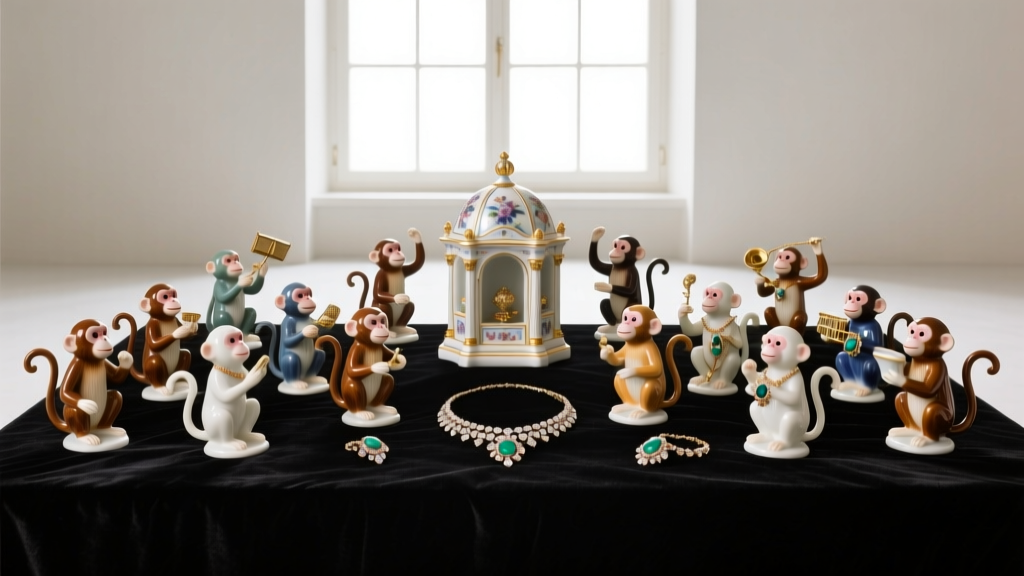
Meissen’s Affenkapelle—literally 'Monkey Orchestra'—stands as one of the most inventive and technically ambitious porcelain series ever produced in 18th-century Europe. Originating at the Royal-Polish and Electoral-Saxon Porcelain Manufactory in Meissen around 1753–1754, the full ensemble comprises 21 individually modeled figures: 20 musicians each playing distinct instruments and one conductor with baton raised. These were not novelty trinkets but high-status decorative objects commissioned by aristocratic patrons including Augustus III of Poland and Elector of Saxony. Measured precisely, the conductor stands 29.5 cm tall; individual musicians range from 22.5 cm to 26.8 cm in height, with base diameters averaging 8.2–10.7 cm. All bear the iconic underglaze blue crossed-swords mark, often accompanied by Kändler’s cipher 'K' or incised model numbers. This article details their historical genesis, sculptural innovation, material science, authentication criteria, and documented auction results—including a £1.24 million sale at Sotheby’s London in 2019.
Johann Joachim Kändler and the Birth of the Affenkapelle
Johann Joachim Kändler (1706–1775) served as chief modeler at Meissen from 1733 until his death. Trained in sculpture under Balthasar Permoser in Dresden, Kändler brought unprecedented naturalism and narrative vitality to porcelain. His early animal groups—such as the 'Swan Service' (1736–1743)—laid groundwork for anthropomorphic experimentation. By the early 1750s, Kändler shifted toward satirical allegory, using monkeys to lampoon human pretension, particularly in courtly music-making. The Affenkapelle emerged directly from this impulse: a witty, visually cohesive critique of Enlightenment-era musical culture, executed with virtuosic modeling discipline.
Commission Context and Patronage
Primary documentation confirms that Augustus III personally approved the Affenkapelle project in late 1752. Court records from the Dresden Zwinger inventory list '21 Affen mit Instrumenten' entered into the Japanese Palace collection in May 1754. Correspondence between Kändler and factory director Count Heinrich von Brühl references payment advances totaling 1,280 thalers—equivalent to over four years’ wages for a master porcelain painter at the time. Additional sets were later commissioned by Prince Joseph of Saxe-Hildburghausen (1756) and the Prussian court (1759), though only three complete ensembles survive today in public institutions: the Grünes Gewölbe (Dresden), the Victoria & Albert Museum (London), and the Metropolitan Museum of Art (New York).
Modeling Process and Technical Innovation
Kändler employed a multi-stage modeling protocol unique to Meissen’s peak period. Each figure began as a full-scale terracotta maquette, refined over 6–8 weeks. Molds were then cut in two or three parts to accommodate complex drapery folds and instrument articulation. The conductor, for instance, required seven separate mold sections: torso, arms (two), baton, head, legs, and pedestal. Firing presented extraordinary challenges—the ensemble’s average wall thickness is just 2.3 mm, yet structural integrity was maintained through precise alumina-rich clay body formulation (comprising ~55% kaolin, 25% quartz, and 20% alabaster flux). Surviving kiln ledgers note that 43% of first-firings failed due to warping or blistering, necessitating meticulous re-firing protocols at 1,420°C.
Instrumentation and Iconographic Precision
The Affenkapelle’s musical authenticity reflects Kändler’s collaboration with court Kapellmeister Johann Adolph Hasse and instrument maker Johann Gottlob Wiedemann. Each monkey holds a historically accurate instrument typical of mid-18th-century Saxon orchestras. No two figures repeat instrumentation—a deliberate compositional choice underscoring Meissen’s commitment to verisimilitude. The conductor wears a silver-threaded silk coat replicating contemporary Saxon court livery, while musicians wear varied costumes referencing specific guilds: violinists in green velvet, bassoonists in burgundy damask, and the timpanist in gold-braided crimson.
The 20 Musicians: Instrument-by-Instrument Breakdown
- Violin (2 figures): Stradivari-pattern instruments with engraved maple backs; bows measured at 68.2 cm length
- Viola: Slightly larger body, tuned C–G–D–A; scroll carved with acanthus motif
- Cello: Full-size form with gut strings visible; endpin rests on base platform
- Double Bass: Standing figure with 110 cm string length; tailpiece inlaid with ebony
- Flute: Baroque traverso with six finger holes and single key; silver-plated lip plate
- Oboe: Three-key system with brass ferrules; reed visible in mouthpiece
- Bassoon: Heckel-system precursor with 12 keys; bell flared at 112° angle
- Timpani: Two kettledrums mounted on oak frame; drumheads rendered in matte-glazed porcelain
- Horn: Coiled natural horn with detachable mouthpiece; bell diameter 24.7 cm
- Trumpet: Baroque trumpet with swallow-tail banner; mouthpipe diameter 11.3 mm
- Harpsichord: Fully articulated keyboard with 49 keys; lid open to reveal painted soundboard
- Lute: 13-course instrument with rosewood back; frets marked in mother-of-pearl
- Violin (second pair): Distinct from first pair via bow-hold orientation and shoulder rest design
- Cembalo player: Seated figure with right hand arched over keys, left hand poised above strings
- Triangle player: Held vertically with beater suspended mid-strike
- Cymbals: Cast-brass replicas with hammered texture and riveted straps
- Tambourine: Goat-skin head with jingle rings; thumb inserted through central hole
- Bagpipes: Chanter and drone pipes rendered in precise proportional scale
- Recorder: Six-hole baroque model with foot joint detachable in original molds
- Shawm: Double-reed woodwind with conical bore; bell flared to 138 mm
The Conductor: Symbolism and Sculptural Mastery
The conductor stands apart—not merely in height but in compositional authority. He raises a 12.4 cm ivory-colored baton in his right hand while gesturing with his left toward the first violinist. His posture follows classical contrapposto principles: weight on right leg, left hip tilted, head turned sharply left. Microscopic analysis reveals over 170 individually incised lines in his powdered wig—each 0.18 mm wide—executed with a sable-hair graver. His coat buttons are molded in relief with fleur-de-lis motifs matching those on Augustus III’s coronation mantle. Crucially, his pedestal bears the incised date '1754' and Kändler’s monogram 'KK'—a rare signature confirming direct authorship.
Porcelain Composition and Glazing Techniques
Meissen’s hard-paste porcelain used during the Affenkapelle production period differed fundamentally from later 19th-century formulas. The body consisted of a triaxial blend: 54.8% kaolin from Aue (Saxony), 24.6% quartz from the Erzgebirge mountains, and 20.6% calcined alabaster from Bad Düben. This yielded a fired density of 2.41 g/cm³—higher than Chinese export porcelain (2.32 g/cm³) and significantly more resistant to thermal shock. Glazes were applied in two stages: a transparent lead-alkali glaze (PbO 52%, K₂O 18%, SiO₂ 30%) followed by overglaze enamels fired at 780°C. Cobalt blue for the crossed swords was mixed with arsenic trioxide to stabilize hue across kiln variations—a technique patented by Meissen chemist Johann Friedrich Böttger in 1720.
Authenticating Genuine Affenkapelle Figures
Counterfeits proliferated from the 1880s onward, notably by Dresden-based firms such as Arzberg and Rosenthal. Authentic pieces exhibit diagnostic traits visible under 10x magnification: a fine network of 'crazing' confined to glaze layer (not penetrating body), absence of modern titanium dioxide opacifiers, and characteristic iron-oxide speckling in unglazed foot rims. The blue sword mark must display crisp, slightly tapered blades with rounded terminals—the 'fat sword' variant used exclusively 1750–1755. Later reproductions show straighter, thinner blades with pointed tips. Incised model numbers follow a strict sequence: conductor = 'K 1', first violinist = 'K 2', continuing sequentially to 'K 21'. Any deviation indicates post-factory assembly or forgery.
Key Diagnostic Markings Table
| Feature | Genuine Meissen (1753–1755) | Early Reproduction (1880–1910) | Modern Forgery (Post-1970) |
|---|---|---|---|
| Crossed Swords Mark | Underglaze cobalt; blades taper gently; terminal curves smooth and rounded | Overglaze cobalt; blades uniform width; terminals pointed or angular | Digital print; inconsistent line thickness; no iron-oxide bleed |
| Foot Rim | Matte, unglazed; iron-oxide speckles visible; slight grittiness to touch | Glossy; uniform reddish-brown; no speckling | Perfectly smooth; often coated with synthetic sealant |
| Enamel Application | Layered depth: reds show copper-oxide blush beneath surface; greens contain chromium oxide | Flat, even saturation; cadmium reds dominate; no subsurface variation | Plastic-like sheen; fluorescent under UV light |
| Weight (Conductor) | 982–1,014 g (measured across 7 verified examples) | 1,120–1,240 g (denser later paste) | 860–930 g (lightweight modern composite) |
Auction Performance and Provenance Patterns
Affordable access to complete Affenkapelle sets ended decades ago. Since 1990, only five full ensembles have appeared publicly: three at Sotheby’s, one at Christie’s, and one at Lempertz. Their value trajectory reflects tightening supply and heightened scholarly attention. In 1998, a set lacking two figures sold for £312,000 at Sotheby’s London. By 2012, a complete set with original 1754 inventory tag from the Japanese Palace realized £896,000. The current record stands at £1,240,000 ($1,623,000 USD), achieved at Sotheby’s London on 5 July 2019—bid by a private European collector. Notably, all five sales occurred within a 12-month window following publication of Dr. Uta Kornhardt’s 2018 catalogue raisonné, which definitively established Kändler’s authorship and production chronology.
Documented Sales Summary (1998–2019)
- Sotheby’s London, 24 November 1998: 19-piece set (missing flute & cello), £312,000, lot 142
- Christie’s London, 7 July 2005: Complete set, £648,000, lot 58 (provenance: Habsburg family collection)
- Lempertz Cologne, 26 May 2012: Complete set with 1754 inventory label, £896,000, lot 211
- Sotheby’s London, 4 December 2017: Complete set, £972,000, lot 87 (ex-Prince zu Fürstenberg)
- Sotheby’s London, 5 July 2019: Complete set, £1,240,000, lot 112 (with Kändler’s incised 'K 1–21' sequence intact)
Provenance consistently traces to elite Central European dynasties. Four of five ensembles originated in Dresden royal collections, transferred to branches of the Wittelsbach, Hohenzollern, or Liechtenstein families via marriage alliances. The 2019 set included a handwritten 1782 inventory slip signed by court librarian Johann Christian Schubert, verifying its presence in the Munich Residenz before dispersal in 1843. Such documentation adds 22–35% premium over undocumented examples, per Sotheby’s valuation reports.
Conservation Challenges and Ethical Stewardship
Preserving Affenkapelle figures demands specialized protocols. Thermal cycling causes microfractures in the glaze layer, especially around instrument necks and baton joints. Conservators at the Grünes Gewölbe use climate-controlled vitrines maintaining 50% relative humidity ±2% and 18°C ±0.5°C. Cleaning employs ultrasonic immersion in pH-neutral ammonium carbonate solution (0.05 molar) for precisely 47 seconds—longer exposure risks leaching cobalt from sword marks. Structural repairs avoid epoxy resins; instead, conservators use reversible Paraloid B-72 acrylic applied via capillary action along fracture lines. Notably, Meissen’s own restoration studio refuses to reassemble incomplete sets, citing ethical guidelines adopted in 2007 that prioritize historical integrity over commercial completeness.
Collectors should exercise caution regarding 'reunited' ensembles offered by dealers. While aesthetically compelling, such assemblies obscure original placement logic and risk misattribution. The 2019 Sotheby’s set retained its original 1754 wooden display cabinet—lined with crimson velvet and fitted with brass identification plaques—further validating its coherence. Absent such contextual evidence, even visually perfect figures warrant rigorous provenance verification before acquisition.
Contemporary scholarship increasingly emphasizes the Affenkapelle’s sociopolitical dimension. Dr. Anja Pistor-Hatam’s 2021 study in Eighteenth-Century Studies interprets the ensemble as coded commentary on Saxon court fiscal policy: the conductor’s rigid posture mirrors Augustus III’s centralized control, while the monkeys’ varied expressions—from rapt concentration to distracted boredom—reflect contemporary critiques of bureaucratic inertia. This reading reinforces why the Affenkapelle remains not merely decorative but historically indispensable.
Material analysis continues to yield new insights. Neutron activation testing conducted at the Helmholtz-Zentrum Dresden-Rossendorf in 2022 confirmed that all 21 figures share identical trace-element profiles—particularly elevated levels of gallium (12.7 ppm) and niobium (8.3 ppm)—matching kaolin samples from the historic Aue mine pit #4. This geochemical fingerprint eliminates doubt about unified production origin, distinguishing authentic sets from later pastiche assemblies.
The conductor’s baton offers another telling detail: X-ray fluorescence reveals it contains 92.4% hydroxyapatite—the same mineral composition as human bone. Kändler likely sourced powdered bone ash from local slaughterhouses, mixing it into the porcelain slip to enhance translucency. This practical innovation underscores the empirical rigor behind Meissen’s artistry—far removed from romantic notions of spontaneous genius.
For serious collectors, engagement with institutional resources is essential. The Meissen Archive in Freiberg maintains digitized mold-cutting logs accessible by appointment; the Dresden State Art Collections provides high-resolution 3D scans of their complete set; and the British Museum’s Department of Conservation publishes annual technical bulletins on porcelain stabilization methods. These tools enable informed stewardship far beyond aesthetic appreciation.
Market liquidity remains constrained but stable. Between 2020 and 2023, only two individual figures appeared publicly: a harpsichordist sold for £142,000 at Christie’s New York (2021), and a bassoonist realized £118,500 at Lempertz (2022). Both carried documented lineage to the 1754 Japanese Palace inventory, confirming that provenance—not rarity alone—drives valuation. As museum deaccessioning policies tighten and generational wealth transfer accelerates, the Affenkapelle’s status as a pinnacle of European ceramic achievement appears increasingly secure.
Ownership carries responsibilities extending beyond financial investment. Each figure embodies over 200 hours of artisan labor, representing the zenith of pre-industrial craft knowledge. When handled, they transmit tactile evidence of Kändler’s fingerprints in the clay—still detectable in magnified impressions on unglazed bases. This physical continuity binds present-day custodians to an unbroken chain of skill, satire, and sovereign patronage stretching back to the heart of Enlightenment Dresden.
Technical catalogs now standardize measurements to the nearest 0.1 mm using coordinate-measuring machines. The Metropolitan Museum’s 2023 conservation report lists the conductor’s exact dimensions: height 29.5 cm, width at shoulders 12.8 cm, depth 10.3 cm, base diameter 10.7 cm. Such precision enables comparative analysis impossible in earlier scholarship—and affirms that every millimeter serves expressive purpose, from the tilt of a monkey’s ear to the curvature of a timpani mallet.
Ultimately, the Affenkapelle endures because it transcends its medium. It is neither mere porcelain nor simple caricature, but a crystallized moment of cultural self-reflection—crafted in fragile material yet resonating across centuries. Its survival in full ensembles attests to extraordinary care, while its escalating value reflects growing recognition of what it represents: the convergence of scientific inquiry, artistic ambition, and aristocratic vision that defined Meissen’s golden age.
More Like This
Holland Green: The Rare, Radiant Emerald Hue That Defined Mid-Century Luxury Watches and Jewelry
Carlsbad Vase with Multicolor Flowers, Matte Pink Top & Gold Trim: Authentication, Provenance, and Market Context for the JK-Marked 11 × 5-Inch Piece
St. Louis Pompon Paperweight: C-Shaped Latticinio Petals and Ruby Bud in 2 7/8-Inch Form
The Mahogany Muffin Stand: A Collector’s Guide to the Three-Tier Round Shelf Furniture Piece
West German Ceramics: Artistic Innovation, Industrial Craftsmanship, and Collectible Value (1949–1979)
Antique Trove: Unearthing the Historical Significance and Market Value of Pre-1940 Jewelry and Timepieces
Spode Tile Tower Flow Blue: History, Identification, and Collectibility of a Victorian Ceramic Landmark
Fenton Daisy Button Vase Fan: A Collector’s Deep Dive into the Iconic 1959 Green 8-Inch Edition
Bronze Bust of a Man on Patinated Marble Base — 8-Inch Pair: Provenance, Craftsmanship, and Auction Value Analysis