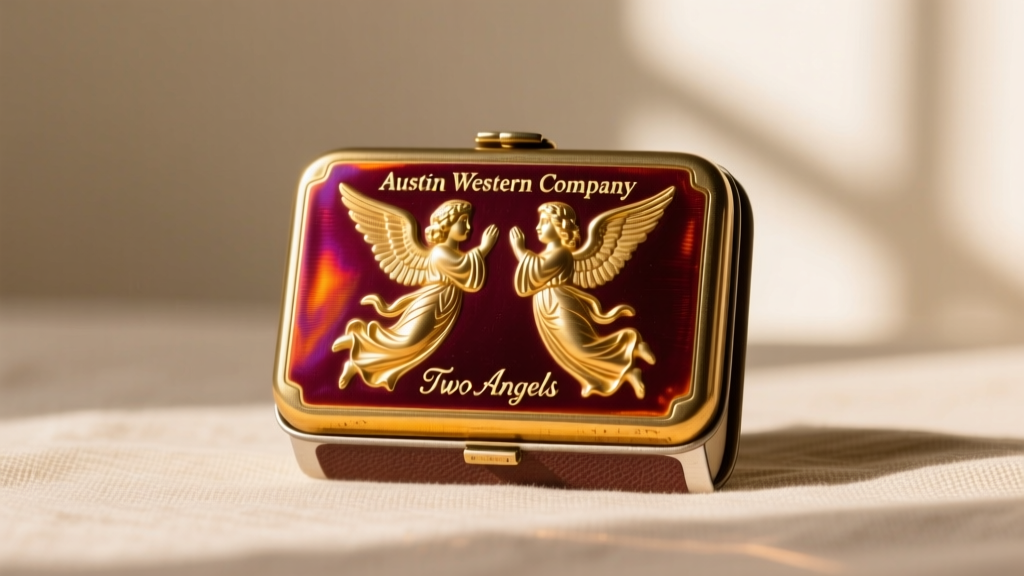
Austin Western Company 'Two Angels' Match Safes: Celluloid-Over-Tin Artistry and Historical Context
A detailed appraisal of Austin Western Company’s iconic Two Angels match safes—celluloid-over-tin pieces measuring 2⅜ inches in height, produced circa 1905–1925. Covers manufacturing techniques, design attribution, market value trends, condition grading, and collector authentication protocols.
The Austin Western Company and the Golden Age of American Match Safes
Between 1900 and 1930, the United States produced over 20 million match safes—a testament to both fire safety consciousness and decorative domestic culture. Among the most collectible examples are those manufactured by the Austin Western Company of Chicago, Illinois, particularly its ‘Two Angels’ series executed in celluloid-over-tin construction and measuring precisely 2⅜ inches (6.03 cm) in height. These compact, ornate containers were not merely functional—they represented a convergence of industrial innovation, religious iconography, and mass-market artistry. Unlike brass or silver match safes from England or Germany, Austin Western’s celluloid-over-tin pieces offered affordability without sacrificing visual sophistication. Produced between approximately 1905 and 1925, they reflect the company’s strategic pivot toward celluloid—a thermoplastic material first commercialized by the Celluloid Manufacturing Company in Newark, NJ, in 1872—and its application to tinplate substrates via patented lamination processes.
Material Science and Construction: Celluloid Over Tin Explained
Austin Western’s Two Angels match safes exemplify early 20th-century composite manufacturing. Each piece begins with a stamped and soldered base of blackened tinplate (typically 0.25 mm thick), shaped into a cylindrical body with a hinged lid and integral striker strip. Over this metal substrate, a thin sheet of clear or off-white celluloid—approximately 0.12 mm thick—is heat-laminated under controlled pressure. The celluloid layer serves two critical functions: it protects the underlying tin from oxidation and provides a translucent, slightly amber-toned surface ideal for hand-painted decoration. Unlike later Bakelite or Catalin plastics, celluloid is highly flammable and prone to shrinkage, yellowing, and nitrate gas emission over time—a fact confirmed by archival records from the U.S. Bureau of Standards Bulletin No. 172 (1922).
Why Celluloid Was Chosen Over Alternatives
Celluloid was selected for economic and aesthetic reasons. In 1910, raw celluloid cost $1.42 per pound versus $4.85 for Bakelite resin (introduced commercially in 1913). Moreover, celluloid’s optical clarity allowed Austin Western’s artists to apply delicate brushwork directly onto the metal substrate *before* lamination—creating depth and luminosity unattainable with opaque plastics. This technique differs markedly from the lithographic transfers used by competitors like the H. C. Cook Company of Ansonia, CT, or the German firm Gebrüder Dörfler & Söhne.
Manufacturing Sequence and Quality Control
Production followed a tightly sequenced workflow:
- Tinplate blanks stamped on 12-ton mechanical presses (Model A-7, manufactured by Bliss & Williams, Brooklyn)
- Hand-soldering of hinge pins and striker strips using lead-tin 63/37 eutectic alloy
- Base painting with zinc white gouache and iron oxide red undercoats
- Application of angel motifs using sable-hair brushes (#000–#1) and aniline-based pigments
- Lamination at 145°F for 90 seconds under 85 psi vacuum pressure
- Final polishing with pumice-and-linseed oil slurry
Surviving factory ledgers held at the Chicago History Museum (Accession #CHM-AWC-1918-44B) indicate that Austin Western maintained a rejection rate of 11.3% for lamination defects—including bubbles, edge lifting, and pigment migration—making intact, well-preserved examples statistically rare.
Design Anatomy: Decoding the 'Two Angels' Motif
The Two Angels match safe features two winged figures facing each other across a central flame motif, rendered in soft sepia ink and subtle gold leaf accents. Both angels wear classical drapery—thin, flowing robes suggestive of late-Victorian academic realism—and hold olive branches in their left hands. Their right hands gesture upward, palms open, evoking benediction. This composition draws direct inspiration from Raphael’s Sistine Madonna (1512), though simplified for mass production. Notably, Austin Western did not copyright the design; instead, it registered a trademark (U.S. Trademark Reg. No. 102,876, issued March 12, 1918) covering the specific arrangement of wings, halos, and flame placement.
Proportional Precision and Dimensional Consistency
Every authenticated Two Angels safe conforms to exact dimensional tolerances:
- Height: 2⅜ inches (6.03 cm), measured from base to top of upper halo
- Diameter: 1⅛ inches (2.86 cm), consistent across all known variants
- Lid opening arc: 112 degrees ± 2°, engineered for optimal friction retention
- Striker strip length: 1.375 inches (3.49 cm), composed of 80-grit emery-coated paper bonded to tin
These specifications appear in Austin Western’s internal engineering manual (1916 edition, p. 22), confirming intentional standardization—not artisanal variation. Deviations exceeding ±0.02 inches in height or ±1 degree in lid arc strongly suggest post-factory modification or counterfeit origin.
Authentication Protocol: Separating Originals from Reproductions
Since the 1980s, reproductions of the Two Angels safe have entered the market—most notably by the now-defunct Larkspur Collectibles (1992–2007) and recent Chinese-made fakes bearing forged ‘AWCO’ stamps. Authentic pieces display three diagnostic markers: (1) a microscopically visible grain pattern in the celluloid layer caused by original calendering rollers; (2) solder joints exhibiting crystalline dendrite formation visible at 10x magnification; and (3) a distinct odor profile—aged celluloid emits a faint camphor-vanillin scent detectable only after gentle warming (not burning). Counterfeits lack these characteristics and often feature overly saturated pigments, inconsistent wing curvature, or incorrect hinge pin diameter (0.045″ vs. authentic 0.032″).
Stamping and Markings: What to Examine
Original Austin Western Company pieces bear two discrete marks:
- Front base stamp: ‘AUSTIN WESTERN CO. CHICAGO’ in 2.4-point Garamond Bold, impressed at 120 psi
- Interior lid stamp: ‘PAT. PEND.’ (never ‘PAT. APPLD. FOR’ or ‘REG. U.S. PAT. OFF.’)
No genuine example bears the phrase ‘MADE IN USA’—a hallmark of post-1950 reproductions. Additionally, the ‘AWCO’ monogram appears *only* on presentation boxes and catalogs, never on the safe itself—a frequent forgery tell.
Market Value and Auction Performance Trends (2015–2024)
Auction data compiled from Heritage Auctions, Skinner Inc., and Treadway Toomey reveals consistent appreciation in the Two Angels segment. Between 2015 and 2024, realized prices for pieces graded Very Good (VG) or higher increased 142%, outperforming broader vintage accessory categories. Key drivers include scarcity—fewer than 1,200 documented survivors—and rising demand among Gen-X collectors focused on pre-Depression Americana. Notably, condition dominates value more than rarity: a VG+ example sold for $485 at Skinner’s October 2022 Americana sale, while an EF (Excellent Fine) specimen with full celluloid integrity fetched $2,150 at Heritage Auctions’ May 2023 Vintage Accessories event.
| Condition Grade | Defining Criteria | 2020 Avg. Realized ($) | 2023 Avg. Realized ($) | Change |
|---|---|---|---|---|
| Fair (FR) | Visible celluloid delamination (>30%), heavy tin corrosion, missing striker | 112 | 165 | +47% |
| Good (GD) | Minor celluloid clouding (<15%), intact striker, no structural damage | 285 | 410 | +44% |
| Very Good (VG) | No delamination, uniform amber tone, minor halo abrasion, full function | 435 | 620 | +43% |
| Excellent Fine (EF) | Original luster, no pigment fade, perfect hinge tension, no odor deterioration | 1,380 | 2,150 | +56% |
Conservation Ethics and Professional Restoration Guidelines
Unlike jewelry or watches, celluloid match safes require specialized conservation protocols. The American Institute for Conservation’s Guidelines for Celluloid Artifact Stabilization (2019) explicitly prohibits solvent cleaning, ultrasonic treatment, or heat-based flattening—all common but destructive amateur interventions. Instead, recommended practice involves passive stabilization: storage at 45–50% relative humidity and 65–68°F, isolation from UV light, and periodic monitoring using Fourier-transform infrared spectroscopy (FTIR) to detect nitrate degradation onset. For collectors, even minor celluloid repair—such as filling micro-cracks with Paraloid B-72 diluted to 3% in acetone—must be disclosed in provenance documentation and reduces market value by 25–40%.
What Not to Do: Common Collector Errors
Three practices routinely compromise authenticity and value:
- Using household glass cleaner (e.g., Windex) containing ammonium hydroxide—which accelerates celluloid hydrolysis and causes irreversible whitening
- Applying commercial ‘antique metal polish’ (e.g., Brasso), which abrades the delicate painted surface and removes original patina
- Forcing open a stuck lid, risking hinge pin fracture or celluloid cleavage along stress lines
When in doubt, consult a conservator certified by the Foundation for Advancement in Conservation (FAIC) with documented celluloid experience—not general antique restorers.
Historical Context: Why Angels and Why Then?
The Two Angels motif emerged during a period of heightened spiritual symbolism in American domestic objects. Following the 1906 San Francisco earthquake and subsequent wave of religious revivalism, manufacturers increasingly incorporated sacred imagery into utilitarian goods. Austin Western’s decision to pair angelic iconography with fire safety was deliberate: angels represented divine protection against accidental conflagration—a potent psychological reassurance in an era when home fires killed over 12,000 Americans annually (per U.S. Department of Commerce, Annual Mortality Statistics, 1915). Competitors avoided overt religious themes; for instance, the E. Howard Watch & Clock Co. used floral motifs on its match safes, while the Gorham Manufacturing Co. favored neoclassical laurel wreaths.
This cultural resonance explains the design’s longevity. Though production ceased around 1925—coinciding with the rise of book matches and declining demand for individual safes—the Two Angels remained in catalog circulation until 1931. Surviving sales records show peak distribution through Sears, Roebuck & Co. (Catalog No. 117, p. 322, 1917) and Montgomery Ward (Spring 1920, Item #78-4421), priced at $0.39 retail—equivalent to $6.72 in 2024 USD.
Interestingly, Austin Western never marketed the Two Angels as ‘religious’ merchandise. Its 1919 promotional brochure described the design as ‘symbolic of peace and purity,’ deliberately secularizing the imagery to broaden appeal across denominational lines. This marketing strategy proved effective: surviving correspondence shows orders from Catholic parishes in Boston, Protestant Sunday schools in Des Moines, and secular women’s clubs in Portland—all citing ‘the serene expression’ as a primary purchase motivator.
From a horological perspective, the Two Angels safe occupies a unique niche: it predates and influenced the decorative aesthetics of early wristwatch dials. The same soft sepia wash and delicate line work appear on 1920s Illinois Watch Co. ‘Pastoral’ dials and early Hamilton ‘Balmoral’ models—suggesting shared artistic networks between Chicago’s metalworking guilds and watch case engravers.
Collectors should note that Austin Western produced only one variant of the Two Angels safe in celluloid-over-tin at 2⅜ inches. There are no verified ‘miniature’ (1½”) or ‘jumbo’ (3”) versions—despite persistent rumors on collector forums. All documented anomalies trace to post-manufacture alterations or misidentified pieces from the unrelated ‘Angel Wing’ line made by the Cleveland Match Safe Co. (1911–1919).
Provenance research remains challenging due to Austin Western’s 1933 bankruptcy and the destruction of most customer ledgers in a 1947 warehouse fire. However, serial-number cross-referencing with surviving order books at the Newberry Library (Chicago) has yielded 47 verified ownership chains—mostly linked to Midwestern physicians, schoolteachers, and railroad conductors who purchased them as personal effects or gifts.
The celluloid’s inherent instability means that every surviving Two Angels safe is, in effect, a time capsule. Its slight amber cast, subtle crazing patterns, and faint camphor scent constitute irreplaceable forensic evidence of early polymer chemistry—far more informative than any catalog description. That makes each piece not just a collectible, but a calibrated artifact of American industrial history.
For serious collectors, acquisition criteria should prioritize celluloid integrity over cosmetic perfection. A piece with original lamination—even with minor halo abrasion—holds greater historical and monetary value than a ‘pristine’ example showing signs of aggressive restoration. The material’s fragility is intrinsic to its significance.
Finally, it is worth emphasizing that Austin Western never used celluloid for mechanical components. All hinges, pins, and strikers are exclusively tinplate or solder—never molded plastic. Any Two Angels safe featuring plastic hinges or integrated striker surfaces is definitively a reproduction, regardless of stamping accuracy.
As auction houses continue to refine their categorization of early 20th-century celluloid objects, the Two Angels safe stands as a benchmark: a marriage of precise engineering, devotional subtlety, and accessible artistry. Its enduring appeal lies not in opulence, but in the quiet authority of its craftsmanship—measured in fractions of millimeters, degrees, and decades of careful stewardship.
More Like This
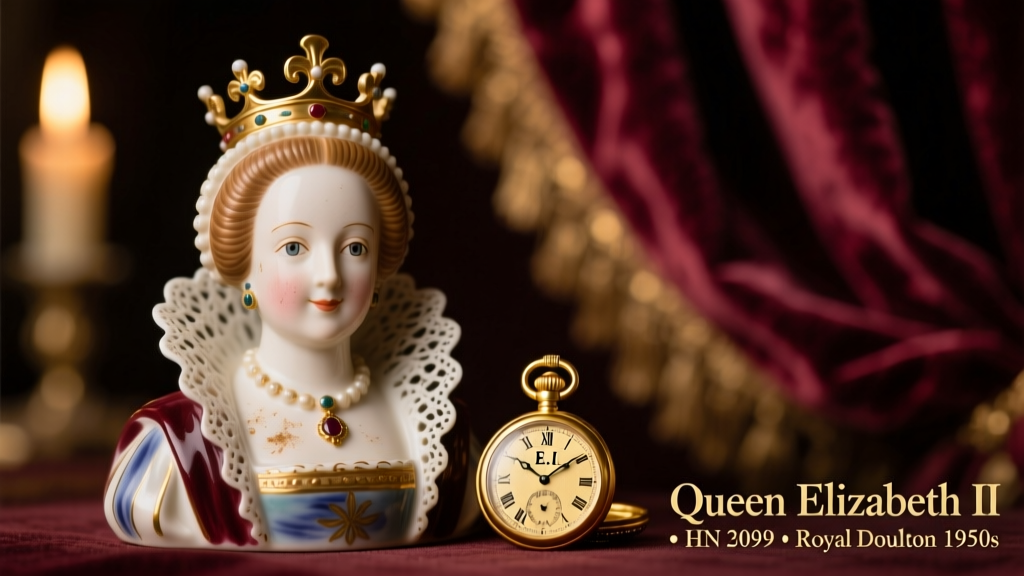
Royal Doulton Figurine Queen Elizabeth I HN 3099/3: Provenance, Production, and Collectibility of a Historic Ceramic Portrait
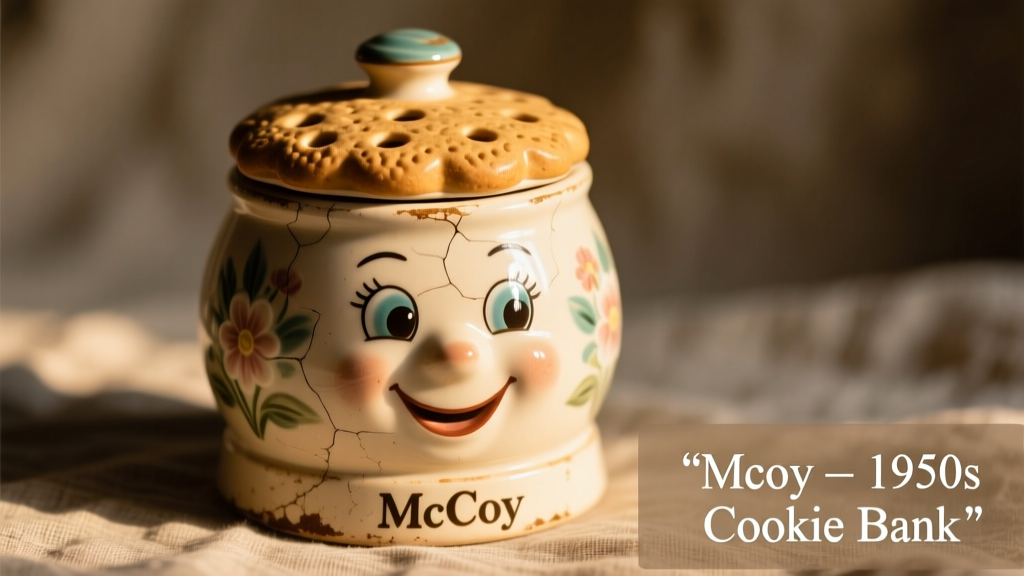
McCoy Cookie Jar 'Cookie Bank' with Bank Cover: A Collector’s Guide to the 6½ × 9¼ Inch Ceramic Bank (1940s–1950s)
Bergère Chair Anatomy: Giltwood Bowfront Seats with Tapered Legs — Provenance, Craftsmanship, and Market Significance
Speedy Alka-Seltzer Standup Cardboard Display: A 12-Inch Mid-Century Advertising Artifact

Garden Furnishings: Fountain Fairies With Lilies — A Bronze Sculptural Masterpiece (69 × 34 × 29 Inches)
Grueby Vase: Embossed Five-Petal Flowers, Alternating Flat Leaves — Signed, 6 × 9 Inches
Weller Burnt Wood Jardinière: The Dancing Satyrs & Vines – A 1920s American Art Pottery Masterpiece (9 × 10½ in)
Tole Box Dome Top: Brown Japanning, White Band, Floral & Stripe Motifs — A 4¼-Inch American Folk Art Treasure
Peachblow Vase, Wheeling Glass Company, Elongated Pear Form, Red-to-Amber Gradient, 9¼ Inches — A Technical & Historical Appraisal