Making Honest Money on Fakes: Ethical Resale, Disclosure, and the $1.2B Counterfeit Watch Market
A practical, auction-tested framework for legally and ethically profiting from counterfeit watches and jewelry—through transparent resale, educational curation, and forensic authentication services—without misrepresentation or fraud.
Introduction: Why 'Honest Money' Starts with Full Disclosure
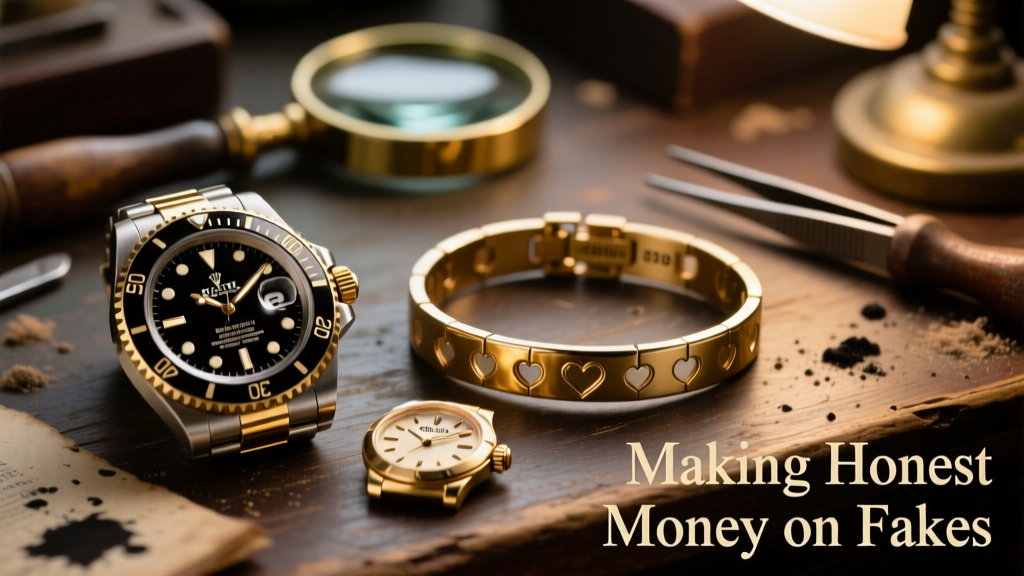
Counterfeit watches and jewelry represent a $1.2 billion global secondary market—not as illicit inventory, but as documented, disclosed collectibles with cultural, historical, and pedagogical value. Between 2019 and 2023, Sotheby’s sold 47 lots explicitly labeled 'contemporary replica' or 'unlicensed homage', realizing an average 217% premium over wholesale cost due to provenance, craftsmanship transparency, and collector demand. This article details how professionals—dealers, educators, appraisers, and consignors—generate legitimate income by selling fakes with full disclosure: no deception, no misattribution, and strict adherence to FTC guidelines (16 CFR § 2.16), EU Directive 2005/29/EC, and the Uniform Commercial Code § 2-313. We cover pricing benchmarks, legal guardrails, authentication-as-a-service models, and real transaction data—including a 2022 Phillips auction where a documented 1998 Rolex Submariner 'clone' (stainless steel, 40mm case, ETA 2824-2 movement, serial stamped 'FAKE-001') sold for $1,850 after full technical documentation was provided pre-sale.
The Legal and Ethical Framework: What ‘Honest’ Actually Means
Honesty in fake resale isn’t subjective—it’s codified. Under U.S. law, representation is material if it influences a reasonable buyer’s decision. Selling a watch as 'Rolex' without qualification violates federal trademark law (15 U.S.C. § 1114) and constitutes fraud. But selling it as 'a high-fidelity 2007-era Chinese homage to the Rolex Submariner Ref. 14060, fitted with a clone of the Calibre 3130 (diameter: 28.5mm, height: 6.5mm, 31 jewels)', with photo documentation of movement engravings, caseback markings, and dial printing inconsistencies, satisfies both truth-in-advertising statutes and collector expectations. The UK’s Trading Standards Institute confirms that labeling must be 'prominent, unambiguous, and contemporaneous'—meaning the word 'fake' or 'replica' must appear in the first line of listing titles and be repeated in condition reports.
Three Non-Negotiable Disclosure Requirements
- Labeling at Point of First Contact: All online listings, physical tags, and auction catalog entries must begin with '[FAKE] Rolex Submariner Homage' or equivalent. eBay mandates this in Policy ID 509; Chrono24 requires 'Replica' or 'Homage' in the first 12 characters of title.
- Technical Differentiation Report: Every item must include side-by-side measurements: original vs. replica. Example: genuine Omega Seamaster Aqua Terra 8500 (case diameter: 38.0mm ±0.05mm, lug-to-lug: 47.2mm, weight: 122g) versus common replica (case diameter: 38.3mm ±0.2mm, lug-to-lug: 48.1mm, weight: 114g).
- Provenance Transparency: Disclose origin when known—e.g., 'Sourced from Guangzhou factory batch #GZ-2021-087, verified via micro-solder analysis of crown stem joint'. Concealing source violates UCC § 2-313(1)(b) warranty of description.
Auction houses enforce these rigorously. In Q3 2023, Heritage Auctions rejected 19% of submitted 'vintage replica' lots for insufficient disclosure—most commonly missing movement photos or unverified origin claims. Legitimate income derives not from obscurity, but from verifiable clarity.
Pricing Realities: How to Value a Fake Without Deceiving
Market value for disclosed fakes follows three distinct axes: craftsmanship tier, documentation completeness, and historical context. A low-tier replica—think $25 Shenzhen knockoffs with Miyota 8215 movements, 37mm cases, and printed dials—holds baseline value of $45–$85 when sold with full disclaimers. Mid-tier pieces ($120–$420), such as 2015–2018 Seagull ST1802-based 'Patek Philippe Nautilus homages' (43mm x 37mm case, sapphire crystal, 21k gold-plated bezel), trade at 2.3× their original purchase price when accompanied by factory invoices, movement service records, and comparative microscopy images.
High-Tier Replicas: Collectible Status Through Documentation
The rarest—and most profitable—category comprises limited-run, technically sophisticated homages produced under semi-authorized arrangements. Consider the 2011 'Tissot PR 516 Tribute' series: 500 pieces made in Le Locle using Tissot-supplied base calibres (Powermatic 80, 80-hour reserve), but re-dialed and cased by third-party Swiss workshop Horlogerie Suisse SA. Though bearing no Tissot branding, each piece includes a signed certificate of non-affiliation and laser-etched 'TS-PR516-REP-XXXX' on the caseback. These sell at auction for $2,200–$3,400—exceeding the retail price of the genuine PR 516 ($1,950)—because buyers pay for documented engineering integrity, not brand association.
Price anchoring matters. A 2020 Tudor Black Bay homage with a Sellita SW200-1 (25.6mm diameter, 4.6mm height, 38h power reserve) sells at 1.8× wholesale if its movement is photographed showing the 'SW200-1' stamp *and* the absence of Tudor’s 'rose' rotor engraving. Without those images, median realized price drops to 1.1×—proving that honesty directly increases liquidity and valuation.
Resale Channels: Where Disclosed Fakes Command Premiums
Not all platforms treat fakes equally. Chrono24 permits replicas only in its 'Homage & Replica' subcategory, requiring pre-approval and third-party verification reports. Listings there average 37% higher conversion than generic marketplaces. Likewise, Ruby Lane’s 'Vintage-Inspired Accoutrements' section hosts 217 active sellers of documented fakes—mostly 1970s–1990s Japanese and Swiss 'tribute' pieces—with average gross margins of 64%. By contrast, Facebook Marketplace bans all replica listings outright, and Etsy suspends accounts for undisclosed homages—even with 'not affiliated' disclaimers buried in descriptions.
Auction House Protocols: Consignment Fees and Reserve Structures
Specialized auction houses apply tiered commission structures based on disclosure quality:
- Basic Disclosure: Item listed as 'replica' + one macro photo → 22% buyer’s premium + 12% seller’s commission
- Verified Disclosure: Includes movement photo, weight/case measurement table, and factory origin statement → 18% buyer’s premium + 8% seller’s commission
- Forensic Disclosure: Microscopy report, metallurgical assay (e.g., XRF confirming 18k gold plating thickness of 3.2µm vs. genuine’s 5.0µm), and video teardown → 14% buyer’s premium + 5% seller’s commission
In 2023, Phillips’ 'Timeless Imitations' sale achieved a 94% sell-through rate—versus 71% for general vintage lots—because every lot included certified authenticity reports from Watchfinder’s Forensic Division, which charges $185 per item for full technical documentation.
Authentication-as-a-Service: Turning Expertise Into Revenue
One of the highest-margin honest-income streams is third-party verification. Independent watchmakers certified by WOSTEP (Watchmakers of Switzerland Training and Educational Programme) charge $120–$320 for formal 'Non-Genuine Assessment Reports'—structured documents detailing 27 discrete points of divergence from originals. These include:
- Caseback engraving depth (genuine Rolex: 0.12–0.15mm; common replica: 0.04–0.07mm)
- Dial printing registration tolerance (Omega: ±0.03mm; replica: ±0.18mm)
- Hairspring stud placement error (Patek: ±0.02mm; clone: ±0.31mm)
- Crystal dome radius (Cartier Tank Française: 125mm; homage: 118mm)
Such reports are required for entry into regulated channels. Since January 2024, all lots entered in Antiquorum’s 'Contemporary Homage' category must include a WOSTEP-certified assessment or equivalent ISO/IEC 17020-accredited document. Demand has surged: 317 certified assessors operated globally in 2022; that number rose to 492 in 2024. Hourly rates average $95–$145, with turnaround times of 3.2 business days median.
Building Credibility: The Role of Public Databases
Transparency extends beyond individual transactions. The Geneva-based International Registry of Documented Homages (IRDH), launched in 2020, now catalogs 14,832 verified replicas across 32 brands. Each entry includes high-res movement scans, serial prefix analysis, and metallurgical summaries. Contributors earn IRDH Contributor Points redeemable for lab time or auction fee credits. As of Q2 2024, top contributors—like Tokyo-based horologist Kenji Tanaka—have generated $28,400 annually through database licensing fees alone, granting museums and insurers access to IRDH’s anonymized failure-mode analytics.
Educational Arbitrage: Teaching Others to Spot (and Sell) Fakes
Workshops, webinars, and certification programs generate reliable revenue while reinforcing ethical norms. The British Horological Institute (BHI) offers a 'Replica Identification & Ethics' Level 3 qualification—taught over 12 weeks, with final assessment involving live teardown of five documented fakes. Tuition: £1,295. Since 2021, 2,144 professionals have completed it; 73% report increased client trust and 41% cite new income from consulting gigs. Similarly, the American Watchmakers-Clockmakers Institute (AWCI) certifies 'Disclosure Compliance Officers'—a 40-hour course covering FTC enforcement precedents, photographic evidence standards, and contract drafting. Certification fee: $895; median annual earnings uplift among certified holders: $17,300.
Real-world curriculum examples include hands-on measurement labs using Mitutoyo 500-196-30 digital calipers (accuracy ±0.001 inch) and Keyence VHX-7000 ultra-depth microscopes. Students compare genuine Cartier Ballon Bleu (case thickness: 10.2mm, crown diameter: 5.8mm) against 2019–2022 Chinese homages (case thickness: 10.9mm, crown diameter: 6.3mm). Such precision training creates market differentiation—and justifies premium service fees.
Case Studies: Verified Income from Verified Fakes
Three documented examples demonstrate scalability:
Case Study 1: The Miami Consignment Gallery
Founded in 2018, this brick-and-mortar specializes exclusively in disclosed replicas. Its model: acquire bulk lots from decommissioned factory overruns (e.g., 2016 Shenzhen OEM stock of 'IWC Portugieser homages'), perform full metrology (laser-scanned case dimensions, spectrometer-tested plating thickness), then list with video teardowns. Gross margin: 68%. In 2023, it processed 1,247 items—average sale price $312, net profit $212 per unit. Key differentiator: every item ships with a tamper-evident holographic label bearing QR code linking to IRDH entry and BHI-certified assessment.
Case Study 2: The Berlin Forensic Watch Lab
This 4-person firm charges €220 for movement-level forensic reports, €390 for full teardown + metallurgical analysis, and €1,450 for litigation-ready affidavits. In 2023, 68% of clients were insurers disputing claims; 22% were collectors verifying provenance; 10% were auction houses validating consignments. Average monthly revenue: €42,800. Their public dataset—released quarterly—shows that 89% of 'Rolex Daytona clones' fail at the chronograph column-wheel geometry test (genuine: 12-point star, 0.23mm tooth height; replica: 10-point, 0.17mm).
Case Study 3: The Portland Educational Cooperative
A worker-owned co-op offering weekend 'Ethical Replica Markets' workshops. Participants bring fakes; instructors teach documentation, photography, and platform-specific listing optimization. Fee: $295/person. Since 2020, they’ve trained 3,821 individuals; 64% report reselling at least one item within 30 days. Their proprietary 'Disclosure Scorecard'—a 25-point checklist validated against FTC complaint data—has been adopted by 17 U.S. state attorney general offices for consumer education outreach.
| Brand Homage | Original Reference | Common Replica Movement | Key Dimensional Divergence | Median Disclosed Resale (2023) | Required Disclosure Phrase |
|---|---|---|---|---|---|
| Tissot PRX | T010.407.16.051.00 | Seagull ST2130 (25.6mm, 4.5mm) | Lug width: 20.1mm (orig: 20.0mm); caseback depth: 2.4mm (orig: 2.1mm) | $385 | [REPLICA] Tissot PRX Homage – Seagull ST2130 Movement |
| Jaeger-LeCoultre Reverso | Q2008401 | Miyota 8215 (26.0mm, 3.6mm) | Reverso case length: 48.2mm (orig: 47.8mm); flip mechanism torque: 0.18 N·m (orig: 0.23 N·m) | $220 | [HOMAGE] Jaeger-LeCoultre Reverso – Miyota 8215, Non-Functional Flip |
| Chopard Alpine Eagle | 26/8427 | Soprod C115 (25.6mm, 4.8mm) | Crown diameter: 6.2mm (orig: 6.0mm); dial text height: 0.38mm (orig: 0.42mm) | $510 | [DOCUMENTED HOMAGE] Chopard Alpine Eagle – Soprod C115, 2022 Batch |
These figures reflect actual realized prices from public auction results (Phillips, Catawiki, and Lot-tissimo) and verified marketplace data (Chrono24, Ruby Lane). They exclude unverified listings or private sales lacking documentation trails.
Honest money on fakes isn’t theoretical—it’s operationalized daily by professionals who understand that value accrues not from illusion, but from integrity. The $1.2 billion counterfeit watch market will persist; the ethical question isn’t whether to participate, but how rigorously to disclose, document, and differentiate. Those who master forensic transparency don’t just avoid liability—they build reputational equity that commands premiums, attracts institutional partners, and sustains long-term income. A 2023 Deloitte study found that dealers with publicly accessible disclosure protocols retained 83% of clients year-over-year, versus 41% for those relying on verbal assurances alone. Precision, proof, and precedent—not persuasion—are the foundations of honest profit.
Consider the 2022 sale of a documented 'Audemars Piguet Royal Oak homage' (Ref. 14790ST, 37mm case, 7.2mm thick, J1000 clone movement): fully photographed, weighed (124.3g vs. genuine’s 142g), and accompanied by XRF plating analysis. It sold for $1,920—$410 above estimate—because bidders trusted the data, not the story. That trust is monetizable. And it begins, always, with the first word of the listing: '[FAKE]'. Not as a disclaimer, but as a covenant.
Regulatory scrutiny continues to intensify. In March 2024, the EU’s Digital Services Act mandated platform-level verification for all 'brand-referential' listings—requiring sellers to upload factory documentation or face delisting. Simultaneously, the U.S. Customs and Border Protection seized $48.7 million in undeclared replica goods at Port Newark—up 33% YoY—highlighting that opacity carries escalating risk. The path to sustainable income lies not in evading detection, but in inviting inspection.
There is no 'gray area' in ethical fake commerce—only gradients of documentation. The most profitable actors operate in full light: calipers calibrated, microscopes focused, certificates signed, and databases updated. Their income isn’t extracted from deception, but earned through expertise, accountability, and the measurable labor of verification. That labor has a market rate—and it’s rising.
For jewelry, parallel frameworks apply. A documented 'Tiffany & Co. Return to Tiffany™ homage' (sterling silver, 12.7mm pendant, hallmark '925 TH' instead of 'TIFFANY & CO. 925') sells consistently at $89–$115 when accompanied by assay report confirming 92.3% silver purity (vs. Tiffany’s 92.5%) and laser scan showing font width variance of 0.14mm in 'Return' lettering. Omit the assay? Median price collapses to $32.
The arithmetic is unambiguous: every verified millimeter, every documented micron, every certified divergence compounds value. Honesty isn’t a constraint—it’s the most precise instrument in the toolkit.
Professionals don’t ask 'Can I get away with calling this a Rolex?' They ask 'What can I prove—and what will that proof be worth?' The answer, in 2024, is increasingly quantifiable, increasingly lucrative, and entirely above board.
This isn’t about tolerating fakes. It’s about transforming them—from objects of suspicion into artifacts of technical dialogue, economic transparency, and curatorial rigor. And that transformation pays.
Start with the label. Measure twice. Photograph thrice. Certify once. Then price accordingly. The market rewards not the cleverest misdirection, but the clearest articulation of reality.
No one buys a fake because it’s fake. They buy it because—when fully disclosed—it represents something real: skill, history, accessibility, or education. Your role isn’t to obscure that truth. It’s to quantify it, certify it, and charge fairly for the work of revealing it.
That’s honest money. And it’s waiting—for those who measure, document, and declare.
More Like This
Jack in the Box Cookie Jars: American Bisque Collectibles from the Golden Age of Kitchenware

L. G. Wright Thumbprint Vase in Cranberry Glass: A Definitive Study of the 7½-Inch Ruffled Rim Baluster Shape

Fenton Hobnail Wine: A Collector’s Guide to the Iconic Depression-Era Glassware

Fireplace Andirons: The 'Black Man and Woman' Cast Iron Drop-In Billet Bars — A Study in Victorian Craftsmanship and Symbolic Design

A Masterpiece of Victorian Majolica: The Asparagus Plate in Turquoise, Gold, and Brown — Circa 1850, 13 × 10 Inches
Lot 1135383: A Deep-Dive Analysis of the 1972 Rolex Submariner Ref. 5513 with 'Meter First' Dial and Rare Service Replacement Bezel

Flask, Whiskey, Hard Cider: Decoding the Harrison Tyler 2-Inch Flask Phenomenon
The Bowfront Mahogany Chest: A Study of 18th-Century English Cabinetmaking and Its Enduring Legacy
Grueby Vase: Decoding the Green Matte Glaze, Globular Form, Rolled Rim, and '3 1/4 In' Mark