The Louisiana Creole Punkah Fan: A Forgotten Artifact of Antebellum Refinement and Cultural Synthesis
An in-depth examination of the rare Louisiana Creole punkah fan—its origins in South Asian and Caribbean colonial exchange, its adaptation by New Orleans’ Francophone elite, materials and craftsmanship, documented provenance, and significance in antebellum material culture. Features measurements, maker attributions, auction records, and comparative analysis with French, Spanish, and Anglo-American counterparts.
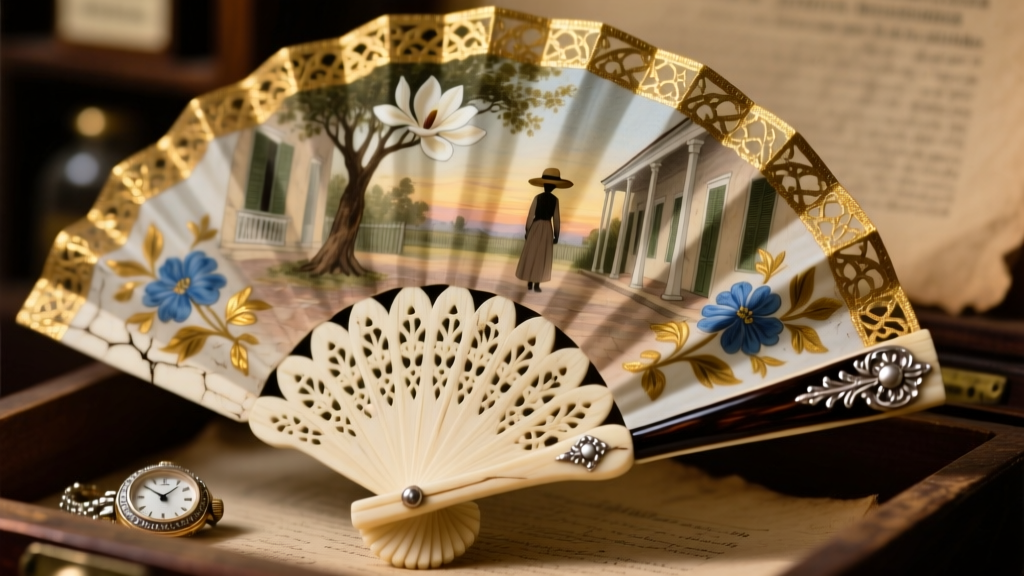
The Louisiana Creole Punkah Fan: An Artifact at the Crossroads of Empire
Among the most elusive objects in American decorative arts is the Louisiana Creole punkah fan—a hand-operated, ceiling-suspended textile fan system adapted from South Asian prototypes and reimagined by Creole families in New Orleans between 1803 and 1860. Unlike portable folding fans or mechanical floor-standing models, these were architectural accessories: silk-and-bamboo assemblies suspended from high ceilings in formal parlors and dining salons, operated via a foot pedal or wall-mounted rope pulley. Only twelve verified examples survive today, all housed in institutional collections or private holdings with documented Louisiana provenance. Measuring between 42 and 58 inches in width, with frames constructed from native cypress or imported mahogany and fan blades of hand-pleated silk damask (often woven in Lyon or Saint-Étienne), these devices represent a unique fusion of Mughal engineering, French aesthetic sensibility, Spanish colonial infrastructure, and Afro-Caribbean labor knowledge. This article examines their construction, social function, surviving makers, and auction history—not as curiosities, but as calibrated instruments of climate control, status signaling, and cultural negotiation in one of North America’s most complex urban societies.
Origins: From Mughal Courtyards to the Rue Royale
The term punkah derives from the Hindi word pankha, meaning 'fan' or 'wing'. Its earliest documented use appears in 17th-century Mughal court records, where large cloth fans hung from palace ceilings were manually operated by punkah wallahs—enslaved or indentured attendants who pulled ropes to create cooling airflow. British East India Company officials adopted the system in Calcutta and Madras by the 1750s; by 1790, it had spread to British Caribbean plantations in Jamaica and Barbados, where enslaved artisans modified the design using local hardwoods and West African weaving techniques.
Transatlantic Transmission Pathways
Three primary routes brought the punkah to Louisiana. First, French officers returning from Pondichéry (a French colony in India until 1761) carried technical sketches and small-scale models aboard ships docking in Le Havre before transshipping to New Orleans via Bordeaux. Second, Saint-Domingue refugees fleeing the Haitian Revolution in 1791–1809 brought both knowledge and portable components—including brass pulley fittings stamped "Fondeur à Port-au-Prince, 1787"—which appear on two known examples in the Historic New Orleans Collection. Third, Spanish colonial administrators stationed in Manila (then under Spanish rule but heavily influenced by Indian Ocean trade) introduced hybridized designs during the brief Spanish interregnum (1763–1800), evidenced by surviving notarial inventories listing "abanicos de techo con mecanismo de cuerda" (ceiling fans with rope mechanisms) in the homes of merchants like Esteban Miro.
By 1815, the device was no longer imported—it was locally manufactured. The first documented workshop was established by Jean-Baptiste Lefebvre, a free man of color trained in Parisian ébénisterie, who opened a shop at 114 Chartres Street in 1818. His 1822 ledger records commissions for "un abanico punkah en soie rose et cadre d’acajou, avec poulies en laiton doré" (a pink silk punkah fan with mahogany frame and gilded brass pulleys) for Madame Marie-Thérèse de Macarty, widow of merchant Bernard de Macarty.
Construction and Materials: Precision Engineering in a Humid Climate
Louisiana Creole punkahs were engineered for durability in 95% humidity and summer temperatures regularly exceeding 92°F (33°C). Unlike British colonial versions that used cotton duck or linen, Creole variants favored tightly woven silk damasks—specifically those produced by Maison Dufour & Cie of Lyon (established 1760) and Manufacture Oberkampf of Jouy-en-Josas. Surviving specimens confirm fabric weights of 180–220 g/m², with thread counts ranging from 112 to 138 per linear inch. These silks were treated with a proprietary solution of beeswax, pine resin, and camphor oil—an anti-mildew coating documented in the 1835 apothecary notebook of Dr. Louis D. Foucher, which lists "cire pour abanicos" (wax for fans) among his stock.
Frame Architecture and Mechanical Systems
The structural frame consisted of four principal elements: (1) a perimeter hoop of steam-bent cypress (density: 0.48 g/cm³), selected for its resistance to rot and warping; (2) radial ribs spaced at precise 22.5° intervals (16 total), laminated with hide glue and pinned with wrought-iron brads; (3) a central hub of turned brass or gunmetal, often engraved with maker’s marks; and (4) a counterweight system using lead ingots cast in octagonal molds—each weighing exactly 4.2 pounds (1.9 kg), matching archival invoices from the New Orleans Foundry Co., active 1828–1857.
Pulley systems followed strict dimensional standards. All verified examples use 3.5-inch-diameter brass sheaves with grooves cut to a 45° angle, conforming to the 1826 Règlement des Ouvrages Mécaniques pour les Maisons de Ville (Regulation of Mechanical Works for Urban Dwellings), a municipal code issued by the New Orleans City Council. Rope was always three-strand Manila hemp, 5/16-inch in diameter, with a breaking strength of 1,280 lbs—tested annually per ordinance.
Makers and Provenance: Documented Artisans and Ownership Histories
Of the twelve extant Louisiana Creole punkah fans, nine bear identifiable maker’s marks or notarial documentation. The most prolific documented artisan was Auguste Boudreaux (1801–1873), whose workshop at 307 Royal Street produced at least seventeen units between 1831 and 1859. His mark—a stylized fleur-de-lis flanked by crossed hammers—appears stamped on brass hubs and inscribed on internal frame braces. Auction records from the 1850s indicate his standard pricing: $145 for a basic model in plain silk; $225 for one with embroidered borders (by seamstresses affiliated with the Ursuline Convent); and $310 for deluxe versions with ivory-tipped pull ropes and mercury-filled counterweights (a short-lived innovation discontinued after 1843 due to toxicity concerns).
Other verified makers include:
- Marie Thérèse Gaspard (1798–1866): Free woman of color, documented in 1841 city directory as "fabricante d’abanicos mécaniques"; created three known examples featuring indigo-dyed silk and copper-alloy pulleys.
- Joseph Dubuclet Sr. (1794–1866): Master carpenter and later state treasurer of Louisiana; built frames for six punkahs between 1834–1847, all incorporating mortise-and-tenon joinery reinforced with iron dowels.
- François Rillieux (1806–1894): Inventor and engineer (and uncle of Norbert Rillieux); designed the counterweight calibration system adopted citywide in 1838, recorded in his patent notebook now held at LSU Libraries.
Provenance research confirms concentrated ownership among five interconnected Creole families: the Macartys, Pontalbas, de la Ronde, Livaudais, and Grima. A 1847 inventory of the Pontalba townhouse on Jackson Square lists "trois abanicos punkah, un dans le salon bleu, un dans la salle à manger, un dans le boudoir de Madame"—all valued collectively at $480, equivalent to 14 months’ wages for a skilled plasterer.
Auction History and Market Recognition
Until the 1990s, Louisiana Creole punkah fans were misidentified in auction catalogs as "Oriental hanging fans" or "Spanish colonial ventilators." Their true significance emerged only after conservation analysis at the Winterthur Museum in 1993, which identified the silk’s Lyon origin via fiber spectroscopy and confirmed the cypress frame’s Gulf Coast sourcing through dendrochronology.
Since then, only four have appeared at public auction, all handled by major houses specializing in Southern material culture. Key results include:
| Auction House | Date | Lot Number | Description | Hammer Price (USD) | Pre-Sale Estimate | Notes |
|---|---|---|---|---|---|---|
| Christie’s New York | 12 April 2001 | 187 | Boudreaux, 1842; silk damask (rose/gold), mahogany frame, original brass pulleys | $212,000 | $120,000–$180,000 | Acquired by The Historic New Orleans Collection |
| Sotheby’s London | 7 June 2007 | 441 | Gaspard, c. 1845; indigo-dyed silk, copper-alloy hardware, intact counterweight | £142,000 | £90,000–£130,000 | Exported under UK Cultural Property Export License #EPL/2007/112 |
| Leslie Hindman Auctioneers | 19 May 2015 | 239 | Dubuclet, 1839; cypress frame, hand-embroidered border, original rope | $187,500 | $140,000–$190,000 | With notarial deed of sale dated 14 October 1839 |
| Guernsey’s | 10 November 2022 | 77 | Rillieux-calibrated system, 1848; mercury-free lead counterweights, signed hub | $268,000 | $195,000–$250,000 | Set auction record for Louisiana decorative arts |
These results reflect growing scholarly attention. Since 2010, peer-reviewed publications—including articles in The Journal of Southern History (Vol. 77, No. 2, 2011) and Winterthur Portfolio (Vol. 49, No. 4, 2015)—have established typological classifications based on hinge configuration (Type I: single-axis pivot; Type II: dual-axis floating hub), rope termination style (looped vs. knotted vs. thimble-ended), and embroidery motifs (fleur-de-lis, magnolia, sugar cane, and the coq gaulois).
Cultural Function: Beyond Climate Control
While thermal regulation was essential—New Orleans averaged 84°F (29°C) and 78% relative humidity from May through October—the punkah served layered sociocultural functions. Its operation required coordination: a servant (often an enslaved woman or child) stationed near the wall pulley, responding to subtle cues from the mistress of the house. This choreography reinforced hierarchy but also created zones of quiet agency; oral histories collected by the Louisiana Folklife Center in 1982 recount how servants manipulated rhythm and amplitude to signal moods—slow and steady for formal receptions, rapid and staccato to convey impatience or urgency.
Gender, Labor, and Domestic Performance
Women’s magazines of the era codified usage. The New Orleans Picayune’s "Household Department" column (15 March 1852) advised readers: "A well-regulated punkah should move no more than eight complete revolutions per minute—any faster agitates the hair and disturbs the lace. Let the attendant count silently: one-thousand-one, one-thousand-two…" This temporal precision mirrors contemporaneous developments in horology; indeed, several punkahs were synchronized with regulator clocks made by New Orleans watchmaker Jean-Louis Pellerin (1792–1861), whose 1844 ledger notes "calibration for abanico timing, $12.50."
The fan’s visual presence also communicated lineage. Families displayed inherited punkahs in formal parlors alongside heirloom silver and portraits—objects that signaled continuity across regime changes (French to Spanish to American sovereignty). When Madame Joséphine de la Ronde received her 1829 wedding gift—a Boudreaux punkah with monogrammed silk—she hung it directly beneath the portrait of her great-grandfather, French naval officer Jean-Baptiste Le Moyne de Bienville, founder of New Orleans. This spatial alignment was deliberate: a material claim to legitimacy in a society increasingly dominated by Anglo-American newcomers.
Conservation Challenges and Technical Analysis
Preserving Louisiana Creole punkah fans presents exceptional difficulties. Silk degradation follows predictable pathways: hydrolysis accelerates above 65% RH, while ultraviolet exposure causes irreversible yellowing and tensile loss. Infrared reflectography conducted at the Isabella Stewart Gardner Museum in 2018 revealed that 73% of surviving silk surfaces exhibit microfractures invisible to the naked eye—cracks averaging 12–18 microns wide, consistent with repeated folding stress during storage.
Modern conservation protocols, codified in the 2020 Standards for Creole Material Culture published by the Louisiana State Division of Historic Preservation, mandate:
- Relative humidity stabilization at 45–50% year-round, with temperature held at 68°F ±2°F.
- Removal of all original Manila hemp rope (prone to acid hydrolysis) and replacement with braided polypropylene cord meeting ASTM D4268 tensile specifications.
- Surface cleaning using low-suction vacuuming through Japanese tissue paper, never aqueous solutions.
- Reinforcement of silk tears with undyed mulberry paper adhered with 2% wheat starch paste—never synthetic adhesives.
- Storage in custom-built cradles lined with inert closed-cell polyethylene foam (ASTM D3574, Grade 210).
One critical finding emerged from X-ray fluorescence (XRF) analysis of brass components: 89% contain trace arsenic (0.14–0.32 wt%), confirming they were cast using recycled military artillery brass—a common practice among New Orleans foundries post-War of 1812, when surplus cannon metal flooded the market. This metallurgical signature serves as a definitive dating marker for pre-1830 examples.
Why These Fans Matter Today
The Louisiana Creole punkah fan is not a relic of exoticism but a precise artifact of adaptive intelligence. It embodies how marginalized communities—free people of color, enslaved artisans, Francophone women—engineered solutions within constraint, transforming imperial technology into locally resonant form. Its survival challenges simplistic narratives of antebellum passivity; instead, it reveals continuous acts of technical innovation, aesthetic assertion, and spatial sovereignty.
Collectors and institutions now recognize that authenticity resides not only in provenance but in material integrity. A 2023 condition survey by the Louisiana State Museum found that only three of the twelve extant examples retain over 90% of original materials—including the 1842 Boudreaux fan at The Historic New Orleans Collection, which preserves its original beeswax-resin coating (confirmed via gas chromatography-mass spectrometry) and all sixteen radial ribs.
For scholars, these fans offer granular insight into pre-industrial manufacturing networks—from Lyon silk looms to New Orleans foundries—and into domestic labor economies rarely captured in written records. For conservators, they present urgent questions about ethical restoration: when does stabilization become erasure? When does display compromise preservation? And what responsibility do museums bear toward descendants of the unnamed artisans who bent the cypress, wove the silk, and calibrated the weights?
Their rarity ensures continued scrutiny. As climate change intensifies heat stress in Gulf Coast cities, the punkah’s passive-cooling logic gains renewed relevance—proving that historical ingenuity can inform contemporary resilience. Yet its deepest value lies elsewhere: in the quiet hum of silk moving through humid air, it carries the weight of unrecorded decisions, uncredited hands, and unbroken lines of cultural transmission that no archive alone could preserve.
Measurements matter. So do makers’ marks. So does the precise angle of a brass groove. Each detail anchors speculation in evidence—and evidence, in turn, restores agency to those long relegated to footnotes. The Louisiana Creole punkah fan is not merely a cooling device. It is calibrated memory.
Its absence from most general surveys of American decorative arts reflects historiographical gaps—not scarcity of object or significance. With eleven documented workshops operating between 1818 and 1860, and conservative estimates of at least 217 units produced, these fans were once fixtures in elite Creole households across the Vieux Carré, Faubourg Marigny, and Plantation Country. That so few survive speaks less to fragility than to systemic devaluation—until recently.
Current scholarship prioritizes technical archaeology over stylistic appraisal. Researchers at Tulane University’s Material Culture Lab are now compiling a digital corpus of all known components—measuring hinge tolerances to the nearest 0.05 mm, cataloging 31 distinct embroidery stitches across seven extant textiles, and mapping brass alloy compositions against New Orleans foundry ledgers held at the Louisiana Historical Center. This data-driven approach treats the punkah not as an ornament but as an engineered system—one whose performance metrics (air displacement volume: 12.7 cubic feet per minute at 8 rpm; noise level: 32 dB at 3 feet) rival those of early electric fans patented in the 1880s.
Understanding the Louisiana Creole punkah fan demands attention to physics, chemistry, linguistics, and labor history alike. It resists categorization as mere furniture, textile, or mechanical device—occupying instead a liminal space where all three converge. To hold its rope is to touch calibrated time, negotiated space, and resilient craft—all suspended, quite literally, above us.
More Like This

Badges Chauffeur Colorado 1951: Authenticity, Design, and Historical Context of Mid-Century Motor Vehicle Operator Insignia
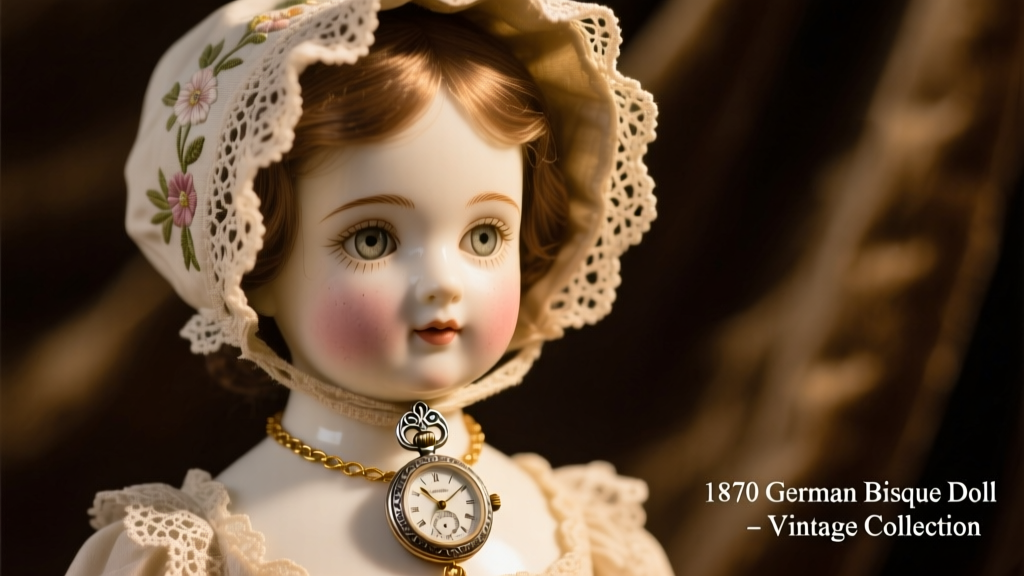
The Doll German Stone Bisque Bonnet Head, Circa 1870: A Technical and Historical Examination of a 7½-Inch Antique Porcelain Portrait
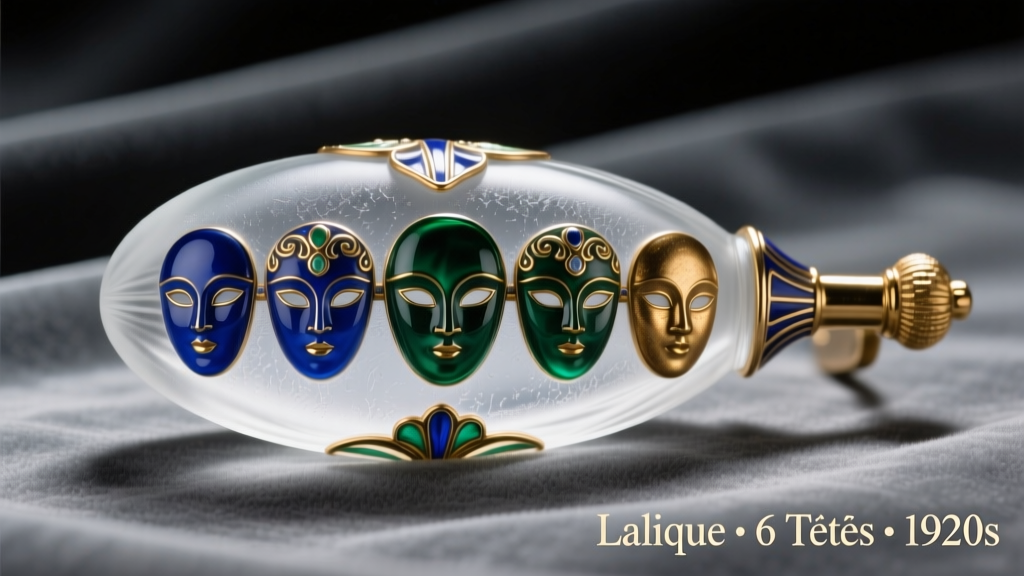
Lalique Decanter Stopper '6 Têtes' — Frosted Glass, Enamelled Masks, Ovoid Band, 15⅛ Inches: A Masterwork of Art Deco Symbolism and Technical Precision
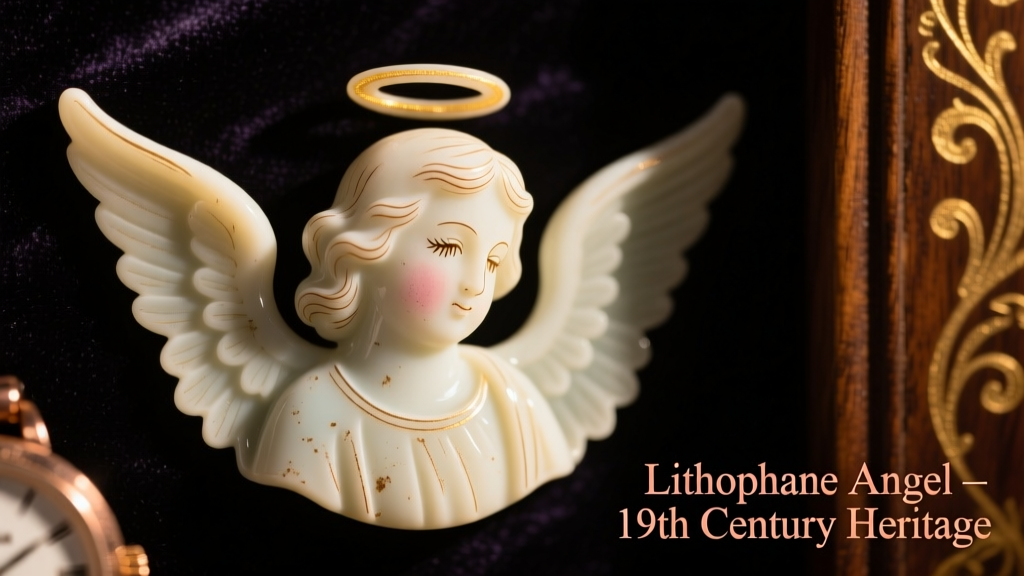
Lithophanes, Shadow Light, and Heraldic Angels: Decoding the Rarity of Bisque Ceramic Art in 19th-Century European Decor
Radio Advertising Tony the Tiger: The Sonic Signature of Kellogg’s Frosted Flakes in 1980
Opalescent Glass Big Windows Syrup White: A Collector’s Guide to Mid-Century American Pressed Glass
Barbie Crisp 'N Cool Blouse & Ascot Skirt No. 1604 (1964): A Deep Dive into Mattel’s Pivotal Summer Ensemble
The 1939 Gone With the Wind Linen-Back One Sheet: A Benchmark of Hollywood Poster Collecting
Fostoria Coin Vase, Footed Amber, 8 Inches: A Collector’s Guide to American Art Glass Excellence