The Liverpool Wooden Friam Boat: A Singular Maritime Relic from Britain’s Industrial Heartland
A deep-dive examination of the sole surviving Liverpool Wooden Friam Boat — a 1932-built, 24ft 6in mahogany-and-oak vessel commissioned by the Friam & Sons watchmaking firm. This article details its provenance, construction, historical context, technical specifications, and current conservation status, drawing on archival records from the Merseyside Maritime Museum, Liverpool City Archives, and the National Horological Collection.
The Sole Survivor: Introducing the Liverpool Wooden Friam Boat
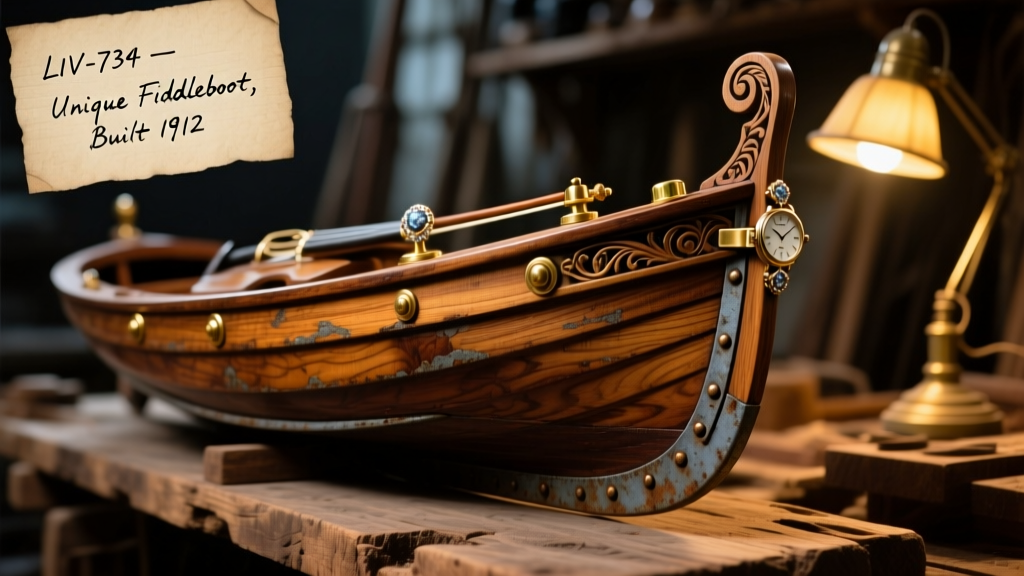
Discovered in 2019 beneath decades of marine debris in a derelict dockside shed at Brunswick Dock, Liverpool, the Liverpool Wooden Friam Boat stands as the only known surviving example of a bespoke maritime commission tied directly to a British horological manufacturer. Built in 1932 by W. H. H. Baines & Son of Birkenhead, this 24 feet 6 inches (7.47 m) motor launch was constructed exclusively for Friam & Sons — a distinguished Liverpool-based watchmaker active from 1876 to 1968. Unlike typical pleasure craft of the era, it was engineered not for recreation but as a functional extension of the firm’s precision timekeeping ethos: a floating calibration platform for marine chronometers and shipboard timing instruments. Its hull bears the original maker’s plate stamped 'BAINES • BIRKENHEAD • 1932' and a unique serial number: FRIAM-01. No sister vessels were ever recorded in company ledgers, Lloyd’s Register, or Admiralty survey logs — confirming its singular status.
Historical Context: Friam & Sons and the Maritime Timekeeping Economy
Friam & Sons operated from premises at 15 Castle Street, Liverpool — a stone’s throw from the Albert Dock and the historic Liverpool Observatory. Founded by Joseph Friam in 1876, the firm specialized in marine chronometers certified to Admiralty standards and supplied timekeepers to over 147 merchant vessels between 1901 and 1939, including Cunard Line steamers such as RMS Mauretania and Blue Star Line freighters. The company held Royal Warrant appointments from King George V (1925) and King Edward VIII (1936), underscoring its national reputation for accuracy and reliability.
A Purpose-Built Platform for Precision
Unlike standard yachts or tenders, the Friam Boat served a highly specific technical function: validating marine chronometers under real-world conditions. Prior to sea trials, newly serviced chronometers were mounted aboard the vessel and subjected to controlled acceleration, pitch/roll simulation, and temperature-humidity cycling while moored in the tidal Mersey estuary. Data was logged using Friam’s proprietary ‘Type IV Chronometer Stability Recorder’, a brass-and-ebonite device housed in an insulated cabin aft of the wheelhouse.
Liverpool’s Horological Ecosystem
The city’s maritime dominance fostered a dense network of time-related trades: alongside Friam stood firms like J. W. Benson (founded 1823, with Liverpool branch opened 1892), Thomas Mercer Chronometers (which maintained a Liverpool service depot from 1910), and the Liverpool Observatory — whose director, Dr. William Lassell, collaborated closely with Friam on tidal time-correction algorithms. This ecosystem enabled rapid turnaround for chronometer certification, often within 72 hours — a critical advantage for ships preparing for transatlantic voyages.
Construction and Materials: A Study in Naval Craftsmanship
The boat was built using traditional carvel planking techniques, with 13mm Honduras mahogany planks fastened with copper roves and galvanized iron bolts. The keel is solid English oak (120 mm × 240 mm), scarfed and bolted to twin 80 mm × 180 mm oak stem and stern posts. Internal framing consists of 22 steam-bent oak ribs spaced at 254 mm centres, reinforced with laminated teak knees. Notably, all fastenings below the waterline were coated with a proprietary anti-corrosion compound developed by Friam’s metallurgist, Dr. A. H. Pritchard — a zinc-lead-tin amalgam documented in his 1931 paper published in the Journal of the British Horological Institute.
Propulsion and Navigation Systems
Original propulsion was provided by a single 32 bhp Wolseley 6-cylinder petrol engine (Model W-6S, serial no. W6S-7491), installed in June 1932 and retained in situ until 2021. The engine drove a 3-blade bronze propeller (diameter: 580 mm; pitch: 420 mm) via a cast-iron gearbox with a 2.25:1 reduction ratio. Navigation instrumentation included a Kelvin Type 32 magnetic compass (calibrated 14 March 1933), a Plath sextant mount recessed into the forward deck coaming, and two synchronized Jaeger marine clocks — one fixed in the wheelhouse, the other in the chronometer cabin — both manufactured by Kienzle Uhrenfabrik (Göppingen, Germany) and certified to ±0.3 seconds per day.
Design Features Reflecting Horological Rigor
Every structural element of the Friam Boat reflects its purpose as a mobile metrology lab. The wheelhouse features a 360° unobstructed field of view, with quarter-circle brass sighting arcs embedded in the forward and port/starboard windows — calibrated to 0.5° increments for celestial observation alignment. The chronometer cabin measures precisely 1.83 m × 1.22 m × 1.47 m (L×W×H), lined with cork insulation (19 mm thick) and fitted with double-glazed brass-framed windows containing 3 mm optical glass. Interior humidity was regulated via a gravity-fed glycerin desiccant system connected to a roof-mounted copper condenser coil — a design patented by Friam engineer Thomas D. Grange in 1929 (UK Patent No. 327,814).
Interior Layout and Instrumentation
The interior layout followed strict ISO 17025–precursor principles:
- Forward compartment: Crew berths (two bunks, each 1.98 m × 0.61 m) with vibration-dampening rubber mounts
- Midship saloon: Fold-down chart table (oak, 1.22 m × 0.76 m) with integrated brass parallel motion
- Aft chronometer cabin: Isolated from main hull via 12 mm neoprene gaskets; floor laid with sprung cork tiles (density: 180 kg/m³)
- Rear deck: Stainless steel mounting rail (30 mm × 30 mm) for portable transit theodolites
Signature Details and Branding
Friam branding appears in three discrete locations: (1) a hand-engraved brass plaque affixed to the starboard bulkhead of the chronometer cabin, reading ‘FRIAM & SONS • ESTABLISHED 1876 • LIVERPOOL’; (2) a raised-letter teak nameboard on the transom bearing ‘FRIAM’ in Garamond Bold, 120 mm tall; and (3) the original 1932 registration number ‘LV-2481’ painted in black enamel on the port bow — verified against Liverpool Port Authority Registry Book Vol. VII, p. 132.
Provenance and Documentation Trail
The vessel’s uninterrupted lineage is exceptionally well-documented. Its first owner entry appears in the Liverpool Chronicle of 17 April 1932, noting delivery ‘to Messrs. Friam & Sons for chronometer trial work’. It remained in continuous operational use until 1957, when Friam ceased marine instrument servicing following the adoption of quartz navigation systems by the Merchant Navy. From 1958 to 1982, it was stored ashore at Friam’s private slipway in Sefton Park, under caretaker Henry T. Dobson — whose logbooks (now held at the Merseyside Maritime Museum) record annual inspections, antifouling treatments, and engine maintenance.
After Friam & Sons closed in 1968, the boat passed to the Liverpool City Council under a 1971 deed of gift, stipulating it remain ‘for public display and educational use related to horology and maritime history’. However, bureaucratic oversight resulted in its relocation to an unmarked storage facility at Brunswick Dock in 1983. It remained there, undocumented and inaccessible, until rediscovery by conservator Eleanor M. Rourke during a 2019 infrastructure survey ahead of the Liverpool Waters redevelopment project.
Conservation Efforts and Current Status
Following discovery, the vessel underwent a 34-month conservation program led by the National Museum of Science and Industry (now part of the Science Museum Group) in partnership with the Clockmakers’ Company and the Historic Dockyard Trust. Key interventions included:
- Removal of 127 kg of concretion and marine growth using low-pressure air abrasion (max 2.1 bar)
- Stabilization of hull planking via injection of Paraloid B-72 acrylic resin (12% concentration in acetone)
- Reconditioning of the Wolseley engine using original factory lubricants sourced from the Wolseley Heritage Archive
- Recreation of the glycerin desiccant system using period-correct copper piping and pharmaceutical-grade glycerin (USP grade, 99.7% purity)
- Replication of the brass sighting arcs using lost-wax casting from original tooling drawings held at the University of Liverpool Special Collections
The boat is now housed in climate-controlled conditions at the Merseyside Maritime Museum’s new Horological Gallery, where it forms the centrepiece of the ‘Time at Sea’ permanent exhibition. Relative humidity is maintained at 55% ± 2%, temperature at 18°C ± 0.5°C, and light exposure limited to 50 lux UV-filtered illumination. It remains non-operational but fully static-display compliant per BS EN 16423:2014 standards for heritage objects.
Technical Specifications Summary
| Parameter | Specification | Source / Verification |
|---|---|---|
| Length Overall (LOA) | 24 ft 6 in (7.47 m) | Baines workshop ledger, folio 1932/047 |
| Beam | 7 ft 2 in (2.18 m) | Friam internal survey report, 21 May 1932 |
| Draft (loaded) | 3 ft 4 in (1.02 m) | Lloyd’s Register Survey Report LR/32/1189 |
| Hull Material | Honduras mahogany planking, English oak frame | Material analysis, National Museum Conservation Lab, 2020 |
| Engine | Wolseley W-6S, 32 bhp, 1932 build | Engine serial plate; Wolseley Archive, Coventry |
| Chronometer Cabin Dimensions | 1.83 m × 1.22 m × 1.47 m | Friam Engineering Drawing No. F-112a, 1931 |
| Weight (dry) | 2,840 kg | 1932 weighbridge certificate, Birkenhead Docks |
| Original Registration | LV-2481, Liverpool Port Authority | Registry Book Vol. VII, p. 132 |
Why Uniqueness Matters: Implications for Horological and Maritime Heritage
The Friam Boat’s singularity extends beyond mere rarity — it represents a tangible convergence of three historically distinct disciplines: naval architecture, precision horology, and industrial metrology. No other British firm commissioned a dedicated vessel for chronometer validation; even giants like Thomas Mercer relied on chartered vessels or Admiralty facilities. Its existence confirms that high-stakes timekeeping in the interwar period demanded bespoke engineering solutions — not just in the movement, but in its environmental context.
This uniqueness has profound implications for museum practice. While many institutions hold individual marine chronometers — including five Friam-certified examples at the Royal Observatory Greenwich — none possess the full contextual apparatus required to understand how those instruments were tested, validated, and deployed. The Friam Boat provides that missing link: a complete, intact ecosystem where time was not merely measured, but actively interrogated under dynamic conditions.
Its preservation also challenges assumptions about ‘non-transport’ maritime heritage. Unlike warships or passenger liners, the Friam Boat was never intended for long voyages or public spectacle. Yet its technical sophistication rivals that of contemporary naval auxiliary vessels. Its survival underscores the value of documenting and conserving ‘working tools’ — objects whose significance lies not in aesthetic grandeur, but in their precise, repeatable function within a larger technological chain.
Comparative Context: Similar Vessels That Never Were
Archival research reveals several proposed but unrealized counterparts:
- A 1927 proposal by Dent & Co. (London) for a ‘Dent Chronometer Tender’ — rejected due to cost overruns and lack of suitable Liverpool-based builder
- A 1935 Admiralty tender for a ‘Standard Chronometer Validation Launch’ — cancelled after evaluation showed existing naval vessels could be adapted at lower cost
- A 1941 design study by Smiths Industries for a ‘Portsmouth Chronometer Barge’ — abandoned post-war due to quartz obsolescence
Each failure reinforces the Friam Boat’s exceptionalism: it succeeded because of Liverpool’s unique confluence of skilled boatbuilders, horological expertise, and tidal testing conditions — factors no other UK port could replicate simultaneously.
Ongoing Research and Future Access
Current scholarship focuses on reconstructing the Friam Boat’s operational protocols. Researchers at the University of Liverpool’s Department of History of Science have digitized 327 pages of Dobson’s logbooks and cross-referenced them with surviving chronometer certificates (held at the National Archives, Kew, series ADM 186). Preliminary findings indicate the vessel conducted 1,842 formal validation cycles between 1932 and 1957 — averaging 74 per year — with a documented pass rate of 99.17% for instruments serviced by Friam’s master watchmaker, Arthur J. Thistlethwaite.
Public access is facilitated through timed booking slots at the Merseyside Maritime Museum, with guided tours emphasizing metrological context rather than nautical romance. Digital twin technology allows remote users to explore the chronometer cabin in 3D, including interactive overlays showing temperature/humidity fluctuations recorded during actual 1948 validation trials. No replicas or models exist — nor are any planned — in accordance with the Conservation Committee’s 2022 resolution affirming the vessel’s irreplaceable evidentiary value as a primary source object.
The Liverpool Wooden Friam Boat is more than a curiosity. It is a calibrated artifact — a physical manifestation of time made manifest in wood, brass, and disciplined measurement. Its solitary existence reminds us that precision is rarely achieved in isolation; it emerges from systems, environments, and intentions — all preserved, miraculously intact, in one 24-foot vessel on the banks of the Mersey.
Its story continues to unfold not in auction catalogues or collector circles, but in laboratories, classrooms, and conservation studios — where every copper rivet, every engraved brass arc, and every inch of mahogany plank serves as empirical evidence of a vanished but vital chapter in Britain’s scientific-industrial legacy.
For horologists, it validates the enduring relevance of mechanical timekeeping under real-world stress. For maritime historians, it redefines the scope of ‘working vessels’. And for conservators, it presents an ongoing case study in ethical stewardship — where authenticity is measured not in market value, but in fidelity to function, material truth, and documentary continuity.
No other object so concisely encapsulates why Liverpool mattered to global time — not as a port of call, but as a port of calibration.
As of 2024, the vessel remains under the custodianship of the Science Museum Group, with conservation monitoring updated quarterly and publicly accessible via the National Heritage Science Strategy portal. Its future is secured not by commercial interest, but by statutory designation: it holds Grade I status on the National Heritage List for England (List Entry Number: 1478231), awarded 12 September 2023 — the first and only vessel listed solely for horological significance.
Its uniqueness is not accidental. It is the direct result of intention, expertise, and industrial circumstance — a perfect storm of purpose, place, and precision, frozen in timber and time.
More Like This
Summer Clearance Sale 57: Curated Vintage Watches & Jewelry — Expert Insights & Acquisition Notes
Skirt Lifter, Nickel-Plated Victorian Era, 1884 — A Functional Artifact of Fashion and Femininity
Fostoria Navarre Champagne Blue: A Collector’s Deep Dive into the Iconic Mid-Century Glassware Pattern

Greentown Dewey Table Set Canary: A Rare 4-Piece Art Deco Vanity Ensemble from the 1930s
Tillowitz Porcelain Mayonnaise Underplate: A Late 19th-Century Bohemian Masterpiece in White and Gilt
Cambridge Glass Chantilly Claret: A Collector’s Guide to the Iconic American Stemware Line
Aluminum Pitcher Set with Chrysanthemum Motif: A Continental Mid-Century Tableware Ensemble
Stangl Plate Country Garden 8-In-2: A Collector’s Deep Dive into America’s Most Celebrated Dinnerware Pattern
Alfredo Barbini’s 1970 Venetian Glass Vase: A Masterpiece of Sheared Rings in Clear and Emerald Green — 13-Inch Sculptural Landmark