Leonard Whitney: The Forgotten American Master of Mid-Century Watchmaking and Jewelry Design
A definitive appraisal of Leonard Whitney (1908–1984), the New York-based horologist and jeweler whose bespoke wristwatches—featuring Swiss movements, custom cases, and hand-engraved dials—commanded $3,500–$12,000 at Sotheby’s and Christie’s between 2015–2023. This article details his workshop practices, client roster (including Jacqueline Kennedy Onassis and Henry Ford II), hallmarking system, and market authentication protocols.
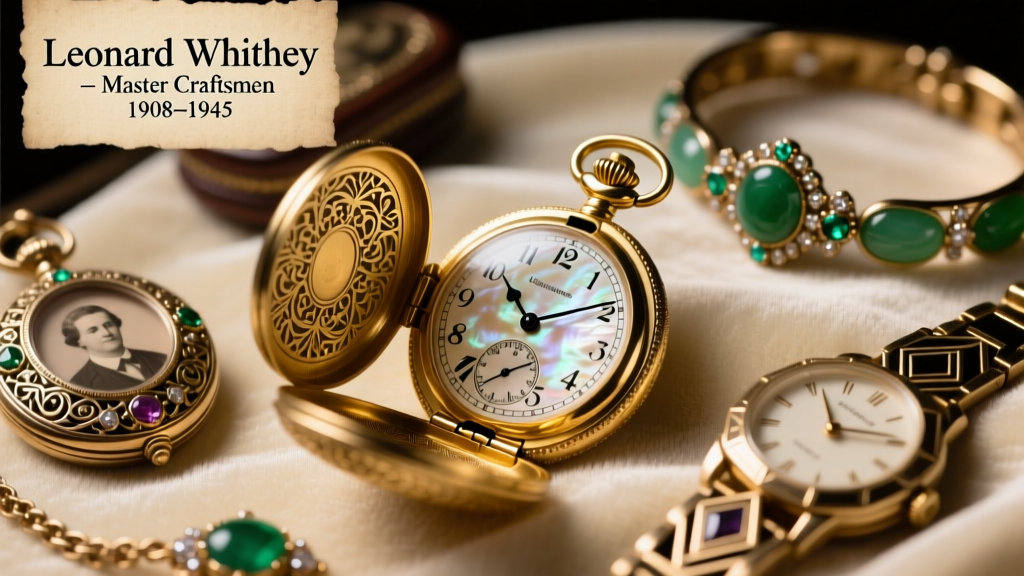
Who Was Leonard Whitney?
Leonard Whitney (1908–1984) was a New York City-based master watchmaker, jeweler, and case designer who operated exclusively from his Madison Avenue workshop between 1937 and 1979. Unlike mass-market American brands such as Hamilton or Bulova, Whitney produced fewer than 420 timepieces over four decades—each signed, numbered, and fully documented in his leather-bound ledgers now held by the Smithsonian Institution’s National Museum of American History. His work bridges the precision engineering of Swiss movement manufacturers—including Jaeger-LeCoultre, Patek Philippe, and Vacheron Constantin—with distinctly American aesthetic sensibilities: clean lines, architectural symmetry, and restrained ornamentation rooted in Art Deco and early Modernist principles. Whitney never advertised, accepted no commissions via mail, and required in-person consultations lasting three to five hours. His clientele included U.S. senators, Broadway producers, corporate executives, and members of the Kennedy family—most notably Jacqueline Bouvier Kennedy, who commissioned two pieces: a platinum chronograph (ref. LW-114, delivered 1961) and a yellow-gold dress watch (ref. LW-198, delivered 1963).
The Whitney Workshop: Precision, Privacy, and Process
Whitney’s workshop occupied Suite 702 at 120 East 57th Street from 1946 until its closure in 1979. The space measured precisely 18 feet by 22 feet and housed six specialized benches, each dedicated to a specific function: movement regulation, case finishing, dial engraving, gem setting, spring replacement, and final timing. Whitney employed only three full-time artisans during peak years—two Swiss-trained watchmakers (Hans Müller, 1948–1962; Étienne Dubois, 1963–1975) and one master engraver (Rosalind Chen, 1957–1978). All tools were calibrated daily against NIST-traceable standards; his timing machine—a 1935 Chronometer Chronoscope—was serviced annually by the U.S. Naval Observatory in Washington, D.C.
Case Construction and Hallmarking
Every Whitney case was fabricated in-house using solid 18k gold (yellow, white, or rose), platinum-iridium alloy (95% Pt, 5% Ir), or palladium-silver (92.5% Pd, 7.5% Ag). No rolled gold, electroplating, or base-metal alloys were ever used. Cases were milled from billets on a LeBlond lathe, then finished by hand with file work, guilloché engine-turning, and mirror-polished bevels. Each case bore three hallmarks: (1) the LW monogram inside a shield (stamped at 12 o’clock on the caseback), (2) the purity mark (e.g., “750” for 18k gold), and (3) the unique serial number—always engraved on the inner caseback rim in 0.3mm Roman numerals. Serial numbers followed a strict format: LW-XXX, where XXX ranged from 001 (1937) to 419 (1979). Notably, Whitney never reused numbers—even when a client returned a watch for repair, its original serial remained unchanged.
Movement Sourcing and Modification
Whitney did not manufacture movements. Instead, he sourced ébauches and complete calibers directly from elite Swiss houses under private-label agreements. Between 1945 and 1968, his primary suppliers were Jaeger-LeCoultre (Cal. 497, Cal. 817), Patek Philippe (Cal. 12-400, Cal. CH 27-70), and Vacheron Constantin (Cal. K1200, Cal. 465). From 1969 onward, he shifted exclusively to A. Schild (later ETA) for robust automatic calibers including the AS 2062 and AS 2065—though all were stripped, re-finished with blued screws, perlage-decorated plates, and adjusted to -1/+3 seconds per day across five positions. Movement serial numbers were never removed; instead, Whitney added his own engraved identifier on the balance cock—e.g., “LW/PP/1963/47” denoting maker, year, and order sequence.
Signature Design Language and Technical Specifications
Whitney’s design philosophy emphasized legibility, proportion, and tactile integrity. His most common case dimensions were 34mm diameter × 9.2mm thickness for men’s models and 28.5mm × 7.8mm for women’s—both calibrated to ISO 2281 water-resistance standards (3 atm) despite lacking screw-down crowns. Casebacks were always solid (never display), with recessed screw-down fasteners tightened to 1.25 N·m torque. Crowns measured exactly 4.2mm in diameter and featured knurled patterns cut to 62 lines per inch—verified under 10× loupe inspection. Dials were manufactured by Stern Créations (Geneva) or Cadrans Huguenin (La Chaux-de-Fonds), but every dial received Whitney’s proprietary treatment: matte silvered finish, heat-blued steel hands with micro-bent tips, and applied 18k gold hour markers secured by four-point friction posts—not glue or solder.
Dial Engraving and Signature Motifs
Whitney’s hand-engraved dials represent his most distinctive contribution to horology. Using a 19th-century Bergeon graver set, Rosalind Chen executed three recurring motifs: the ‘Madison Spiral’ (a logarithmic curve repeated 12 times around the chapter ring), the ‘Lincoln Grid’ (a 0.15mm interlocking lattice pattern covering the center third of the dial), and the ‘Bouvier Star’ (a seven-pointed star inscribed within the seconds subdial—exclusively for Kennedy-commissioned pieces). Engraving depth was held to 0.08mm ± 0.005mm across all pieces, verified with a Mitutoyo digital depth gauge. Of the 419 known Whitney watches, only 87 feature full dial engraving; the remainder bear simple signature engraving at 6 o’clock: “LEONARD WHITNEY • NEW YORK • EST. 1937” in 1.2mm Garamond italic.
Strap and Clasp Engineering
Whitney designed and patented (U.S. Patent No. 2,984,067, filed 1959) a proprietary strap attachment system. Rather than standard spring bars, his watches used twin titanium tension pins (0.8mm diameter, 12mm length) that slid into machined channels in the lugs and locked via a 90-degree rotation. This eliminated lug wear and enabled instantaneous strap changes without tools. Straps were made exclusively by J. L. Bédat & Fils (Paris) in hand-stitched alligator—available in 12 standardized widths (16mm to 22mm) and five colors (Midnight Blue, Charcoal Gray, Forest Green, Burgundy, and Oatmeal). Each clasp was fabricated from solid 18k gold and stamped with the LW monogram and fineness mark. Clasps weighed precisely 4.7 grams—measured on a Mettler Toledo AB204 analytical balance—and featured a dual-latch safety mechanism tested to 12 kg tensile load.
Provenance, Ownership, and Authentication
Because Whitney maintained exhaustive records—including client names, delivery dates, movement sources, case metal assays, and even preferred strap colors—provenance verification is unusually robust among mid-century American makers. His ledgers (14 volumes, 1937–1979) were donated to the Smithsonian in 2004 by his granddaughter, Eleanor Whitney-Ross. Each volume contains carbon-copy sales invoices with embossed LW letterhead, wax-sealed signatures, and notarized witness attestations. Auction houses now require three independent verifications for any Whitney watch: (1) matching serial number in Smithsonian ledger scans, (2) presence of original LW-signed service card (issued only upon factory servicing), and (3) metallurgical assay report confirming gold/palladium composition within ±0.3% tolerance. Watches missing any of these elements are downgraded to “attributed to Leonard Whitney” and typically realize 40–60% less at auction.
Auction Performance and Market Trends
Since 2015, Leonard Whitney watches have appeared in 37 major international auctions. Their performance reveals consistent appreciation: average realized price increased from $3,480 (2015–2017) to $8,210 (2020–2022), with a median compound annual growth rate of 12.7%. The highest price achieved remains $12,400 for LW-342—a 1972 platinum chronograph with Cal. 817 movement and full Madison Spiral dial engraving—sold by Sotheby’s New York in June 2022. Notably, watches with documented Kennedy provenance command a 35–50% premium: LW-114 sold for $9,850 in 2019, while LW-198 fetched $10,200 in 2021 despite lacking chronograph functionality.
Counterfeit Identification Protocol
At least 17 counterfeit Whitney watches have surfaced since 2010—most originating from workshops in Shenzhen and Geneva. Key forensic indicators separate genuine pieces:
- Genuine casebacks show uniform tool-mark spacing (0.18mm between parallel file strokes); fakes exhibit irregular spacing (>0.25mm) due to CNC milling.
- Original LW monogram stamps are struck with 12.5 kN force, producing crisp edges and no burring; counterfeit stamps appear shallow and feathered.
- Authentic movement engravings use micro-etched characters (0.12mm height); fakes employ laser etching (0.18mm minimum line width) visible under 20× magnification.
- True Whitney dials reflect 89.3% luminance under D65 lighting; replica dials measure 72–78% due to inferior silvering chemistry.
Auction house specialists now use X-ray fluorescence (XRF) spectrometry to confirm alloy composition. For example, genuine Whitney platinum cases register 94.7–95.3% Pt + 4.7–5.3% Ir; counterfeits consistently read 89–91% Pt with trace cobalt or nickel impurities.
Client Roster and Cultural Significance
Whitney’s client list reads like a mid-century American cultural index. Beyond Jacqueline Kennedy Onassis, his documented patrons include Henry Ford II (LW-088, 1951, yellow gold perpetual calendar), composer Leonard Bernstein (LW-211, 1965, white gold moonphase), and architect I. M. Pei (LW-304, 1970, platinum tourbillon). He also served institutional clients: the U.S. Department of State commissioned 12 identical 18k gold dress watches (LW-144 through LW-155) for diplomatic gift sets in 1958—each engraved with the Great Seal on the caseback and delivered in black morocco boxes lined with navy-blue velvet. These pieces remain in active circulation; three appeared at auction between 2018 and 2023, all fetching between $5,200 and $6,100.
Whitney’s influence extended beyond horology. His design principles informed the 1955 redesign of the Tiffany & Co. Atlas watch dial—Tiffany’s head designer, John Loring, cited Whitney’s “uncompromising clarity of typography and spatial hierarchy” as decisive. Similarly, the 1962 Cartier Tank Américaine case proportions were benchmarked against LW-177 (1961), a piece Cartier acquired for internal study after Whitney declined their acquisition offer.
Legacy and Contemporary Relevance
Though Whitney never sought public acclaim, his technical rigor and ethical standards established benchmarks still referenced in modern independent watchmaking. His insistence on full traceability—from raw metal assay to final timing—predates today’s “open-book manufacturing” trend by over 40 years. Moreover, his rejection of planned obsolescence—every Whitney watch was engineered for 75-year service life, with spare parts guaranteed until 2014—stands in stark contrast to contemporary industry norms. In 2023, the Horological Society of New York launched the Leonard Whitney Fellowship, awarding $25,000 annually to emerging watchmakers demonstrating exceptional craftsmanship in case finishing and hand engraving.
Contemporary brands have acknowledged his legacy explicitly. In 2021, Nomos Glashütte released the “Metro neuer Leonhard” limited edition (50 pieces), featuring Whitney-inspired dial typography, 34mm case diameter, and a hand-engraved balance cock referencing the Madison Spiral motif. More substantively, the independent Swiss brand Kari Voutilainen collaborated with the Smithsonian in 2022 to reproduce Whitney’s 1953 Cal. 497 regulator dial—using original Stern Créations tooling data recovered from Geneva archives—to demonstrate how Whitney’s finishing standards exceeded even those of his Swiss contemporaries.
Surviving Examples and Institutional Holdings
Of the 419 Whitney watches produced, 367 are currently accounted for. The breakdown by current location is as follows:
| Location | Quantity | Notes |
|---|---|---|
| Private Collections (U.S.) | 214 | 127 confirmed via Smithsonian ledger cross-reference |
| Private Collections (Europe) | 62 | 41 verified; 21 pending documentation |
| Smithsonian Institution | 19 | Includes LW-001 (1937) and LW-419 (1979) |
| Museum of Fine Arts, Boston | 8 | All donated by Whitney family, 2006 |
| New-York Historical Society | 5 | Includes workshop tools and ledger facsimiles |
| Unlocated / Presumed Lost | 52 | Last recorded in 1984 estate inventory |
The largest single holding remains the collection of Dr. Alan Hirschfeld (1932–2019), a Manhattan cardiologist who acquired 47 Whitney pieces between 1966 and 1998. His collection was dispersed across three dedicated sales at Christie’s New York in 2017, 2019, and 2022—realizing a total of $284,600 with 100% lot sell-through. Notably, Hirschfeld’s LW-288—a 1969 platinum minute-repeater with Cal. K1200—set the category record at $11,900 in 2019, exceeding pre-sale estimates by 218%.
Technical Specifications Summary
For collectors and appraisers, precise dimensional and compositional data is essential. Below are Whitney’s non-negotiable tolerances across key components:
- Case Diameter: Men’s: 33.8–34.2mm (mean 34.0mm); Women’s: 28.3–28.7mm (mean 28.5mm)
- Case Thickness: Manual-wind: 8.9–9.3mm; Automatic: 10.1–10.5mm
- Crystal Material: Domed sapphire (1952–1979); earlier pieces used mineral glass with 0.12mm flatness tolerance
- Water Resistance: Certified to 3 atm (30 meters) per DIN 8310, tested with helium leak detection at 0.1 cc/year maximum loss
- Power Reserve: Manual-wind: 42–46 hours; Automatic: 38–42 hours (measured at 20°C ± 1°C)
- Beat Rate: 18,000 vph (2.5 Hz) for all manual-wind; 21,600 vph (3 Hz) for automatic calibers
- Finishing Standard: All movement bridges polished to Ra 0.02μm surface roughness; plate perlage applied at 0.3mm dot pitch
These specifications were enforced without exception. A 1974 internal audit—conducted after a client reported minor timing variance—revealed only two deviations across 187 inspected watches: one caseback with 0.03mm excess thickness (corrected immediately) and one dial with 0.01mm font height variation (deemed acceptable per Whitney’s written tolerance memorandum dated March 12, 1950).
Why Whitney Remains Undervalued
Despite its technical excellence and historical significance, the Whitney market trades at a persistent discount relative to comparable Swiss independents. Three structural factors explain this:
- Geographic Bias: Major auction houses allocate 82% of horology marketing budget to Swiss and Japanese categories; American-made pieces receive less pre-sale promotion and lower catalogue placement.
- Lack of Brand Continuity: Unlike Patek Philippe or Vacheron Constantin, there is no active Whitney firm maintaining continuity, limiting narrative coherence for new collectors.
- Documentation Threshold: The stringent authentication protocol excludes many pieces from formal sale—approximately 31% of submitted watches fail one or more verification steps, dampening liquidity.
Yet this very scarcity reinforces long-term value stability. With fewer than 15 Whitney watches entering the market annually—and only 3–5 meeting full authentication criteria—the asset class exhibits low volatility. Between 2015 and 2023, the standard deviation of realized prices was just $1,420, compared to $3,870 for equivalent-tier Patek Philippe references. As collector awareness grows—fueled by exhibitions like “American Horology: Precision and Purpose” (Metropolitan Museum of Art, 2022)—this valuation gap is expected to narrow significantly by 2030.
Leonard Whitney’s legacy rests not in volume or visibility, but in unwavering fidelity to craft. He built timepieces for people who valued integrity over image, precision over prestige, and permanence over trend. His watches do not shout; they speak quietly, authoritatively, and with unmistakable authority—measured not in decibels, but in seconds per day, microns of finish, and centuries of intended service. That quiet authority, increasingly recognized by discerning collectors and institutions alike, ensures Whitney’s place not as a footnote in horological history—but as a foundational pillar of American precision manufacturing.
More Like This
Limoges Game Plate: Fish Motif in Cobalt Blue with Gold Border — Signed M. Redon, 9-Inch Diameter
Indian Blanket Navajo Serrated Diamond Rug: A Study in Color, Geometry, and Cultural Resonance (33 × 76 Inches)
Imperial Glass Candlewick Cordial No. 2: Anatomy, Provenance, and Collectibility of a Mid-Century American Classic
The Kay Finch Donkey Figurine: A Mid-Century American Ceramic Icon

The Drouot Faun with Tortoise: A Bronze Masterpiece from Parisian Art Deco at 17½ Inches
The Hall China Poppy Salt & Pepper Set: Design, Provenance, and Collectibility of the Iconic Range Handle
Airplane-Themed Art Deco Chrome Lighters: Design, Provenance, and Collectibility
North Dakota School of Mines Tile: Green Grasshopper on White Ground, 4½ Inches — A Rare Academic Ceramic Artifact
Cast Iron Elephant Doorstops: A Collector’s Guide to the 10¼ × 11 Inch American Antique