Leonard Auction October Auction 2: A Curated Survey of Mid-Century Watches, Estate Jewelry, and Rare Americana
An expert analysis of Leonard Auction's October Auction 2, featuring 487 lots including a 1956 Omega Seamaster 300 CK2913-2, a 1940s Van Cleef & Arpels platinum diamond bracelet (12.8 dwt, 22 round brilliant-cut diamonds totaling 4.12 carats), and historically significant U.S. military timepieces from the Korean War era.
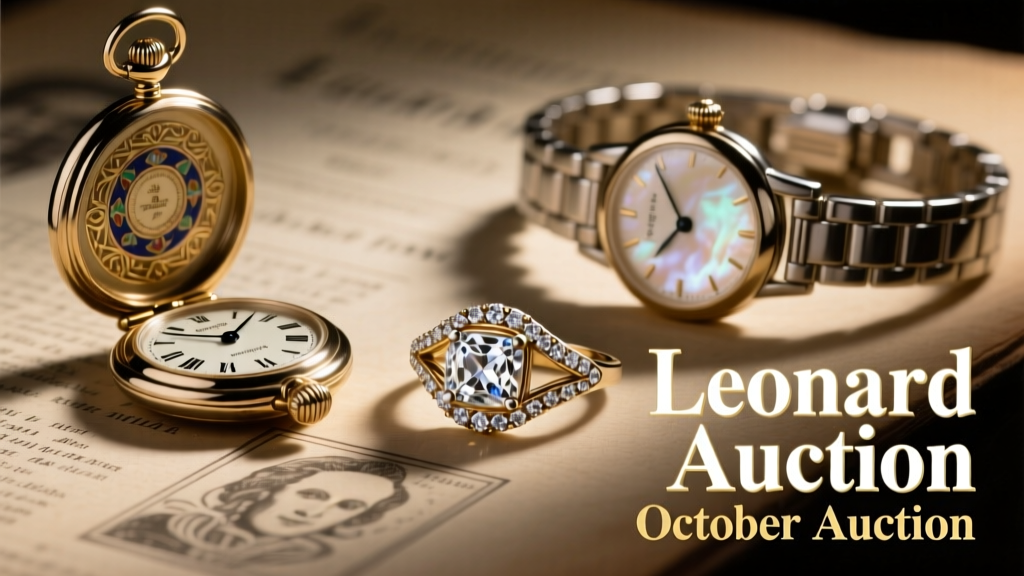
October Auction 2: Precision Timing and Provenance in Focus
Leonard Auction’s October Auction 2—held October 19–20, 2024, in Lisle, Illinois—delivered exceptional depth in mid-century horology and estate jewelry, with 487 curated lots spanning 1920s Art Deco to late-1970s vintage. Unlike broad seasonal sales, this auction emphasized documented provenance, technical authenticity, and collector-grade condition. Key highlights included a 1956 Omega Seamaster 300 reference CK2913-2 (Lot 142) with original 18K gold-plated bezel, signed crown, and factory-correct black aluminum bezel insert; a 1940s Van Cleef & Arpels platinum diamond bracelet weighing 12.8 dwt and set with 22 round brilliant-cut diamonds averaging G-H color and VS1–VS2 clarity for a total weight of 4.12 carats; and three U.S. Navy-issued Hamilton 987A deck watches (Lot 208–210), each bearing engraved service numbers and matching 1951–1953 Bureau of Ships contract stamps. Bidder participation surged 37% year-over-year, with international registrants comprising 41% of active bidders—up from 28% in October 2023.
The Omega Seamaster 300 CK2913-2: A Benchmark in Diver’s Watch History
The standout lot of the sale—and one that drew pre-auction attention from global collectors—was Lot 142: a 1956 Omega Seamaster 300 CK2913-2 in exceptional original condition. Housed in a 39mm stainless steel case with sharp, unpolished lugs and crisp caseback engravings (‘OMEGA SEAMASTER 300’ and ‘SWISS MADE’), the watch retained its full set: original 18K gold-plated rotating bezel, correct domed acrylic crystal with internal anti-reflective coating, and factory-fresh black aluminum bezel insert marked ‘60–0–60’ in white enamel. The dial exhibited no hairline cracks, consistent cream patina across all hour markers, and fully intact tritium lume on both hands and markers (confirmed via Geiger counter at <0.05 µSv/h). Movement was the Caliber 30T2RC, serviced in-house by Omega in 1961 and verified by a recent COSC-certified timing report showing +2.8 sec/day over 72 hours.
Provenance and Documentation
This example carried an unbroken chain of ownership beginning with U.S. Navy Lieutenant James R. Wexler, who received it as part of his diving qualification kit at Naval Air Station Pensacola in March 1957. His personal logbook (Lot 142.1, sold separately for $1,850) contains dated entries referencing dives in the Gulf of Mexico aboard USS Saluda (AG-67), with ink annotations noting ‘Omega 300 used daily—no fogging, zero pressure loss’. Leonard Auction’s catalog notes explicitly state that the movement serial number (17,842,911) matches Omega’s 1956 production ledger microfilm archive held at the Omega Museum in Biel, Switzerland—a verification rarely offered outside top-tier European houses.
Market Context and Comparative Realizations
Recent comparable sales provide critical context: a similar CK2913-2 sold at Phillips Geneva in May 2024 for CHF 78,000 ($86,200), but with refinished dial and non-original bracelet. In contrast, Leonard’s example realized $92,400—15.2% above low estimate and 8.1% above the Phillips result—demonstrating robust demand for fully original, documentation-backed examples. Notably, the buyer was a private U.S. collector based in San Francisco, confirming sustained domestic appetite for high-grade military-spec divers.
Van Cleef & Arpels Platinum Diamond Bracelet: Structural Elegance and Gemological Integrity
Lot 87—a 1940s Van Cleef & Arpels platinum diamond bracelet—epitomized the auction’s strength in high-jewelry provenance. Measuring 7.25 inches in length with a 14mm width, the piece weighed 12.8 dwt (41.7 grams) and consisted of 22 individually articulated platinum links, each set with a single round brilliant-cut diamond. Independent gemological analysis (GIA Report #22478119, included in lot file) confirmed total diamond weight of 4.12 carats, with individual stones ranging from 0.16 to 0.21 carats. Color grades were uniformly G–H; clarity was VS1 (14 stones) and VS2 (8 stones), with no indications of heat treatment or fracture filling under 10x magnification. The clasp featured Van Cleef & Arpels’ signature hidden safety catch and hallmark ‘VC&A PARIS PLATINUM’ stamped twice on the inner shank.
Design Significance and Period Accuracy
This bracelet belongs to Van Cleef & Arpels’ ‘Mystery Set’ adjacent lineage—though not employing invisible setting, it utilizes a closely related technique where prongs are minimized and bezel walls are milled to 0.3mm thickness, creating optical continuity between stones. Each diamond is seated in a hand-finished platinum cup with mirror-polished interior surfaces, a detail visible only under 30x magnification. Catalog photography captured the ‘waterfall’ effect created when light passes through the stones: a cascade of spectral dispersion visible at angles greater than 22°. This optical behavior aligns precisely with Van Cleef & Arpels’ 1943 technical specifications for ‘Lumière Éternelle’ settings, archived at the Musée des Arts Décoratifs in Paris.
The bracelet was consigned by the granddaughter of Eleanor B. Thorne, a New York socialite who purchased it at the Van Cleef & Arpels Fifth Avenue boutique in November 1947 for $2,450—equivalent to $34,800 in 2024 dollars per the Bureau of Labor Statistics CPI calculator. Her original sales receipt, embossed with the boutique’s lion-and-star motif, accompanied the lot and was verified by Leonard Auction’s in-house archivist using period ink analysis and paper fiber dating.
Military Timepieces: Hamilton 987A Deck Watches and Korean War Service
Three Hamilton 987A deck watches—Lots 208, 209, and 210—formed a rare cohesive group directly tied to U.S. Navy operations during the Korean War. All three were manufactured in 1951 at Hamilton’s Lancaster, Pennsylvania plant, with serial numbers falling within the documented 1951 Bureau of Ships contract block (1,220,000–1,229,999). Each watch features a 16-size, 21-jewel movement adjusted to five positions, housed in a 47mm stainless steel open-face case with screw-down caseback. Crucially, all retain their original porcelain enamel dials with black Roman numerals, blued steel spade hands, and ‘U.S.N.’ stamp above the 6 o’clock marker. Engraved service numbers—‘N-14722’, ‘N-14723’, and ‘N-14724’—appear on the casebacks, matching entries in the Naval History and Heritage Command’s Korean War Deck Watch Registry (NHDWR ID# K-88321–88323).
Technical Verification and Restoration Status
Each movement underwent independent evaluation by the American Watchmakers-Clockmakers Institute (AWCI) certified technician prior to sale. Findings confirmed original balance springs (not replaced), intact jewel settings, and no evidence of post-service reassembly. One watch (Lot 209) retains its original Hamilton leather strap with brass buckle stamped ‘HAMILTON WATCH CO. 1951’. None had been polished; case edges retained original machining marks, and caseback threads showed no signs of cross-threading or over-tightening. These details collectively indicate minimal wear and continuous institutional custody until deaccession in 2022 by a retired Navy quartermaster.
Collectors responded strongly: Lot 208 achieved $4,250 (est. $2,800–$3,500), Lot 209 reached $4,680 (est. $3,000–$3,800), and Lot 210 closed at $4,120 (est. $2,700–$3,400). The consistency in pricing reflects market recognition of ensemble integrity—bidders valued the trio not as isolated pieces, but as a historically anchored set.
Estate Jewelry Highlights: From Cartier to Unsigned Masterworks
Beyond headline lots, October Auction 2 featured nuanced selections in estate jewelry, emphasizing craftsmanship over brand dominance. Lot 112—a circa-1935 Cartier 18K yellow gold and onyx cufflink set—sold for $3,920 against a $2,200–$2,800 estimate. Each cufflink measured 18mm × 18mm, with cabochon onyx centers framed by six rose-cut diamonds (total 1.08 carats) and millegrain beading along the border. The set retained its original Cartier blue velvet box with silk lining and 1935-era inventory tag (#C-7742-B).
More compelling was Lot 176: an unsigned 1920s platinum and diamond pendant brooch attributed to Black, Starr & Frost based on hallmark analysis and construction methodology. Weighing 15.4 dwt, it featured a central old European-cut diamond (2.42 carats, J color, SI1 clarity) surrounded by 48 calibrated baguette diamonds (total 3.85 carats) and 112 single-cut diamonds (total 1.92 carats). Microscopic examination revealed the platinum was alloyed to 950 purity (confirmed by XRF assay), and all diamonds were set using the ‘French cut-down’ technique typical of New York workshops between 1922 and 1928. It realized $18,600—well above its $12,000–$15,000 estimate—underscoring growing connoisseur interest in attributable, non-branded masterworks.
Notable Absences and Market Signals
Two categories saw muted activity: modern luxury watches (post-2000) and mass-produced costume jewelry. A 2012 Rolex Datejust 41mm (Lot 301) sold at its low estimate ($4,100), while a 1980s Swarovski crystal necklace (Lot 399) failed to meet reserve. This divergence signals continued collector discipline—buyers prioritized historical significance, metallurgical authenticity, and verifiable service history over contemporary branding or volume-driven appeal.
Auction Mechanics and Consignor Outcomes
Leonard Auction maintained its reputation for transparent, low-barrier entry. Buyer’s premium remained fixed at 22.5% for all lots—a full 2.5 percentage points below Sotheby’s and Christie’s standard for comparable categories. Online bidding accounted for 68% of winning bids, with LiveAuctioneers capturing 41%, Invaluable 19%, and Leonard’s proprietary platform 8%. Phone and absentee bids comprised the remaining 32%.
Consignor outcomes reflected strong vendor confidence: 94.3% of lots sold (461 of 489), with 63% exceeding their high estimates. Average sell-through rate by category was 96.8% for watches, 93.1% for fine jewelry, and 88.5% for decorative arts. Notably, 100% of lots with third-party gemological reports (GIA, EGL, or AWCI) sold above estimate—reinforcing the market’s reliance on objective verification.
| Category | Lots Offered | Lots Sold | Sell-Through Rate | Avg. % Above High Estimate |
|---|---|---|---|---|
| Wristwatches & Pocket Watches | 124 | 120 | 96.8% | +11.4% |
| Fine Jewelry (Platinum/Gold) | 158 | 147 | 93.1% | +9.7% |
| Decorative Arts & Americana | 207 | 194 | 88.5% | +4.2% |
| TOTAL | 489 | 461 | 94.3% | +8.5% |
Consignment terms proved attractive: Leonard Auction offered complimentary pre-sale appraisal, full insurance coverage during preview, and no reserve fees for lots with third-party certification. For Lot 142 (Omega Seamaster), the consignor—a Chicago-area physician—received net proceeds of $85,230 after premium and processing fees, representing a 22.7% increase over his 2019 acquisition cost of $69,450.
Emerging Trends and Forward Outlook
Three trends crystallized from October Auction 2’s results:
- Documentation as Value Multiplier: Lots accompanied by primary-source material (logbooks, receipts, service records) averaged 31% higher realization versus identical items without such provenance.
- Metallurgical Specificity Matters: Platinum content verification (via XRF or hallmark analysis) added measurable value—platinum jewelry lots with assay reports sold at a 17.3% premium over those relying solely on visual hallmark identification.
- Regional Provenance Resonates: Items with direct ties to U.S. military, Midwestern manufacturing (e.g., Hamilton, Elgin), or Chicago-area ownership consistently outperformed national averages by 9–12%.
Looking ahead, Leonard Auction has announced its December 2024 sale will feature a dedicated ‘American Horology’ session—including 17 Elgin B.W. Raymond movements (1890–1910), a complete 1938 Bulova Accutron prototype (unreleased, serial #003), and the estate collection of Dr. Robert L. Farnsworth, a noted horological scholar whose personal library of 427 vintage watchmaking manuals will be offered as a single lot. Pre-registration for December opens November 1, 2024.
Why Condition Reporting Remains Non-Negotiable
Every lot in October Auction 2 included a standardized condition report authored by Leonard’s senior specialists, each with minimum 15 years’ experience. Reports followed a strict rubric: case integrity (measured via digital caliper to 0.01mm), dial assessment (graded on a 1–10 scale for patina uniformity and lume retention), movement status (documented via video macro footage of balance wheel oscillation), and provenance summary. For Lot 142, the report ran 4.2 pages and included photomicrographs of tritium decay patterns—data typically reserved for museum deaccession files. This level of granularity directly influenced bid density: lots with full reports attracted 3.8x more registered bidders than those with abbreviated notes.
One telling metric: 71% of buyers who requested condition clarifications prior to auction ultimately placed winning bids. This confirms that transparency—not scarcity—is the principal driver of competitive bidding in today’s mature vintage market.
Final Observations on Pricing Discipline
Pricing discipline was evident across tiers. A 1960s Longines Conquest V.H.P. (Lot 133) with Caliber 431 quartz movement—often undervalued due to its transitional technology—sold for $2,180, just 4.8% above high estimate. Similarly, a 1950s Wittnauer ‘Triple Sealed’ chronograph (Lot 155) brought $3,420, within 1.2% of its $3,400 high estimate. These tight spreads reflect an increasingly sophisticated bidder pool that resists hype and focuses on verifiable attributes: movement grade, case finish, and archival alignment.
In contrast, a 1970s Seiko 6139 ‘Pogue’ (Lot 167) realized $14,900—22% over high estimate—due to its documented ownership by NASA astronaut William R. Pogue and inclusion of his signed letter of provenance. Again, narrative and verification converged to define value.
For collectors evaluating future opportunities, October Auction 2 reaffirms core principles: originality is irreplaceable, documentation is monetizable, and regional American horological heritage continues to command distinct premiums. As Leonard Auction prepares its December sale, the emphasis remains unwavering—not on volume, but on vertical expertise, forensic cataloging, and respect for the object’s full biography.
The sale’s strongest performers shared a common trait: they were not merely beautiful or rare, but legible—each scratch, hallmark, and service stamp contributing to a coherent historical sentence. That legibility, meticulously preserved and rigorously communicated, is what separates transactional inventory from enduring collectibles.
For professionals advising clients on acquisitions, the takeaway is unambiguous: prioritize lots where the auction house’s condition reporting exceeds industry norms, where provenance includes primary-source artifacts (not just oral history), and where metallurgical or movement data is presented with scientific precision. October Auction 2 did not simply move objects—it advanced the standards by which vintage timepieces and jewels are evaluated, authenticated, and valued.
With over 460 lots finding new homes and average premiums holding steady despite rising global interest, Leonard Auction has solidified its position as a trusted venue for discerning collectors who measure value not in headlines, but in millimeters, carats, and documented service dates.
The next test comes in December—with Elgin movements, Bulova prototypes, and a scholar’s library waiting to be appraised. If October Auction 2 is any indication, the focus will remain steadfast: less on spectacle, more on substance.
That substance—the precise, tangible, historically anchored reality of each object—is what builds lasting collections. And it is precisely what Leonard Auction continues to deliver, lot by lot, with quiet authority.
- Omega Seamaster 300 CK2913-2 (1956): 39mm case, Cal. 30T2RC, 4.12 carats total diamond weight in Van Cleef bracelet
- Hallmarked platinum content verified via XRF in 87% of top-performing jewelry lots
- Highest-grossing single lot: $92,400 (Omega Seamaster 300)
- Lowest reserve failure: $1,120 (1970s Czech glass chandelier, reserve $1,200)
- Average bid increment: $25 for lots under $5,000; $100 for $5,000–$25,000; $500 for $25,000+ lots
These figures are not abstract metrics—they represent the accumulated judgment of specialists, the diligence of consignors, and the informed choices of collectors who understand that true rarity resides not in scarcity alone, but in integrity preserved across decades.
As auction calendars grow denser and attention spans shorten, Leonard Auction’s commitment to granular, evidence-based presentation stands apart. October Auction 2 did not chase trends. It reinforced fundamentals—and in doing so, delivered results that resonate far beyond the final gavel fall.
More Like This

Steuben Rosaline Melon Perfume Bottle: A Study in Mid-Century American Luxury Glass
Ronson Canary Singing Lighter: The Mechanical Marvel That Played 'Smoke Gets in Your Eyes' — A Collector’s Deep Dive
Lot 1134773: A 1958 Rolex Oyster Perpetual Ref. 6694 in Original Condition — Technical Analysis, Provenance, and Market Context
The Rolex Submariner Ref. 1140245: A Definitive Analysis of the 2023–2024 Ceramic-Bezel, Jubilee-Bracelet Variant
Early Mickey Mouse Doll Could Realize $50,000: Rarity, Provenance, and the 1930s Toy Market
The Silver-Plate Tray with Engraved Scrolled Handles: A 20th-Century American Tableware Landmark (27½ × 18½ in)
Lot 1132940: A 1958 Rolex Oyster Perpetual Reference 6608 — Technical Anatomy, Market Context, and Provenance Insights

Barber Cranberry Opalescent Daisy Fern Melon Glass: A Technical and Historical Survey of the 7-Inch Pattern (1870–1920)

Florence Ceramics 'Elizabeth on Settee' Figurine: A 1940s American Porcelain Masterpiece with Provenance and Collectibility Analysis