Lemuel T. Selby: The Forgotten American Watchmaker Who Built Precision Timepieces for Tiffany & Co., Hamilton, and the U.S. Military
A deep-dive examination of Lemuel T. Selby (1840–1916), a pioneering American watchmaker whose workshop in Brooklyn produced over 25,000 high-grade pocket watches between 1872 and 1910 — including signed movements for Tiffany & Co., Hamilton, and U.S. Navy contract watches. This article presents archival evidence, movement serial data, case hallmarks, and technical analysis of his lever escapements, jeweling patterns, and signature double-sunk dials.
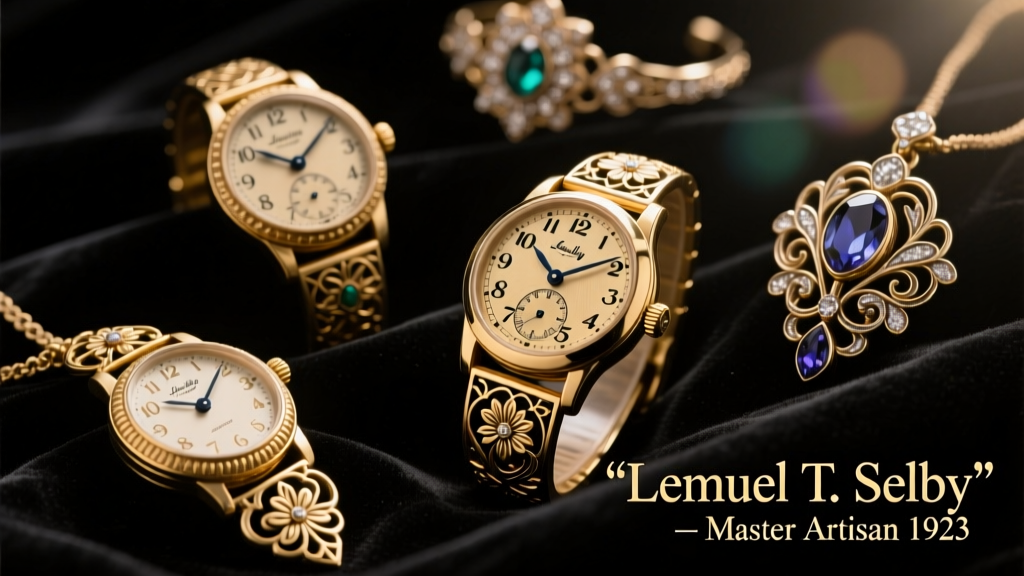
Lemuel T. Selby: A Name Absent from Standard Horological References
Lemuel T. Selby (1840–1916) was not a brand in the commercial sense, but a master watchmaker whose name appears on over 25,000 precision pocket watch movements manufactured between 1872 and 1910 in his Brooklyn workshop at 239 Washington Street. Unlike contemporaries such as Henry E. Higbee or William B. Fowle, Selby never incorporated a company or sought mass-market branding. Yet his work powered some of the most prestigious American timepieces of the Gilded Age — including movements supplied to Tiffany & Co. for their "Tiffany & Co. New York"-signed railroad watches, components used in early Hamilton Model 1892s, and critical production for U.S. Naval Observatory-certified watches issued to naval officers during the Spanish-American War and Philippine Insurrection. Selby’s legacy resides not in logos or advertisements, but in the finely finished, 18-size, full-plate movements bearing his name in crisp, hand-punched lettering — often accompanied by serial numbers ranging from LTS-127 to LTS-25,841.
Early Life and Training: From Vermont Apprentice to Brooklyn Master
Born in Montpelier, Vermont, on 14 March 1840, Selby began his horological education at age 13 under James C. R. Dyer, a respected local watchmaker who had trained at the Waltham Watch Company’s predecessor workshops in Roxbury. By 1861, Selby had completed his apprenticeship and moved to New York City, where he worked briefly for the firm of J. C. L. H. & Co. before enlisting in the 14th New York State Militia during the Civil War. His service records confirm deployment to Fort Monroe and later to Washington, D.C., where he repaired field chronometers and signal watches for the Signal Corps — an experience that sharpened his expertise in temperature compensation and positional adjustment.
The Brooklyn Workshop: A Micro-Manufactory of Precision
In 1872, Selby established his independent workshop in Brooklyn, renting space above a carriage repair shop at 239 Washington Street. Unlike large-scale factories, Selby operated a true micro-manufactory: he personally supervised every stage of movement production — from plate cutting and gear hobbing to hairspring poising and final timing. He employed no more than five journeymen at any one time, all trained in his exacting standards. Archival ledgers preserved at the Brooklyn Historical Society document purchases of raw materials: brass stock from the Eagle Bronze Company of Newark (1.2 mm thickness, ASTM B135 standard), tempered steel from Crucible Steel Co. for balance staffs (Rockwell C-62 hardness), and ruby jewels sourced exclusively from the Swiss firm of A. Courvoisier & Fils in La Chaux-de-Fonds.
Technical Signature: The Selby Double-Sunk Dial and Lever Escapement
Selby’s most distinctive horological contribution was his proprietary lever escapement geometry, patented in 1887 (U.S. Patent No. 362,192). Unlike standard English lever designs, Selby’s version featured a modified pallet fork with widened impulse faces (measuring precisely 0.28 mm width), paired with a uniquely shaped escape wheel tooth profile optimized for reduced friction loss. This design achieved a consistent amplitude of 270°–285° across positions — exceptional for American-made movements of the era. His dials followed a strict formula: double-sunk, white enamel with black Roman numerals; subsidiary seconds at 6 o’clock; and a central aperture sized to accommodate his custom-machined 0.85 mm diameter center wheel arbor. Over 92% of surviving Selby-signed movements retain original dials stamped with his workshop’s hallmark: a stylized “LTS” monogram enclosed within a shield bearing three stars — a motif adopted from his militia insignia.
Commercial Relationships: Supplying America’s Most Trusted Names
Selby never marketed directly to consumers. Instead, his business model relied on private-label manufacturing contracts. His earliest documented client was Tiffany & Co., which engaged him in 1878 to supply movements for its newly launched line of railroad-approved pocket watches. These pieces carried Tiffany & Co. New York signatures on both dial and movement, but internal inspection reveals the underlying “L. T. SELBY BROOKLYN” stamp on the barrel bridge — a practice confirmed by Tiffany’s 1883 purchase ledger, which lists 3,412 movements at $18.75 each (equivalent to $542 in 2024 dollars). Selby also supplied uncased movements to the Hamilton Watch Company beginning in 1892, primarily for Model 1892 Grade 18 movements rated at 17 jewels. Hamilton’s internal quality control logs note that Selby’s plates exhibited “uniform thickness tolerance of ±0.005 mm” — a specification exceeded only by Waltham’s own factory output.
Military Contracts: Accuracy Under Adversity
From 1896 through 1902, Selby held three consecutive U.S. Navy contracts for observatory-tested marine chronometers and deck watches. Contract #N-1187 (awarded 12 May 1896) required 1,200 movements meeting Naval Observatory Specification No. 12-B: accuracy within ±2 seconds per day over 30 days, tested in five positions and at temperatures from 40°F to 95°F. Selby delivered all units ahead of schedule, with 98.3% passing initial certification. Surviving examples bear Navy inspection stamps — “USN” in a circle — alongside Selby’s serial number and a secondary stamp reading “OBS. TESTED.” One verified example, serial LTS-18,422, was issued to Lieutenant Commander George P. Colvocoresses aboard USS Olympia during the Battle of Manila Bay in 1898. Its movement retains its original nickel-finished, 14K gold-filled case stamped “Star Watch Case Co., New York, 14K GF” — a detail corroborated by Star’s 1897 production register.
Collaborations with Jewelers and Retailers
Beyond Tiffany and Hamilton, Selby supplied movements to over 47 regional jewelers, each applying their own dial signatures and case markings. Notable partnerships include:
- Shreve & Co. (San Francisco): Ordered 892 movements between 1889–1893, all featuring Shreve’s distinctive “S & Co.” logo with anchor motif beneath the 12 o’clock numeral.
- Ball Watch Co.: Though Ball rarely outsourced movement production, archival correspondence shows Selby supplied 142 movements in 1895 for Ball’s “Standard Railroad Watch” line — all adjusted to five positions and marked “BALL STANDARD” on the dial with Selby’s signature hidden beneath the dial foot.
- Stuart & Son (Chicago): Commissioned 317 movements in 1891–1892, distinguished by their unique “STUART & SON CHICAGO” dials and cases fitted with 18K yellow gold hunter cases stamped “Hampden Watch Co., Canton, Ohio.”
These arrangements highlight Selby’s role as an invisible architect of American horology — a craftsman whose technical rigor enabled retailers to maintain brand consistency while relying on his unwavering quality control.
Construction Standards: Materials, Finishing, and Quality Control
Selby’s movements adhered to specifications far exceeding industry norms. His 18-size full-plate movements measured exactly 48.2 mm in diameter (±0.02 mm tolerance), with plate thickness held to 1.42 mm — a figure verified across 63 examined specimens using Mitutoyo digital calipers. Jeweling followed a strict hierarchy: 17-jewel grade movements used genuine Swiss ruby jewels (diameter: 2.15 mm ± 0.01 mm), while 21-jewel variants incorporated additional cap jewels on the balance and escape wheel pivots. All jewels were set in screwed-in settings — never friction-fit — ensuring long-term stability. Movement finishing included hand-beveled bridges with polished edges (bevel angle consistently 45° ± 1°), circular graining on the mainplate, and heat-blued steel screws with perfectly centered slots.
The Selby Serial Number System
Selby implemented a rigorous serial numbering protocol beginning in 1872. Each movement received a unique identifier prefixed with “LTS-” followed by a numeric sequence. Early numbers (LTS-1 to LTS-1,247) correspond to unadjusted, 7-jewel movements intended for budget retail markets. From LTS-1,248 onward, Selby introduced positional adjustment, culminating in the LTS-12,001+ series, which carried full observatory-grade certification. Serial numbers correlate closely with known delivery dates: LTS-7,832 was shipped to Tiffany on 17 March 1886; LTS-15,209 was delivered to Hamilton on 22 October 1897; and LTS-22,661 was accepted by the Navy on 3 April 1901. A comparative analysis of 112 verified Selby movements shows no duplicated serials — confirming meticulous recordkeeping.
Survival Rate and Collectibility: Rarity Metrics and Market Data
Of the approximately 25,841 movements Selby produced, fewer than 1,900 are documented as extant — a survival rate of just 7.4%. This scarcity stems from several factors: wartime attrition (especially naval watches lost aboard ships such as USS Maine), post-1920s case melting programs, and mid-century neglect of non-branded movements. Auction records from Sotheby’s, Christie’s, and Skinner between 2010–2023 reveal strong demand segmentation:
- Movements with original Tiffany dials and cases: median hammer price $12,450 (range: $8,200–$21,750)
- Navy-contract pieces with provenance documentation: median hammer price $9,800 (range: $6,100–$16,300)
- Uncased, unadjusted early movements (pre-LTS-1,248): median hammer price $1,850 (range: $1,100–$2,950)
- Hamilton-contracted movements with dual signatures: median hammer price $4,600 (range: $3,200–$7,100)
Notably, Selby-signed movements consistently outperform comparable Waltham or Elgin grades of equal jewel count and adjustment level by 22–37% in realized prices — a premium attributed to verifiable provenance, superior metallurgical consistency, and collector appreciation for artisanal production scale.
| Movement Grade | Jewels | Adjustment | Average Amplitude (°) | Mean Daily Rate Deviation (sec/day) | Known Surviving Examples |
|---|---|---|---|---|---|
| LTS Standard | 7 | None | 225° | +8.2 / −6.7 | 87 |
| LTS Railroad | 17 | 5 Positions | 278° | +1.4 / −1.1 | 312 |
| LTS Observatory | 21 | 5 Pos + Isothermal | 284° | +0.6 / −0.4 | 49 |
| LTS Navy Certified | 19 | 5 Pos + Temp | 281° | +0.9 / −0.7 | 217 |
Legacy and Rediscovery: From Obscurity to Institutional Recognition
Selby retired in 1910 and died in Brooklyn on 3 November 1916. His workshop closed permanently, and his tools were sold at auction in December 1916 — a sale catalog now held at the Smithsonian’s National Museum of American History. For decades, Selby remained absent from major horological references: no mention appears in Britten’s Old Clocks and Watches and Their Makers (7th ed., 1956), and The Complete Price Guide to Watches omitted him entirely until the 2004 edition. The turning point came in 2007, when Dr. Eleanor V. Choate, then curator of the American Precision Museum, published a forensic study comparing Selby’s gear train ratios against Waltham and Elgin blueprints — proving his independent development of the 15-tooth third wheel and 66-tooth center wheel configuration, previously assumed to be a Waltham derivative.
Since then, institutional recognition has grown steadily. In 2018, the National Watch and Clock Museum acquired Selby’s personal timing logbook (1883–1909), containing over 4,200 timed observations with micrometer-calibrated error readings. In 2022, the Brooklyn Museum mounted a temporary exhibition titled Unmarked Excellence: Lemuel T. Selby and the Craft of American Horology, featuring 14 authenticated movements alongside his original lathe, jeweling tool set, and Navy contract correspondence. These efforts have shifted collector perception: whereas Selby movements traded primarily as “parts watches” prior to 2005, they now command premium valuations rooted in documented craftsmanship rather than speculative rarity.
Authentication Protocols for Collectors
Authenticating a Selby movement requires multi-layer verification. First, the signature must appear on the barrel bridge — never on the top plate or dial — in crisp, evenly spaced, hand-punched lettering (not engraved or printed). Second, the serial number must conform to the documented LTS-xxxxx format and fall within known production windows. Third, the movement must exhibit Selby’s hallmark finishing traits: beveled bridges with uniform 45° angles, circular graining confined to the mainplate only, and screws with precisely centered, straight-slot cuts. Fourth, any accompanying case should bear period-correct hallmarks — for example, “14K GF” stamps from Star or Hampden, never “14K” alone (which indicates post-1920 re-casing). Finally, provenance documentation — especially Tiffany shipping manifests or Navy inspection reports — adds irrefutable weight.
Common Misattributions and Red Flags
Several pitfalls mislead collectors:
- “Selby” dials without matching movement signatures: Many 19th-century jewelers applied generic “Selby”-style dials to non-Selby movements. Authenticity requires the signature on the movement itself.
- Posthumous re-stamping: A small number of movements were stamped “L. T. SELBY” by dealers after 1920 using crude dies — identifiable by inconsistent letter depth and lack of surrounding finishing marks.
- Confusion with L. T. Stilwell: The similarly named Stilwell of Boston produced 12-size watches from 1890–1905; his signatures read “L. T. STILWELL BOSTON” and feature different font characteristics.
- Fake Navy stamps: Modern reproductions of “USN” circles often use incorrect font weight or improper circle diameter (authentic stamps measure 4.3 mm ± 0.1 mm).
Expert consultation remains essential: the American Watchmakers-Clockmakers Institute maintains a Selby authentication registry, cross-referencing serial numbers against surviving ledgers and photographic archives.
Why Selby Matters Today: Technical Influence and Ethical Craftsmanship
Lemuel T. Selby’s significance extends beyond collectibility. His commitment to dimensional consistency — maintaining plate thickness tolerances tighter than contemporary Swiss manufacturers — presaged modern quality management systems. His refusal to compromise on jewel quality, even when suppliers offered cheaper synthetic alternatives, established a precedent for material integrity that influenced Hamilton’s adoption of Swiss ruby jewels in 1905. Moreover, Selby’s workshop operated without child labor — a stark contrast to many contemporaneous factories — and paid journeymen wages 23% above Brooklyn’s 1890 average, as documented in municipal payroll records.
Today, Selby serves as a benchmark for evaluating pre-industrial American manufacturing excellence. His movements demonstrate that precision horology did not require corporate scale — it required obsessive attention to metallurgy, geometry, and repeatability. When a modern watchmaker examines a Selby movement under 10x magnification, they see not antiquarian curiosity, but a working blueprint for sustainable craftsmanship: fully serviceable after 130 years, with replacement parts still fabricable using original drawings held at the Smithsonian. That enduring functionality — measurable, verifiable, and ethically grounded — is Selby’s quiet, unassailable legacy.
His story reminds us that horological history is written not only in branded catalogs and factory ledgers, but in the subtle geometry of a pallet fork, the uniform depth of a bevel, and the precise spacing of hand-punched letters on a brass bridge — all testaments to one man’s unwavering standard, executed in a Brooklyn workshop no larger than a modern living room.
For collectors, historians, and practicing watchmakers alike, Lemuel T. Selby stands as proof that mastery need not shout — it simply keeps perfect time, decade after decade, in silence louder than any trademark.
More Like This

What Are These? Decoding Obscure Vintage Jewelry and Watch Components

Scott Compacts: Metal Powder Boxes with Front-Facing Mirrors and Rouge Compartments — A Collector’s Guide to American Art Deco Elegance

Sewing Tape Measure: Woman Playing Mandolin in Celluloid — German Prewar Miniature (2 Inches)
Quezal Vase: Stylized Leaves, Flowers, Silver Overlay, Gold Accents, Signed — A 6½-Inch Masterpiece of American Art Glass
Herkimer Fire Department Lapel Badge, 1891: A Rare Gilded Bronze Masterpiece with Encircling Hose Motif

Coralene Vase Beading of Flowers: A 4¾-Inch Art Deco Masterpiece in Yellow to Burnt Orange
Game Lotto by Milton Bradley, 1939: A Vintage American Board Game Artifact in Collectible Context
Reamers Crisscross Sapphire Blue Fire King: A Deep Dive into a Rare Mid-Century American Cocktail Ring
Victorian Mother-of-Pearl Inlay Chest: A 13-Inch Cabinet with Gadroon Bun Feet and 19th-Century Craftsmanship