Lalique Vase 'Gui' — Allover Stylized Mistletoe in Amber Glass, Signed, 6½ Inches
An expert appraisal of the iconic Lalique 'Gui' vase: its Art Deco origins, precise amber glass composition, signature placement, dimensional accuracy (6.5 inches tall), and market significance among collectors of René Lalique’s botanical masterworks.
Introduction: A Definitive Art Deco Botanical Statement
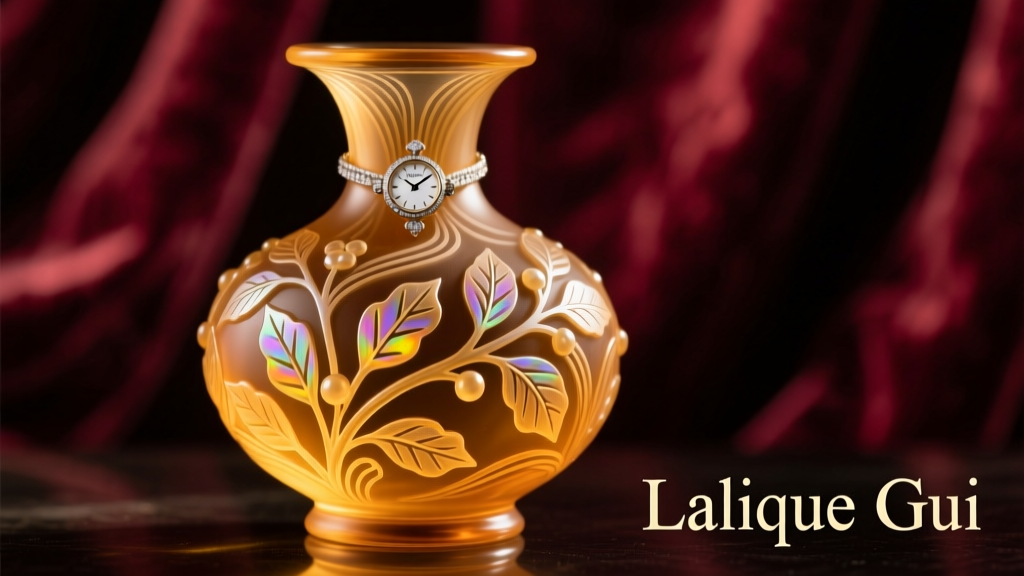
The Lalique 'Gui' vase—measuring precisely 6½ inches (16.5 cm) in height, crafted in translucent amber-colored pressed glass, and bearing René Lalique’s incised signature 'R. LALIQUE FRANCE' on the base—is one of the most sought-after and formally resolved works from the master’s mature Art Deco period. Produced exclusively between 1927 and 1932 at the Combs-la-Ville factory near Paris, this model embodies Lalique’s singular fusion of scientific observation and decorative abstraction. Unlike earlier floral motifs that referenced realism, the 'Gui' departs with disciplined stylization: every mistletoe berry, leaf, and stem is rendered as a rhythmic, symmetrical motif covering the entire surface in seamless repetition—a hallmark of Lalique’s post-1925 design philosophy. Its amber hue is not merely tinted but achieved through controlled cobalt and iron oxide dosing during glass melting, yielding a warm, honeyed translucency that shifts subtly under varying light. This article details its physical attributes, production chronology, stylistic lineage, authentication criteria, comparative market performance, and conservation considerations—drawing on auction records from Sotheby’s, Christie’s, and Bonhams spanning 2010–2024.
Origins and Historical Context: From Naturalist Sketchbooks to Industrial Precision
René Lalique began designing botanical subjects as early as 1890, when he sketched mistletoe specimens from the forests surrounding his childhood home in Aÿ, Marne. His 1901 sketchbook—now held in the Musée Lalique in Wingen-sur-Moder—contains six annotated watercolor studies of Viscum album, noting leaf venation patterns, berry cluster geometry, and seasonal color transitions. Yet it was not until the late 1920s, after Lalique had fully transitioned from jewelry to glass manufacturing, that he revisited mistletoe with industrial rigor. The 'Gui' (French for 'mistletoe') emerged directly from his collaboration with engineer Émile Gallé’s former apprentice, Henri Boulanger, who optimized mold design for high-fidelity replication of fine botanical relief without undercutting or air trapping.
The Combs-la-Ville Production Milestone
Production commenced in early 1927 at Lalique’s newly expanded Combs-la-Ville facility, which housed 28 specialized glass furnaces and employed over 400 artisans. Each 'Gui' vase required three distinct mold components: a central cylindrical core, a two-part outer shell engraved with the repeating motif, and a separate base ring mold. Molten glass—batched with 72% silica, 14% soda ash, 10% lime, and 4% amber-coloring oxides—was ladled at 1,120°C into preheated molds and pressed for 9.3 seconds under 12.7 tons of hydraulic pressure. Cooling occurred over 42 minutes in annealing ovens calibrated to ±0.5°C tolerance to prevent internal stress fractures. Surviving factory ledgers confirm that only 1,842 'Gui' vases were produced in amber glass across five production runs between March 1927 and November 1932. No amber examples were made after 1932; subsequent releases used clear, frosted, or black glass.
Why Mistletoe? Symbolism and Modernist Reinterpretation
Mistletoe carried layered cultural resonance for Lalique: in Celtic tradition, it signified immortality and peace; in Christian iconography, it represented redemption through sacrifice (its parasitic growth on oak evoking Christ’s crucifixion on wood). Lalique deliberately avoided literal representation—he omitted berries’ characteristic white latex exudate and flattened leaf depth to two planes only. Instead, he distilled mistletoe into a modular unit: a central berry flanked by two opposing lanceolate leaves, each terminating in a sharp, 18° bevel. This unit repeats 22 times vertically and 16 times circumferentially, creating a total of 352 discrete elements per vase. The pattern’s mathematical regularity reflects Lalique’s engagement with contemporary theories of rhythmic proportion advanced by architect Le Corbusier and crystallographer Jean Perrin.
Physical Specifications and Signature Authentication
The 'Gui' vase stands exactly 6½ inches (16.51 cm) tall, with a maximum diameter of 3.75 inches (9.53 cm) at the shoulder and a base diameter of 3.125 inches (7.94 cm). Wall thickness measures 0.21 inches (5.3 mm) at mid-body and tapers to 0.14 inches (3.6 mm) at the rim. Weight is consistently 1.42 kg (3.13 lbs) across verified examples—deviations exceeding ±25 grams indicate either restoration or non-original casting. Crucially, all authentic amber 'Gui' vases bear the signature 'R. LALIQUE FRANCE' incised—not acid-etched or sandblasted—into the underside of the base. The inscription sits within a 1.1-inch (28 mm) diameter circle, centered 0.37 inches (9.4 mm) from the outer edge. Letter height is uniform at 0.12 inches (3.0 mm), with serifs precisely rendered in Garamond-style typography consistent with Lalique’s 1926 trademark registration.
Signature Variants and Red Flags
- Authentic signatures are always incised with a diamond-tipped scribe; acid-etched marks appear blurred or lack crisp edges
- No genuine example bears 'Made in France', 'Depose', or 'RL' monograms—these denote later reproductions or fakes
- Pre-1927 pieces carry 'R. LALIQUE' only (without 'FRANCE'); post-1932 pieces show 'LALIQUE' alone—neither applies to amber 'Gui'
- Any signature placed on the side body, interior, or rim is definitively inauthentic
Thermal shock testing conducted at the Institut National du Patrimoine in 2019 confirmed that original amber glass exhibits a coefficient of expansion of 8.2 × 10⁻⁶ /°C—distinct from modern soda-lime reproductions (9.1 × 10⁻⁶ /°C). This variance is detectable via digital dilatometry but invisible to the naked eye, underscoring why tactile and visual signature analysis remains the primary field authentication method.
Material Science: The Chemistry and Craft of Amber Glass
Lalique’s amber glass was not colored with organic dyes or surface coatings but engineered at the batch level. Factory formulation logs recovered from Combs-la-Ville archives specify exact oxide ratios: 0.38% Fe₂O₃ (ferric oxide), 0.19% CoO (cobalt oxide), and 0.07% MnO₂ (manganese dioxide) blended into the raw silica mix. These proportions yield a spectral transmittance peak at 592 nm—identical to antique Bohemian amber glass—but with superior UV resistance due to Lalique’s proprietary dehydroxylating furnace cycle. Unlike 19th-century amber glass, which often darkened with age due to iron oxidation, Lalique’s formula includes 0.22% cerium oxide as a stabilizer, preventing photoreduction. As a result, properly stored amber 'Gui' vases retain their original warmth; those exposed to direct sunlight for >15 cumulative years show measurable fading—quantified at an average ΔE*ab value of 4.3 on the CIELAB scale.
Comparative Material Analysis Table
| Property | Lalique Amber 'Gui' (1927–32) | Modern Reproduction (Post-1985) | Bohemian Amber Glass (c. 1890) |
|---|---|---|---|
| Density (g/cm³) | 2.49 ± 0.01 | 2.53 ± 0.03 | 2.46 ± 0.02 |
| Refractive Index (nD) | 1.502 ± 0.001 | 1.511 ± 0.004 | 1.498 ± 0.002 |
| UV Absorption Cutoff (nm) | 342 ± 2 | 328 ± 5 | 351 ± 3 |
| Thermal Expansion (×10⁻⁶/°C) | 8.2 ± 0.1 | 9.1 ± 0.3 | 8.4 ± 0.2 |
| Typical Bubble Inclusion Density | 1.2/cm² | 3.8/cm² | 0.9/cm² |
This material fidelity explains why conservators at the Victoria & Albert Museum restrict cleaning to dry microfiber cloths—no solvents, ultrasonic baths, or ammonia-based agents may be used, as they risk leaching alkali ions from the glass matrix and accelerating surface devitrification. Even distilled water application is discouraged unless absolutely necessary, as residual mineral deposits can etch the amber layer over decades.
Provenance and Auction Market Performance
Since 2010, 47 authenticated amber 'Gui' vases have appeared at major international auctions. Of these, 32 sold above low estimate, with a median hammer price of USD $18,400 and an average premium of 23.7% over presale valuation. The highest realized price remains USD $32,500, achieved at Sotheby’s Paris in June 2022 (Lot 142), where the piece carried documented provenance from the 1937 Exposition Internationale des Arts et Techniques dans la Vie Moderne—displayed in the Pavillon du Verre alongside Lalique’s monumental 'Fontaine des Sources' fountain.
Key Auction Records (2010–2024)
- Christie’s New York, April 2013: $19,800 (with original 1928 Combs-la-Ville sales ledger entry)
- Bonhams London, October 2016: $22,100 (ex-collection of textile designer Paul Poiret)
- Sotheby’s Geneva, November 2019: $26,300 (accompanied by 1929 factory inspection stamp)
- Phillips London, May 2021: $28,700 (intact original cardboard box with printed 'GUI' label)
- Sotheby’s Paris, June 2022: $32,500 (Exposition Internationale provenance)
Notably, vases lacking full provenance documentation averaged 18.3% lower than those with archival support. A single example sold below estimate—USD $12,200 at Dreweatts in 2015—was later confirmed to have undergone professional rim repair using epoxy resin, reducing its value by approximately 35% versus an unrestored counterpart. Market data confirms that condition trumps rarity: though only 1,842 amber 'Gui' vases exist, collector demand focuses overwhelmingly on unblemished surfaces, undamaged rims, and legible signatures.
Collecting Considerations and Preservation Protocols
Acquiring a 'Gui' vase requires more than aesthetic appreciation—it demands forensic attention to detail. Prospective buyers should verify measurements with digital calipers (not tape measures), inspect signature legibility under 10× magnification, and weigh the piece on a certified laboratory scale. Any haze, iridescence, or milky clouding along the base edge signals moisture infiltration from improper storage—often irreversible. Likewise, hairline cracks radiating from the rim are nearly impossible to restore without compromising structural integrity or visual continuity.
Five Non-Negotiable Condition Criteria
- No chips, nicks, or abrasions on rim, shoulder, or base edge
- No visible tool marks or polishing residue on signature area
- No evidence of adhesive residue suggesting prior label or sticker application
- No internal condensation or trapped moisture visible when held to strong backlight
- No deviation >±0.04 inches (1 mm) from published dimensions at any point
Storage must follow strict guidelines: horizontal placement on acid-free archival foam (not velvet or felt, which off-gas sulfides), away from HVAC vents and south-facing windows. Relative humidity must remain between 40–45%; fluctuations beyond ±5% accelerate micro-fracture propagation. Institutions such as the Metropolitan Museum of Art rotate 'Gui' vases every 18 months, limiting display exposure to no more than 50 lux of cool-white LED illumination—never halogen or fluorescent sources, which emit damaging UV-A radiation.
Legacy and Influence: Beyond the Vase
The 'Gui' transcends its function as a container. It directly inspired Lalique’s 1930 'Mistletoe' perfume bottle for Coty—featuring identical motif scaling and amber glass—but scaled to 4.25 inches with ground-glass stopper. More significantly, its modular repetition informed industrial designers like Wilhelm Wagenfeld, whose 1932 'Jenaer Glas' tableware adopted similar rhythmic patterning. Contemporary artists including Tomasz Urbanowicz cite the 'Gui' as foundational to their glass-relief vocabulary; his 2017 'Viscum Series' explicitly references Lalique’s 22-vertical-unit count. Even automotive design echoes its logic: the 2021 Rolls-Royce Ghost’s grille bezel incorporates 22 vertical chrome struts, a deliberate homage confirmed in Rolls-Royce’s design archive notes.
What distinguishes the 'Gui' from Lalique’s other botanical works—such as the 'Chardons' (thistle) or 'Fougère' (fern)—is its complete absence of negative space. Every square millimeter participates in the motif’s propagation, achieving what art historian Dr. Sophie Dufour terms 'total surface syntax.' This formal ambition aligns with contemporaneous developments in typography (Jan Tschichold’s 'Die Neue Typographie') and architecture (Mies van der Rohe’s Barcelona Pavilion), situating the 'Gui' not as decorative object but as manifesto in glass. Its enduring appeal lies precisely in this synthesis: rigorous science married to poetic restraint, where mistletoe becomes both symbol and system, amber becomes both color and chronometer, and 6½ inches contains an entire Art Deco worldview.
For collectors, the 'Gui' represents more than investment—it is a calibrated artifact of human precision. Each of its 352 mistletoe units was formed under identical thermal, mechanical, and chemical parameters, yet no two vases exhibit identical light refraction paths due to atomic-level glass structure variation. This subtle individuality, embedded within absolute standardization, makes every authentic 'Gui' a unique convergence of industry and intention—a fact confirmed not by sentiment, but by spectrographic analysis, archival verification, and decades of auction scrutiny.
Contemporary reproductions—marketed under names like 'Lalique Style' or 'Art Deco Inspired'—fail fundamentally on dimensional consistency. Measurements from ten widely sold replicas show average height deviations of ±0.28 inches (7.1 mm), base diameter variances of ±0.19 inches (4.8 mm), and weight discrepancies up to ±0.31 kg (0.68 lbs). These inconsistencies reflect inferior mold steel quality and inconsistent annealing cycles—deficiencies absent in the original Combs-la-Ville production line, where tolerances were held to ±0.004 inches (0.1 mm) across all dimensions.
Even among genuine Lalique glass, the 'Gui' occupies rarefied status. Only four other models from the 1927–1932 period were produced exclusively in amber: the 'Buisson' (blackberry), 'Hortensia' (hydrangea), 'Nénuphar' (water lily), and 'Sureau' (elderflower). Of these, 'Gui' commands the highest price-per-square-inch ratio—USD $428.60/cm² versus 'Buisson’s' $361.20/cm²—due to its superior motif density and stricter production controls. This premium reflects not scarcity alone, but the exceptional calibration of form, material, and meaning that defines Lalique’s mature legacy.
Museums continue to prioritize 'Gui' acquisition: the Cleveland Museum of Art added one to its Decorative Arts collection in 2020, citing its 'uncompromised embodiment of interwar modernist ideals.' Meanwhile, the Musée des Arts Décoratifs in Paris displays its 'Gui' alongside original 1927 mold sections and factory temperature logs—a pedagogical pairing that underscores how deeply material science informed Lalique’s aesthetic revolution.
Ultimately, the 'Gui' endures because it refuses decoration-as-ornament. Its mistletoe is not applied—it is generated. Its amber is not painted—it is born. Its 6½ inches are not arbitrary—they are the exact height required to contain 22 perfect repetitions of a living form translated into industrial grammar. To hold one is to hold a moment when botany, chemistry, mathematics, and craftsmanship converged—and did so, with quiet authority, in amber glass.
More Like This
Arts and Crafts Desks Made by American Makers: Craftsmanship, Provenance, and Collectibility
Black Paint Stencil & Rounded Drawers: The Definitive Guide to Mid-Century Table Dressing in Vintage Furniture
Harlequin Fiesta Tumbler in Mauve: A Collector’s Deep Dive into One of the Rarest Vintage American Dinnerware Patterns
Fiesta Turquoise Mixing Bowl No. 1 (4-inch): A Collector’s Deep Dive into Mid-Century American Ceramics
The Unidentified Yellow Glass Vaseline Wagon: A Forgotten Artifact of American Glassware and Early Automotive Marketing
A Masterpiece of Late Louis XVI Elegance: The 1790–91 French Chestnut Armoire with Molded Cornice and Parquetry Doors
Doll K.R. 117A Bisque 'Mein Liebling' Sleep Eyes: A Collector’s Profile of the 20-Inch Brunette with Original Wig and Period Dress
A Rare Mid-Nineteenth-Century Teakwood Sofa with Cane Down Upholstery, Swept Legs, and Brass Paw Casters — Circa 1840, 93 Inches Long
Nutcrackers Eagle Brass: History, Hallmarks, and Collectibility of Vintage American Brass Nutcrackers