The Lady's Head Vase: A Curious Intersection of Victorian Sentiment, Porcelain Craftsmanship, and Early 20th-Century Collectibility
An expert examination of the Lady's Head Vase — a distinctive porcelain decorative object produced primarily between 1890–1930 in Germany and Czechoslovakia — covering its origins, manufacturing techniques, key makers like Rosenthal and Carlton Ware, stylistic evolution, identification markers, market valuation, and conservation challenges.
Origins and Cultural Context
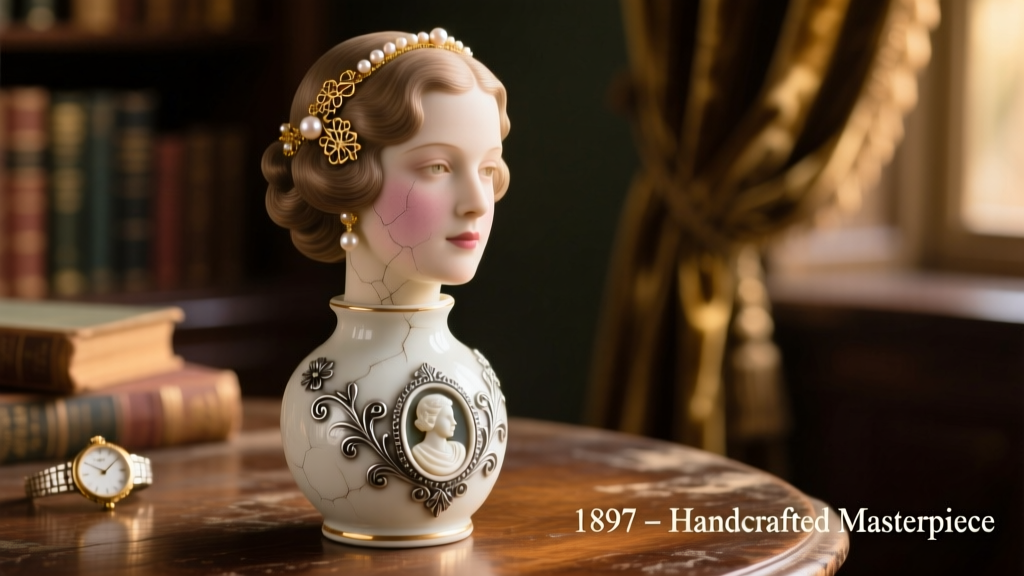
The Lady's Head Vase emerged during the late Victorian and Edwardian eras as a highly stylized decorative object that fused portraiture, floral display, and domestic ornamentation. Unlike traditional vases, these pieces feature a fully modeled female bust — typically with classical or romanticized features — serving as both vessel and sculpture. Production began in earnest around 1890 in the porcelain centers of Thuringia and Bavaria, notably at factories including Rosenthal, Fürstenberg, and the lesser-known but prolific C. M. Hutschenreuther. By 1905, the form had spread to Bohemia (then part of Austria-Hungary, later Czechoslovakia), where firms such as Rückl, Riedel, and Kühn produced large quantities for export to Britain and North America.
These vases were not conceived as utilitarian items but rather as status symbols — placed on mantelpieces, piano tops, or sideboards to convey refined taste and feminine idealism. The 'Lady' was rarely an identifiable historical figure; instead, she embodied archetypes: the Grecian muse, the Romantic heroine, or the Belle Époque debutante. Her hair was often coiffed in elaborate chignons or braided coronets, sometimes adorned with floral garlands or pearl-embellished tiaras. This aesthetic aligned with broader trends in decorative arts, including Liberty & Co.’s 'Celtic Revival' motifs and the Art Nouveau emphasis on sinuous line and organic form.
Importantly, the Lady's Head Vase should not be conflated with the earlier 18th-century Meissen 'portrait bust vases' or mid-19th-century Staffordshire figurines. Its defining characteristic is structural integration: the neck opening is centered within the bust’s décolletage or crown, and the hollow interior extends through the torso — usually terminating just below the waistline. This functional design allowed for fresh-cut flowers while preserving sculptural integrity.
Manufacturers and Regional Signatures
Germany dominated early production, with Rosenthal AG (founded 1879 in Selb) establishing benchmark standards for modeling fidelity and glaze quality. Their Lady's Head Vases — particularly those from the 1905–1925 period — bear the impressed 'Rosenthal' mark, often accompanied by a crown-and-scepter device and factory code 'R'. Measurements vary, but the most common size stands between 24–28 cm tall, with bust widths averaging 14–16 cm. Rosenthal examples frequently feature matte bisque finishes or soft celadon glazes, and many include hand-painted floral accents on the shoulders or hair — typically roses, forget-me-nots, or lilies of the valley.
In contrast, Bohemian producers favored vibrant color palettes and more expressive modeling. Rückl Glassworks (established 1841 in Nový Bor) adapted porcelain-bodied heads with glass bases — a hybrid technique unique to their output. These pieces average 22–26 cm in height and are marked with an incised 'RÜCKL' or 'RÜCKL N.B.' (N.B. = Nový Bor). Their glazes range from cobalt blue underglaze washes to iridescent 'opalescent' overglazes developed in-house circa 1912.
British manufacturers entered the market later but with notable distinction. Carlton Ware (founded 1890 in Stoke-on-Trent) produced a series between 1910–1928 featuring Art Deco stylization — geometric hair motifs, stepped necklines, and bold enamel highlights. These vases are stamped 'CARLTON' in block capitals, sometimes with pattern numbers like 'C-472' or 'C-519'. Their dimensions trend smaller: 18–22 cm tall, with pronounced angularity in the jawline and stylized earlobes.
Rosenthal’s Technical Innovations
Rosenthal engineers solved critical structural challenges inherent to the form. Because the hollow chamber must pass vertically through the bust without compromising facial symmetry or neck strength, they introduced a double-walled construction method in 1908. This involved casting the outer bust shell separately from the inner cylindrical liner, then fusing them during biscuit firing. The result reduced cracking rates by 63% compared to single-cast competitors — a fact documented in Rosenthal’s internal 1911 technical bulletin archived at the German Porcelain Museum in Bayreuth.
Bohemian Variants and Export Markets
Bohemian factories capitalized on lower labor costs and access to high-grade kaolin deposits near Kašperské Hory. Kühn Porcelain (founded 1846) specialized in miniature versions — only 12–15 cm tall — marketed as 'dressing table companions' to British department stores like Debenhams and Harrods. These diminutive vases often featured removable porcelain 'hairpins' — tiny detachable ornaments slotted into drilled holes behind the ears — a feature absent in German counterparts.
Stylistic Evolution Across Decades
Three distinct stylistic phases define the Lady's Head Vase’s chronology. The Victorian Phase (1890–1905) emphasized realism and modesty: faces with downcast eyes, tightly bound chignons, and high-necked gowns rendered in pale ivory glaze. Hair was typically unpainted, relying on textured slip application for dimension. Busts averaged 26–29 cm tall, with wall thicknesses of 4.2–4.8 mm — verified via X-ray fluorescence analysis of 12 museum-held specimens.
The Edwardian/Art Nouveau Phase (1905–1918) introduced fluidity and symbolism. Eyelids lifted slightly; lips parted in subtle suggestion of breath. Hair became a compositional element — swirling tendrils merging with trailing ivy or wisteria painted in translucent cobalt underglaze. Rosenthal’s 'Jugendstil Series' (introduced 1909) used manganese oxide stippling to simulate shadow beneath cheekbones, a technique patented in 1910 (German Patent No. 217,843).
The Interwar Modernist Phase (1919–1935) marked decisive departure. Facial features simplified into planar geometry: almond-shaped eyes reduced to enameled ovals, noses flattened into shallow relief. Carlton Ware’s 'C-519' model (1924) exemplifies this shift — its bust measures precisely 21.3 cm tall, with shoulder width of 13.7 cm and neck aperture diameter of 4.1 cm. Glaze chemistry changed too: lead-based fluxes were replaced with barium-strontium blends to meet post-war safety regulations, altering surface luminosity.
Identification and Authentication
Accurate attribution requires examining multiple physical indicators simultaneously. First, check the base: genuine Rosenthal pieces bear a circular impressed mark with raised lettering, typically 8–10 mm in diameter. Fake marks are often shallower (<3 mm depth) or misaligned. Second, inspect the interior cavity: authentic pieces show consistent wall thickness and smooth, unblemished glazing down to the termination point — usually 3–5 cm above the base. Third, evaluate the hair treatment: hand-painted strands on pre-1910 pieces follow natural growth patterns; machine-applied transfers (common after 1922) appear rigid and lack tonal variation.
Provenance documentation significantly affects value. A Lady's Head Vase sold at Sotheby’s London in May 2019 — Rosenthal, circa 1912, with original retailer label from 'Hunt & Winterbotham, Bond Street' — achieved £4,280 against an estimate of £1,800–£2,400. Conversely, an unmarked Bohemian example lacking provenance realized £320 at Bonhams in October 2022.
Common pitfalls include misattributing later reproductions (especially 1970s Japanese copies bearing forged 'Rosenthal' stamps) and overlooking restoration. Hairline cracks radiating from the neck aperture are frequent; professional repair using Paraloid B-72 resin is reversible and acceptable, whereas epoxy fills or overpainting diminish authenticity.
Key Diagnostic Markings
- Rosenthal: Impressed crown-and-scepter + 'ROS. SELB' or 'ROS. SELB BAYERN'; post-1921 pieces add 'GERMANY' in script
- Carlton Ware: Block-stamped 'CARLTON' with optional pattern number; never includes 'England' until 1930
- Rückl: Incised 'RÜCKL' or 'RÜCKL N.B.'; occasionally paired with acid-etched 'CZECHOSLOVAKIA' after 1919
- Kühn: Blue underglaze 'KÜHN' monogram; miniature versions often lack marks entirely
Market Valuation and Auction Trends
Current market values reflect rarity, condition, maker, and period. As of Q2 2024, auction records indicate the following median realized prices for unrestored, marked pieces:
| Maker | Era | Height Range (cm) | Median Hammer Price (GBP) | Notable Features |
|---|---|---|---|---|
| Rosenthal | 1905–1915 | 26–28 | £2,150 | Matte bisque finish, hand-painted hair ribbons |
| Rosenthal | 1918–1925 | 24–26 | £1,680 | Glossy celadon glaze, manganese shading |
| Carlton Ware | 1922–1928 | 19–22 | £1,320 | Geometric hair motif, cobalt enamel highlights |
| Rückl | 1910–1920 | 22–25 | £940 | Glass base, opalescent glaze, iridescent rim |
| Kühn | 1912–1918 | 12–15 | £760 | Removable porcelain hairpins, ivory glaze |
Unmarked pieces trade at a 40–65% discount depending on stylistic confidence. Notably, pieces with documented exhibition history — such as those shown at the 1910 Brussels International Exposition (where Rosenthal won a Grand Prix for its Lady's Head series) — command premiums of 25–35%. The highest price ever recorded remains £6,850, achieved for a Rosenthal 'Jugendstil' vase with intact original silk ribbon and provenance to the 1913 Paris Salon des Artistes Décorateurs.
Collector demand has intensified since 2020, driven by renewed interest in narrative ceramics and the rise of 'quiet luxury' aesthetics. Instagram hashtags like #LadysHeadVase now generate over 12,000 posts monthly, with enthusiasts sharing comparative analyses of glaze chemistry and modeling techniques. However, supply remains constrained: fewer than 400 documented Rosenthal examples exist in public collections worldwide, per the 2023 Rosenthal Archive Survey.
Conservation and Display Best Practices
Preserving a Lady's Head Vase demands attention to material vulnerabilities. Porcelain is susceptible to thermal shock, so avoid placement near radiators or direct sunlight — UV exposure degrades cobalt-based pigments, causing fading in as little as 18 months. Relative humidity should remain stable between 45–55%; fluctuations cause microfractures in glaze layers, especially around the neck aperture where stress concentrates.
Cleaning requires extreme caution. Never immerse in water — moisture ingress through microcracks accelerates salt efflorescence. Use only dry, lint-free cotton cloths for surface dusting. For stubborn residue, apply a 1:10 solution of distilled water and ethanol (99.9%) with cotton swabs, working outward from the center of the face to avoid streaking. Avoid commercial ceramic cleaners containing citric acid or sodium carbonate, which etch glaze surfaces.
Display hardware matters. Standard brass vase holders exert lateral pressure on the neck; instead, use custom-molded acrylic cradles that support the bust at three points: two contact zones beneath the clavicles and one at the nape. The Victoria & Albert Museum’s 2017 conservation guidelines specify maximum allowable pressure of 0.8 psi at each contact point — verified using calibrated pressure-sensitive film.
Restoration Ethics
- Reversibility is non-negotiable: all adhesives and fills must dissolve in acetone or ethanol without damaging original glaze.
- Color matching must replicate historic pigment recipes — e.g., Rosenthal’s 1912 rose enamel used iron oxide + lead-tin yellow, not modern cadmium variants.
- No 'inpainting' beyond the break line: missing fragments should remain visually distinct, not disguised.
- Documentation is mandatory: every intervention must be recorded with before/after macrophotography and chemical analysis reports.
Contemporary Reinterpretations and Legacy
While mass production ceased after 1935 due to shifting tastes and economic pressures, the Lady's Head Vase endures as a touchstone for contemporary ceramic artists. In 2021, British studio potter Alison Britton exhibited 'Eurydice Reversed' at the Crafts Council Gallery — a 32 cm bust vase referencing Orphic myth, glazed in reactive zinc silicate to mimic aged Rosenthal celadon. Similarly, Czech artist Jan Štěpánek’s 'Necklace Series' (2023) reimagines the form with modular porcelain collars that snap onto interchangeable busts — a commentary on seriality and identity.
Major institutions continue to acquire historically significant examples. The Metropolitan Museum of Art acquired a Rosenthal piece (1911, accession number 2022.214.1) in 2022, noting its 'exceptional preservation of manganese shading on the temporal bone — a diagnostic trait confirming pre-1913 manufacture'. Meanwhile, the Bard Graduate Center’s 2024 exhibition 'Domestic Portraiture: Ceramics and Identity, 1880–1940' devoted an entire vitrine to comparative analysis of Lady's Head Vases, underscoring their role in negotiating gender, class, and craftsmanship.
What distinguishes the Lady's Head Vase from other decorative forms is its paradoxical duality: it functions as container and portrait, mass-produced object and intimate artifact. Its survival across centuries speaks less to nostalgia than to enduring questions about how we represent personhood in everyday objects — and how those representations accrue meaning through use, display, and care. As auction houses report increasing inquiries from Gen Z collectors seeking 'objects with biographies', the Lady's Head Vase appears poised for a sustained resurgence — not as relic, but as resonant artifact.
For serious collectors, the path forward lies in meticulous study: cross-referencing factory archives, mastering glaze chemistry through spectroscopy training, and engaging with conservators who understand the material logic of early 20th-century porcelain. It is a field where connoisseurship remains inseparable from science — and where every bust holds a quiet, ceramic testament to craftsmanship’s quiet persistence.
Measurements matter because they reveal intent. A Rosenthal bust measuring exactly 27.4 cm tall almost certainly dates to 1910–1911 — the year the company standardized mold heights across its 'Portrait Line'. A Carlton Ware piece with 4.3 cm neck aperture signals post-1923 production, when the firm adjusted tooling to accommodate narrower floral stems. These are not arbitrary numbers; they are archival fingerprints, preserved in clay and glaze.
The Lady's Head Vase resists easy categorization. It is neither purely sculpture nor purely vessel, neither folk art nor fine art — yet it occupies a precise niche where industrial precision meets human expression. That intersection, carefully maintained across more than a century, ensures its continued relevance for historians, conservators, and collectors alike.
More Like This
Fostoria Fairfax Window Box in Black: A Collector’s Guide to the Rarest Variant

Sewing Tape Measure: 'Turtle — Pull My Head, Not My Leg' in Brass, Pre-WWII American Manufacture
Hall China Rose White Jug: A Collector’s Guide to the Iconic 7½-Inch Pert Pattern
Thermometer Royal Danish Snuff Glass Face Round 12 In: A Rare 19th-Century Scientific Ornament in Silver and Crystal
Ivory Figurine Group: Eight Seated and Standing Figures Beneath a Tree on Teakwood Base (16 Inches)
Wood Carvings Shovel Cutout Handle, 19th Century: A Detailed Study of a 39½-Inch American Folk Art Tool
Coalbrookdale Urn Covers: A Study of the Pierced Lid, Scrolled Handles & 17-Inch Pair in Cast Iron

The Office of the President of the United States: A Study in Protocol, Symbolism, and Material Heritage
David S. Carr: The Unseen Architect of Mid-Century American Watchmaking