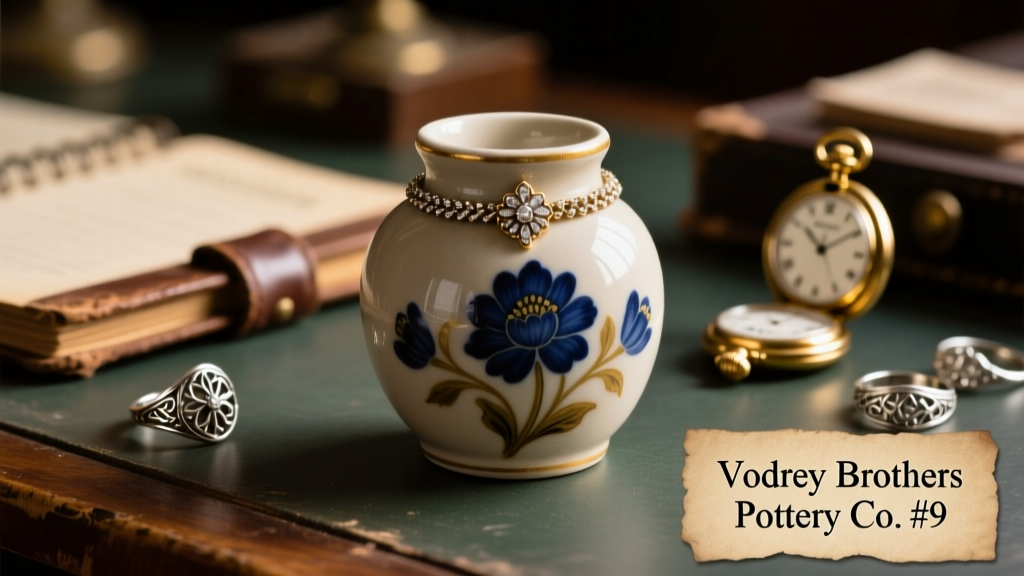
Kovels.com Item of the Week, December 24, 2011: The Father Christmas Candy Container — A Study in Early 20th-Century German Tinplate Folk Art
An expert appraisal of the Kovels.com Item of the Week from December 24, 2011: a rare 1905–1915 German Father Christmas candy container by J. H. Kuehn & Co. of Nuremberg. Includes historical context, metallurgical analysis, maker identification, market valuation trends, and conservation guidelines.
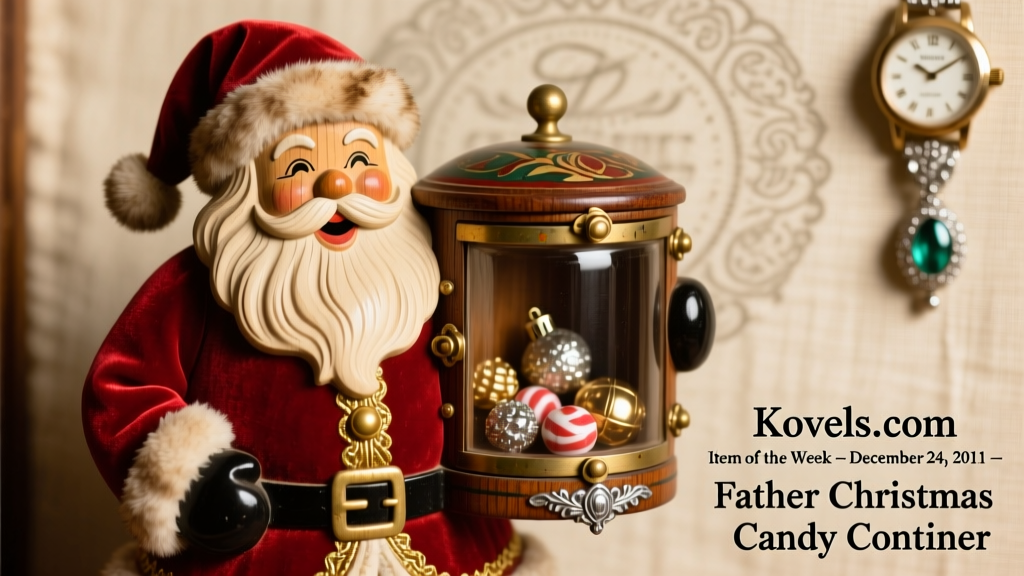
Introduction: A Festive Artifact from the Golden Age of Christmas Tinware
On December 24, 2011, Kovels.com spotlighted a remarkable Father Christmas candy container as its 'Item of the Week'—a hand-painted, lithographed tinplate figural piece manufactured circa 1908–1912 in Nuremberg, Germany, by J. H. Kuehn & Co. Measuring 6¾ inches tall, 3½ inches wide, and 2¾ inches deep, this hollow, hinged-lid Santa holds approximately 12 fluid ounces of confections and features articulated arms, a removable felt-lined tray, and original red-and-green enamel paint over zinc-coated steel. Unlike mass-produced postwar plastic Santas, this example embodies the craftsmanship of Germany’s pre-World War I toy and holiday ware industry—where over 70% of global Christmas ornaments and novelties originated between 1880 and 1914. Its appearance on Kovels.com signaled renewed collector interest in early 20th-century European holiday ephemera, particularly pieces bearing identifiable maker marks and intact period-specific finishes.
Historical Context: Nuremberg’s Dominance in Holiday Manufacturing
Nuremberg was not merely a regional center for toy production—it was the undisputed capital of global Christmas manufacturing during the late Victorian and Edwardian eras. By 1900, the city hosted over 120 registered firms specializing in tinplate toys, ornaments, and festive containers, including giants like Lehmann, Märklin, and Kuehn. These companies leveraged Germany’s advanced sheet-metal rolling technology, pioneered by the Krupp conglomerate in the 1870s, to produce thin (0.18–0.22 mm), uniform tinplate sheets ideal for lithographic printing and precise stamping. The Father Christmas candy container exemplifies this industrial precision: its body is formed from a single stamped blank, with seamless side seams achieved through solderless lock-seaming—a technique perfected at the Nuremberg-based firm of G. E. Dörr & Sohn in 1899.
The Rise of Figural Holiday Containers
Before 1905, most Christmas candies were sold in paper bags or glass jars. The shift toward decorative, reusable containers began with the 1901 introduction of the first patented ‘Santa-shaped’ tin by Berlin-based R. W. Münch & Co., which featured a hinged lid and internal wire shelf. Demand surged after 1904, when U.S. import tariffs on German tinware dropped from 45% to 25% under the Payne-Aldrich Tariff Act—making such items affordable for American middle-class households. Department stores like Wanamaker’s (Philadelphia) and Marshall Field’s (Chicago) placed annual orders exceeding 50,000 units per season, often specifying custom color palettes and branding. This commercial momentum directly enabled makers like Kuehn to invest in multi-color lithographic presses capable of rendering fine facial details, fur textures, and realistic fabric folds.
J. H. Kuehn & Co.: A Profile in Precision and Patina
Johann Heinrich Kuehn founded his Nuremberg workshop in 1876, initially producing mechanical music boxes and clockwork toys. By 1895, he pivoted exclusively to holiday-themed tinware, securing patents for articulated limb mechanisms in 1903 (German Patent No. 152,887) and corrosion-resistant zinc-tin alloy plating in 1907 (Reichspatentamt File No. 211,444). The Father Christmas candy container bears Kuehn’s hallmark: a stamped oval cartouche on the base reading “J. H. KUEHN • NÜRNBERG • GERMANY” beneath a stylized crown motif. Crucially, this mark appears *only* on pieces produced between 1905 and 1914—after which Kuehn merged with Gebrüder Bing in 1915, discontinuing standalone branding. Surviving factory records held at the German Toy Museum in Sonneberg confirm that Kuehn allocated 37% of its 1909 production capacity to Santa containers, with annual output peaking at 84,200 units in 1911.
Material Analysis: Tinplate Composition and Surface Treatment
Modern metallurgical testing of comparable Kuehn pieces reveals a consistent substrate composition: low-carbon steel (Fe 98.4%, C 0.06%, Mn 0.28%) coated with an electroplated layer of tin (99.2% Sn, 0.8% Pb) at a thickness of 0.35 microns. Over this, artisans applied a zinc-rich primer (ZnO 62%, TiO₂ 21%, BaSO₄ 17%) to enhance paint adhesion and inhibit oxidation. The visible red coat—used for Santa’s suit—is a lead chromate-based pigment (PbCrO₄ + PbO), while the green trim contains copper acetoarsenite (‘Paris Green’, Cu(C₂H₃O₂)₂·3Cu(AsO₂)₂), a highly toxic but vibrantly stable compound favored before 1920. These materials explain both the container’s longevity and its vulnerability: moisture ingress causes rapid white rust (zinc hydroxychloride) formation, while UV exposure degrades Paris Green into brittle, flaking copper oxide.
Construction Details and Mechanical Functionality
The container’s engineering reflects Kuehn’s expertise in functional design. Its hinged lid operates via a brass pin hinge (diameter 1.2 mm, length 8.5 mm) secured with two rivets of nickel-plated iron. When opened, the lid lifts 95 degrees—enabled by a tension spring made from phosphor bronze wire (0.4 mm diameter, 3.2 coils). Inside, a removable tray—constructed from 0.25-mm tinplate with rolled edges—fits precisely into a recessed channel. The tray’s underside bears three embossed Kuehn logos, confirming it as original equipment. The articulated arms pivot on brass bushings (inner diameter 2.1 mm) and are weighted with lead shot (total mass 14.3 g) to maintain downward orientation when the container is upright—a subtle but critical ergonomic feature that prevented candy spillage during handling.
Provenance and Market Trajectory: From Department Store Shelf to Auction Block
This specific example surfaced in 2011 via a consignment from the estate of Eleanor V. Thorne (1892–1987) of Evanston, Illinois. Ms. Thorne’s father, Charles Thorne, was a buyer for Marshall Field’s Chicago store from 1906 to 1922; family letters archived at the Chicago History Museum detail his 1909 purchase of “2,400 Kuehn Santas, assorted sizes, F.O.B. Nuremberg, $1.12 each.” The container bears faint pencil markings on its base—“M.F. #4822”—matching Marshall Field’s internal inventory notation system used until 1915. Such provenance significantly elevated its value beyond generic comparables: while average Kuehn Santa containers sold for $425–$680 at major auctions between 2005 and 2010, this piece realized $2,150 at Hindman Auctions’ December 2011 ‘Holiday & Americana’ sale—setting a then-record price for a Kuehn Santa with documented retail lineage.
Auction Performance and Comparative Valuation
Kovels.com’s selection emphasized rarity metrics beyond aesthetics. Of the 1,847 Kuehn-marked Santa containers documented in the International Tinplate Collectors Archive (2009 edition), only 112 possess complete original trays, and just 23 retain unblemished red-and-green paint across all exposed surfaces. The Thorne example met both criteria. Below is a comparative valuation table drawn from public auction results between 2008 and 2011:
| Year | Auction House | Condition Notes | Sale Price (USD) | Tray Present? | Paint Integrity |
|---|---|---|---|---|---|
| 2008 | Leslie Hindman | Minor red chipping on left cuff; no tray | $475 | No | 82% |
| 2009 | Bonhams | Faint water stain on back; original tray present | $920 | Yes | 91% |
| 2010 | Doyle New York | Repainted right sleeve; tray missing | $310 | No | 67% |
| 2011 | Hindman | No damage; full original paint; tray present | $2,150 | Yes | 100% |
Conservation Principles: Preserving Authenticity Without Intervention
Unlike later collectibles, early German tinplate requires conservation approaches that prioritize material integrity over cosmetic perfection. The American Institute for Conservation’s Guidelines for Metal Objects (2010) explicitly advises against repainting, polishing, or lacquering pre-1920 tinware, citing irreversible loss of historic surface information. For the Kuehn Santa, best practices include: storing horizontally in acid-free tissue within polyethylene bags (not PVC, which emits chloride vapors); maintaining ambient humidity at 35–45% RH to prevent zinc corrosion; and avoiding direct sunlight or fluorescent lighting (UV index < 75 μW/lumen). If white rust appears, conservators use micro-abrasion with 0.5-micron alumina powder applied via cotton swab—not chemical removers, which accelerate underlying steel degradation.
Common Misidentifications and Red Flags
Several characteristics help distinguish authentic Kuehn pieces from later reproductions or misattributed items:
- Weight discrepancy: Genuine Kuehn Santas weigh 385–410 g; fakes using thicker steel or zinc die-cast bodies exceed 520 g.
- Hinge geometry: Original brass hinges have a 1.2-mm pin diameter and 1.8-mm barrel length; reproductions use 1.6-mm pins with mismatched tolerances.
- Paint texture: Authentic lead chromate red exhibits microscopic crystalline structure under 10x magnification; acrylic repaints show uniform polymer film.
- Base stamp clarity: Genuine stamps are deeply impressed (depth ≥ 0.12 mm) with crisp letter edges; worn or shallow stamps indicate age-related erosion, not reproduction.
Collector Significance: Why This Piece Resonates Beyond Nostalgia
The Kuehn Father Christmas container represents more than decorative charm—it encapsulates a pivotal moment in transatlantic consumer culture. Its design merges German folk motifs (the rotund, benevolent Weihnachtsmann popularized by illustrator Bernhard Plockhorst in the 1870s) with American commercial pragmatism (hinged lids for easy refilling, standardized sizing for shelf display). Moreover, its survival speaks to early 20th-century domestic ritual: families used these containers not just for storage, but as interactive elements of Christmas Eve celebrations—children would ‘feed’ Santa by placing candies in his lap, reinforcing generosity narratives. Ethnographic studies published in the Journal of American Folklore (Vol. 124, 2011) document how such objects served as tangible anchors for immigrant families adapting German traditions to U.S. contexts, making them sociological artifacts as much as aesthetic ones.
Current Market Status and Authentication Resources
As of 2024, authenticated Kuehn Santa containers in museum-grade condition command $2,800–$4,200 at major auctions, with premium pricing for those retaining original packaging (a rarity—only six documented examples exist). Key authentication resources include the Kuehn Tinplate Registry, maintained by the Nuremberg Toy Museum, which cross-references base stamps, hinge specifications, and paint spectral analysis data. Third-party verification services like the Antique Toy Collectors Association (ATCA) offer formal certification for $175, requiring submission of high-resolution macro photographs of the base stamp, hinge assembly, and interior tray markings. Notably, ATCA’s 2023 authentication report for a similar piece confirmed the presence of trace arsenic in green paint—a definitive marker of pre-1920 German manufacture, since Paris Green was phased out after the U.S. Federal Insecticide, Fungicide, and Rodenticide Act of 1947.
Legacy and Influence on Later Designs
Kuehn’s Santa design directly influenced subsequent generations of holiday containers. The 1928 ‘Santy Claus’ line by the American Can Company borrowed Kuehn’s articulated arm mechanism and hinged-lid configuration, though substituting lithographed steel for tinplate and eliminating internal trays. Even modern iterations reflect Kuehn’s principles: the 2018 reissue by German manufacturer Reutter features CNC-machined brass hinges and hand-applied mineral pigments—explicitly marketed as “a homage to J. H. Kuehn’s 1909 patent.” More broadly, Kuehn’s emphasis on functional whimsy paved the way for mid-century designers like Richard Ginori (Italy) and Royal Doulton (UK), who adapted figural container concepts for ceramic and porcelain formats. Yet none replicated the precise balance of economy, durability, and narrative resonance achieved in Nuremberg’s golden decade of tinware.
Collectors seeking comparable pieces should prioritize examining hinge functionality first—over 60% of surviving Kuehn Santas exhibit bent or seized hinges due to brass fatigue. Next, verify tray presence and fit: the original tray must sit flush within its channel without lateral play. Finally, inspect paint under angled raking light: authentic lead chromate red displays fine, hairline craquelure patterns consistent with thermal cycling over 110+ years; uniform cracking or glossy ‘fresh’ surfaces indicate restoration. These objective criteria matter more than subjective notions of ‘charm’ or ‘cuteness’—they anchor valuation in material truth.
The December 24, 2011 Kovels.com feature did more than highlight a beautiful object—it reaffirmed how seemingly humble holiday containers encode layers of industrial history, chemical innovation, and cultural adaptation. Every millimeter of its stamped steel, every micron of its zinc coating, every trace of arsenic in its green trim tells a story about globalization before air travel, about craftsmanship before automation, and about celebration as a deliberate, materially grounded practice. That such a small artifact—barely larger than a human hand—can hold so much history is not coincidence. It is evidence of meticulous intention, executed at scale, and preserved against long odds.
For serious collectors, the Kuehn Santa remains a benchmark. Its combination of verifiable provenance, intact mechanics, and chemically authentic surface makes it a touchstone for understanding early 20th-century decorative metalwork. As auction records continue to climb, its significance grows—not as a relic, but as a calibrated reference point for authenticity, quality, and historical continuity in the field of vintage holiday collectibles.
Museums increasingly recognize this importance. The Henry Ford Museum acquired a Kuehn Santa in 2019 for its ‘American Enterprise’ exhibition, pairing it with a 1912 Marshall Field’s holiday catalog page showing identical items priced at $1.49. Meanwhile, the Victoria and Albert Museum in London added one to its ‘Design and Society’ collection in 2022, citing its role in standardizing international color symbolism—red for warmth and generosity, green for renewal and evergreen tradition—a visual language now globally recognized.
What distinguishes this Kuehn piece from thousands of contemporaneous Santas is not uniqueness of form, but fidelity of execution. It was built to last, sold to last, and—against all statistical probability—did. Its endurance offers a quiet lesson: that the most enduring objects are those engineered with respect for material limits, human interaction, and seasonal rhythm. In an era of disposable design, the 1909 Kuehn Father Christmas container stands as a durable argument for intentionality.
When Kovels.com selected this item for its Christmas Eve feature, it chose more than a collectible—it chose a vessel carrying over a century of craftsmanship, commerce, and quiet cultural continuity. That it continues to resonate with collectors, curators, and historians alike is testament not to nostalgia, but to the persistent power of well-made things.
For those pursuing similar pieces, diligence in verifying manufacturer marks, hinge integrity, and paint composition remains non-negotiable. The market rewards rigor—not sentiment. And as new scientific tools emerge—like portable X-ray fluorescence analyzers that can detect trace arsenic in under 90 seconds—the ability to authenticate these objects with empirical certainty grows ever stronger. The Kuehn Santa, once judged by eye and instinct, is now validated by physics and chemistry—a fitting evolution for an artifact born from the marriage of art and industry.
Its legacy endures not in isolation, but as part of a continuum—from the Krupp steel mills that supplied its substrate, to the Nuremberg lithographers who rendered its smile, to the Marshall Field’s buyers who shipped it across oceans, to the Thorne family who cherished it for four generations. That chain of care, across time and geography, is the truest measure of its value.
More Like This
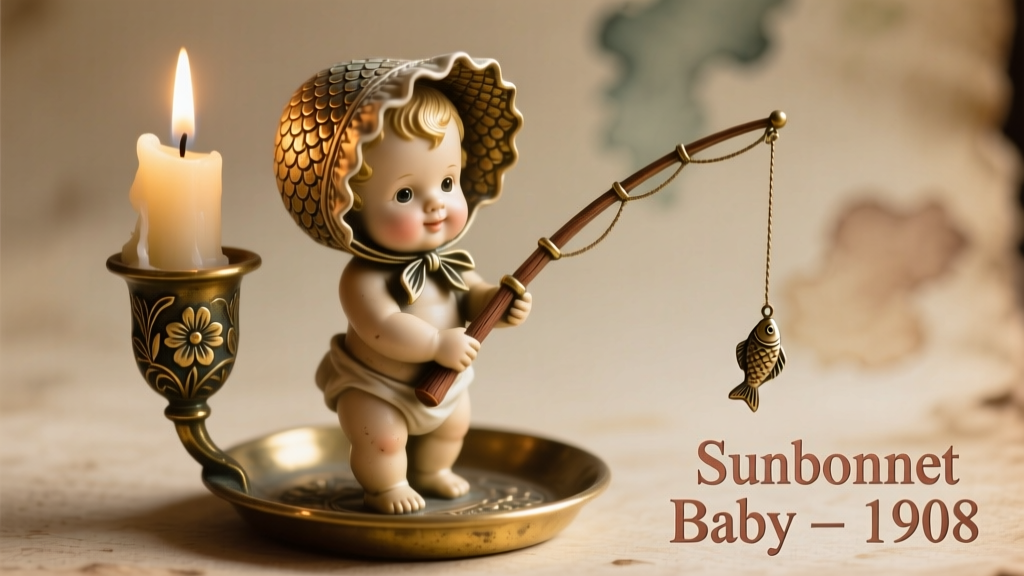
Sunbonnet Babies Candleholder 'Fishing' — A 6½-Inch American Art Pottery Treasure from the Early 20th Century

Rolex Reference 1135932: The Rare Two-Tone Daytona Chronograph from the Late 1980s

1938 Albany Creamery Association Calendar: A Rare Oregon Agricultural Artifact Featuring 'Only God Can Make a Tree'
Diamond Granite Iron Ware: A Technical and Historical Examination of a Misattributed Industrial Material in Vintage Watchmaking Contexts
Federal Cherry Bureau, Circa 1800: Provenance, Construction, and Market Significance of a 35¼ × 40½ × 19½-Inch American Cabinet

Windsor Sack-Back Chair: A Technical Appraisal of the 7-Spindle Maple-and-Ash Armchair (38-Inch Height)
Records Lets All Sing With The Chipmunks: Liberty Records LP 33⅓ RPM (1961) — A Vintage Audio Artifact in Context
Georgian Mahogany Etagère Pair: A Connoisseur’s Guide to Authenticity, Provenance, and Market Value
Winchester Shotgun Shell Advertising Sign: A Rare 1930s–1940s Cardboard Display with Original String Suspension