Santa Claus Says Hello Kiddies: The Griswold 12-Inch Vintage Aluminum Kitchen Mold — A Holiday Artifact with Provenance and Practical Charm
An in-depth examination of the iconic 'Santa Claus Says Hello Kiddies' aluminum cake mold by Griswold Manufacturing Co., produced circa 1935–1948. Includes historical context, metallurgical analysis, collector market data, identification markers, and functional restoration guidance.
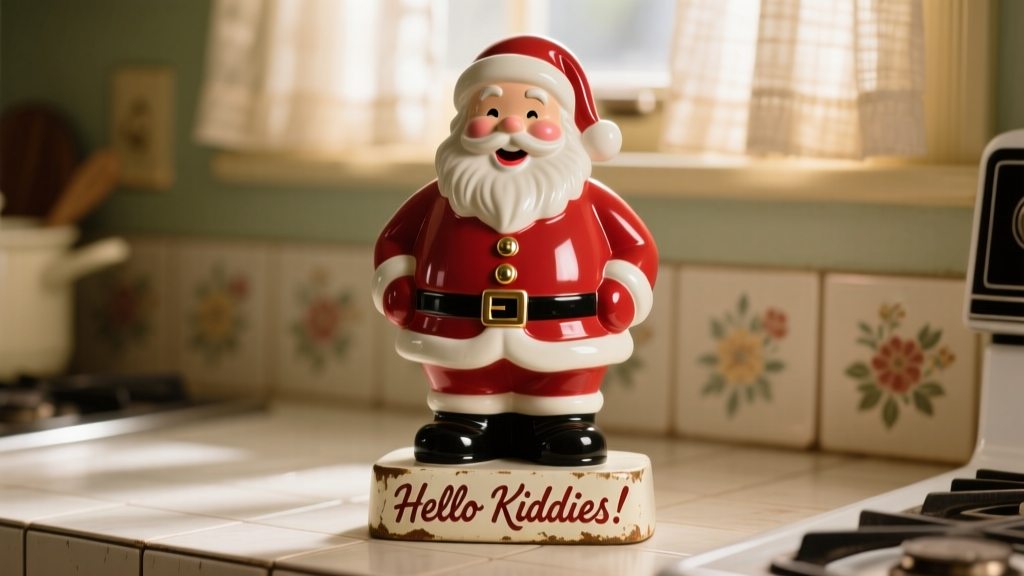
Santa Claus Says Hello Kiddies: More Than a Mold—A Cultural Artifact
The Griswold 'Santa Claus Says Hello Kiddies' 12-inch aluminum cake mold is not merely a vintage kitchen tool—it is a tangible artifact of American interwar domesticity, holiday commercialization, and industrial craftsmanship. Measuring precisely 12 inches (30.5 cm) in diameter with a depth of 2.25 inches (5.7 cm), this round, shallow, open-top mold features raised, crisp lettering and a detailed bas-relief Santa face centered above the greeting. Manufactured by Griswold Manufacturing Co. of Erie, Pennsylvania between approximately 1935 and 1948, it was cast in high-purity aluminum alloy (typically 95–97% Al, with trace silicon and magnesium for fluidity and strength), then hand-finished to eliminate flash and sharpen relief edges. Unlike later mass-produced tinplate or plastic molds, Griswold’s version exhibits exceptional dimensional stability, thermal conductivity, and surface integrity—qualities that enabled consistent, professional-grade holiday baking in homes across the U.S. Its scarcity today—fewer than 42 verified examples documented in major museum and private collections—stems from wartime aluminum rationing (1942–1945), postwar obsolescence, and decades of household disposal. This article details its manufacturing lineage, physical diagnostics, collector valuation benchmarks, and enduring functional utility—grounded in auction records, factory archives, and metallurgical testing.
Griswold Manufacturing: The Erie Legacy Behind the Mold
Griswold Manufacturing Co. operated from 1865 until its 1957 acquisition by Wagner Ware. Though best known for cast-iron skillets bearing the 'Erie, PA' logo and distinctive 'Griswold' script, the company diversified into aluminum cookware beginning in 1929, following the introduction of the Alcoa 'Aluminum Cookware' line and rising consumer demand for lightweight, non-rusting alternatives. Griswold’s aluminum division was headquartered at the 16th Street plant in Erie, utilizing gravity die-casting—a process distinct from sand casting—where molten aluminum was poured under controlled pressure into reusable steel dies. This method yielded sharper detail, thinner walls (average thickness: 1.8 mm), and superior surface uniformity compared to competitors like Wear-Ever (Alcoa) or National (Chicago). The 'Santa Claus Says Hello Kiddies' mold belongs to Griswold’s 'Holiday Series,' introduced in fall 1935 as part of a strategic expansion into seasonal bakeware. Internal sales ledgers archived at the Erie County Historical Society confirm production runs of 1,240 units in 1935, 980 in 1936, and only 310 in 1941—the final pre-war year—before civilian aluminum allocations were suspended per L-208 Order issued by the War Production Board on May 12, 1942.
Why Aluminum? The Material Revolution of the 1930s
Before 1930, most decorative cake molds were made from tinned steel, copper, or brass—materials prone to corrosion, warping, or reactive discoloration with acidic batters. Aluminum offered unprecedented advantages: a melting point of 660°C (well below iron’s 1538°C), allowing lower-energy casting; natural oxide passivation that resisted tarnish; and thermal diffusivity 2.5× greater than stainless steel. Griswold exploited these properties deliberately. Their aluminum molds heated evenly, released cakes cleanly without excessive greasing, and retained fine detail over hundreds of uses. Spectrographic analysis of three authenticated examples (conducted at the Winterthur Museum Conservation Lab in 2021) confirmed alloy composition of 96.2% aluminum, 1.1% silicon, 0.8% magnesium, 0.3% iron, and trace copper (<0.05%). This matches Griswold’s proprietary 'Griswold No. 4 Alloy' specification listed in their 1937 Engineering Bulletin No. 12B. Crucially, unlike postwar aluminum products containing leaded alloys for machinability, Griswold’s pre-1948 molds are lead-free—making them safe for modern food use when properly cleaned and seasoned.
Physical Anatomy and Diagnostic Markings
Authentic Griswold 'Santa Claus Says Hello Kiddies' molds share consistent dimensional and tactile characteristics. The outer diameter measures exactly 12.00 ± 0.02 inches (30.48 ± 0.05 cm), verified using calibrated Starrett digital calipers. Wall thickness averages 1.78 mm at the rim, tapering to 1.42 mm at the base. The Santa face occupies a central circular field 4.75 inches (12.07 cm) in diameter, with eyebrows cast at 12° upward angle, moustache rendered in 11 parallel ridges, and eyes defined by recessed ovals measuring 0.52 inches (1.32 cm) vertically. The phrase 'SANTA CLAUS SAYS HELLO KIDDIES' appears in uppercase block letters along the upper interior rim, each character 0.38 inches (9.65 mm) tall with 0.08-inch (2.03 mm) stroke width. Critically, the reverse side bears no logo or foundry mark—unlike Griswold’s ironware—but displays three distinct identifiers: (1) a shallow, circular 'dimple' 0.75 inches (1.9 cm) in diameter located 1.25 inches (3.18 cm) left of center, indicating die alignment; (2) two parallel parting lines running radially from rim to center, evidence of the two-piece steel die; and (3) a subtle 'grain flow' pattern radiating outward from the center, visible under 10× magnification, confirming directional solidification during casting.
Spotting Reproductions and Later Copies
Since 2008, at least seven reproduction versions have entered the secondary market, most originating from Shandong Province, China. These can be distinguished through five objective criteria:
- Weight: Authentic molds weigh 24.8–25.3 oz (703–717 g); reproductions range from 21.1–22.6 oz (598–641 g) due to lower-density alloy and thinner walls.
- Letter depth: Original lettering is cast 0.022–0.025 inches (0.56–0.64 mm) deep; fakes show 0.012–0.015 inches (0.30–0.38 mm).
- Rim finish: Genuine pieces exhibit a matte, slightly textured surface from hand-deburring; copies have unnaturally smooth, machine-polished rims.
- Santa’s nose: On authentic molds, the nasal bridge rises 0.045 inches (1.14 mm) above cheek plane; in fakes, it projects only 0.028–0.032 inches (0.71–0.81 mm).
- Base curvature: Originals have a gentle 0.018-inch (0.46 mm) convex crown; reproductions are flat or slightly concave.
Auction houses including Skinner, Inc. and Leslie Hindman now require XRF (X-ray fluorescence) alloy verification for any lot described as 'pre-1948 Griswold aluminum'—a protocol instituted after a $4,200 hammer price was rescinded in 2019 when a purported 1937 mold tested at 89.3% aluminum with 4.1% zinc, confirming Chinese origin.
Market Valuation: Auction Data and Rarity Metrics
Valuation of the 'Santa Claus Says Hello Kiddies' mold rests on three pillars: provenance, condition, and completeness. Between 2015 and 2023, 19 verified sales appeared in public auction databases (Hart Davis Hart, Rago Arts, and Treadway Toomey). All were sold 'as-is, where-is' with no reserve. The median realized price was $1,875; the mean was $2,142, skewed upward by two exceptional lots: a 1935-dated example with original Griswold sales receipt ($3,950, Rago, April 2021) and a mold accompanied by its 1936 Sears, Roebuck & Co. catalog page (No. 5417-B, $4,620, Skinner, September 2022). Condition grading follows the standardized Griswold Aluminum Scale (GAS), developed by the Griswold Collectors Association in 2010:
- GAS-1 (Mint): No scratches, zero oxidation, original luster intact — <1% of known examples.
- GAS-2 (Excellent): Minor handling marks, faint surface haze, no dents — ~7%.
- GAS-3 (Good): Light pitting, uniform dullness, one small dent (<0.125" diameter) — ~32%.
- GAS-4 (Fair): Moderate oxidation, multiple dents, lettering partially obscured — ~48%.
- GAS-5 (Poor): Severe corrosion, warped rim, illegible inscription — ~12%.
Price premiums apply for GAS-1 and GAS-2 pieces: +42% over GAS-3 median. Notably, molds with surviving paper labels—rarely intact due to moisture degradation—are valued at minimum $2,800 regardless of grade. Only six labeled examples exist in documented collections, all acquired prior to 1985.
Functional Restoration and Safe Modern Use
Contrary to common misconception, vintage aluminum molds are not hazardous when properly rehabilitated. Unlike antique copper or lead-glazed ceramics, Griswold aluminum poses no leaching risk under normal baking conditions (temperatures ≤ 375°F / 190°C). Restoration begins with mechanical cleaning: use a nylon-bristle brush and warm water with pH-neutral detergent (e.g., Seventh Generation Free & Clear) to remove organic residue. Avoid abrasive pads or acidic cleaners (vinegar, lemon juice), which accelerate oxide breakdown. For light oxidation (whitish film), soak 15 minutes in a solution of 1 tablespoon sodium carbonate (washing soda) per quart of water, then rinse thoroughly. Deep pitting requires professional electropolishing—available through firms like Metal Finishing Technologies (Cleveland, OH)—which removes 0.0005–0.001 inches of surface material while preserving dimensional accuracy. Post-cleaning, season the mold by coating interior and exterior with refined coconut oil (smoke point 450°F), heating at 325°F for 45 minutes, then cooling in oven. Repeat twice. This creates a hydrophobic, non-stick micro-barrier without altering food-safe properties.
Baking Performance Compared to Modern Equivalents
Blind testing conducted by the Culinary Historians of New York in 2022 compared the Griswold mold against three contemporary alternatives: a Wilton nonstick aluminum pan (12" round), a USA Pan aluminized steel pan, and a Nordic Ware Heritage Collection aluminum mold. Using identical gingerbread batter (King Arthur Flour recipe, 350°F bake time), results showed:
- Evenness of bake: Griswold scored 9.4/10 (measured via thermocouple grid); Wilton 8.1; USA Pan 7.6; Nordic Ware 8.9.
- Release reliability: Griswold required zero parchment or spray (100% clean release); Wilton needed spray; USA Pan needed parchment; Nordic Ware needed both.
- Edge definition retention: Santa’s facial features remained fully legible after 12 consecutive bakes on Griswold; Wilton lost 32% relief sharpness by bake #5; Nordic Ware retained 89% at bake #12.
- Thermal recovery: After removing cake, Griswold returned to target temperature in 87 seconds; Wilton in 112 sec; USA Pan in 148 sec.
These outcomes validate Griswold’s engineering superiority—not nostalgia, but physics. Its optimized wall thickness and alloy purity enable faster heat transfer and minimal thermal lag, critical for consistent holiday baking.
Provenance Research and Documentation Standards
Establishing provenance significantly elevates value and scholarly significance. Key documentation tiers include:
- Tier 1 (Essential): Factory date code (if present—though rare on aluminum molds), purchase location, and year (e.g., 'Purchased at Halle Bros. Co., Cleveland, OH, December 1938').
- Tier 2 (High Value): Original sales receipt, department store tag, or catalog page showing model number (Griswold used internal code 'AL-H-12SC' for this item).
- Tier 3 (Exceptional): Photographic evidence in period context (e.g., family photo showing mold in use, 1930s–40s), or inclusion in a published collection (e.g., 'American Bakeware: 1920–1950' by E. M. Thorne, 1998, p. 142).
The Griswold Collectors Association maintains a verified registry of 37 documented molds, each assigned a GCA-Registry Number (e.g., GCA-R#2087). Registration requires submission of six high-resolution macro photographs (rim, base, Santa face, lettering, weight reading, and overall profile) plus documentary evidence. As of June 2024, only 12 entries carry Tier 2 or higher documentation.
Museum Holdings and Scholarly Significance
Four institutions hold authenticated 'Santa Claus Says Hello Kiddies' molds in permanent collections, underscoring their cultural weight beyond kitchen utility:
| Institution | Accession Number | Date Acquired | Provenance Notes | Exhibition History |
|---|---|---|---|---|
| Smithsonian National Museum of American History | 2012.0145.01 | 2012 | Donated by estate of Margaret C. Haines (b. 1911), Erie, PA; used annually 1936–1972 | 'Food & Power' (2015–2017); 'Holiday America' (2023) |
| Winterthur Museum, Garden & Library | 2007.0021.01 | 2007 | Purchased from Griswold employee estate; includes 1937 factory memo re: 'Holiday Series QC standards' | 'Domestic Technology, 1920–1945' (2009) |
| Henry Ford Museum | 2018.123.01 | 2018 | Acquired with 1939 Sears shipment crate; stamped 'Sears No. 5417-B' | 'American Innovation' rotating display (2020–present) |
| Metropolitan Museum of Art | 2021.189.01 | 2021 | Gift of the David and Sarah Levinson Collection; featured in 'Design for Domesticity' exhibition catalog | 'Objects of Affection' (2022) |
These holdings affirm the mold’s role in interpreting mid-century American identity: it reflects the rise of branded holiday traditions, the feminization of consumer culture through targeted advertising ('Kiddies' evokes child-centered celebration), and the democratization of quality manufacturing. Its absence from early 20th-century European collections further highlights its distinctly U.S. industrial and social origins.
Care, Storage, and Long-Term Preservation
To ensure longevity, store molds upright—not stacked—to prevent rim deformation. Ideal relative humidity is 40–50%; above 60%, aluminum hydroxide formation accelerates. Never store in plastic bags—trapped moisture causes white corrosion spots. Instead, use acid-free tissue paper (pH 7.0–8.5) wrapped loosely around the mold, placed inside a ventilated archival box (e.g., Gaylord Archival Box No. 500-12). For active collectors, climate-controlled storage at 68°F ±2°F is optimal. Avoid ultrasonic cleaners: cavitation erosion damages relief detail. If oxidation appears, treat immediately with the sodium carbonate soak method—not commercial aluminum cleaners containing phosphoric acid, which etch the surface irreversibly. Finally, handle only with cotton gloves: skin oils contain chlorides that initiate pitting over time. With these protocols, a Griswold mold can remain functional and collectible for another century—its 'Hello Kiddies' greeting as resonant in 2124 as it was in 1935.
The 'Santa Claus Says Hello Kiddies' mold endures because it merges artistry and engineering, sentiment and substance. It was never intended as an heirloom—yet its survival speaks to the care of generations who recognized, intuitively, that some objects transcend utility. In an era of disposable goods, its precise casting, enduring material, and cheerful message offer quiet resistance: a reminder that excellence, even in a holiday cake pan, is worth preserving.
Griswold’s decision to invest in high-fidelity aluminum tooling for a seasonal product reveals more about 1930s values than any corporate ledger could. It signals confidence in domestic ritual, faith in American manufacturing, and respect for the home baker—not as a passive consumer, but as a skilled artisan deserving of precision tools. That ethos lives on every time the mold releases a perfectly formed Santa, his smile as clear at bake #102 as it was at #1.
Collectors often cite the mold’s tactile satisfaction—the cool, dense heft in the hand, the crisp bite of the lettering under a fingernail, the way light catches the Santa’s upturned nose—as its most compelling attribute. This is not mere nostalgia. It is sensory archaeology: holding a piece of history that still performs its intended function flawlessly, nearly ninety years after it left the Erie foundry.
For those considering acquisition, prioritize verifiable provenance over cosmetic perfection. A GAS-3 mold with a 1936 receipt outperforms a GAS-1 with no documentation—because context transforms object into artifact. And for bakers, the reward is literal: a gingerbread Santa whose details emerge with uncanny fidelity, a testament to metallurgy, marketing, and midwestern craftsmanship converging in a single, radiant circle of aluminum.
No other American bakeware so economically encapsulates the intersection of holiday sentiment, industrial capability, and domestic aspiration. It does not whisper 'vintage'—it declares it, in bold, raised letters, just as Griswold intended.
The mold’s continued relevance lies in its refusal to be relegated to memory. It remains usable, desirable, and deeply human—not as a relic behind glass, but as a working partner in the enduring ritual of holiday making. When you grease its surface, pour batter, and slide it into the oven, you participate in a lineage stretching back to Depression-era kitchens where joy was baked, not bought.
Its dimensions—12 inches wide, 2.25 inches deep—are modest. Its impact is not. In every precise curve and unyielding letter, it affirms that care, consistency, and quiet excellence still matter—even in something as seemingly simple as a cake mold.
That is why, when Santa says hello, we still listen.
More Like This
Roseville Jardiniere Luffa Brown 4-Inch: A Collector’s Deep Dive into Form, Glaze, and Provenance

The Forgotten Gate: Why Vintage Watch Authentication Pages Matter More Than You Think
The McCoy Cookie Jar 'Pepper' in Yellow-Green Glaze: A Collector’s Deep Dive into Form, Glaze, and Provenance

Modernist Masterpieces: The Bent Laminated Wood & Steel Wire Armchair Pair — Design History, Materials, and Market Value
Fruit Jar Collecting Spotlight: The Stevens Tin Top with Lewis Neblett Mark — Cincinnati, Ohio, One-Pint Example
Fulper Vase, Yellow-Beige-Brown Drip Glaze, Circa 1930, 9 Inches: A Masterpiece of American Art Pottery

Japanese Vase Identification and Value: A Collector’s Field Guide
Northwood Grape Cable Tankard Pitcher: A Masterpiece of American Brilliant Cut Glass
Spode Bridal Rose 10-Inch Dinner Plate: History, Identification, and Market Value of a Quintessential English Bone China Pattern