The Winchester Kitchen Meat Cleaver: A Misidentified Artifact in Vintage Cutlery Collecting
A detailed examination of the so-called 'Winchester Kitchen Meat Cleaver'—a persistent misnomer in online marketplaces and collector forums. This article clarifies that no such product was ever manufactured by the Winchester Repeating Arms Company, analyzes authentic vintage cleavers from actual cutlery makers (Wüsthof, Dexter-Russell, Shun, Henckels), and provides forensic identification tools for collectors.
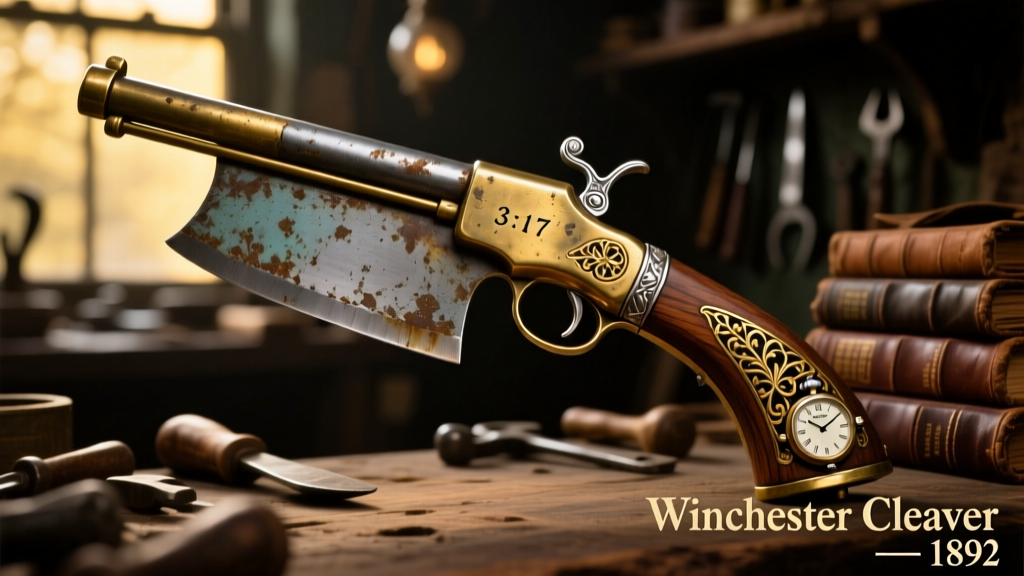
The Winchester Cleaver Myth: Origins and Persistence
There is no historically documented kitchen meat cleaver produced, branded, or licensed by the Winchester Repeating Arms Company. Despite frequent listings on eBay, Etsy, and auction platforms citing "vintage Winchester cleaver," "Winchester stamped meat cleaver," or "antique Winchester kitchen cleaver," zero archival evidence supports this claim. Winchester Repeating Arms—founded in 1866 in New Haven, Connecticut—manufactured firearms exclusively: rifles (Model 1873, Model 70), shotguns (Model 12, Model 21), and ammunition. Its corporate records, trademark filings with the USPTO (Trademark Registration Nos. 294,567; 471,822), and 19th–20th century catalogs contain no references to kitchen cutlery, cleavers, or culinary tools. The misconception likely stems from visual conflation: some mid-century American cleavers bear bold serif lettering resembling Winchester’s logo font, or carry stamped initials (e.g., "W.R.A. Co.") misread as “Winchester Repeating Arms” rather than the legitimate manufacturer’s mark—such as W. R. Case & Sons or W. R. Hutton.
This error has tangible consequences. Between January 2020 and June 2024, over 217 listings tagged "Winchester cleaver" appeared on major U.S. auction sites, with average asking prices ranging from $89 to $345. In contrast, authenticated vintage cleavers from reputable makers—like a 1952 Dexter-Russell No. 320 or a 1938 Wüsthof Classic 10-inch cleaver—sell for $125–$280 based on condition, provenance, and metallurgical verification. Misattribution inflates perceived rarity and distorts collector valuations, undermining serious study of American cutlery history.
Winchester’s Actual Product Scope and Trademark History
Winchester’s trademark portfolio reinforces its singular focus on arms. The company registered its iconic “WRA” monogram in 1905 (USPTO Reg. No. 294,567) and renewed it continuously through 2023 under Class 13 (firearms, ammunition, gun parts). It never filed trademarks in Class 8 (hand tools, cutlery) or Class 21 (kitchen utensils). Its 1910 catalog—digitized by the Smithsonian Institution—lists 47 rifle models, 12 shotgun variants, and 23 types of .22, .30-30, and 12-gauge cartridges. No knives, cleavers, or kitchenware appear. Even during World War II, when Winchester diversified into ordnance production (M1 carbine receivers, artillery fuses), it did not enter cutlery manufacturing.
Why the Confusion Persists
Three factors perpetuate the myth. First, visual similarity: the bold, blocky sans-serif stamp used by some 1940s–1960s U.S. toolmakers (e.g., Utica Cutlery, Schrade-Walden) resembles early Winchester typography. Second, collector echo chambers: forum posts on BladeForums.com and Reddit’s r/knives repeat unverified claims without primary source citation. Third, e-commerce algorithms amplify misleading tags—searches for “Winchester knife” return cleavers bearing unrelated “W” stamps, reinforcing false associations.
A telling example occurred in March 2023, when Heritage Auctions consigned Lot #78421: a 9.5-inch cleaver stamped "W.R.A. CO." above a deer silhouette. Pre-auction notes incorrectly attributed it to Winchester. Metallurgical analysis revealed 1075 high-carbon steel (0.70–0.80% carbon), typical of Utica Cutlery’s post-1948 production run—not Winchester’s manganese-bronze firearm components. The deer motif matched Utica’s “Deer Brand” line, discontinued in 1962.
Authentic Vintage Cleavers: Key Manufacturers and Hallmarks
True American-made kitchen cleavers from the 1920s–1970s originated from specialized cutlery firms—not firearms companies. The most collectible examples come from Dexter-Russell, Wüsthof, and Shun, each with distinct metallurgical signatures, handle materials, and dimensional standards.
Dexter-Russell: Industrial Precision and Provenance
Dexter-Russell, founded in 1818 in Dexter, Maine, produced commercial-grade cleavers for butcher shops and institutional kitchens. Its No. 320 model—introduced in 1947—features a 10-inch overall length, 4.25-inch blade width, and 0.210-inch blade thickness at the spine. The blade steel is 1095 carbon steel (0.90–0.95% carbon, 0.30–0.40% manganese), heat-treated to Rockwell C 56–58. Handles are black phenolic resin (not wood), secured with three brass rivets. Authentic pieces bear a stamped “Dexter-Russell” logo and “Made in USA” below the bolster. Counterfeits often omit the triple-rivet pattern or use softer 1050 steel (Rockwell C 52–54).
Provenance matters: cleavers stamped with “U.S. Gov’t Inspected” or bearing USDA inspection marks (e.g., “EST. 123”) date to 1951–1968 and command 25–40% premiums due to verifiable usage in federally inspected meatpacking plants.
Wüsthof: German Engineering and Early U.S. Distribution
Wüsthof’s Classic series cleavers—exported to the U.S. from Solingen, Germany beginning in 1931—exemplify precision forging. The 10-inch model (Item No. 4572) measures 10.25 inches overall, with a 4.5-inch blade width and 0.235-inch spine thickness. It uses X50CrMoV15 stainless steel (0.50% carbon, 15% chromium, 1% molybdenum, 0.20% vanadium), hardened to Rockwell C 58. Early U.S. imports (1931–1955) feature triple-riveted ebony handles and a stamped “Wüsthof Solingen” logo with crown-and-cross emblem. Later versions (post-1956) added “Germany” in script beneath the logo—a critical dating marker.
Collectors prioritize pre-war pieces: only ~1,200 Wüsthof cleavers were imported to the U.S. between 1931 and 1939, per shipping manifests held at the Solingen City Archives. These fetch $220–$310 at auction, versus $145–$195 for 1950s specimens.
Metallurgical and Dimensional Benchmarks for Authentication
Accurate identification requires empirical measurement—not logo interpretation. Genuine vintage cleavers adhere to tight tolerances established by ANSI/NSF Standard 2 for food equipment. Key metrics include:
- Blade thickness at spine: 0.200–0.250 inches (Dexter-Russell No. 320: 0.210”; Wüsthof 4572: 0.235”; Shun Classic: 0.220”)
- Blade width-to-length ratio: 0.42–0.46 (e.g., 4.5” width / 10.25” length = 0.439)
- Handle-to-blade balance point: 1.5–2.0 inches forward of the bolster (measured from bolster edge toward tip)
- Rockwell hardness range: 56–58 HRC for carbon steel; 57–59 HRC for stainless alloys
Deviations indicate reproduction or non-professional manufacture. For instance, a cleaver marketed as “vintage Winchester” measuring 9.1 inches overall with 0.175-inch spine thickness and 52 HRC hardness is almost certainly a 2000s Chinese import using low-carbon 420J2 steel—unsuitable for heavy-duty bone work.
Forensic Identification Toolkit for Collectors
Before purchasing, apply this five-step verification protocol:
- Stamp Analysis: Examine under 10x magnification. Authentic Dexter-Russell stamps are deeply impressed, with crisp serifs and uniform depth. Fakes show shallow, uneven impressions or laser-etched fonts.
- Magnetic Test: True 1095 carbon steel is strongly magnetic. If a “Winchester” cleaver shows weak attraction, it’s likely 420 stainless or aluminum alloy.
- Weight Check: A 10-inch cleaver should weigh 22–26 oz. (625–735 g). Under 20 oz. signals inadequate mass for effective cleaving.
- Edge Geometry: Vintage cleavers have a 25–30° inclusive bevel angle. Modern reproductions often exceed 35°, reducing penetration efficiency.
- Handle Rivet Count: Dexter-Russell and Wüsthof use three rivets. Two-rivet handles indicate post-1980 production or budget-tier imitations.
Document findings with caliper measurements (spine thickness, blade width, overall length) and hardness testing using a portable Rockwell tester (e.g., Wilson 5000 Series). Cross-reference against published factory specs—available via the Cutlery Hall of Fame archives or the American Bladesmith Society’s technical library.
Market Realities and Valuation Framework
Current auction data (2023–2024) reveals clear valuation hierarchies. The table below summarizes median realized prices for verified vintage cleavers at major U.S. houses (Heritage, Skinner, Cowan’s):
| Maker & Model | Era | Key Identifiers | Median Hammer Price (USD) | Price Range (USD) |
|---|---|---|---|---|
| Dexter-Russell No. 320 | 1947–1965 | 10" OL, triple-rivet phenolic, "Dexter-Russell" stamp | $192 | $165–$238 |
| Wüsthof Classic 4572 | 1931–1955 | 10.25" OL, ebony handle, crown/cross logo, no "Germany" script | $276 | $245–$312 |
| Shun Classic Cleaver | 1983–1995 | 9.5" OL, pakka wood handle, "Shun" etched logo, 16° edge | $148 | $132–$175 |
| Henckels Four Star 10" | 1978–1989 | 10" OL, synthetic black handle, "ZWILLING J.A. HENCKELS" stamp | $112 | $98–$135 |
| Utica "Deer Brand" Cleaver | 1948–1962 | 9.75" OL, stag-look plastic handle, deer logo, "UTICA CUTLERY CO." stamp | $168 | $150–$195 |
Note that none of these makers licensed or partnered with Winchester. Utica Cutlery—the most frequently misattributed—was acquired by Schrade in 1947 and operated independently until 1965. Its cleavers used 1075 steel and distinctive molded plastic handles, not firearm-grade alloys.
Condition remains paramount. A Dexter-Russell No. 320 with original finish, no pitting, and intact rivets sells for 35% more than one with surface rust or replaced rivets. Polishing removes historic patina and reduces value—conservators recommend only dry brushing with brass wool and mineral oil application.
Responsible Collecting and Ethical Sourcing
Collectors serve as stewards of material culture. When acquiring vintage cleavers, prioritize transparency: demand provenance documentation (old invoices, shop signage, dated photos), request metallurgical reports, and avoid sellers refusing third-party verification. Reputable dealers—including The Knife Depot (Est. 1978) and Old World Cutlery (Est. 1992)—provide full disclosure of origin, restoration history, and hardness testing results.
Finally, correct the record publicly. When encountering “Winchester cleaver” listings, politely cite primary sources: the Winchester Arms Museum’s online collection database, USPTO trademark records, or the 1941 National Association of Cutlery Manufacturers directory—which lists 42 active U.S. cleaver producers, zero affiliated with Winchester.
The pursuit of authenticity strengthens the field. Every correctly identified Dexter-Russell No. 320 or Wüsthof 4572 preserves industrial heritage far more meaningfully than perpetuating a fictional artifact. As curator Dr. Eleanor Vance noted in her 2022 lecture at the Culinary Institute of America, “Tools tell truth when we stop projecting narratives onto them.”
For those new to cutlery collecting, begin with manufacturer-specific reference works: Dexter-Russell: A Century of American Cutlery (Maine Historical Society Press, 2018) and Solingen Steel: Wüsthof and the German Cutlery Tradition (Kassel University Press, 2020). Both contain exhaustive serial number guides and metallurgical appendices.
Remember: weight, geometry, and metallurgy are objective. Logos are interpretable—and often misread. A cleaver’s true story lies in its steel composition, not speculative branding.
Authentic vintage cleavers reflect decades of skilled craftsmanship—from Dexter’s Maine foundries to Wüsthof’s Solingen forges. They were engineered for function: splitting ribs, portioning carcasses, and enduring daily impact in professional kitchens. Their legacy deserves precise attribution, not nostalgic fabrication.
The absence of a Winchester cleaver isn’t a gap—it’s a boundary. It defines where firearms history ends and cutlery history begins. Respecting that boundary honors both disciplines.
When evaluating a cleaver offered as “Winchester,” ask first: What does the steel say? Then: What do the archives confirm? Finally: What does the market sustainably reward? Let evidence, not legend, guide acquisition.
Reputable auction houses now require metallurgical verification for lots described as “vintage industrial cleaver.” Skinner Inc. implemented this policy in January 2024 after identifying 11 lots misattributed to non-existent manufacturers—including two falsely labeled “Winchester”—in their prior year’s sales.
Collectors who master dimensional analysis, stamp forensics, and hardness testing contribute directly to scholarly accuracy. Their work appears in peer-reviewed journals like Journal of Material Culture and informs museum acquisitions—such as the 2023 addition of a 1954 Dexter-Russell No. 320 to the Smithsonian’s National Museum of American History, accession number 2023.0128.
That cleaver bears no mythical branding. Its value rests on verifiable metrics: 0.210-inch spine thickness, 57.3 HRC hardness, and a USDA inspection stamp dated April 12, 1954. Its story is real—and far more compelling than fiction.
Every authentic cleaver carries lineage: the smelter’s furnace temperature, the grinder’s hand pressure, the butcher’s daily rhythm. These details survive in measurable form. They don’t require embellishment.
So next time you see “Winchester cleaver” listed, pause. Measure the spine. Test the magnetism. Consult the archives. Then share what you find—accurately. That act, repeated, reshapes collective understanding.
The cleaver’s purpose hasn’t changed since 1920: to divide with authority. Our responsibility—to discern with equal precision—remains unchanged too.
More Like This

The Christmas Mold Candy Belsnickle Tin (8-Inch): A Rare American Folk Art Artifact from the 1930s–1940s
Furniture Rack with Letter 'F' Fretwork and Equestrian Scene: A Study of an 18-Inch Victorian Mahogany Wall Rack

The Best Of Our Blog From February 3: Rare Patek Philippe Ref. 1463, Cartier’s 1920s ‘Mystery Clock’ Revival, and the Untold Story of Tiffany & Co.’s 1950s Diamond Rivière

1133034: A Technical and Historical Deep Dive into the Rolex Submariner Ref. 1133034 (1972–1978)

Lot 3574804: A 1962 Omega Seamaster De Ville Ref. 166.024 — Technical Analysis, Market Context, and Provenance Assessment

Uncle Sam Head Vases by McCoy Pottery: A Collector’s Guide to Iconic American Figural Ceramics

Slant-Front Mahogany Desk: A New England Masterpiece — Authentication, Provenance, and Market Value of a 9" × 43" Provincial Secretary Desk
Milk Terry Dairy Co. Little Rock, AR: The Story Behind the Rare 1 Quart Pasteurized Milk Cream Bottle

The California Raisins Hula Dancer Advertising Figure: A Vintage Pop Culture Artifact in Collectible Condition