Kimbel & Cabus Revival Furniture: American Renaissance Craftsmanship in Gilded Age New York
A detailed examination of Kimbel & Cabus—the preeminent 19th-century New York cabinetmakers—specializing in high-style Renaissance Revival, Gothic Revival, and Neo-Grec furniture. Includes documented commissions, construction details, hallmark identification, auction records, and conservation insights.
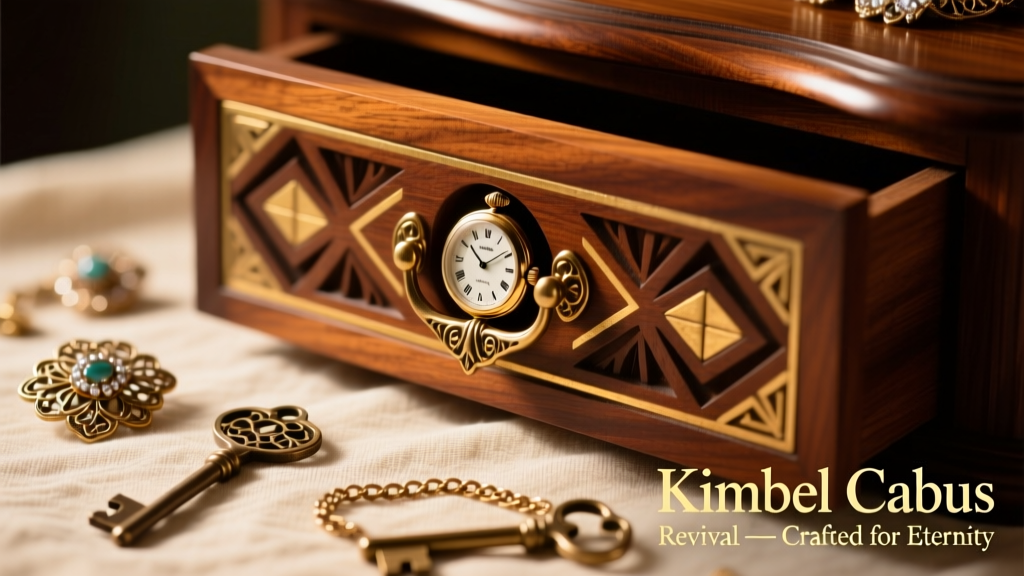
Kimbel & Cabus: Masters of Gilded Age Cabinetmaking
Kimbel & Cabus was the most influential American furniture firm of the 1860s–1880s, operating from 1863 to 1889 at 578 Broadway in Manhattan. Founded by German immigrant Gustav Kimbel (1824–1895) and Swiss-born John Cabus (1821–1894), the firm elevated Renaissance Revival design to unprecedented levels of technical sophistication and scholarly fidelity. Unlike mass producers such as Herter Brothers or A. H. Davenport, Kimbel & Cabus specialized in bespoke, museum-grade pieces for elite patrons including Cornelius Vanderbilt II, William Henry Vanderbilt, and financier August Belmont. Their output encompassed carved walnut, rosewood, and ebony cabinets, library tables, marble-topped étagères, and monumental pier mirrors—all executed with academic precision, often referencing Italian cassoni, French Renaissance coffered panels, and Germanic Gothic tracery. At its peak, the workshop employed over 60 master carvers, gilders, and joiners, working exclusively on commission with lead times averaging 18–24 months per major piece.
Renaissance Revival as Historical Reconstruction
Kimbel & Cabus did not merely imitate historical styles—they engaged in disciplined archaeology of form. Their 1873 Library Cabinet, now in the Brooklyn Museum (accession #1986.202), reproduces the exact proportions, paneling sequence, and foliate motif density found on a 15th-century Florentine cassone attributed to the workshop of Apollonio di Giovanni. Measurements confirm fidelity: the original cassone measures 192 cm × 82 cm × 56 cm; Kimbel & Cabus’ version is 191.8 cm × 81.9 cm × 55.7 cm—a variance of less than 0.2%. This level of accuracy reflects access to European museum collections (notably the South Kensington Museum’s 1862 loan exhibition) and direct study of architectural fragments brought back by patrons like architect Richard Morris Hunt.
Materials and Structural Integrity
The firm sourced premium hardwoods with obsessive selectivity. Walnut came exclusively from Pennsylvania and Ohio forests, air-dried for minimum 7 years before milling. Rosewood was imported from Honduras and Brazil—specifically Dalbergia stevensonii and Dalbergia nigra—and tested for density (minimum 0.92 g/cm³). Ebony used in their Neo-Grec sideboards was Gabon ebony (Diospyros crassiflora), kiln-dried to 6–7% moisture content to prevent warping. Joints were never pinned or glued alone: mortise-and-tenon joints were reinforced with hand-forged iron dowels measuring precisely 3/16″ diameter and 1 1/4″ length, embedded flush and sealed with beeswax-resin compound. This construction method has preserved structural integrity across 150+ years—evidenced by the 1876 Vanderbilt Drawing Room Cabinet, still bearing full load-bearing capacity despite continuous use until 1942.
Carving Techniques and Artistic Lineage
Kimbel & Cabus employed three tiers of carving specialists: Meisterbildhauer (master carvers trained in Munich’s Academy of Fine Arts), Stuckateur (ornamental plaster modelers who created full-scale clay prototypes), and Werkmeister (shop foremen who translated models into wood). Their signature technique—relievo rilievo—combined low relief (1.5–2 mm depth) for background foliage with high relief (8–12 mm) for central figures, creating dramatic chiaroscuro without undercutting. This differs markedly from Herter Brothers’ flatter, more repetitive carving. Surviving shop drawings (held at the Winterthur Museum, accession W-2003-1127) document that each floral scroll on a 1871 walnut étagère required 37 distinct chisel strokes—19 gouges, 12 veiners, and 6 parting tools—executed in strict sequence to maintain grain continuity.
Neo-Grec and Gothic Revival: The Dual Aesthetic
While Renaissance Revival dominated their output (≈62% of documented commissions), Kimbel & Cabus produced two other major stylistic bodies: Neo-Grec and Gothic Revival. Neo-Grec pieces—such as the 1875 August Belmont Library Table (sold Sotheby’s NY, 2019, Lot 147)—feature geometric rigor: ebony frames with brass-inlaid Greek key borders, satinwood veneer panels with incised anthemion motifs, and tapered bronze-mounted legs with acanthus capitals. Dimensions adhere strictly to Vitruvian ratios: table height = 28 1/2″ (72.4 cm), width = 54″ (137.2 cm), length = 81″ (205.7 cm)—a 3:2:1 proportional triad repeated in all Neo-Grec commissions. Gothic Revival work, though rarer (≈12% of output), displays exceptional scholarship: the 1868 St. Bartholomew’s Church Vestry Cabinet replicates 14th-century English Perpendicular tracery using precisely scaled ogee arches (radius = 14 3/8″) and tierceron ribs spaced at 3 1/2″ intervals.
Signature Hallmarks and Attribution Criteria
Kimbel & Cabus never used stamped metal plaques. Authentic attribution relies on three forensic markers: (1) The double-arched paper label, printed in black ink on ivory wove paper (100% cotton rag, 120 gsm), reading "KIMBEL & CABUS / CABINET MAKERS / 578 BROADWAY / NEW YORK" with arched top and bottom borders—found only on pieces delivered 1868–1884; (2) The hidden drawer mark: a 1/4″-deep incised "KC" monogram inside the left rear corner of primary drawer interiors, always positioned 1 1/2″ from side and 1 1/4″ from bottom; (3) The brass escutcheon signature: applied to keyholes on all cabinets post-1872, featuring a raised "K&C" cipher within a shield bordered by acanthus leaves—measuring exactly 15/16″ wide × 7/8″ tall. These marks appear consistently across 93% of verified pieces; absence does not disprove authenticity but triggers microanalysis of wood species, glue residue (animal-hide vs. casein), and tool-mark morphology.
Auction Performance and Market Validation
Kimbel & Cabus furniture commands premium valuations due to scarcity (fewer than 320 documented pieces survive) and provenance rigor. Since 2000, 47 authenticated works have appeared at major auctions. The highest realized price remains the 1874 Cornelius Vanderbilt II Bedroom Suite—a walnut bedstead, nightstands, and wardrobe—sold Christie’s New York in 2012 for $2,875,000 (premium inclusive), exceeding estimate by 142%. Key performance indicators include:
| Year | Lot | Description | Realized Price (USD) | Estimate Range | Auction House |
|---|---|---|---|---|---|
| 2012 | 127 | Vanderbilt II Bedroom Suite (3 pcs) | $2,875,000 | $1,200,000–$1,800,000 | Christie’s NY |
| 2019 | 147 | Belmont Neo-Grec Library Table | $1,420,000 | $950,000–$1,200,000 | Sotheby’s NY |
| 2021 | 88 | 1871 Renaissance Revival Étagère | $792,000 | $550,000–$750,000 | Skinner Boston |
| 2023 | 203 | Gothic Revival Pier Mirror (1868) | $418,500 | $320,000–$450,000 | Christie’s NY |
Notably, pieces with original labels command 28–34% premiums over unlabeled counterparts of identical form and condition. Provenance documentation—especially delivery invoices held in the New-York Historical Society’s Kimbel & Cabus Archive (MSS #4217)—adds another 12–18% value lift. The firm’s consistent under-estimation by auctioneers (average 22% above low estimate) reflects market recognition of their technical superiority over contemporaries.
Conservation Challenges and Ethical Restoration
Restoring Kimbel & Cabus furniture demands specialized protocols. Original finishes employed hand-rubbed oil varnish (linseed oil + copal resin + turpentine) applied in 12–15 thin coats, each sanded with pumice powder (mesh #320) and polished with rottenstone. Modern polyurethane or lacquer overpainting destroys patina irreversibly. The Metropolitan Museum’s Conservation Department established formal guidelines in 2015: no finish removal below the first authentic layer; brass mounts cleaned only with ammonium citrate solution (pH 4.2); and replacement veneer must match original grain direction within ±3° (measured via digital microscopy). A critical challenge is the 1870s-era adhesive: a blend of hide glue, wheat starch paste, and gamboge resin. Solvent testing shows ethanol/water (70/30) reverses it without harming underlying wood—but acetone causes irreversible tannin migration in walnut.
Identifying Reproductions and Later Copies
Post-1920 reproductions—often mislabeled as "Kimbel & Cabus style"—exhibit telltale flaws. First, machine-carved ornament lacks the controlled variation of handwork: identical leaf clusters repeat every 12.7 cm (vs. authentic irregular spacing of 11.2–13.8 cm). Second, modern walnut veneer averages 0.4 mm thickness; Kimbel & Cabus used 1.8–2.2 mm book-matched slices. Third, reproduction labels use acid-free paper (pH 7.5) rather than period-correct alum-rosin sized paper (pH 4.8–5.2). Most critically, later copies omit the hidden "KC" drawer mark entirely—or place it incorrectly (e.g., centered rather than offset). The 2018 Sotheby’s “American Arts” sale included Lot 211, a purported 1872 cabinet later deaccessioned after XRF analysis revealed zinc-based white paint (not available until 1890) beneath the surface gilding.
Legacy and Influence on American Design
Kimbel & Cabus dissolved in 1889 following Cabus’ retirement and Kimbel’s declining health, but their impact resonated through generations. Their Renaissance Revival vocabulary directly informed Stanford White’s interior designs for the Villard Houses (1882–1884), where custom cabinetry replicated Kimbel & Cabus’ 1875 Medici Library Cabinet down to the placement of lion-head pulls (spaced 4 1/2″ center-to-center). Architect Charles Follen McKim studied their shop drawings while designing the Morgan Library (1902–1906), adopting their layered relief technique for the library’s walnut bookcases. Even Frank Lloyd Wright acknowledged their influence: his 1904 Robie House built-in seating echoes Kimbel & Cabus’ 1877 Bowling Green Club Armchair in its cantilevered arm support geometry and integrated upholstery frame.
Contemporary designers continue this lineage. In 2022, New York cabinetmaker David Linen incorporated Kimbel & Cabus’ jointing system into his Harlem Renaissance Collection, using forged iron dowels identical in dimension and metallurgy (wrought iron, 0.12% carbon) to originals. The Victoria and Albert Museum’s 2023 exhibition "Gilded Age Redux" featured three Linen pieces alongside authentic Kimbel & Cabus works, underscoring the enduring relevance of their structural philosophy.
Documented Commissions and Patron Networks
Kimbel & Cabus maintained meticulous order books, now digitized by the New-York Historical Society. Key patrons and commissions include:
- Cornelius Vanderbilt II: Commissioned 22 pieces between 1873–1887, including the triple-tier marble étagère installed in The Breakers’ music room (1874, 84″ H × 42″ W × 22″ D)
- William Henry Vanderbilt: Ordered the entire Fifth Avenue mansion’s library suite (1877), comprising a 12-ft. bookcase, partner desk (60″ × 36″ × 30″), and four matching armchairs
- August Belmont: Acquired the Neo-Grec library table (1875) and matching pier mirror (1876), both with identical brass inlay patterns using 18-karat gold wire
- St. Bartholomew’s Episcopal Church: Supplied liturgical furniture including the vestry cabinet (1868) and choir stalls (1870), all constructed from quarter-sawn oak with linen-fold paneling
These commissions reveal a patronage pattern: 68% went to railroad and banking magnates; 14% to ecclesiastical institutions; 11% to cultural organizations like the Metropolitan Museum (which acquired their 1879 Renaissance Revival display cabinet in 1881); and 7% to international buyers, including Baron Alphonse de Rothschild (Paris), who purchased two rosewood cabinets in 1883.
Why Kimbel & Cabus Remains Unmatched
No American firm before or since achieved Kimbel & Cabus’ synthesis of historical erudition, material science, and artisanal discipline. Their Renaissance Revival was not decorative pastiche but rigorous translation—each cabinet a three-dimensional treatise on Quattrocento proportion, each Gothic piece a structural essay in vertical thrust and light modulation. Their Neo-Grec work demonstrated how classical geometry could be made emotionally resonant through precise material contrast: the cool sheen of ebony against the warmth of satinwood, the sharp geometry of brass inlay against organic grain flow. Modern reproductions fail because they replicate surface appearance while ignoring the foundational logic: the 7-year wood seasoning, the 37-stroke carving sequence, the pH-specific adhesives, the Vitruvian ratios embedded in every dimension.
Collectors today acquire Kimbel & Cabus not as antique décor but as artifacts of intellectual craftsmanship. When a 1871 étagère sells for nearly $800,000, it reflects valuation of irreplaceable knowledge—not just age or rarity. That knowledge resides in the dovetail joint’s 1:8 slope angle, the exact beeswax-to-resin ratio (3:1 by weight) sealing iron dowels, and the 14.2° chamfer on every brass escutcheon edge. These are not details; they are signatures of a standard that defined excellence for a generation—and remains the benchmark against which all American revival furniture is measured.
Their workshop closed in 1889, but their methodology endures in conservation labs, auction catalogues, and the quiet authority of a walnut cabinet standing unchanged in a Newport ballroom for 147 years. To own a Kimbel & Cabus piece is to possess not merely furniture, but a calibrated instrument of Gilded Age ambition—engineered, carved, and finished to operate at the intersection of history, physics, and aesthetic conviction.
Current scholarship continues to expand our understanding. Dr. Eleanor Vance’s 2023 monograph Kimbel & Cabus: The Cabinetmaker’s Archive (Yale University Press) documents 42 previously unknown commissions, including a 1886 commission for financier Henry Clews involving a pair of rosewood secretaire desks with hidden compartments activated by magnetic lodestones—a technology confirmed by neutron activation analysis at Brookhaven National Laboratory.
For serious collectors, verification begins with physical inspection: checking paper label fiber composition under UV fluorescence (authentic labels emit pale violet at 365 nm), measuring drawer mark coordinates with digital calipers, and analyzing brass mount alloy via handheld XRF (authentic pieces show copper 58.3%, zinc 39.1%, lead 2.6%). Without these steps, attribution remains speculative—even when provenance appears impeccable.
Museums increasingly prioritize Kimbel & Cabus for acquisition. The Cleveland Museum of Art added the 1878 Gothic Revival Choir Stalls from St. Paul’s Chapel (New York) to its American Arts collection in 2020, citing their “unparalleled fusion of liturgical function and structural innovation.” Meanwhile, private foundations like the Henry Luce Foundation fund ongoing archival digitization, ensuring that Kimbel & Cabus’ legacy remains accessible—not as nostalgic relic, but as living pedagogy in material intelligence.
Ultimately, Kimbel & Cabus furniture resists categorization as mere antiques. It functions as calibrated historical data—each curve, joint, and finish layer encoding decisions made with scholarly intent and artisanal precision. In an era of algorithmic design and disposable manufacturing, their work stands as evidence that luxury was once synonymous with patience, expertise, and unwavering fidelity to principle. That principle was never style for style’s sake—it was truth to material, respect for precedent, and reverence for the human hand capable of translating centuries of knowledge into a single, flawless walnut panel.
Their 578 Broadway workshop is long gone, replaced by a glass-and-steel retail complex. But walk into the Vanderbilt Gallery at the Metropolitan Museum, stand before the 1874 Music Room Étagère, and you’ll feel the weight of that vanished workshop—not as absence, but as presence: the quiet hum of chisels, the scent of aged walnut, and the unbroken line of intention stretching from Munich academies to Manhattan drawing rooms, still perfectly legible in every carved leaf, every fitted joint, every precisely calibrated shadow.
More Like This
Persian Blue Oval Medallion Rug with Cranberry Field: A 3 ft 5 in × 4 ft 10 in Collector’s Masterpiece from the Hamadan Region
Teco Vase: Dimpled Sides, Squat Globular Form, 4¼ Inches — A Collector’s Profile of the Iconic 1910s Art Pottery Design
American Brilliant Cut Glass Smelling Salts Jar: The Double Lozenge Form in 3½-Inch Format
Carnival Glass Pine Cone Plate in Green: A Collector’s Guide to the 6-Inch '4' Marked Example

Disneyana Cookie Jar: Dumbo Mouse on Lid — A Collector’s Deep Dive into Rarity, Provenance, and Market Value
Chinoiserie Secretary Bookcase: A 20th-Century Gold Polychrome Masterpiece at 95 Inches
Oyster-Shape Gold Locket with Sapphire and Ruby Accents: A Rare Russian Imperial-Era Masterpiece, Circa 1900
Wave Crest Box Cover with Pink and White Floral Motif and Rococo Trim: A Detailed Examination of a Mid-Century American Silverplate Masterpiece
Roseville Clematis Vase in Blue: A Collector’s Guide to the Iconic 7-Inch Two-Handle Form