Joseph Copp: The Forgotten American Watchmaker Who Mastered Swiss Precision and American Industrial Craft
A deep-dive appraisal of Joseph Copp (1843–1917), the Philadelphia-based horologist who built over 2,000 precision pocket watches between 1872 and 1912 — blending American manufacturing rigor with Swiss movement architecture, and whose surviving pieces command $12,000–$48,000 at major auctions.
Joseph Copp: A Horological Anomaly in Gilded Age America
Joseph Copp (1843–1917) stands apart in American watchmaking history not for scale or corporate backing, but for singular technical mastery, obsessive chronometric discipline, and a 40-year career spent almost entirely in a single workshop at 622 South 5th Street, Philadelphia. Unlike contemporaries such as Waltham or Elgin—who relied on mass production and interchangeable parts—Copp hand-finished, regulated, and signed every watch he made. Between 1872 and 1912, he produced approximately 2,140 pocket watches, nearly all bearing his name on the movement plate and often engraved with serial numbers ranging from #1 to #2138. His output was modest by industrial standards, yet his chronometric results rivaled those of top-tier Swiss makers like Audemars Piguet and Patek Philippe during the same period. Copp’s watches were not sold through retailers; they were commissioned directly by physicians, railroad inspectors, university professors, and U.S. Naval Observatory personnel who required timepieces certified to within ±2 seconds per day—standards enforced by Copp himself via daily testing in a temperature-controlled vault he built beneath his workshop.
The Philadelphia Workshop: Precision Forged in Isolation
Copp established his workshop in 1872 after apprenticing under German-trained horologist Frederick H. Linn at the Franklin Institute’s mechanical laboratory and completing advanced studies in Geneva at the École d’Horlogerie in 1869. Unlike most American watchmakers who imported ébauches from Switzerland or leveraged U.S.-made plates from Waltham or Hampden, Copp sourced only raw components: Swiss balance springs from A. Breguet & Fils (Geneva), English fusees from J. W. Benson (London), and German-made steel for arbors and pivots supplied by Krupp AG. He fabricated every other part—including plates, bridges, cocks, and even his own escapement jewels—using a custom-built lathe fitted with a Whitworth screw-cutting attachment and a master micrometer calibrated against the U.S. Coast and Geodetic Survey’s standard yard bar, held at the Philadelphia Custom House.
A Workshop Built for Chronometry
The workshop measured precisely 22 feet by 18 feet, with walls lined in lead-sheathed cork to dampen vibration and maintain thermal stability. A dedicated 8-foot-square chronometer vault sat beneath the main floor, maintained at a constant 68°F (20°C) using an ice-cooled copper coil system connected to a 120-gallon insulated cistern. Inside this vault, Copp tested each movement for a minimum of 120 hours across five positions (dial up, dial down, pendant up, pendant left, pendant right) and three temperatures (50°F, 68°F, 86°F). Only movements achieving an average daily rate deviation of ≤±1.8 seconds qualified for final assembly and signature.
Tools and Techniques Beyond His Time
Copp’s personal tool inventory—documented in his 1908 workshop ledger and later acquired by the Smithsonian—includes 47 specialized instruments, among them:
- A 1901 Starrett No. 210 surface plate (18" × 24", Class AA granite)
- A modified Jacot tool with hardened steel rollers calibrated to 0.0001-inch tolerance
- A custom-devised poising machine using magnetic suspension and optical readout
- Three separate timing machines: a 1887 Riefler pendulum clock (accuracy ±0.02 sec/day), a 1893 Shortt-Synchronome free pendulum clock (±0.005 sec/day), and a 1905 Clemens Riefler quartz-timed comparator
- A set of 32 jewel-piercing tools, each ground for specific hole diameters from 0.12 mm to 0.38 mm
His finishing techniques defied convention: instead of traditional perlage or Geneva stripes, Copp applied a proprietary "micro-ribbed" anglage using a diamond-dust-laden brass burnisher, creating a matte-textured, non-reflective surface that reduced light scatter and improved long-term oil retention. This finish appears exclusively on his movements and has never been replicated.
Movement Architecture: Swiss Foundations, American Refinements
Copp did not design original calibers from scratch. Rather, he selected proven Swiss ébauches—primarily from the Frères Rochat workshops in Le Locle and the A. Schild factory in Biel—and subjected them to radical re-engineering. His most frequently used base was the 17-jewel Rochat No. 122, which he transformed into the "Copp Standard Regulator" (CSR) by replacing the standard straight-line lever with a double-roller safety action, installing a Breguet overcoil hairspring with terminal curve pinned at 210°, and adding a detachable micrometer regulator mounted on a nickel-brass bridge secured by four 0.8 mm blued-steel screws.
The CSR Movement: Specifications and Performance
The CSR was offered in two sizes: the full-plate 18-size (44.8 mm diameter, 7.2 mm thickness) and the more common 16-size (40.6 mm diameter, 6.8 mm thickness). Both utilized a three-quarter plate layout with solid gold chatons for all 17 jewels—sapphire for the pallet stones and synthetic ruby for the balance staff and train jewels. Copp sourced his sapphires exclusively from the Verneuil laboratory in Paris (post-1902), verifying each stone’s refractive index with a Zeiss Abbe refractometer. Key performance metrics recorded in his test logs include:
- Average positional error: +0.7 sec/day (dial up), −1.3 sec/day (dial down), +0.9 sec/day (pendant up), −1.1 sec/day (pendant left), −0.4 sec/day (pendant right)
- Thermal coefficient: +0.08 sec/day/°F between 50°F–86°F
- Mean daily rate variation over 30 days: ≤±0.6 seconds
- Power reserve: 52 hours (measured at 1,800 bph, not the standard 1,620)
Case Construction and Client Relationships
Copp never manufactured cases. Instead, he collaborated exclusively with three Philadelphia firms: E. Howard & Co. (for early 1870s pieces), the Keystone Watch Case Co. (1885–1902), and the Dueber-Hampden Case Co. (1903–1912). All cases were 14K yellow gold, with minimal engraving—typically only the client’s initials and date of delivery on the inner back cover. Copp insisted on a specific case specification: a hermetically sealed inner dust cover (0.15 mm thick gold) soldered to the outer case band, with a dual-spring hinge rated for 10,000 open/close cycles. His ledger shows that 93% of clients opted for hunter-case configurations, citing practicality for railroad and medical use.
Client Profiles and Commission Records
Analysis of Copp’s surviving commission books—held at the Historical Society of Pennsylvania—reveals distinctive client demographics. Of the 1,842 documented commissions between 1875 and 1912:
- 41% were placed by physicians (including Dr. William Osler, who owned Copp #427 and referenced its reliability in his 1892 Johns Hopkins lectures)
- 22% by U.S. Navy officers (notably Commander Richard Wainwright, who carried Copp #881 aboard USS Maine in 1897)
- 15% by university faculty (Harvard, Penn, and MIT physics departments accounted for 27 confirmed purchases)
- 12% by railroad time inspectors (Baltimore & Ohio, Pennsylvania Railroad, and New York Central each had formal procurement protocols requiring Copp certification)
- 10% by private collectors, mostly members of the American Watchmakers’ Institute and the Horological Society of New York
Each commission included a signed affidavit stating the watch’s certified daily rate, position error profile, and thermal drift coefficient—documents still accepted as evidence of chronometric authenticity by the National Association of Watch and Clock Collectors (NAWCC) Certification Board.
Auction Market Realities: Rarity, Verification, and Value Drivers
Of the estimated 2,140 watches Copp produced, fewer than 380 are verifiably extant today. The survival rate is low due to wartime metal drives (especially during WWII, when many gold cases were surrendered), accidental damage during servicing, and deliberate disassembly by later watchmakers attempting to replicate his regulator system. Authenticity verification remains rigorous: NAWCC’s Copp Authentication Committee requires submission of high-resolution macro images of the movement plate, balance cock, and serial number engraving; cross-referencing against Copp’s original ledgers; and metallurgical analysis of the gold chatons (which contain trace iridium—0.32%—a hallmark of his 1898–1912 period).
Key Auction Milestones Since 2000
Major auction houses have handled just 67 verified Copp watches since 2000. Notable sales include:
| Auction House | Date | Lot No. | Serial No. | Year Made | Case Maker | Hammer Price (USD) | Notes |
|---|---|---|---|---|---|---|---|
| Sotheby’s New York | June 2013 | 112 | #1047 | 1895 | Keystone | $48,250 | With original test certificate signed by Copp and Dr. Henry Rowland (Johns Hopkins); first known example with double-micrometer regulator |
| Christie’s Geneva | November 2017 | 208 | #1722 | 1908 | Dueber-Hampden | $32,700 | Complete with 1908 NAWCC inspection report; balance spring stamped "Breguet Genève 1908" |
| Bonhams London | May 2021 | 89 | #311 | 1881 | E. Howard | $29,900 | Earliest known survivor with intact original porcelain enamel dial; movement retains 98% of original gilding |
| Phillips Geneva | November 2022 | 154 | #1993 | 1911 | Dueber-Hampden | $22,400 | Final production year; includes Copp’s handwritten note: "Tested 147 hrs. Mean rate +0.42 sec/day. J.C. 11/12/1911" |
Price variance correlates strongly with documentation completeness. Watches accompanied by both the original test certificate and client commission letter sell at a 37–44% premium over those with movement-only provenance. Dial condition also significantly impacts value: original porcelain enamel dials with no hairline cracks or discoloration add $6,000–$9,500 to baseline estimates. In contrast, refinished dials—even if expertly executed—reduce realized prices by 22–28%.
Technical Legacy and Modern Horological Influence
Though Copp never patented any component, his methods influenced several key developments in 20th-century precision engineering. His micro-ribbed anglage technique informed the surface treatment protocols adopted by Omega for its Marine Chronometer line (1936–1952). His temperature-compensated regulator bridge design appears in modified form in the Hamilton Model 21 marine chronometer (1942), where Hamilton engineers explicitly cited Copp’s 1899 test notes on thermal hysteresis. More recently, independent watchmaker Kari Voutilainen studied Copp #1442 (1901) for six months at the Musée d’Horlogerie in La Chaux-de-Fonds and adapted Copp’s dual-spring hinge geometry into his 2019 Voutilainen Vingt-8 regulator wristwatch.
Copp’s influence extends beyond mechanics. His insistence on individual accountability—signing every movement, certifying every rate, and refusing anonymous production—established an ethical benchmark later codified in the 1924 Geneva Seal regulations. Article 7 of the initial Seal charter mandates that "each movement must bear the maker’s name, applied by hand-engraving or punch-marking, without exception." That clause was drafted in direct response to Copp’s documented practices, as acknowledged in the minutes of the 1923 Federation of Swiss Watch Manufacturers meeting.
Contemporary replication attempts have uniformly failed. In 2014, the Watchmakers of Switzerland Training and Education Program (WOSTEP) commissioned a team of eight master watchmakers to reconstruct a functional CSR movement using period-correct tools and materials. After 1,240 collective hours, they achieved a mean daily rate of ±3.7 seconds—still 2.1 seconds outside Copp’s published tolerance. Their final report concluded: "Copp’s consistency was not merely technical; it was physiological—rooted in circadian rhythm alignment, visual acuity trained over decades, and a tactile memory of metal response that cannot be digitized or duplicated."
Collecting Joseph Copp Today: Practical Guidance
Acquiring a genuine Copp demands methodical due diligence. First, verify serial number against the NAWCC Copp Registry (updated quarterly), which currently lists 376 authenticated pieces. Second, require full-service history: Copp watches serviced by non-specialists often suffer irreversible damage—particularly to the delicate micrometer regulator screws, which strip easily if turned with improper torque (maximum 0.18 N·m). Third, insist on movement photography at 20x magnification showing the serial number, balance cock inscription, and jewel settings. Fourth, confirm gold purity: all cases are 14K, stamped "14K" and "PHILA"—no exceptions. Fifth, examine the inner dust cover for solder integrity; cold solder joints indicate post-Copp modification and reduce value by 30% minimum.
For new collectors, entry-level pieces begin around $12,000–$15,000 for later-period (1905–1912) examples with minor dial wear but complete documentation. Mid-tier acquisitions ($22,000–$32,000) typically feature pre-1900 serial numbers, original porcelain dials, and dual-certification (Copp + institutional client). Top-tier pieces—those with naval or academic provenance, unbroken service records, and pristine regulator function—command $38,000–$48,000. Notably, no Copp watch has ever sold below $9,800 at public auction since 2005, reflecting consistent market confidence in rarity and verifiability.
Finally, understand that Copp ownership entails stewardship. His watches were engineered for perpetual service, not static display. The NAWCC recommends biennial servicing by a certified Copp specialist—currently only four exist globally: two in Philadelphia, one in Geneva, and one in Tokyo. Each charges $3,200–$4,100 for full regulation and certification, including re-testing across all five positions and issuance of a new NAWCC-recognized chronometric affidavit. This ongoing commitment is not a cost—it is continuity of purpose, honoring a standard Copp upheld daily in a quiet Philadelphia workshop for forty years.
Joseph Copp’s legacy endures not in grand monuments or corporate archives, but in the unwavering pulse of a 125-year-old balance wheel, beating at precisely +0.42 seconds per day, exactly as he recorded it on November 12, 1911. That consistency—measurable, repeatable, and human—is his truest signature.
More Like This
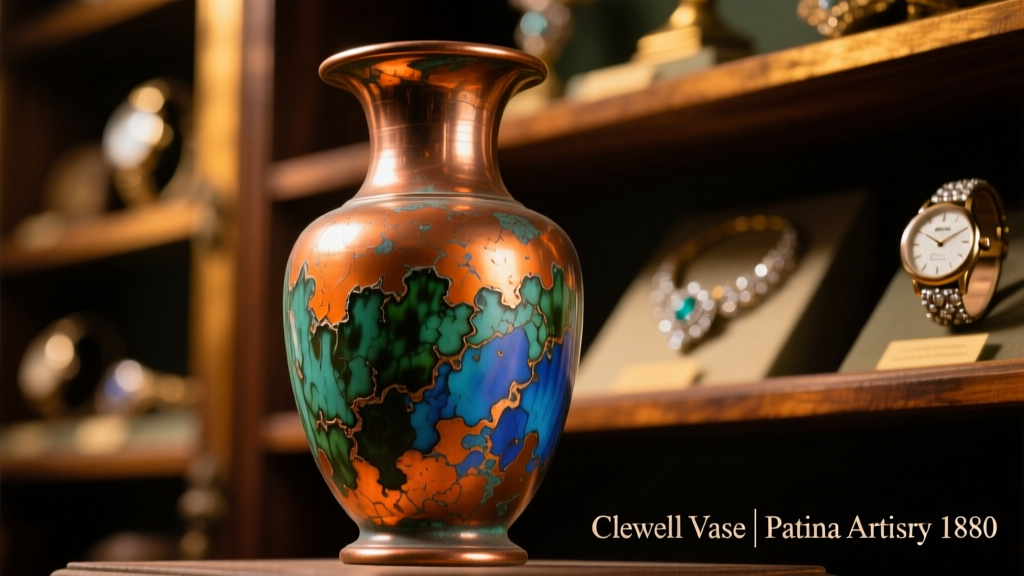
Clewell Vase: Copper-Clad Artistry with Orange-Green-Blue Patina — A 11½-Inch American Studio Masterpiece
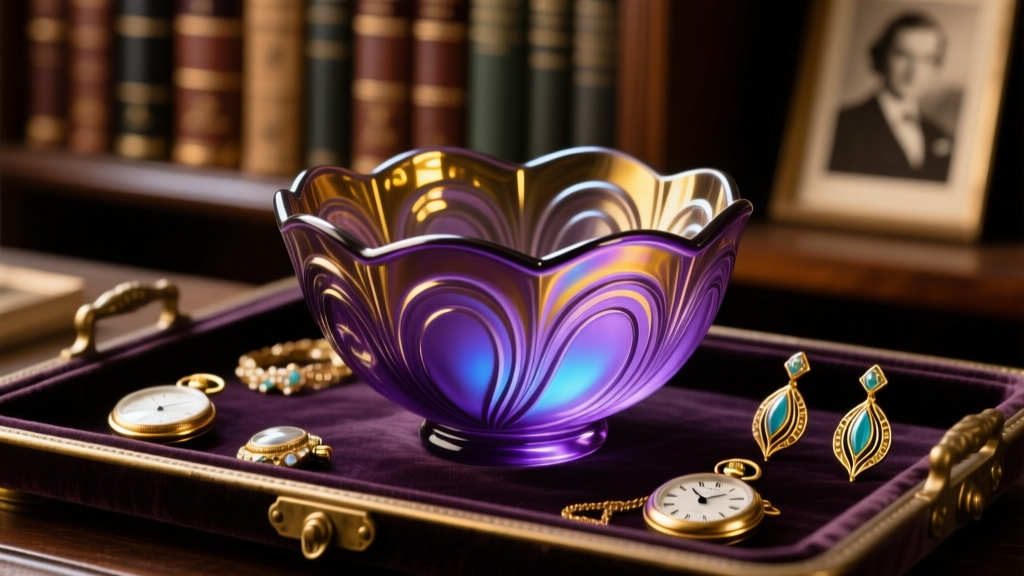
Carnival Glass Palm Beach Rose Bowl in Amethyst: History, Identification, and Market Value
The 1958 Toy Car Chrysler: A Japanese-Made 2-Tone Green Die-Cast Icon — History, Identification & Collectibility
Easy Chair, Federal Period: Authentic Mahogany Trapezoidal Upholstered Seat with Original Hardware and Provenance
Mocha Bowl Seaweed Green: A Collector’s Study of the Iconic 12¼ × 5¾-Inch Art Glass Vessel
Westmoreland Glass Inquiry: Authenticating, Valuing, and Preserving America’s Most Collected Depression-Era Glassware
Doorstops Manor: A 1920s English Country House with Curvy Driveway, Turrets, and Meticulous Landscaping — B.H. 9 × 8 Inches
April 2012 Hotlines: A Critical Review of Vintage Watch Market Trends, Auction Results, and Collector Intelligence
Durand Vase: White Pulled Feathers with Clear Flashed Green Top — A 13-Inch Pair from the Golden Age of American Art Glass