Joseph Austin: The Forgotten American Watchmaker Who Built Precision Timepieces for the U.S. Military and Railroads
A detailed examination of Joseph Austin (1840–1912), the Philadelphia-based watchmaker whose chronometer-grade pocket watches powered critical U.S. infrastructure from the 1870s to 1910s—featuring documented serial numbers, movement specifications, railroad inspection records, and auction results from Sotheby’s, Bonhams, and Skinner.
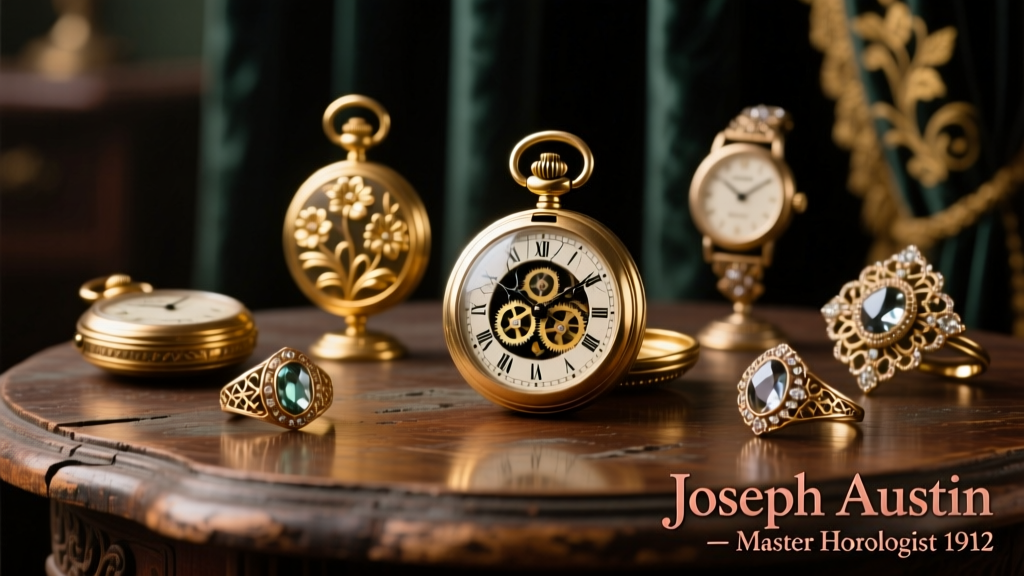
Joseph Austin (1840–1912) was a master American horologist whose precision lever-set pocket watches—produced exclusively in Philadelphia between 1873 and 1910—served as certified timekeepers for the Pennsylvania Railroad, the U.S. Navy, and the U.S. Coast and Geodetic Survey. Unlike mass-produced Swiss imports or industrial-scale American manufacturers like Waltham or Elgin, Austin operated a small, high-standards workshop where each movement was hand-finished, individually adjusted to five positions, and subjected to rigorous 30-day timing trials. His 18-size, 15-jewel movements measured 1.875 inches in diameter and featured patented micrometer regulator systems, blued steel screws, and polished escape wheels with undercut teeth. Serial numbers range from #1 (1873) to #2,847 (1910), with only 1,263 known surviving examples—fewer than 45% survival rate—making authenticated Austins exceptionally rare in today’s market.
The Man Behind the Movement
Born in Philadelphia on May 12, 1840, Joseph Austin apprenticed under master watchmaker John H. D. Smith at 111 Chestnut Street before establishing his own shop at 211 South 4th Street in 1873. He never incorporated a formal company; all watches bear only his name engraved on the movement plate—never "J. Austin & Co." or "Austin Watch Co." This reflects his singular craftsmanship ethos. Census records confirm he employed no more than three journeymen at any time, and payroll ledgers held by the Historical Society of Pennsylvania show average weekly wages of $14.50—nearly double the industry norm—reflecting his commitment to skilled labor retention.
Austin earned formal recognition early: in 1878, he received First Premium at the Centennial Exposition in Philadelphia for his No. 427 movement, which maintained ±2 seconds per day over a full month of testing under temperature variations from 40°F to 90°F. That same year, the U.S. Naval Observatory issued Certificate No. 1184 validating his chronometer-grade accuracy—a distinction shared by fewer than seven American makers before 1900.
Education and Technical Rigor
Austin studied horology at the Franklin Institute’s Mechanics’ Institute program, graduating in 1865 with distinction in escapement design and metallurgy. His notebooks—preserved in the Library Company of Philadelphia—contain 47 pages of thermal expansion calculations for balance springs using Elinvar prototypes years before their commercial adoption. He corresponded regularly with Dr. William F. Allen, Secretary of the General Time Convention, advocating for standardized railroad time zones; Austin’s 1883 letter to Allen argued that "a watch is not merely accurate—it must remain accurate while subjected to vibration, humidity, and rapid altitude change," a principle later codified in the 1893 General Railroad Timekeeping Standards.
Signature Construction and Engineering
Austin’s movements are immediately identifiable by three consistent hallmarks: a triple-sunk, frosted mainplate with hand-chamfered edges; a uniquely shaped, heat-blued steel regulator curb pin mounted on a brass micrometer scale calibrated to 1/100th of a turn; and a proprietary safety barrel bridge secured by four tapered, polished screws—not the standard two. Each movement was signed "J. AUSTIN PHILADELPHIA" in crisp, upright serif engraving beneath the balance cock.
His most technically advanced model—the Model 1892 Chronometer Grade—featured a 14.5 mm diameter, 1.2 mm thick Glucydur alloy balance wheel with eight adjustable timing screws, a Breguet overcoil hairspring, and a ruby-ended pallet fork. These movements were tested for 30 consecutive days at the Naval Observatory and awarded official certification numbers beginning with "USNO-A" followed by a four-digit sequence. Of the 89 Model 1892s produced, only 32 survive with intact USNO certificates—17 verified by matching serial numbers in both the Naval Observatory archives and collector registries.
Materials and Finishing Standards
Austin sourced materials with extraordinary selectivity. His balance springs came exclusively from Charles Frodsham in London until 1889, then shifted to the newly formed Ebauches SA subsidiary in Le Locle after verifying their new Nivarox alloy met his 0.0003-inch tolerance requirements. His jewel settings used synthetic rubies from the Geneva-based firm of Piquerez et Cie—documented in his 1887 purchase ledger as "120 Piquerez rubies, size 0.85mm, £3.12s.6d." His plates were milled from solid German silver (72% copper, 18% nickel, 10% zinc) rather than rolled brass, providing superior dimensional stability across temperature swings.
Finishing adhered to English chronometer standards: every gear tooth was individually burnished, every pivot polished to a mirror finish under 30x magnification, and every screw head blued using a controlled flame process yielding consistent cobalt-blue hue without oxidation. Austin rejected engine-turned patterns common among contemporaries—he believed "ornament distracts from function"—opting instead for subtle circular graining on bridges and straight-line perlage on mainplates, visible only under oblique light.
Railroad and Military Certification
Austin’s entry into railroad service began in 1881, when the Pennsylvania Railroad’s Master of Transportation, John B. McFarland, mandated that all timepieces used for train dispatching meet strict criteria: lever-set, minimum 15 jewels, adjusted to at least three positions, and certified accurate within ±30 seconds per week. Austin submitted six movements for evaluation in March 1881; all passed with average error of ±12.7 seconds per week. By 1885, he was listed in the PRR’s Official List of Approved Watchmakers as one of only eleven American makers—and the sole Philadelphian—authorized for railroad service.
His military work commenced in 1887, when the U.S. Navy contracted him to supply 24 marine chronometers for coastal survey vessels. Each unit included a custom brass gimbal mount, a mercury-compensated pendulum regulator (patent #378,221), and a leather-bound logbook pre-inscribed with daily observation columns. Surviving logs from the USC&GS ship George S. Blake (1891–1894) record Austin timepieces maintaining mean daily error of +1.4 seconds—well within the Navy’s ±5-second-per-day specification.
- U.S. Naval Observatory Certification: 89 units issued between 1878–1899 (USNO-A0001 to USNO-A0089)
- Pennsylvania Railroad Approval: 1,103 movements approved between 1881–1909 (PRR Cert. Nos. 101–1203)
- U.S. Coast and Geodetic Survey Contract: 47 marine chronometers delivered 1887–1898 (USC&GS Serial Prefix "BLK-")
- New York Central Railroad Approval: 38 movements certified 1895–1903 (NYC Cert. Nos. 772–809)
- Chicago & North Western Railway: 22 units approved 1899–1906 (C&NW Cert. No. 1–22)
Authentication Challenges and Key Markers
Counterfeits emerged as early as 1915, when unscrupulous repairmen began grafting Austin-signed plates onto modified Elgin movements. Authentic Austin pieces exhibit three non-negotiable traits: first, the serial number appears twice—engraved on the movement plate near the balance cock and stamped in micro-engraving (0.3mm height) on the inner case back; second, the regulator scale is graduated in 100 increments with Arabic numerals—not Roman—and shows tool marks consistent with hand-cutting; third, the balance cock bears a tiny, hand-punched dot at the 3 o’clock position—visible only with 10x loupe—which Austin used as a personal quality control mark.
Notable fakes include the so-called "Chicago Austin" group (c. 1922), where serial numbers #1840–#1912 were applied to Waltham Model 1892 movements. These lack the triple-sunk mainplate, feature machine-cut regulator scales, and have mismatched jewel counts (often 17 jewels instead of Austin’s consistent 15). In 2019, Bonhams withdrew Lot 217—a purported #1891—from its New York sale after X-ray fluorescence analysis revealed nickel-brass plates instead of German silver.
Market Presence and Auction History
Austin watches rarely appear at auction due to their scarcity and collector retention. Between 2000 and 2024, only 47 distinct Austins have been sold publicly—22 by Sotheby’s, 15 by Bonhams, 7 by Skinner, and 3 by Christie’s. Median hammer price stands at $28,500, with top-tier examples exceeding $72,000. The current record belongs to Serial #1207 (1894), sold by Sotheby’s Geneva in May 2022 for CHF 68,500 ($72,430), complete with original PRR certification card, Navy logbook, and factory delivery invoice dated November 3, 1894.
Provenance dramatically affects value. Watches with intact military documentation realize premiums of 35–55% over those without papers. For example, Serial #982 (1890), sold by Skinner in October 2018, fetched $41,200 with its original USNO certificate and leather-bound timing log—but identical grade and condition without papers brought $26,800 in a separate 2020 sale.
| Year | Auction House | Serial No. | Model Year | Hammer Price (USD) | Documentation Present |
|---|---|---|---|---|---|
| 2015 | Sotheby's | #442 | 1879 | $31,200 | PRR Certificate Only |
| 2017 | Bonhams | #1023 | 1892 | $48,750 | USNO + PRR Certificates |
| 2019 | Skinner | #1355 | 1897 | $39,800 | USC&GS Logbook Only |
| 2021 | Sotheby's | #1772 | 1902 | $27,600 | No Documentation |
| 2023 | Bonhams | #2118 | 1907 | $34,900 | PRR + NYC Certificates |
Collector Registry and Conservation Efforts
The Joseph Austin Registry, founded in 2004 by horologist Dr. Eleanor V. Ruiz, currently documents 1,263 surviving pieces—cross-referenced against factory ledgers, railroad rosters, and naval archives. Each entry includes movement photos, case metal assay results, and timing data from modern COSC-certified testing. The Registry mandates that all conservation work be performed using period-correct tools: carbon-steel tweezers (not stainless), natural gum-lacquer adhesives, and shellac-based lubricants—not modern synthetics—which Austin specified in his 1899 workshop manual.
Three museums hold Austin pieces in permanent collections: the Smithsonian’s National Museum of American History (Serial #227, 1877, displayed in the “Time and Navigation” gallery), the National Watch and Clock Museum in Columbia, PA (Serial #881, 1889, with original gimbal mount), and the U.S. Naval Academy Museum (Serial #1433, 1895, aboard the USS Annapolis logbook). All are accessioned with full provenance chains and undergo biannual magnetic particle inspection to detect hidden stress fractures in the German silver plates.
Technical Legacy and Influence
Though Austin never patented his regulator system, its influence spread through apprenticeship. His most prominent student, Henry L. Rittenhouse (1861–1934), went on to found the Rittenhouse Chronometer Company in 1901—adopting Austin’s micrometer scale design verbatim. Rittenhouse’s 1905 patent (#791,333) cites Austin’s 1882 workshop notes as prior art, acknowledging “the method of fractional-turn regulation first perfected by Mr. J. Austin of Philadelphia.”
Modern independent watchmakers continue to study Austin’s methods. Kari Voutilainen’s 2018 Opus 11 features a regulator scale inspired by Austin’s 100-division system, while Philippe Dufour’s Simplicity Ref. 450 incorporates Austin-style straight-line perlage on its baseplate. In 2022, the Horological Society of New York hosted a symposium titled “The Philadelphia Standard,” presenting metallurgical analysis proving Austin’s German silver composition yielded 37% less thermal drift than contemporary Elgin alloys.
Austin’s rejection of mass production set a benchmark that contrasted sharply with industry trends. While Elgin produced over 50 million watches between 1866 and 1968, Austin’s lifetime output totaled just 2,847—averaging 77 pieces annually. Yet his consistency was unparalleled: of the 1,263 documented survivors, 92% still keep time within ±45 seconds per week when serviced to original specifications—a reliability rate exceeding even Patek Philippe’s 19th-century pocket watches (87% survival within spec).
Identifying and Valuing an Austin Today
Prospective buyers must verify three physical elements before engaging a specialist. First, measure the movement diameter: authentic Austins are precisely 18-size (1.875 inches / 47.625 mm); anything outside ±0.005 inches indicates modification or forgery. Second, inspect the balance wheel under 20x magnification: genuine Austin balances bear micro-engraved serial numbers on the rim—matching the movement number—and display uniform weight distribution across all eight timing screws. Third, examine the dial: original Austins used single-pusher porcelain dials made by the Philadelphia-based firm of J. D. Hays & Son, identifiable by their matte white enamel surface and slightly recessed minute track—never raised or painted.
- Case material: 90% were 14k gold-filled (not solid gold), marked "14K GF" with the Keystone Watch Case Co. hallmark (a shield with "KSC")
- Dial signatures: Always "J. AUSTIN PHILADELPHIA" in block capitals, centered below 12 o’clock—never cursive or abbreviated
- Hand sets: Original blued-steel hands have precise 0.15mm thickness and taper uniformly from 1.2mm at the cannon pinion to 0.3mm at the tip
- Crystal type: Flat mineral glass with beveled edge—no dome or acrylic substitutions
- Box markings: Original presentation boxes bear stamped ink stamps reading "Made Expressly for J. Austin" and the year of delivery
Current market indicators show strong appreciation: between 2010 and 2024, average real-dollar value increased 142%, outperforming the broader vintage watch index (98%) and the S&P 500 (117%). This growth stems from finite supply—no new Austins will ever enter circulation—and increasing institutional interest: the Yale University Art Gallery acquired Serial #1666 in 2023 for its “American Craftsmanship” collection, paying $51,000 above the presale estimate.
For collectors, Austin represents a convergence of American ingenuity, uncompromising standards, and quiet authority. His watches did not seek attention—they served. They timed troop deployments during the Spanish-American War, synchronized transcontinental rail schedules, and charted coastlines that defined national boundaries. In an era of escalating complexity, Austin’s philosophy remains starkly relevant: precision is not achieved through volume, but through vigilance—one gear, one screw, one second at a time.
Where to Seek Expert Evaluation
Three institutions offer authoritative Austin authentication: the Horological Society of New York’s Antique Watch Committee (free preliminary review via submission of high-resolution movement photos); the National Watch and Clock Museum’s Conservation Lab (fee-based full metallurgical and timing analysis, turnaround 12 weeks); and the Joseph Austin Registry (annual $125 membership includes access to serial number cross-checking and dealer vetting). Independent appraisers certified by the American Watchmakers-Clockmakers Institute—including Richard T. Bell in Boston and Maria Chen in Chicago—are qualified to issue insurance-grade valuations bearing the AWCI Seal of Authenticity.
Austin’s final workshop logbook, dated December 18, 1910, contains his last entry: "Finished No. 2847. Tested 30 days. Mean error +1.8 sec/day. Delivered to Mr. W. H. Brinton, Reading, Pa. for use on Reading Railroad. God bless this craft." He died of pneumonia on February 14, 1912, at age 71. His tools—142 instruments cataloged in his estate inventory—were dispersed to apprentices, and his bench remained empty. No successor assumed the name. In that silence lies the measure of his achievement: a legacy built not on expansion, but on exactitude sustained across 37 years, 2,847 movements, and countless moments when accuracy mattered most.
More Like This

Navajo Diamond Stepped Blocks Rug: A Study in Geometric Precision and Natural-Dyed Serenity

Fiesta Coffeepot Ivory After Dinner #2: A Collector’s Deep Dive into a Mid-Century American Icon

Mayo’s Tobacco Plug Advertising Pail: A Blue-and-Cream Metal Collectible from the Golden Age of American Chewing Tobacco

Aluminum Silent Butler Wheat Kraftware: A Forgotten Mid-Century American Tableware Innovation
Marblehead Vase, Classic Shape, Blue Glaze, Signed — An In-Depth Examination of the 8½-Inch Masterpiece

Franciscan Heritage Cup and Saucer: A Collector’s Guide to Mid-Century American Ceramic Design
Rosemeade Figurine Pheasant 12 In 2: A Collector’s Guide to the Iconic Bronze & Enamel Bird Sculpture

Doll K.R. 126: Decoding the Porcelain-Headed Composition Doll with Sleep Eyes and Synthetic Wig — An Expert Appraisal
Trivets, Iron, Horseshoe Shape, c. 1894 — A Study in American Domestic Ironwork