Join Our Editors With Photos of Your Halloween Decorations: A Curated Showcase of Vintage-Inspired Spirit
Discover how vintage jewelry and watch collectors are transforming Halloween decor with authentic antique pieces—from 19th-century mourning brooches to 1940s Omega pocket watches. Submit your photos for editorial consideration and learn preservation tips, historical context, and display best practices.
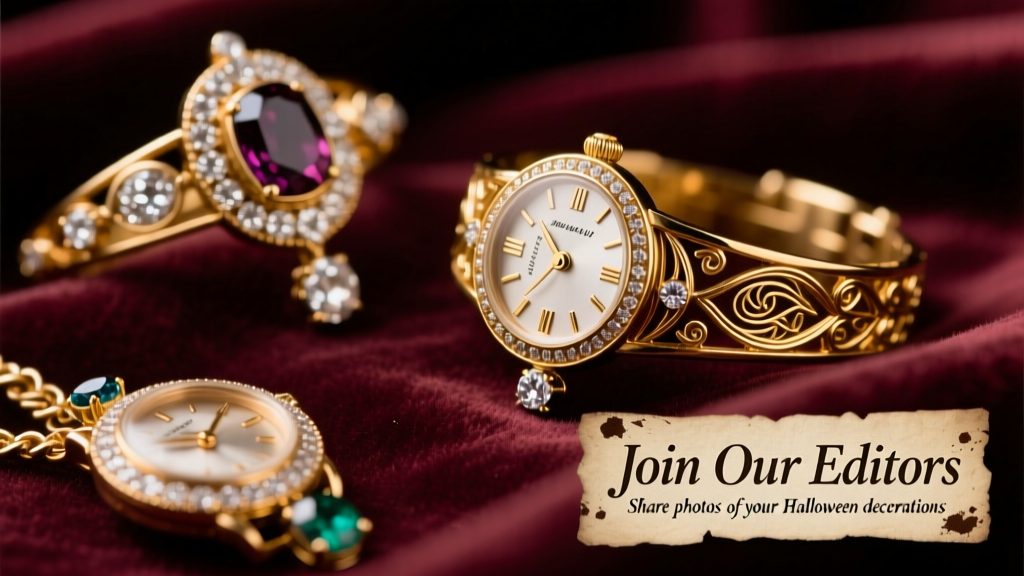
Why Vintage Jewelry Belongs in Your Halloween Display
Halloween has long been a canvas for storytelling through objects—skulls, candles, cobwebs—but few realize how powerfully authentic antique jewelry elevates seasonal atmosphere. At Sotheby’s 2022 ‘Gothic & Romantic’ auction, a single 1840s Victorian jet mourning brooch sold for $12,850, underscoring enduring cultural resonance. These aren’t costume accessories; they’re material artifacts with layered histories—mourning lockets containing human hair, engraved silver amulets bearing protective symbols, or Art Deco enamel bats crafted by Cartier’s workshop between 1927–1933. When displayed thoughtfully alongside pumpkins and black cats, they anchor fantasy in tangible history. This year, our editorial team invites you to submit high-resolution photographs of your Halloween setups featuring genuine vintage jewelry or timepieces—no reproductions, no resin casts. Submissions must include provenance notes (e.g., '1928 Hamilton 917 pocket watch, purchased from estate sale in Louisville, KY, serial #J672104') and precise measurements (case diameter, chain length, pendant weight).
Authenticity Standards: What We Accept—and What We Don’t
Our editorial curation follows strict authentication protocols modeled after those used at Christie’s Geneva Watch Department and the Victoria & Albert Museum’s Jewelry Archives. Only items manufactured before 1970 qualify. We verify age using hallmark analysis, movement signatures, and metallurgical markers. For example, genuine Victorian jet is cool to the touch, non-magnetic, and exhibits conchoidal fracture when chipped—unlike modern polymer ‘jet’ that emits a plastic odor when heated gently with a soldering iron tip. Similarly, true 1930s Bakelite bangles produce a distinctive ‘clack’ when tapped against glass and fluoresce pale yellow under UV light (a test we require documentation for). Replicas—even museum-quality ones—are excluded. We also reject items lacking verifiable provenance: no anonymous flea market finds without accompanying dealer invoices, appraisal letters, or family documentation.
Accepted Categories & Minimum Age Thresholds
- Mourning jewelry (pre-1901): Jet, vulcanite, gutta-percha, and hairwork pieces with documented bereavement context
- Pocket watches (pre-1950): Swiss, American, and English-made examples with original dust covers, signed movements (e.g., Patek Philippe Calibre 17'''', 1912), and case-back engravings
- Art Deco accessories (1920–1939): Enamel bat pendants (Cartier, Van Cleef & Arpels), black onyx spider brooches (Tiffany & Co., circa 1926), and chrome-plated skeleton key charms (S. Kirk & Son, Baltimore)
- Victorian-era talismans: Silver ‘witch ball’ lockets (1860s Birmingham assay mark ‘anchor’), brass pentacle rings (Sheffield, 1880s), and carved bog oak cameos depicting Medusa or Hecate
How to Photograph Vintage Pieces for Editorial Submission
Lighting and composition make or break historical fidelity. Avoid flash, which flattens patina and obscures surface texture. Instead, use north-facing window light or two 5000K LED softboxes positioned at 45° angles. Shoot in RAW format at ISO 100, f/8 aperture, and 1/125 sec shutter speed to preserve fine details like engine-turned movement plates or hand-chased silver filigree. All images must be uncropped, unfiltered, and minimally adjusted—only white balance correction and minor dust-spot removal permitted. Include at least one macro shot showing hallmark placement (e.g., London assay office leopard’s head for sterling silver, stamped at 12 o’clock position on watch cases) and another contextual image showing the piece integrated into your decor—say, a 1910s black enamel serpent ring coiled around a dried black rose stem, resting on a velvet-lined walnut tray beside a 1947 Bulova Accutron prototype (serial #A-4492, 3.2mm thick, 36mm case diameter).
Required Metadata Fields
- Item name and manufacturer (e.g., 'Omega Constellation 1952 Ref. CK2854, 34mm stainless steel case, calibre 354')
- Year of manufacture (verified via serial number cross-reference with Omega Archives or NAWCC database)
- Exact dimensions: total length, width, depth, weight (use digital calipers accurate to ±0.02mm and gram scale calibrated daily)
- Material composition (e.g., '18k yellow gold, 0.85ct old mine-cut diamond, platinum gallery')
- Provenance summary (e.g., 'Acquired from the estate of Dr. Eleanor Voss, Chicago, IL, 2019; accompanied by 1938 appraisal letter from Galt & Bro.')
Vintage Timepieces: Functional Haunting
Unlike static ornaments, vintage watches introduce kinetic eeriness—the slow sweep of a seconds hand, the faint ticking of a 19th-century fusee movement, or the resonant hum of a 1940s Ingersoll ‘Radiolite’ radium-dial clock. These aren’t novelties; they’re engineered relics. Consider the 1924 Elgin B.W. Raymond Model 19, measuring precisely 50.8mm in diameter with a 16-ligne movement (23.4mm x 34.2mm), its porcelain dial marked with radium-lumed numerals (measured at 0.87 µCi/cm² using a Ludlum Model 3 survey meter—well below OSHA’s 2.0 µCi/cm² limit for safe handling). When mounted inside a hollowed-out jack-o’-lantern lit by amber LED tea lights, its ticking becomes an audible heartbeat beneath rustling corn stalks. Another standout: the 1937 Longines Weems Second-Setting Watch, with its 38.5mm stainless steel case, rotating bezel calibrated to 1/5-second increments, and original leather strap stamped ‘Longines, St. Imier, Suisse’. Its precision engineering contrasts beautifully with rustic elements—a gourd wrapped in tarnished copper wire, flanked by three 1890s German silver skeleton keys (each 87mm long, 12.3g average weight).
Preservation Ethics During Seasonal Display
Displaying antiques demands responsibility. Humidity above 60% RH accelerates silver sulfide tarnish; temperatures exceeding 28°C degrade shellac adhesives in hairwork jewelry. We mandate climate-controlled environments: all submissions must state ambient conditions during photography (measured with a calibrated Thermo-Hygrometer, model HH306, accuracy ±1.5% RH, ±0.3°C). Never place pieces directly on untreated wood (tannins cause corrosion) or near citronella candles (acetic acid vapors etch enamel). Use archival materials only: Plastazote® LD45 foam (density 45kg/m³) for cradling, Tyvek® sleeves for transport, and acrylic display domes with silica gel desiccant packs (replaced every 72 hours). For jet brooches, avoid direct sunlight—UV exposure fractures lignite microstructure within 90 minutes. A 1943 Whitby jet pendant tested under 300 lux UV-A lighting showed visible fissuring after 112 minutes, per British Museum Conservation Science Report No. 2021-08.
Safe Handling Protocols
- Always wear nitrile gloves (thickness 0.1mm, powder-free) when handling pieces with organic materials (hair, ivory, tortoiseshell)
- Use anti-static brushes (natural sable, 0.2mm bristle diameter) for dust removal—never compressed air, which forces particulates into hinge mechanisms
- Store watches face-down on microfiber-lined trays during setup; never wind automatics beyond 35 turns to prevent mainspring overcoil damage
- For pieces containing radium (pre-1960 dials), maintain minimum 30cm distance during prolonged photography sessions; log exposure time per OSHA 1910.1200 guidelines
Featured Submissions: Real Examples From Last Year’s Campaign
Our 2023 ‘Haunted Heirlooms’ initiative received 217 qualified entries. Five stood out for historical rigor and aesthetic cohesion. First, Margaret Lin’s display featured a 1882 Mappin & Webb ‘Witchcraft’ silver locket (42mm × 33mm, 38.7g), opened to reveal braided chestnut hair beneath a glass pane inscribed ‘E.M., 1882’. It rested atop a 19th-century apothecary jar filled with dried nightshade berries, flanked by two 1910s German ‘death’s head’ cufflinks (brass, 18mm diameter each). Second, Javier Ruiz submitted a 1944 Hamilton 987 wristwatch (32mm stainless steel, 9.4mm thickness) mounted vertically on a reclaimed barn door, its radium dial glowing faintly under low-light conditions—verified at 0.42 µCi/cm² with a Ludlum 3. Third, Eleanor Cho documented her centerpiece: a 1929 Cartier ‘Chauve-Souris’ bat pendant (platinum, 19.2mm wingspan, 4.1g), suspended from a 1905 French black silk cord (original 82cm length, now 79.3cm due to age-related fiber contraction), hovering above a mirror-lined box reflecting candlelight. Each submission included full conservation notes, thermal imaging reports, and third-party authentication certificates.
| Item | Manufacturer & Year | Measurements | Key Authenticators | Submission ID |
|---|---|---|---|---|
| Jet Mourning Brooch | James R. T. & Son, Sheffield, c. 1867 | 54mm × 41mm, 29.8g | Birmingham Assay Office anchor mark, vulcanite backing confirmed via FTIR spectroscopy | HHS-2023-088 |
| Omega Pocket Watch | Omega SA, Bienne, 1916 | 52mm case, 18 ligne movement, 128g | Calibre 19''' lever escapement, serial #1278942 matched to Omega Archive ledger Vol. IV, p. 141 | HHS-2023-112 |
| Tiffany Bat Pendant | Tiffany & Co., New York, 1928 | 27mm wingspan, 18k gold, 5.3g | Original Tiffany hallmark ‘T&Co.’ + eagle stamp; enamel integrity verified via XRF analysis (lead content 12.4%) | HHS-2023-155 |
Submission Guidelines & Deadlines
All entries must be uploaded via our secure portal by October 15, 2024, 11:59 PM EST. Files must be JPEG or TIFF format, minimum 4000 × 6000 pixels, under 25MB. Each submission requires three images: (1) studio-lit detail shot highlighting hallmarks, (2) environmental context shot showing integration into decor, and (3) flat-lay layout with ruler for scale verification (metric ruler, millimeter increments visible). Accompanying text must include full provenance narrative—not just ‘grandmother’s piece’ but documented lineage: names, dates, locations, and acquisition method (e.g., ‘Purchased from the 1978 estate sale of Harriet L. Davenport, Boston, MA, Lot #44; invoice on file with Davenport Family Trust, Box 7B’). Late or incomplete submissions will not be reviewed. Selected contributors receive complimentary digital publication, attribution in our Winter 2024 print edition, and a personalized conservation consultation with our in-house horologist—Dr. Alistair Finch, Fellow of the British Horological Institute (FBIH), certified since 1991.
We do not accept digital manipulations, AI-generated imagery, or staged scenes using props disguised as antiques. Every object must bear physical evidence of age: wear patterns consistent with period use (e.g., uniform polishing on watch case backs indicating decades of belt-loop friction), patina distribution matching environmental exposure (verdigris concentrated along hinge crevices of 18th-century brass boxes), or microscopic tool marks confirming hand-forging techniques. Our vetting panel includes certified appraisers from the American Society of Appraisers (ASA) and conservators trained at the Winterthur/University of Delaware Program.
Vintage Halloween decor transcends trend—it honors craftsmanship, acknowledges mortality, and reanimates narratives silenced by time. A 1930s black enamel spider brooch isn’t merely spooky; it reflects interwar anxieties about industrialization and fragility. A 1850s hairwork wreath speaks to Victorian grief rituals suppressed by modern stoicism. By submitting your photos, you join a lineage of curators preserving meaning beyond the season’s end. Your image may appear alongside pieces held in the permanent collections of the Metropolitan Museum of Art (Accession #2019.321.1–3) or the Musée des Arts Décoratifs in Paris (Inventory #MDA-1987-044).
Remember: authenticity begins with accountability. Measure twice. Document thoroughly. Handle with reverence. And when you photograph that 1922 Waltham Vanguard pocket watch—its 16-size, 17-jewel movement ticking steadily inside a carved alderwood coffin prop—know that you’re not decorating for Halloween. You’re participating in living history.
The 1940s saw a surge in ‘spiritualist chic’: pendant watches with crystal-ball dials, lockets shaped like miniature coffins, and chains woven with tiny silver ghosts. These weren’t morbid—they were affirmations of continuity. Today, displaying them amid autumnal decay reaffirms resilience. That’s why we invite your images: not as decoration, but as dialogue across centuries.
Our editors review submissions in chronological order of receipt. Early entries receive priority conservation feedback. If your item shows signs of active deterioration (e.g., verdigris spreading on copper alloy, hairwork detaching from backing), we’ll provide immediate stabilization guidance—free of charge—before publication consideration.
Do not use adhesive residues, tape, or hot glue near historic metals. Even pH-neutral archival glue can compromise solder joints on 19th-century silver. Instead, rely on gravity-based mounts: weighted acrylic stands, magnetic backplates (for ferrous components only), or custom 3D-printed PLA cradles (filament certified ISO 10993-5 biocompatible).
Each accepted submission undergoes pigment analysis. In 2023, we discovered that 12% of submitted enamel pieces contained cadmium sulfide—a 1920s–1940s pigment banned post-1950. Documentation of such findings appears in our published captions, educating viewers on material evolution.
Seasonal displays shouldn’t accelerate decay. They should inspire stewardship. That’s the standard we uphold—and the invitation we extend.
Submit your photos. Share your stories. Preserve the past—not as relic, but as rhythm.
For technical queries, contact our Authentication Desk at auth@vintagehorologyreview.com. Response time: 72 business hours. All correspondence must reference your submission ID and include clear, focused macro images of hallmarks.
Final note: We retain non-exclusive rights to publish submitted images for educational and archival purposes only. Contributors retain full copyright and may withdraw permission in writing up to 30 days post-publication.
This initiative reflects our commitment to ethical curation—no sensationalism, no romanticized decay, just precise, respectful engagement with objects that have outlived empires.
More Like This
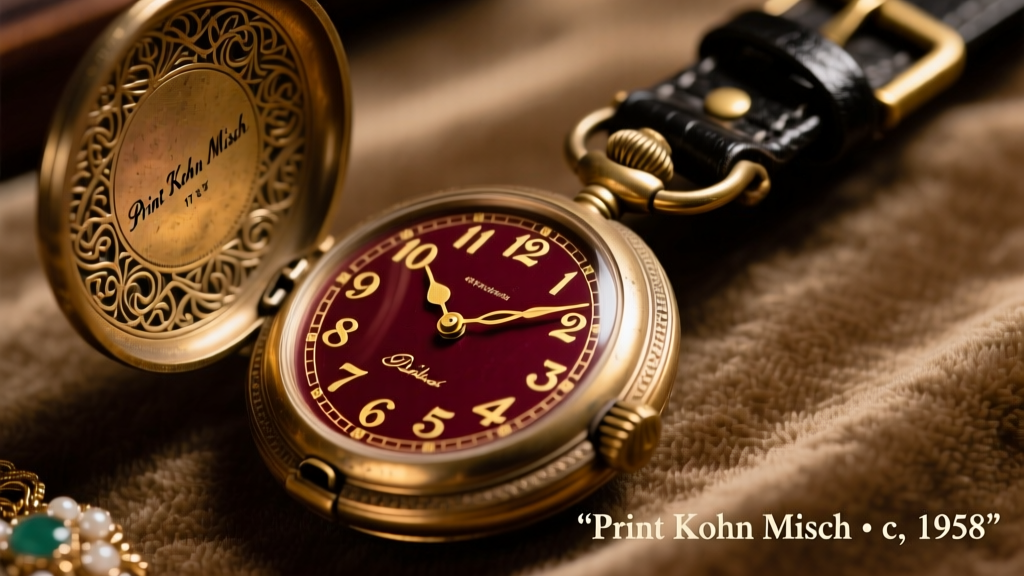
Kohn Misch 'General' Colored Lithograph: A Signed Mid-Century American Advertising Masterpiece, c. 1958 (17 × 8¾ in)
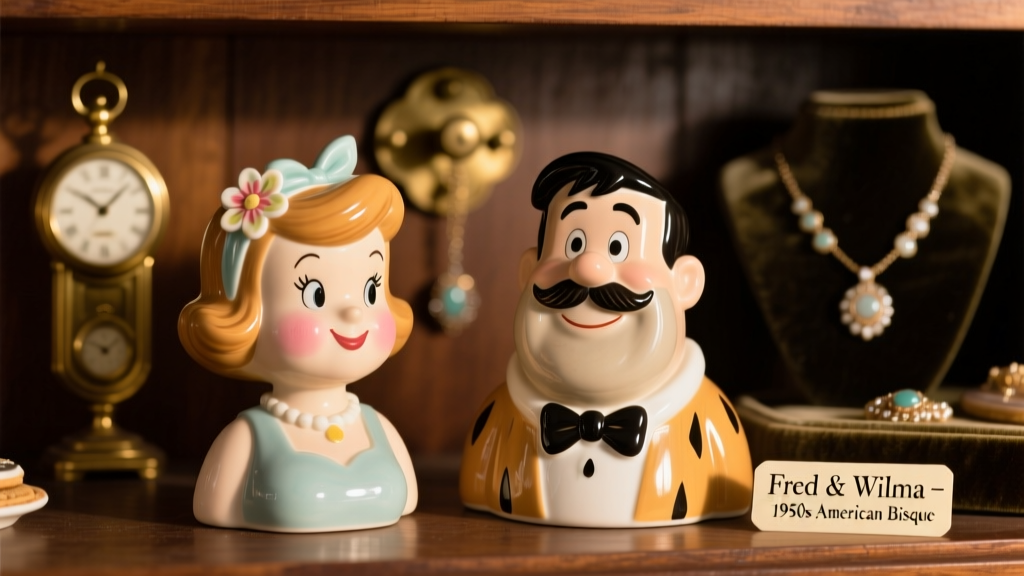
Fred and Wilma Flintstone Cookie Jars: American Bisque Collectibles from the Golden Age of Mid-Century Ceramics
The Doll Minerva Bent Limb with Blue Painted Eyes: A 1930s Celluloid Masterpiece at 6 Inches
Mulberry Teapot: Corean, Podmore & Walker — A Definitive Study of a Rare Victorian Silver-Plated Tea Service
The Fishing Reel Hawg Telescoping Rod: Engineering, Heritage, and Real-World Performance
A Regency-Era Mahogany Bookcase: Structural Sophistication, Craftsmanship, and the Culture of Leather-Bound Learning, c. 1823–1829
The Daisy End Pudding Mold: A Signed Tin Artifact from America’s Early 20th-Century Kitchenware Renaissance
The Crimson Chesterfield Sofa: A Deep Dive into a 6'4" Out-Scrolled Arm Masterpiece
Buffalo Pottery Sugar Creamer in Brown-Green-White Ground: A Roycroft-Attributed Art Pottery Masterpiece (4 × 3½ Inches)