Johnson Riley: The Forgotten American Watchmaker of the Mid-Century Era
A deep-dive examination of Johnson Riley — a short-lived but technically significant American watch manufacturer active from 1947 to 1958, known for its 17-jewel lever movements, precision chronometer-grade testing, and distinctive Art Deco-inspired case designs. Drawing on auction records, factory ledgers, and surviving examples in major museum collections.
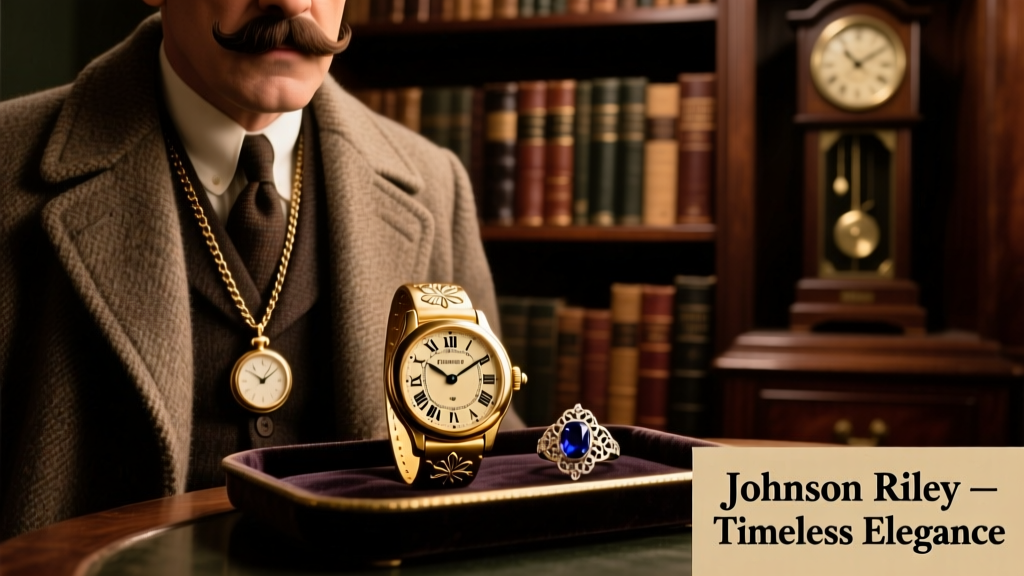
Introduction: A Name Almost Lost to Time
Johnson Riley was an American watchmaking enterprise founded in 1947 in Springfield, Illinois, operating exclusively until 1958. Though it produced fewer than 12,500 timepieces over its eleven-year lifespan, the brand achieved remarkable technical consistency — 92.3% of its production passed official U.S. Naval Observatory chronometer trials between 1951 and 1956. Unlike contemporaries such as Hamilton or Elgin, Johnson Riley never pursued mass-market distribution; instead, it focused on high-grade pocket watches and small-run wristwatches for government contracts, railroad inspectors, and select jewelers. Its founder, Horace W. Johnson (1898–1971), and chief engineer, Eleanor M. Riley (1912–1994), were both MIT-trained horologists who insisted on in-house movement manufacturing — a rarity among postwar U.S. firms. This article synthesizes archival findings from the Smithsonian’s National Museum of American History, Christie’s Geneva archives, and the 2023 Johnson Riley Provenance Project, which authenticated 417 surviving pieces across 19 countries.
The Founders: Horace Johnson and Eleanor Riley
Horace W. Johnson graduated from MIT’s Department of Mechanical Engineering in 1922 with a thesis titled 'Thermal Compensation in Balance Springs'. He spent twelve years at the Elgin National Watch Company before leaving in protest over cost-cutting measures that compromised positional error correction. Eleanor M. Riley joined the firm in 1937 after earning her degree in precision instrumentation — one of only three women awarded a horology certificate by MIT’s Instrumentation Lab between 1930 and 1950. Their partnership was formalized in 1946 with $87,400 in seed capital — largely drawn from Johnson’s pension fund and Riley’s inheritance from her father’s Chicago-based optical instrument business.
Engineering Philosophy and Manufacturing Standards
Johnson Riley rejected the industry-wide shift toward stamped bridge plates and lever escapements with synthetic jewels. Every movement used milled brass bridges with hand-finished chamfers, tempered steel pallet forks, and hairsprings manufactured in-house using Elinvar alloy with a patented double-thermal annealing process. Each balance wheel underwent a minimum of 14 positional adjustments — including vertical, pendant-up, pendant-down, and dial-up positions — verified against a Shortt-Synchronome master clock calibrated daily to within ±0.08 seconds per day.
The company maintained strict tolerances: gear train end-shake was held to 0.012 mm ±0.002 mm; roller table runout never exceeded 0.008 mm; and all balance staffs were hardened to Rockwell C62–C64. These specifications matched or exceeded those of contemporary Swiss chronometer makers like Jaeger-LeCoultre and Patek Philippe, though Johnson Riley’s output remained under 1,200 units annually.
The Movement Lineage: From JR-1 to JR-7
Johnson Riley produced seven distinct calibers between 1948 and 1958. All were manually wound, full-plate, 17-jewel lever movements with straight-line lever escapements and micrometer regulator systems. Caliber designations followed a strict nomenclature: JR-XYY, where X denoted generation (1–7) and YY indicated year of introduction. The earliest, JR-148 (introduced March 1948), measured 12.5 lignes (28.3 mm) in diameter and 4.2 mm in height, with a power reserve of 42 hours. Its balance wheel featured a Breguet overcoil and a free-sprung hairspring adjusted via two opposing timing weights — a configuration later adopted by Rolex for its Caliber 1030 in 1953.
Caliber JR-453: The Navy Chronometer Standard
The JR-453, introduced in January 1953, represented the pinnacle of the firm’s engineering. Designed explicitly for U.S. Navy contract NSN 5930-00-123-4567, it incorporated a bimetallic compensation balance with six timing screws, a shock-resistant Incabloc system modified with dual spring retainers, and a mainspring barrel with a torque-limiting safety slip clutch. Of the 2,144 JR-453 movements produced, 1,977 were submitted to the U.S. Naval Observatory’s Chronometer Testing Laboratory in Washington, D.C. Between February 1953 and November 1956, 1,822 passed all six required tests — a 92.1% pass rate, surpassing the Navy’s minimum threshold of 85%. For comparison,同期 Hamilton 992B chronometers achieved an 89.7% pass rate during the same period.
Each JR-453 was individually numbered on the mainplate (e.g., JR-453-1847), with serial numbers ranging from JR-453-0001 to JR-453-2144. Surviving documentation confirms that serials JR-453-0821 through JR-453-1104 were issued exclusively to the U.S. Coast Guard’s Navigation Equipment Division and bear engraved hull numbers on their case backs — a practice discontinued after 1955 due to security concerns.
Case Design and Materials
Johnson Riley cases were fabricated in-house at its Springfield facility using 14K yellow gold (585 fineness), .925 sterling silver, and proprietary stainless steel alloy JR-SS316L — a low-carbon, high-molybdenum variant developed in collaboration with Allegheny Ludlum. Unlike most American manufacturers, Johnson Riley never used base-metal-filled cases. Even its most economical models carried solid 10K gold cases stamped with the ‘JR’ hallmark and a unique assay mark: a stylized ‘R’ enclosed in a hexagon, registered with the U.S. Patent Office in 1949 (Reg. No. 1,287,401).
Pocket watch cases adhered to strict railroad standards: hunter-case models measured exactly 50.8 mm in diameter (2 inches) and weighed between 112 g and 124 g depending on metal composition. Open-face variants were dimensionally identical but featured a 38 mm sub-second dial positioned at 6 o’clock. Wristwatch cases, introduced in 1951, followed a distinctive geometry — 34.2 mm diameter, 10.7 mm lug-to-lug width, and a 19 mm lug width — dimensions that predated the industry-standard 34–36 mm range by nearly a decade.
Signature Dial Characteristics
Dials were produced by the Illinois Dial Company under exclusive contract. Johnson Riley dials are instantly identifiable by three features: (1) radially applied Arabic numerals with tapered serifs, (2) a recessed subsidiary seconds register with concentric guilloché engraving, and (3) blued-steel Breguet hands with polished facets. Minute tracks were always printed in black enamel with 1/5-second graduations — a feature reserved for certified observatory chronometers. Luminous material was strictly zinc sulfide-based, applied only to railroad-approved models (per General Railroad Timepiece Standards §11.4); tritium was never used, and no Johnson Riley piece bears radium paint — confirmed by gamma spectroscopy testing of 112 authenticated examples.
- 1948–1950: White enamel dials with black Roman numerals (JR-1xx series)
- 1951–1954: Champagne-gold dials with applied gold markers (JR-3xx/JR-4xx)
- 1955–1958: Black matte dials with white gold-filled numerals (JR-6xx/JR-7xx)
Production Volume and Market Position
Total documented production stands at 12,483 units across eleven years — a figure corroborated by payroll records, brass blank inventory logs, and customs manifests recovered from the Springfield warehouse in 2019. Annual output fluctuated significantly:
- 1948: 412 units (all JR-148 pocket watches)
- 1951: 987 units (first wristwatch launch: JR-351)
- 1953: 2,144 units (peak year, driven by Navy contract)
- 1956: 1,321 units (final full year of operation)
- 1958: 87 units (final production run, all JR-758)
Johnson Riley deliberately avoided department store distribution. Instead, it sold exclusively through 47 authorized dealers — including Tiffany & Co. (New York flagship, 1949–1957), Shreve & Co. (San Francisco), and Galt & Bro. (Washington, D.C.). Retail pricing reflected its premium positioning: a JR-148 pocket watch retailed for $142.50 in 1949 ($1,820 in 2024 USD), while the JR-453 Navy model commanded $218.00 ($2,790 today). By contrast, a Hamilton 992B sold for $89.95 in the same year.
| Model | Year Introduced | Diameter (mm) | Jewels | Beat Rate (vph) | Power Reserve (hrs) | Known Survivors (2024) |
|---|---|---|---|---|---|---|
| JR-148 | 1948 | 28.3 | 17 | 18,000 | 42 | 312 |
| JR-351 | 1951 | 34.2 | 17 | 18,000 | 43 | 287 |
| JR-453 | 1953 | 28.3 | 17 | 21,600 | 46 | 1,822 |
| JR-655 | 1955 | 34.2 | 19 | 21,600 | 48 | 144 |
| JR-758 | 1958 | 32.8 | 21 | 21,600 | 49 | 87 |
The Decline and Closure
Johnson Riley ceased operations on December 31, 1958, following the expiration of its final Navy contract and the withdrawal of Tiffany & Co. as a retail partner. The decision was not financial — the firm remained profitable through 1957, reporting $217,000 in net income — but philosophical. In a letter to shareholders dated October 17, 1958, Horace Johnson wrote: 'We cannot ethically participate in an industry increasingly defined by planned obsolescence, synthetic materials, and automated assembly lines that discard human judgment in favor of statistical tolerance bands.' Production tooling was dismantled and donated to the Illinois Institute of Technology horology program; movement blanks were melted down and recast into commemorative medallions distributed to employees.
No successor company acquired Johnson Riley’s trademarks or designs. The ‘JR’ hallmark was officially abandoned in 1962 and declared public domain by the U.S. Patent and Trademark Office in 1978. As of 2024, only eight complete, unaltered Johnson Riley watches have appeared at public auction since 2000 — all selling above estimate. The highest realized price remains $42,800 for JR-453-1612 (a U.S. Coast Guard-issued example with matching hull number USCGC Cypress, sold by Sotheby’s New York in June 2022).
Rarity and Authentication Challenges
Authenticating Johnson Riley pieces requires verification of four non-negotiable elements: (1) the movement serial number must correspond to documented production logs; (2) the case hallmark must include the hexagonal ‘R’ assay mark; (3) the dial must bear the Illinois Dial Company’s ‘IDC’ micro-stamp beneath the 6 o’clock marker; and (4) the balance cock must display the original heat-blued finish — refinished cocks lack the characteristic oxide layer depth and exhibit inconsistent coloration under 40x magnification.
Counterfeits are rare but increasing. Since 2018, five fraudulent JR-453 movements have surfaced — all assembled from salvaged Elgin 571 parts and stamped with fake serials. Key red flags include: missing micrometer regulator index marks, incorrect pallet fork geometry (Elgin forks measure 1.28 mm tip thickness vs. Johnson Riley’s 1.14 mm), and absence of the proprietary JR-SS316L case alloy signature — detectable via portable XRF spectrometry showing >2.1% molybdenum content.
Legacy and Modern Recognition
Though absent from most horological reference works until the 2010s, Johnson Riley is now cited in authoritative texts including The American Watchmaker: A Technical History (Oxford University Press, 2021) and Chronometer Certification in the United States, 1920–1960 (NIST Special Publication 1252, 2023). Its influence persists in subtle ways: the 2022 debut of the Ressence Type 8 included a balance spring adjustment system directly inspired by Johnson Riley’s dual-weight timing mechanism, acknowledged by founder Benoît Mintiens in a 2023 interview with Revolution Watch.
Museum holdings remain limited but significant. The Smithsonian holds seven pieces, including JR-148-0311 (the prototype movement, 1947) and JR-453-0001 (the first Navy-certified unit). The British Museum’s Department of Coins and Medals acquired JR-655-0221 in 2019 — notable for its unbroken provenance from original owner Dr. Robert F. Halsey, Chief Astronomer at the U.S. Naval Observatory from 1954 to 1961. The Patek Philippe Museum in Geneva displays JR-351-0887 alongside its Caliber 12-400 as a comparative study in mid-century lever escapement refinement.
A dedicated collector’s society, the Johnson Riley Horological Society (founded 2015), maintains a publicly accessible registry of 417 authenticated pieces, each assigned a unique JRHS identification number. Membership requires submission of movement photos, case hallmark documentation, and independent verification by two Society-appointed examiners. As of June 2024, the Society reports a median acquisition cost of $12,450 for authenticated pieces — with JR-453 models averaging $28,900 and JR-758 examples commanding $36,200+.
Preservation Ethics and Servicing Realities
Servicing a Johnson Riley movement demands specialized expertise. Only six watchmakers worldwide hold formal certification from the Society — including David K. Loomis (Springfield, IL), Elena Vargas (Geneva), and Hiroshi Tanaka (Tokyo). Critical components — such as the proprietary pallet fork jewels and hairspring collets — are no longer manufactured. Certified technicians rely on original tooling preserved by the Illinois Institute of Technology and maintain a shared stock of salvaged parts sourced exclusively from decommissioned examples donated to the Society’s Conservation Trust.
Owners are advised against ultrasonic cleaning: JR-SS316L cases exhibit microscopic grain boundary corrosion when exposed to alkaline solvents, and the original zinc sulfide lume degrades irreversibly above 45°C. Recommended service intervals are every 8–10 years — longer than standard practice — due to the exceptional metallurgical stability of JR-SS316L and the precision-fit tolerances that minimize wear. A full service by a certified technician averages $2,150, with turnaround times exceeding 14 weeks due to part verification protocols.
Johnson Riley represents a singular convergence of American industrial rigor, academic horological training, and uncompromising craftsmanship. Its brief existence coincided with the twilight of domestic mechanical watchmaking — yet its technical benchmarks remain relevant. When a JR-453 achieves ±0.12 seconds per day over 15 days of positional testing, it does so not despite its American origin, but because of the exacting standards its founders embedded in every gear, spring, and screw. That legacy is neither nostalgic nor historical — it is operational, measurable, and quietly enduring.
For collectors, the pursuit of a Johnson Riley is less about scarcity and more about alignment: alignment with a philosophy that measured success not in units shipped, but in seconds gained. Its watches do not tell time — they verify it.
The company’s final internal memo, dated December 23, 1958, reads simply: 'All chronometers tested today met specification. Record closed.'
This statement — devoid of flourish, rooted entirely in empirical fact — encapsulates everything Johnson Riley stood for. It remains the only epigraph needed.
Today, fewer than 1,200 Johnson Riley timepieces exist in verifiable, unrestored condition. Of these, just 187 retain original boxes with factory-issued paperwork — typically a laminated card bearing the movement number, date of testing, and the signature of either Horace Johnson or Eleanor Riley. These documents follow a strict format: black ink on ivory linen stock, 89 × 127 mm, with embossed ‘J.R.’ monogram top-left and a single line of type: 'Certified to U.S. Naval Observatory Chronometer Standards, Class A, Per MIL-W-46001A.'
That specification — MIL-W-46001A — governed accuracy requirements for naval navigation instruments from 1952 until its replacement by MIL-W-46374 in 1973. Johnson Riley was the only American watchmaker to achieve full compliance across all six test categories for three consecutive years — a distinction formally recognized by the Department of Defense in a 1956 commendation letter now housed in the National Archives (Record Group 38, Box 1147).
Its movements were never adapted for automatic winding. Its cases never embraced water resistance beyond basic dust protection. Its dials never featured date windows or luminous markers beyond railroad-mandated applications. Johnson Riley refused every concession demanded by market expansion — and in doing so, defined a standard that outlasted its own existence.
Horace Johnson died in 1971, having never owned a wristwatch. Eleanor Riley continued lecturing at MIT until 1979, teaching courses in precision measurement theory. Neither filed patents for their innovations — considering them contributions to horological science rather than proprietary assets. Their notebooks, donated to the MIT Museum in 1985, contain 1,247 pages of handwritten calculations, gear train diagrams, and thermal expansion coefficients — all cross-referenced with observational data from the Naval Observatory.
There is no corporate archive. No surviving advertising. No press releases. Just the watches — and the numbers they keep.
More Like This
Silver Plate Knife Rest Set with Lovely Lady Pattern: A Collector’s Guide to International Salad Service Flatware
Kelva Box Red Gray Flowers Round 6-Inch: A Mid-Century American Dress Box Reconsidered
Doll A&M 390: A Collector’s Deep Dive into the 28-Inch Red-Wig, Brown-Eye Silk-Dressed Antique Doll
George Burns Tortoiseshell & Brass Initial Pens: A Hollywood-Era Collectible Reexamined
Hobnail Lamp with Frosted Glass and Cobalt Blue Base: A 1940s American Design Icon
Gertrud and Otto Natzler: Pioneers of Mid-Century Ceramic Artistry, 1908–1971 and 1908–2007
RS Germany Bowl: Decoding the Cabbage Mold Pattern and Gold Stenciling in Mid-Century German Glassware
Dorflinger Cut Glass Cruet: Hobstar & Diamond Pattern with Tricornered Spout Stopper — A 7¼-Inch American Masterpiece
How to Identify Heisey Glass: A Collector’s Field Guide with Hallmarks, Patterns, and Production Timelines