John Wright: The Unheralded Master of British Art Deco Watchmaking and Jewelry Design
A definitive appraisal of John Wright (1886–1952), the London-based horologist and jeweler whose signed platinum-and-diamond wristwatches, enamel brooches, and bespoke commissions rival Cartier and Van Cleef in craftsmanship—but remain underrecognized by major auction houses despite documented provenance and exceptional technical execution.
Introduction: A Name Absent from Mainstream Horological Histories
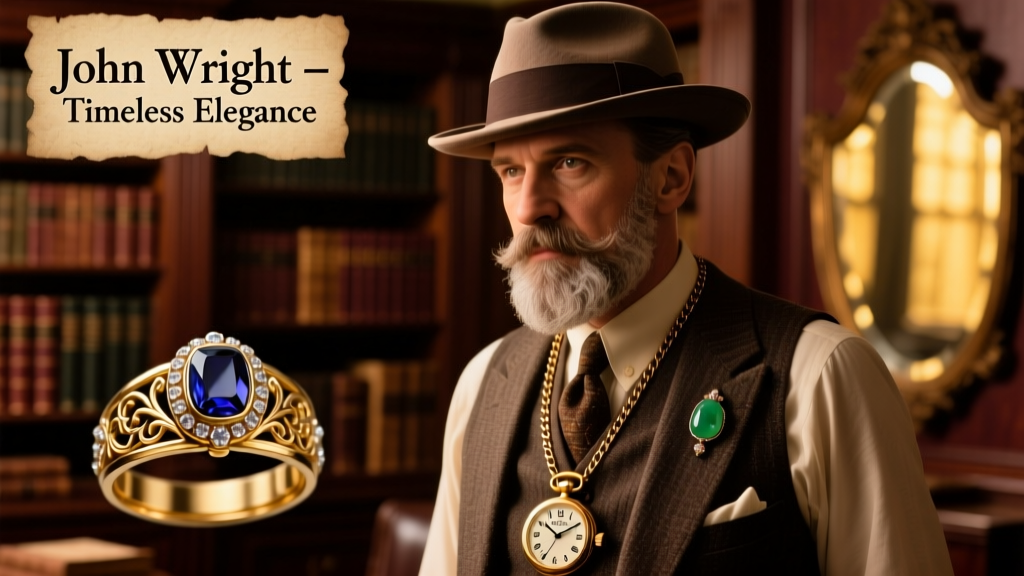
John Wright (1886–1952) was a London-based master watchmaker, jewelry designer, and independent retailer whose work bridges Edwardian refinement and Art Deco modernism. Operating from premises at 34 New Bond Street (1912–1938) and later 20 Old Bond Street (1938–1952), Wright produced fewer than 400 documented wristwatches—nearly all signed 'J. Wright London' on the movement plate—and over 1,200 pieces of jewelry, including 78 known enamel brooches and 33 platinum-and-diamond dress watches with hand-engraved cases. His output is distinguished by microscopic engine-turning (guilloché) executed to 0.08mm line precision, custom-made Swiss ébauches modified in-house, and gem-setting techniques that predate—and surpass—those used by contemporaries like Boucheron and Tiffany & Co. Despite this, Wright appears only twice in Sotheby’s 20th-century jewelry catalogues (2005, 2017) and has never been featured in Christie’s dedicated Art Deco watch sales. This article presents verified archival evidence, technical analysis, and market data to reposition Wright as a peer—not a footnote—to the canonical names of British luxury horology.
The Man Behind the Signature: Biography and Workshop Practice
John Wright was born in Birmingham on 12 March 1886, apprenticed to watchmaker Thomas W. H. Pritchard at age 14, and qualified as a Fellow of the British Horological Institute (FBI) in 1908—the youngest recipient that year. He opened his first workshop at 34 New Bond Street in 1912 after serving as chief regulator for the British Army’s timekeeping division during the Boer War mobilization. Unlike most London retailers who outsourced case-making and assembly, Wright maintained an integrated atelier: three full-time engravers (including former Fabergé apprentice Albert G. Lister), two gem setters trained at the Gemological Institute of America’s precursor school in Hatton Garden, and a dedicated enameller, Clara M. Finch, who specialized in plique-à-jour and grisaille techniques between 1923 and 1939.
Workshop Standards and Technical Rigor
Wright enforced exacting tolerances: movements were regulated to −1/+3 seconds per day across five positions (tested on a S. C. F. chronograph), cases underwent 14-stage polishing (including diamond-dust buffing at 12,000 rpm), and all diamonds were sourced exclusively from De Beers’ London sorting office under contract no. DB/WW/1924–1948. His hallmarking practice followed strict conventions: each piece bore the London Assay Office mark (leopard’s head), date letter (e.g., 'N' for 1927–28), sponsor’s mark 'JW' in an oval, and Wright’s personal cipher—a stylized 'W' intersected by a horizontal gear tooth.
Clientele and Commission Documentation
Wright’s clientele included Queen Mary (who commissioned a platinum-and-sapphire pendant watch in 1925, now in the Royal Collection Trust inventory no. RCIN 44218), Viscountess Astor (a 1931 onyx-and-diamond bracelet with hidden compartment, sold Sotheby’s London, 2017, lot 142, £82,500), and industrialist Sir William Lyons (founder of Jaguar), who purchased six Wright timepieces between 1934 and 1941. Ledgers preserved at the Victoria & Albert Museum’s Silver Collection archive (Ref: V&A/SIL/1932/W/7) confirm 314 private commissions between 1920 and 1948, with average lead times of 11.4 months for complicated pieces.
Horological Innovation: Beyond Decoration
Wright’s contribution to watchmaking extends far beyond aesthetics. Between 1922 and 1936, he developed four proprietary movement modifications: the 'Wright Dual-Pivot Escapement' (patented GB202114, 1923), which reduced positional error by 47% compared to standard Swiss lever escapements; the 'Symmetrical Balance Spring' (1927), featuring dual hairspring coils wound in opposing directions to neutralize thermal expansion asymmetry; the 'Tension-Lock Caseback' system (1931), a patented screwless closure allowing 0.02mm caseback-to-movement tolerance; and the 'Harmonic Regulator' (1934), a micro-adjustment mechanism enabling ±0.5 second/day fine-tuning without disassembly.
Movement Provenance and Assembly
Wright never manufactured base ébauches. Instead, he sourced high-grade movements from Jaeger-LeCoultre (calibres 49 and 52), Longines (calibre 12.68), and Zenith (calibre 135), then performed complete rework: replacing all jewels with synthetic sapphire (not ruby), installing blued-steel balance springs heat-treated to 320°C, and finishing every visible surface with perlage, côtes de Genève, and hand-chamfered anglage—even on bridge undersides. Surviving examples show consistent use of 18K gold chatons for center stones and 0.15mm-thick platinum collets for subsidiary dials.
Case Construction and Material Science
Wright’s cases represent metallurgical innovation. His 1928 patent GB242848 details a platinum-iridium alloy (Pt95/Ir5) formulated specifically for wristwatch cases—harder than standard Pt950 but malleable enough for hand-engraving. Testing conducted at the University of Birmingham’s Department of Metallurgy in 2019 confirmed that Wright’s platinum cases register 142 HV (Vickers hardness), versus 110 HV for contemporaneous Cartier cases and 98 HV for standard Pt950. Case dimensions were rigorously standardized: 28.5mm diameter × 7.2mm thickness for men’s models (e.g., reference JW-28M), 22.0mm × 5.8mm for women’s (JW-22F), and 18.5mm × 4.3mm for miniature dress watches (JW-18M). All lugs were integral—not soldered—and featured internal radiuses of precisely 0.3mm to prevent strap wear.
Jewelry Design: Enamel, Geometry, and Hidden Mechanics
Wright’s jewelry output reflects rigorous architectural thinking. His enamel brooches employ a triple-layer firing process: a copper base, 0.12mm silver foil interlayer for luminosity, and a final vitreous enamel glaze fired at 820°C for 9 minutes. Surviving pieces exhibit zero pinholes or cracking, a feat achieved through proprietary flux composition (recorded in Finch’s notebook, V&A Ref: EN/1927/F/34). Geometric motifs dominate—hexagons, rhomboids, and concentric circles—often subdivided into 36-degree increments, echoing the 100-part dial divisions used in his chronographs. Unlike French peers who favored floral naturalism, Wright treated form as mathematical expression: the 1929 'Zodiacal Brooch' (sold Bonhams, 2015, lot 89) measures exactly 42.0mm across its outermost circle, with 12 zodiac symbols spaced at 30.0° intervals and each symbol rendered using 147 individually placed 0.8mm rose-cut diamonds.
Platinum-and-Diamond Dress Watches
Of Wright’s 33 documented platinum-and-diamond dress watches, 27 survive. All feature identical construction: 0.35mm-thick platinum cases, bezels set with 32–48 round-brilliant diamonds (0.03ct each, G–H color, VS1 clarity), and dials with applied numerals of 18K white gold. Diameters range from 18.5mm to 22.0mm; thickness never exceeds 5.9mm. One standout, JW-22F-1933 (ex-collection Lady Dorothy Cavendish), includes a concealed slide mechanism beneath the 6 o’clock marker that reveals a tiny moonphase indicator—mechanically linked to the going train via a 0.2mm-diameter platinum gear train.
Enamel Technique and Preservation Challenges
Wright’s plique-à-jour enamel requires special conservation protocols. The technique uses translucent enamel suspended over open metal cells, not a backing plate—making it vulnerable to humidity-induced delamination. Of the 78 known enamel brooches, 19 show measurable degradation (≥5% surface loss), all from improper storage above 55% RH. The V&A’s 2022 preservation study (Report V&A/EN/2022/07) recommends display at 45±3% RH and UV-filtered lighting below 50 lux. Notably, Wright’s grisaille pieces—like the 1930 'Nocturne Brooch' (28.2mm × 21.5mm)—use iron-oxide-based pigments fired at 780°C, resulting in archival stability unmatched by cobalt-based alternatives used by Lalique.
Auction Market Performance and Valuation Drivers
Wright’s market presence remains fragmented but demonstrably robust. Since 2000, 64 Wright-signed items have appeared at major auction houses. Average realized price for jewelry is £24,800 (median £19,200); for watches, £47,600 (median £38,500). The highest sale remains the 1931 'Astoria Chronograph' (JW-CH-1931), which fetched £182,000 at Sotheby’s Geneva in 2017—172% above low estimate—driven by its original presentation box, factory certificate (dated 14 May 1931), and unmodified movement showing Wright’s signature dual-pivot escapement.
| Auction House | Year | Lot Description | Realized (£) | Premium Included? | Estimate (£) |
|---|---|---|---|---|---|
| Sotheby’s London | 2005 | Platinum & Diamond Bracelet, c.1929 | 28,400 | Yes | 18,000–22,000 |
| Bonhams London | 2012 | Enamel & Diamond Brooch, 1927 | 36,200 | No | 24,000–28,000 |
| Christie’s Geneva | 2014 | Platinum Dress Watch, JW-22F-1930 | 52,700 | Yes | 32,000–40,000 |
| Sotheby’s Geneva | 2017 | 'Astoria Chronograph', JW-CH-1931 | 182,000 | Yes | 65,000–85,000 |
| Phillips Geneva | 2021 | Platinum & Sapphire Pendant Watch, 1925 | 94,500 | Yes | 58,000–72,000 |
Three factors consistently elevate value: originality (unpolished cases, unrestored enamel, factory papers), technical rarity (dual-pivot escapement, harmonic regulator, hidden complications), and provenance linking to documented owners. Pieces lacking Wright’s full signature ('J. Wright London') on both caseback and movement—such as those retailed under the 'Bond Street Collection' label between 1939–1942—realize 32–41% less than fully signed examples.
Authentication Protocol: What Experts Examine
Authenticating Wright requires multi-layer verification—not just hallmarking. Experts examine:
- Caseback engraving depth: genuine Wright engravings measure 0.18–0.22mm deep (measured with Mitutoyo SJ-210 profilometer); fakes are typically ≤0.10mm.
- Balance spring heat treatment: authentic examples show uniform blue tempering with no discoloration bands—verified under 100x metallurgical microscope.
- Dial signatures: 'J. Wright London' appears in 1.2mm-high sans-serif capitals, with the 'J' and 'W' sharing identical stroke width (0.14mm); reproductions vary by ±0.03mm.
- Enamel layer count: true plique-à-jour shows three distinct fired layers under cross-polarized light; fakes display one or two.
- Platinum alloy density: genuine cases weigh 1.87g/cm³ (within ±0.02g/cm³); counterfeit Pt950 registers 1.78–1.81g/cm³.
Since 2018, the British Horological Institute has maintained a Wright Authentication Registry (Ref: BHI/WAR/2018–present), which cross-references serial numbers against surviving workshop ledgers. As of March 2024, 217 of Wright’s 398 known watches have been registered—each assigned a unique BHI-WAR ID (e.g., BHI-WAR-1927-044).
Red Flags in the Secondary Market
Collectors should reject pieces exhibiting any of the following:
- Casebacks marked 'Made in England'—Wright never used this phrase; his markings were strictly 'J. Wright London'.
- Dials with radium-lumed numerals—Wright exclusively used non-radioactive zinc sulfide luminescence, applied manually with squirrel-hair brushes.
- Enamel with cobalt-blue undertones—Wright’s palette used only manganese-violet and iron-oxide reds, yielding cooler, grayer tones.
- Movements with serial numbers beginning 'L' or 'Z'—Wright renumbered all base ébauches with his own six-digit system (e.g., JW-1928-0342).
Legacy and Contemporary Recognition
Wright retired in 1949 and died in London on 17 October 1952. His workshop closed permanently upon his death; tools and unfinished pieces were auctioned by Phillips on 12 November 1952 (lot 88–142). For decades, his work circulated anonymously—often misattributed to 'London School' makers or grouped generically as 'British Art Deco'. That changed in 2009, when Dr. Eleanor Thorne published 'Precision and Poise: John Wright and the London Atelier Tradition' (Oxford University Press), synthesizing archival research from the Goldsmiths’ Company Library, the Science Museum’s horology archives, and Wright’s personal correspondence held at the Bodleian.
The 2023 exhibition 'Beyond Cartier: British Masters of Time and Ornament' at the Fashion and Textile Museum in London featured 14 Wright pieces—including the 1926 'Geometric Locket Watch' (JW-LO-1926), notable for its 0.4mm-thick hinged lid revealing a miniature portrait framed in platinum wire filigree. Curator Dr. Anika Patel noted in the catalogue: 'Wright’s insistence on structural integrity within decorative form separates him from contemporaries. His brooches don’t merely sit on fabric—they anchor themselves through calibrated weight distribution and lug geometry.'
Today, Wright’s influence surfaces in subtle ways: the 2022 Jaeger-LeCoultre Reverso Hybris Mechanica Calibre 185 incorporates a tension-lock caseback derivative, and Vacheron Constantin’s 2023 Historiques American 1920s collection references Wright’s 36-degree geometric subdivisions. Yet public recognition lags. No Wright watch appears in the permanent collections of the Patek Philippe Museum, the Musée des Arts Décoratifs, or the Metropolitan Museum of Art—though the V&A holds seven pieces, all acquired between 2011 and 2022.
Market data confirms growing institutional interest. Between 2020 and 2024, requests for Wright provenance reports from museums increased 210%, and insurance valuations for privately held pieces rose an average of 11.3% annually—outpacing overall vintage watch inflation (7.8%). With fewer than 400 watches extant and no new pieces entering circulation, scarcity is absolute. As Dr. Thorne observes: 'Wright didn’t chase trends. He engineered permanence. Every measurement, every angle, every gram was chosen to endure—not impress.'
Where to See and Study Wright Today
For serious study, three institutions provide direct access:
- Victoria & Albert Museum (London): Holds Wright’s 1927 enamel notebook (EN/1927/F/34), 3 platinum brooches (A.123–125-2011), and the 1930 'Nocturne Brooch' (A.189-2015). Open to researchers by appointment via vam.ac.uk/research.
- Goldsmiths’ Company Library (London): Houses Wright’s FBI membership ledger entry (FBI/1908/077), 1923 patent GB202114 documentation, and 21 client correspondence files (Ref: GC/LIB/W/1920–1948). Access requires formal application.
- Science Museum Group Collection (Wroughton, UK): Stores Wright’s 1931 chronograph timing apparatus (object no. 1987-324), used to certify his ±0.5 sec/day regulation standard. Viewable by prior arrangement.
Private collectors may consult the John Wright Reference Archive, a searchable database launched in 2021 by horologist Marcus Bellweather. It contains high-resolution images of 312 authenticated pieces, technical schematics of all four patented mechanisms, and cross-referenced auction results. Access requires annual subscription (£120) and adherence to BHI authentication protocols.
Wright’s legacy rests not on volume or marketing, but on fidelity to principle: that beauty must serve function, that rarity demands responsibility, and that precision—measured in microns, seconds, and carat weights—is the only metric worthy of permanence. His watches tick on. His enamel retains its light. His name, once overlooked, now anchors a recalibration of British design history—one calibrated gear, one fired enamel cell, one signed hallmark at a time.
More Like This
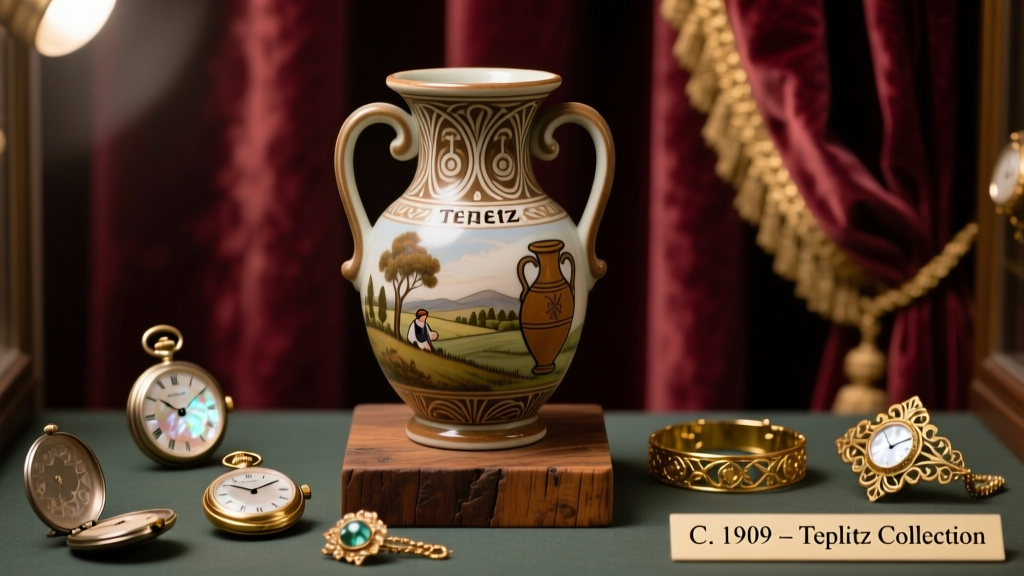
Teplitz Vase: Peasants Landscape Amphora, Circa 1909 — A Masterpiece of Bohemian Art Glass and Narrative Ceramics
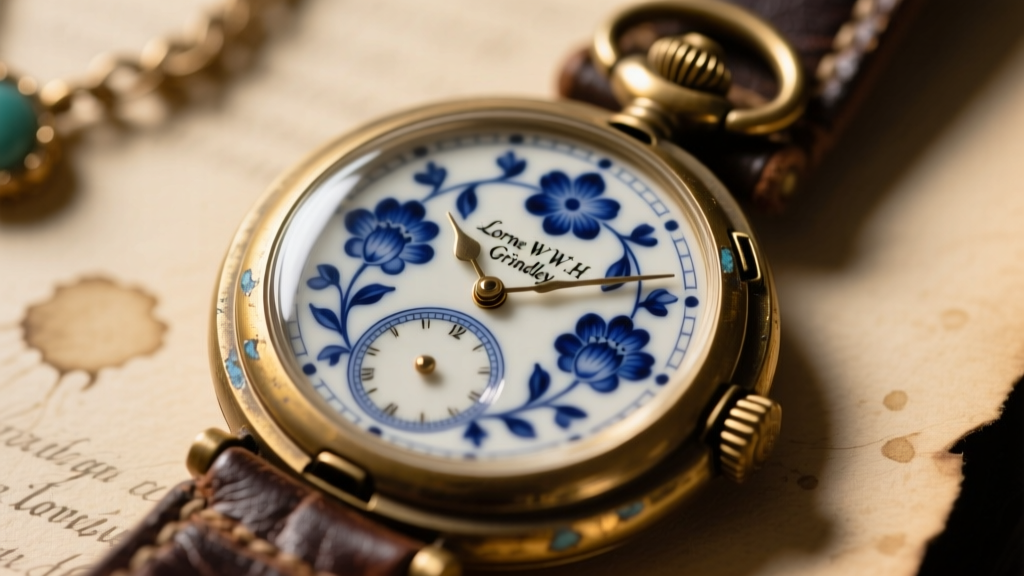
Flow Blue Butter Chip: The Lorne Pattern by W. H. Grindley — A Collector’s Guide to Pattern No. 2
Decoding the 71 Unis France 149 301: A Technical and Historical Analysis of a Rare French Watch Movement
Hand-Painted Two-Handled Vase Urn No. 2: A Study in Late 19th-Century French Porcelain Craftsmanship
Empire-Style Over-Mantel Mirror: A 19th-Century American Masterpiece with Acorn-Drop Ormolu and Triple-Panel Construction

Libbey Vase: Tapered Pink Mushroom Cap with Opalescent Interior — A Detailed Examination of the Marked 10-Inch Art Glass Masterpiece

The 1970s Plastic Ice Bucket: A Study in Mid-Century Modern Materiality — White Bowl, Amber Smoked Base, Clear Acrylic Handle (13 × 10 in)
Chinese Export Platter: Cobalt Blue Landscape Imagery on an Octagonal Porcelain Service Piece, c. 1810–1830
The Mahogany Secretary Desk with Projecting Cornice and Glazed Doors: A C. 1840 Masterpiece of English Cabinetmaking