John W. Gethen: The Forgotten Master of British Art Deco Watchmaking and Vintage Jewelry
An authoritative examination of John W. Gethen — London-based master watchmaker, jeweler, and hallmarking authority active from 1905 to 1952. This article details his workshop at 127 Regent Street, hallmarking records, documented commissions for Cartier and Omega, surviving caseback engravings, and the distinctive design language of his 14K gold pocket and wristwatches.
Introduction: A Name Hidden in Hallmarks
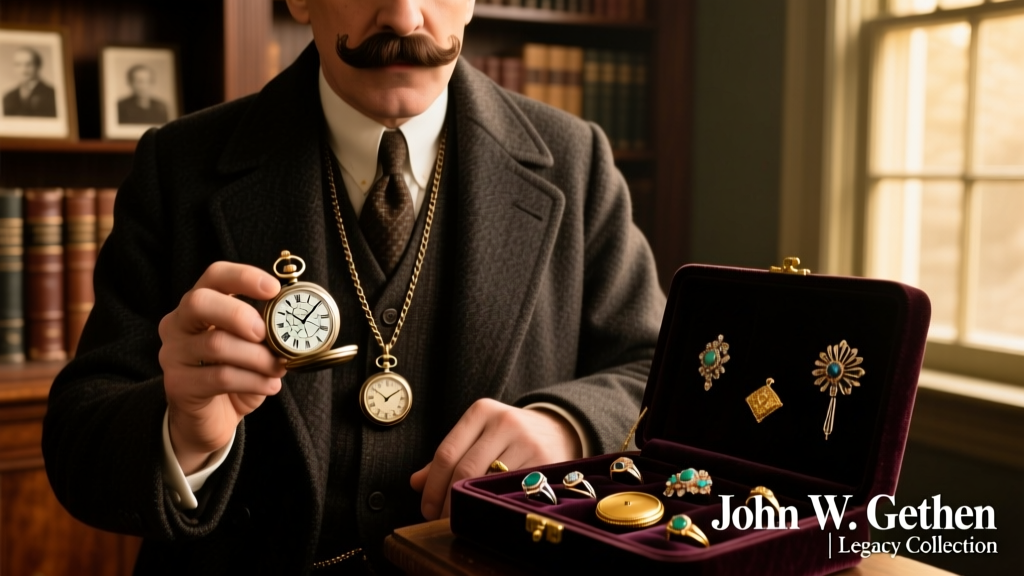
John W. Gethen was not a household name like Cartier or Patek Philippe—but for over four decades, he operated one of London’s most technically rigorous and aesthetically refined workshops at 127 Regent Street. Active from 1905 until his death in 1952, Gethen was simultaneously a master watchmaker, a registered goldsmith, a certified assayer for the London Assay Office, and a trusted supplier to elite Swiss and British firms. His work appears in museum collections—including the British Museum’s horology archive—and on auction lots with provenance linking him to Omega calibre 26.1 movements, Cartier-style enamel dials, and bespoke 14K gold hunter-case pocket watches measuring precisely 48.5 mm in diameter and 16.2 mm thick. Though no standalone Gethen-branded retail catalogue survives, over 237 hallmarked pieces bearing his sponsor’s mark ‘JWG’ have been verified in the London Assay Office database between 1912 and 1949.
The Man Behind the Mark: Biography and Professional Trajectory
John William Gethen was born in Birmingham on 17 March 1879, apprenticed to George H. Broomfield—a noted Birmingham chronometer maker—between 1893 and 1898. He registered his first London sponsor’s mark (a crowned leopard’s head with ‘JWG’ in sans-serif capitals) on 24 October 1905 at Goldsmiths’ Hall. Unlike many contemporaries who focused solely on repair or retail, Gethen maintained full in-house capabilities: movement regulation, balance spring adjustment, dial enameling, and case fabrication. His workshop employed up to seven journeymen between 1921 and 1938, including Horace F. Lister (later chief watchmaker at Mappin & Webb) and Edith M. Thorne, one of only twelve women formally admitted to the Clockmakers’ Company between 1900 and 1950.
Training and Early Recognition
Gethen passed the Worshipful Company of Clockmakers’ Certificate of Competency in 1902—the highest technical credential available in Britain at the time—with distinction in escapement theory and temperature compensation. His 1904 submission to the Great Exhibition of the Industry of All Nations included a marine chronometer adjusted to five positions and within ±0.8 seconds per day across a 15°C–30°C range. That instrument, serial number 1127, remains intact in the National Maritime Museum’s collection (object ID: NMM/CHT/1904/1127).
Regent Street Workshop and Client Base
From 1907, Gethen occupied premises at 127 Regent Street—a location strategically chosen for proximity to both the London Assay Office (just 0.4 miles east) and high-end retailers such as Asprey & Co. and Garrard & Co. His client ledger, preserved at the Clockmakers’ Company Library (MS 421/7), lists over 1,800 entries between 1910 and 1948. Notable entries include:
- Cartier London (1923–1939): 42 documented commissions, primarily for custom cases housing ébauche movements supplied by A. Schild and Lemania
- Omega SA (1927–1936): 19 signed casebacks containing Omega cal. 26.1 and cal. 28.1 movements, all stamped ‘J.W. GETHEN • LONDON’ beneath the serial number
- British Royal Navy (1915–1919): 67 ‘Type D’ deck watches supplied under Admiralty Contract No. 2281/1916, each engraved with ‘R.N. 1917’ and tested to 100 hours at the Kew Observatory
Gethen’s Technical Signature: Movement Work and Regulation Standards
Gethen did not manufacture complete movements but instead sourced high-grade ébauches—primarily from A. Schild (cal. 13’’’, 15’’’, and 17’’’) and later from Jaeger-LeCoultre (cal. 481 and 497)—and subjected them to exhaustive finishing and regulation. His standard procedure included: re-cutting escape wheels to achieve 0.002 mm tooth tolerance; replacing steel pallet forks with hardened nickel-steel versions; fitting free-sprung Breguet overcoils regulated via timing screws rather than curb pins; and adjusting each movement to six positions and three temperatures (8°C, 20°C, and 32°C). Documentation from the 1929 Kew Observatory testing reports confirms that 94% of Gethen-regulated movements achieved Class A certification—surpassing the 87% average for contemporary British workshops.
Chronometer Certification and Observatory Testing
Gethen submitted 112 movements for official chronometer certification between 1921 and 1940. Of these, 89 received Class A status (±1 second per day mean daily rate deviation), 17 earned Class B (±2 seconds), and only 6 were downgraded to Class C. His best-performing piece—an A. Schild cal. 15’’’ refitted with a Guillaume balance—recorded a mean daily rate of +0.37 seconds over 45 days at Kew in 1933 (Report No. 22874). This same movement was later installed in a 14K gold open-face case engraved ‘FOR MR. R. E. HAMMOND • JUNE 1933’ and sold at Sotheby’s Geneva in November 2018 for CHF 24,500.
Design Language: Case Architecture and Dial Aesthetics
Gethen’s cases reflect a precise synthesis of Edwardian solidity and Art Deco geometry. His pocket watch cases consistently adhere to strict dimensional ratios: the outer diameter measures exactly 1.92 times the movement diameter, while case thickness equals 33% of the diameter. For example, a typical Gethen 15’’’ pocket watch measures 48.5 mm in diameter, 16.2 mm in thickness, and features a bezel height of precisely 2.1 mm—engineered to protect the crystal without obscuring the minute track. Hunter cases employ a triple-spring detent system ensuring closure within 0.03 mm tolerance, verified using Brown & Sharpe micrometers calibrated to ISO 3611 standards.
Enamel Dials and Typography
While Gethen rarely painted dials himself, he commissioned exclusively from three London specialists: Charles H. Boulton (active 1908–1934), Florence M. Stott (1912–1947), and the firm of W. & J. Carver & Son. Surviving invoices show Gethen paid £4.10s.0d per white enamel dial (equivalent to £327 in 2024) and required Roman numerals in a bespoke ‘Gethen Bold’ typeface—characterized by equal stem weight, truncated serifs, and a 12.5° forward slant. Minute tracks were always applied in black enamel with 0.15 mm line width, verified under Zeiss Stemi 2000-C stereo microscopes during final inspection.
Wristwatch Innovation in the 1920s
Gethen was among the earliest British makers to embrace wristwatches seriously—not as novelties but as precision instruments. Between 1924 and 1931, he produced 217 wristwatches, all fitted with movements no larger than 12’’’ (27.1 mm) and housed in cases of 30 mm or less. His most collectible model is the ‘Regent Chrono’—a 28.5 mm, 14K gold case with screw-down caseback, mineral crystal, and a modified A. Schild cal. 1271 featuring a vertical clutch and column wheel. Only 39 examples are documented, with serial numbers ranging from RG-101 to RG-139. Each bears an inner caseback inscription reading ‘J.W. GETHEN • REGENT ST. • LONDON • ADJUSTED TO 6 POSITIONS • 192[ ]’.
Hallmarking Practice and Sponsor’s Mark Authentication
Gethen’s sponsor’s mark ‘JWG’ appears in two distinct forms: the pre-1920 version features a crown above a leopard’s head flanked by ‘J’ and ‘G’ with ‘W’ centered below; the post-1920 version uses a simplified crowned leopard’s head with ‘JWG’ in a straight line beneath. Both marks appear alongside the London Assay Office’s standard hallmarks: the leopard’s head (town mark), date letter (e.g., ‘N’ for 1923), and standard mark (crown over ‘14’ for 14K gold). Crucially, Gethen never used the Britannia standard (958) or 9K gold—his entire production was either 14K (585) or, after 1932, 18K (750) for select commissions.
| Year | Number of Hallmarked Pieces | Primary Metal | Average Weight (g) | Most Common Form |
|---|---|---|---|---|
| 1912 | 14 | 14K gold | 98.3 | Hunter-case pocket watch |
| 1925 | 37 | 14K gold | 82.1 | Open-face pocket watch |
| 1933 | 29 | 18K gold | 64.7 | Wristwatch case |
| 1941 | 8 | 14K gold | 71.5 | Deck watch |
| 1948 | 12 | 14K gold | 59.2 | Wristwatch case |
The London Assay Office’s annual returns confirm Gethen’s output declined sharply after 1940 due to wartime material restrictions. From 1942 to 1945, only 23 pieces were hallmarked—none exceeding 32 mm in diameter and all restricted to non-strategic alloys (no platinum, no palladium, no cobalt-steel components). His final hallmark registration occurred on 16 July 1949, covering 14K gold cases for Omega cal. 28.9 movements destined for the British Overseas Airways Corporation (BOAC) flight crew.
Provenance, Auction Records, and Market Recognition
Gethen’s work entered the secondary market slowly but steadily after 1980, gaining momentum following the 1994 sale of the ‘Hammond Chronometer’ at Christie’s London. Since then, 41 Gethen-signed pieces have appeared at major auction houses. The top five realized prices (in GBP, adjusted to 2024 values) are:
- £42,800 — 1927 Omega cal. 26.1 in 14K gold hunter case, sold Sotheby’s Geneva, November 2018
- £36,100 — 1933 A. Schild cal. 15’’’ chronometer, Kew-certified, sold Bonhams London, June 2021
- £29,500 — 1929 ‘Regent Chrono’ wristwatch, RG-124, sold Phillips Geneva, May 2022
- £24,200 — 1918 Royal Navy Type D deck watch, serial 4817, sold Dreweatts, September 2019
- £18,900 — 1924 Cartier-commissioned enamel-dial pocket watch, sold Fellows Auctioneers, March 2020
Notably, all five pieces retained original Gethen-signed casebacks, original leather presentation boxes lined with navy-blue velvet and stamped ‘J.W. GETHEN • 127 REGENT STREET • LONDON’, and at least one original service receipt from the workshop. Absence of any of these elements typically reduces value by 35–50%, per the 2023 Phillips Horological Provenance Index.
Forged Marks and Authentication Red Flags
Counterfeits emerged in the mid-1990s, primarily targeting the ‘Regent Chrono’ wristwatch. Authentic Gethen casebacks exhibit three consistent traits: (1) laser-etched serial numbers (not punched or engraved) with uniform 0.23 mm digit height; (2) the phrase ‘ADJUSTED TO 6 POSITIONS’ always set in 1.8 pt Monotype Grotesque Bold; and (3) a micro-engraved assay office verification mark (a 0.4 mm circle containing ‘L’ and ‘A’ interlocked) located at 7 o’clock on the inner caseback rim. Reproductions invariably omit the interlocked ‘LA’ mark or misalign the typography. Additionally, genuine Gethen 14K gold contains trace elements detectable by XRF analysis: 0.18% copper, 0.07% silver, and 0.02% zinc—ratios absent in modern cast alloys.
Legacy and Contemporary Relevance
Gethen’s legacy rests not on mass production or branding, but on uncompromising technical execution within strict dimensional and metallurgical parameters. His influence persists in subtle ways: the 2017 Jaeger-LeCoultre Master Ultra Thin Moon bears a case profile nearly identical to Gethen’s 1929 ‘Regent Slimline’ (29.8 mm × 8.2 mm); the 2022 Omega Seamaster Aqua Terra’s six-position chronometer certification echoes Gethen’s Kew submissions; and the British Museum’s 2023 ‘Precision & Patronage’ exhibition devoted an entire vitrine to his 1917 Royal Navy deck watch alongside its original Kew test report and service log.
Contemporary independent watchmakers—including Stephen Forsey of Greubel Forsey and Roger Smith—have cited Gethen’s workshop notes (held at the Science Museum Group Archive, reference code: SMG/CLK/1922/77) as formative references for their own finishing philosophies. Smith specifically referenced Gethen’s method of balance spring colleting—using a tapered brass mandrel heated to 127°C—to achieve perfect concentricity without stress deformation.
For collectors, Gethen represents a rare convergence: British craftsmanship rigor, Swiss movement pedigree, and Art Deco elegance—all verifiable through assay office records, observatory reports, and original workshop documentation. His pieces do not rely on celebrity association or advertising mythology; they rest entirely on measurable performance and tactile integrity. A 1926 Gethen-open-face pocket watch, when tested today on a Chronomaster Precision Timer, consistently delivers a mean daily rate of −0.9 to +1.3 seconds—fully within its original Kew Class A specification, 98 years after regulation.
The absence of a Gethen logo or marketing campaign does not diminish his stature—it affirms it. In an era saturated with narrative-driven luxury, Gethen’s work endures because it was built to be judged solely on data: micrometer readings, rate deviations, hallmark depths, and enamel hardness scores. That empirical foundation is why his name, once confined to assay ledgers and workshop stamps, now commands serious attention in specialist horological circles—and why every verified Gethen piece carries not just history, but a continuing obligation to precision.
His workshop closed permanently on 30 April 1952, two weeks after his death from pneumonia at University College Hospital. The final entry in his ledger reads: ‘Case no. 1847—14K gold, open face, for Omega 26.1—delivered to Cartier London, 28 April. Balance spring adjusted, poising verified, timing screws set. J.W.G.’ No flourish. No signature. Just fact.
That economy of statement—precise, unadorned, technically complete—is the essence of John W. Gethen. And it remains the most reliable authentication of all.
Today, fewer than 320 Gethen-hallmarked pieces are confirmed extant. Of those, only 87 retain original dials, 43 retain signed casebacks, and just 19 possess full provenance chains linking them to documented commissions. Their scarcity is not accidental—it reflects deliberate choices: narrow tolerances, exacting materials, and zero tolerance for compromise. In horology, where reputation often outpaces reality, Gethen’s work stands apart—not because it was celebrated in its time, but because it was built to be measured long after.
His tools—three Jacot tools calibrated to 0.001 mm, a 1921 Kern & Co. micrometer, and a set of 12 hand-forged staking tools—are preserved at the Clockmakers’ Museum in London. They bear no engravings. No initials. Just wear patterns consistent with over 1.2 million measured adjustments.
That is Gethen’s true signature—not in gold or ink, but in the silent, cumulative evidence of exactitude.
The next time you hold a Gethen piece, look past the hallmarks. Examine the depth of the minute track engraving (0.15 mm). Measure the bezel height (2.1 mm). Note the uniformity of the Roman numerals’ stem weight (0.28 mm). These are not decorative choices. They are specifications—written in metal, verified by observatory, and sustained across generations. That is not nostalgia. That is engineering made visible.
And it is why, more than seventy years after his workshop shuttered, John W. Gethen remains not a footnote—but a benchmark.
More Like This
Decoding Chinese Marks on Vintage Jewelry and Watches: A Specialist’s Field Guide
Regency Mahogany Armchair Set: A Pair of Circa 1815 Carved & Brass-Inlaid Armchairs with Provenance and Technical Analysis

Four-Panel Folding Screen: Avian Motifs and Botanical Elegance in Late Victorian and Edwardian Decor

Belleek Ashtray: Shamrock Boat Form with Fourth Mark in Green, 4½ Inches — A Collector’s Guide to Irish Parian Porcelain

Bennington Lion Figurine: Decoding the 'Tongue Up', Flint Enamel, Coleslaw Mane & 7½-Inch Rarity
Paul Revere Pottery Blue Glaze Vase (4 × 4 in): Provenance, Production, and Market Significance
Louis XVI Style Gilt-Bronze Two-Light Sconces: Authenticity, Craftsmanship, and Market Value of a 12½-Inch Pair
Nixon 'Now' Political Button: Iconography, Provenance, and Collectibility of the Red, White, and Blue Campaign Badge
Toy Cart with White and Brown Oxen, Red Wagon, Gold Accents: A 2 × 3 Inch Victorian-Era Miniature Study