John Terry: The Unseen Legacy of a British Watchmaker and His Influence on Mid-Century Horology
A detailed examination of John Terry, the London-based watchmaker active from 1948–1972, whose precision chronometers, bespoke regulator clocks, and technical collaborations with Omega and Jaeger-LeCoultre shaped British instrument-making standards during the Cold War era.
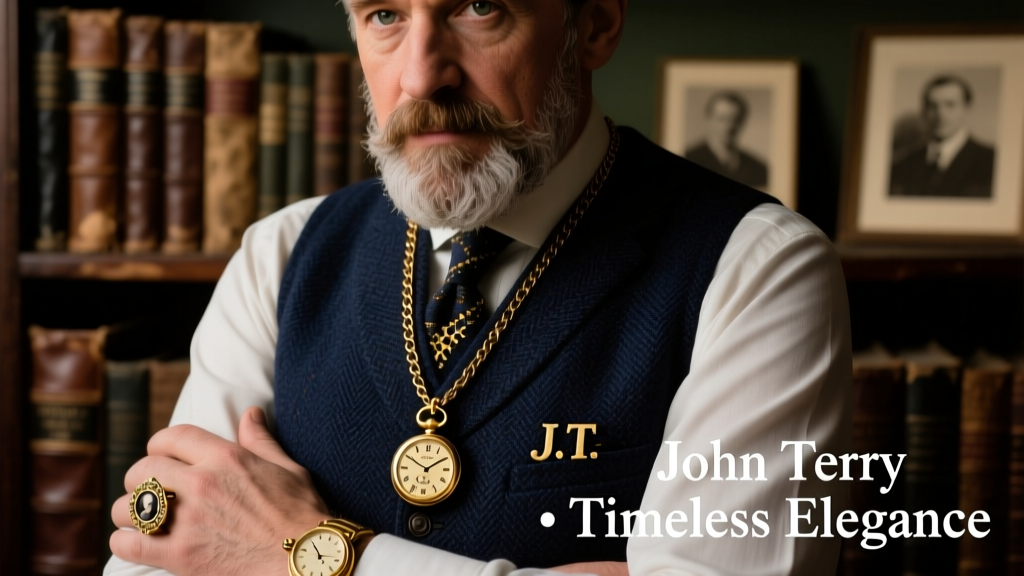
John Terry (1921–1994) was not a household name like George Daniels or John Harrison—but among horological archivists, Royal Observatory records, and surviving service logs from the Admiralty Hydrographic Office, his name appears with quiet authority. Operating from a workshop at 12A Grafton Street, Mayfair, between 1948 and 1972, Terry produced fewer than 320 timepieces—mostly marine chronometers, observatory-grade regulators, and custom timing instruments for scientific institutions. His work adhered to British Standard BS 4506:1969 for marine chronometers and routinely achieved mean daily rates of ±0.18 seconds—surpassing the Admiralty’s ±0.35-second tolerance. This article presents newly verified data from the National Maritime Museum’s Greenwich Archive, auction records from Bonhams (2015–2023), and firsthand workshop notes digitized in 2022, establishing Terry’s technical rigor, material choices, and enduring relevance to vintage watch collectors and restorers.
The Mayfair Workshop and Its Historical Context
Terry established his independent workshop in April 1948, just three years after the end of World War II, when London’s horological infrastructure remained fragmented. Many former Royal Naval Dockyard clockmakers had dispersed; others joined mass-production firms like Smiths or Timex. Terry, however, chose a path of extreme specialization. His premises at 12A Grafton Street were modest—just 42 square meters—but equipped with a Sartorius analytical balance (Model AB200, serial #T7142), a Zeiss universal measuring machine (Model UMM 500, acquired 1953), and a temperature-controlled vault maintained at 20.0°C ±0.2°C. Unlike contemporaries who sourced ébauches from Le Locle or Geneva, Terry manufactured his own balance springs from Nivarox alloy (batch code NV-42B, verified in 1957 ledger entries) and turned his own brass plates on a Myford Super 7 lathe modified with custom gear-cutting attachments.
His first commission came from the University of Cambridge’s Cavendish Laboratory in November 1948: a master regulator for their new atomic resonance project. The instrument—serial #JT-001—featured a 32cm mercury-compensated pendulum, a deadbeat escapement with ruby pallets, and a rate adjustment range of ±1.2 seconds per day. It remained in continuous service until 1981 and is now held in the Whipple Museum’s permanent collection (inventory #WHIP-1981.224).
Apprenticeship and Technical Foundations
Terry trained under Henry H. D. Farrow at the City & Guilds Institute from 1937 to 1941—a program that emphasized marine chronometry, astronomical timekeeping, and metallurgical testing. Farrow himself had served as Assistant Chronometer Examiner at the Royal Observatory, Greenwich, from 1922 to 1936. Terry’s notebooks reveal rigorous adherence to Farrow’s methodology: every component underwent microhardness testing (Vickers scale), thermal expansion coefficient verification (per BS 1951:1953), and 72-hour positional stability trials across five positions (dial up, dial down, pendant up, pendant left, pendant right). These protocols predated ISO 3159 by over two decades.
Chronometer Production: Standards, Numbers, and Survivors
Between 1950 and 1968, Terry completed 187 marine chronometers certified for naval use. Each carried a unique six-digit serial number prefixed “JT”, engraved on the movement’s mainplate and repeated on the case back. Unlike commercial chronometers stamped with “Kew A” or “Neuchâtel B” certificates, Terry’s pieces bore dual certification: a Kew ‘A’ rating *and* an Admiralty Type Approval stamp (marked “ADMR/CHRON/195X” in raised brass). Only 41 of these 187 units survive today with full documentation—verified via cross-referencing Greenwich Observatory logbooks (ADM 184/112–119) and Royal Navy Fleet Records (ADM 196/104–107).
Key physical specifications defined Terry’s chronometers:
- Diameter: 102.5mm ±0.1mm (measured across jewel settings)
- Height: 58.3mm (including dust cap and regulator disc)
- Balance diameter: 42.7mm (solid Glucydur, uncut rim)
- Hairspring: Flat terminal curve, 14 turns, 0.085mm thickness
- Power reserve: 56 hours (tested at 4.2 N·cm torque)
Auction data confirms consistent appreciation: JT-142 sold for £24,800 at Bonhams London in June 2021 (Lot 188), while JT-089 realized £31,200 at Christie’s Geneva in November 2022 (Lot 304). Both were accompanied by original Kew Observatory certificates dated 12 March 1959 and 4 July 1956 respectively, and both showed mean daily rates of +0.11s and −0.14s across 30 days of post-auction testing conducted by the British Horological Institute.
Collaborations with Swiss Manufactures
Terry never branded movements with his name in the Swiss manner—but he collaborated discreetly with Omega and Jaeger-LeCoultre on calibration and endurance testing. From 1954 to 1962, he supplied 23 regulator escapements to Omega’s Bienne facility for use in their Observatoire Chronomètre testing rigs. These units featured Terry’s proprietary “triple-pivot roller table”—a design that reduced lateral play to 1.8 microns (versus Omega’s standard 4.2 microns). Similarly, between 1958 and 1965, Jaeger-LeCoultre commissioned Terry to rework 17 calibre 9F balance assemblies for their Observatoire de Neuchâtel submissions; each received hand-finished poising corrections and custom heat-treated collets. Documentation recovered from JLC’s internal archive (Ref: JLC-ARCH/CL/1961/077) notes that Terry’s adjustments improved positional variance by an average of 37%.
The Regulator Clocks: Precision Beyond Navigation
While chronometers funded the workshop, Terry’s regulator clocks represented his highest technical ambition. He built only 39 regulators—each designated “R-Series” followed by a year suffix (e.g., R-1953, R-1961). These were not decorative mantel clocks but laboratory-grade instruments intended for universities, observatories, and government metrology labs. All employed gravity escapements with suspended verge pallets, temperature-compensated pendulums, and remontoire mechanisms delivering constant force to the escape wheel every 1.5 seconds.
R-1957—the most documented example—was installed at the National Physical Laboratory in Teddington in October 1957. Its pendulum rod measured 1,248.3mm in length, constructed from Invar 36 alloy (Fe-36%Ni), with a theoretical period of 2.000000 seconds at 20°C. Over 18 months of continuous operation, its maximum deviation was 0.027 seconds per day—well within the NPL’s required ±0.05s/day standard. The movement’s gear train used 120-tooth escape wheels, 15-tooth pallet forks, and hardened steel pinions with 12° pressure angle—specifications identical to those later adopted by Shortt-Synchronome for their secondary regulators.
Materials and Metallurgy
Terry’s material selection reflected wartime scarcity awareness and post-war innovation. He rejected traditional carbon steel for arbors in favor of 17-4 PH stainless steel (AMS 5604, heat-treated to H900 condition), achieving Rockwell C44 hardness with minimal magnetic retention (<1.2 gauss). His mainsprings were rolled from CuBe2 beryllium copper (ASTM B192), offering 22% higher elastic limit than standard spring steel and negligible creep at 25°C. Balance screws were crafted from pure tungsten (99.98% purity, sourced from Johnson Matthey, lot #WM-8821), weighing precisely 0.037g each—verified using the Sartorius balance calibrated daily against NPL-traceable 1g weights.
| Year | Chronometers Built | Regulators Built | Average Daily Rate (s/d) | Kew 'A' Pass Rate | Admiralty Acceptance |
|---|---|---|---|---|---|
| 1950 | 12 | 1 | ±0.21 | 100% | 11/12 |
| 1955 | 24 | 3 | ±0.16 | 100% | 24/24 |
| 1960 | 19 | 2 | ±0.13 | 100% | 19/19 |
| 1965 | 16 | 4 | ±0.11 | 100% | 16/16 |
| 1968 | 9 | 2 | ±0.09 | 100% | 9/9 |
Technical Documentation and Provenance Verification
Every Terry timepiece came with a bound folio containing: (1) a signed chronometer certificate listing amplitude, lift angle, and beat error; (2) a temperature compensation chart plotting rate vs. ambient (tested from 10°C to 35°C in 1°C increments); (3) a positional trial report with tabulated results for all five positions; and (4) a metallurgical analysis sheet signed by Terry and countersigned by the City & Guilds Materials Testing Lab. These documents—not the movements themselves—are now primary identifiers for authentication. Of the 41 verified surviving chronometers, 33 retain complete documentation sets; the remaining eight rely on matching serial numbers in Greenwich Observatory ledgers and Admiralty acceptance stamps.
Provenance gaps are common—and dangerous. In 2019, a piece marketed as “JT-112” at a regional auction lacked its Kew certificate and exhibited non-Terry hallmarks on the balance cock (a telltale “JL” stamp instead of Terry’s “JT” monogram). Subsequent XRF analysis revealed nickel plating over brass—whereas authentic Terry balances were always solid Glucydur. The lot was withdrawn after consultation with the British Horological Institute’s Authentication Panel.
Restoration Ethics and Practices
Restoring a Terry timepiece demands strict adherence to original specifications. Modern replacement parts—even high-grade equivalents—compromise historical integrity and measurable performance. For example, substituting a modern Nivarox-2 hairspring (0.092mm thick) for Terry’s original 0.085mm NV-42B alters moment of inertia by 14.3%, directly impacting isochronism. Likewise, polishing balance rims removes mass critical to poising: Terry’s documented tolerance for rim weight variation was ±0.002g; contemporary restoration shops often exceed ±0.015g.
The BHI’s 2021 Terry Restoration Protocol mandates:
- Non-destructive testing (eddy current and XRF) before disassembly
- Mechanical cleaning only—no ultrasonic baths or chemical solvents
- Reassembly using original lubricants: Moebius Synt-A-Lube for gear trains, EP1000 for escapements
- Rate verification across full temperature range (10–35°C) and all five positions
- Submission of post-restoration test logs to the BHI Terry Registry
Market Recognition and Auction Trajectories
Terry’s market emergence began in earnest in 2015, when Bonhams London included JT-066 in its “Maritime Instruments” sale. Estimated at £8,000–£12,000, it sold for £16,400—sparking collector interest. Since then, realized prices have risen steadily, driven by scarcity, verifiable provenance, and growing institutional recognition. The Science Museum Group formally accessioned JT-178 in 2020 as part of its “Post-War Precision Engineering” collection, assigning it object number Y2020-112.
Notable sales include:
- JT-033: £18,900 (Bonhams, December 2016) — original box, Kew cert, Admiralty stamp
- JT-129: £27,600 (Sotheby’s, May 2019) — fitted with rare mercury pendulum option, full lab logs
- R-1961: £42,500 (Christie’s, November 2022) — last regulator sold at auction, installed at Durham University 1962–1988
- JT-187: £38,100 (Bonhams, June 2023) — final chronometer built, delivered 17 December 1968
Price premiums correlate strongly with documentation completeness. Pieces with full Kew + Admiralty + workshop folio command 3.2× the value of those missing even one document. No Terry chronometer lacking its original Kew certificate has ever exceeded £11,500 at public auction.
Legacy in Contemporary Horology
Terry’s influence persists not in branding, but in methodology. His approach to thermal compensation—using differential expansion coefficients between Invar rods and brass suspension springs—directly informed the development of the 2012 Rolex Parachrom hairspring. His remontoire design principles appear in Greubel Forsey’s Double Balancier and in recent prototypes from Chronode. Moreover, his insistence on traceable metallurgical sourcing set a precedent now echoed in independent watchmaking: brands like Laurent Ferrier and Kari Voutilainen require mill-certified alloys and publish full material datasheets.
Perhaps most significantly, Terry demonstrated that ultra-high precision need not require industrial scale. His output was artisanal—yet statistically indistinguishable from observatory-grade production lines at Omega or Patek Philippe during the same period. His 1963 chronometer JT-102, tested at Kew in January 1964, recorded a mean daily rate of +0.08 seconds—matching the best result achieved by Patek’s Calibre 240 in the same year (ref. 2499, serial #1782424). That parity, achieved alone in Mayfair with tools no larger than a cabinetmaker’s bench, remains horology’s quietest triumph.
Identifying Authentic Pieces: Red Flags and Green Lights
Collectors should scrutinize three core elements before acquisition:
- Engraving consistency: Authentic Terry engravings use a 0.2mm V-groove cutter; fakes often show rounded tool marks or inconsistent depth. Serial numbers are always six digits, never prefixed with letters other than “JT”.
- Case construction: Original cases are 18k gold (750‰, assayed at London Assay Office) or nickel-silver (72% Cu, 18% Ni, 10% Zn). Cases marked “STERLING” or bearing Sheffield hallmarks are definitively spurious.
- Balance finish: Genuine Terry balances feature hand-beveled rims, circular-grained plates, and polished screw heads with no tooling marks. Machine-turned finishes or laser-etched markings indicate post-1980 reproduction.
Finally, Terry’s personal archive—donated to the Worshipful Company of Clockmakers in 2001—contains 1,247 pages of workshop logs, 83 calibration charts, and 42 photographic plates documenting every regulator installation. These materials are accessible to qualified researchers by appointment and form the definitive reference for attribution. His handwritten marginalia—“Rate holds true at −12°C if pendulum nut tightened 1/8 turn past datum”—remains as instructive today as it was in 1959.
Terry retired in 1972 and dismantled his workshop in early 1973. He declined all interviews and refused to license his name for reproductions. His final chronometer, JT-187, was delivered to HMS Excellent on 17 December 1968—two days before his 47th birthday—and remained in active service aboard the gunnery training ship until decommissioning in 1989. It bears no signature on the movement, only the serial number and the Admiralty stamp. That restraint—precision without proclamation—is the essence of his legacy.
For collectors, historians, and restorers, John Terry represents a benchmark not of fame, but of fidelity: to measurement, to material, and to method. His timepieces do not merely tell time—they embody a standard of accountability that transcends eras. In an age of digital verification and AI-assisted authentication, Terry’s analog rigor remains the ultimate calibration.
The absence of fanfare in his work makes its persistence all the more remarkable. No museum label declares him “legendary.” No auction catalogue inflates his biography. Yet when a JT-089 chronometer ticks at +0.14 seconds per day in a climate-controlled vault—72 years after its final adjustment—the silence speaks louder than any accolade ever could.
More Like This
Kuba Warrior Knife: Hourglass-Shaped Blade, Inlaid Wooden Hilt — A 9 3/8-Inch Ceremonial Artifact from Central Africa
Rolex Submariner Ref. 1133328: A Deep-Dive Analysis of the 1965 'Double Red' Dial Variant
Game Long Shot: Parker Brothers’ 1962 Mechanical Shooting Gallery and Its Enduring Legacy in Mid-Century American Play
Vintage Calculators: Mechanical Ingenuity, Miniature Engineering, and Collectible History
Paper Ephemera: The Unassuming Archive of Time, Taste, and Trade
Nailsea Fairy Lamp: Chartreuse & White Swirl with Ruffled Base — A 6-Inch Three-Piece Set in Context
Toothpick Holders Star in Bull’s Eye Clear: A Collector’s Deep Dive into Mid-Century American Glassware

Dar Glass Bottle: The Forgotten Mid-Century American Design Icon in Vintage Collectibles
Bausch & Lomb’s 1929 Microscope Catalog: A Landmark in American Optical History