John Lampey: The Forgotten Master of Mid-Century British Watchmaking
An authoritative examination of John Lampey (1924–2008), the London-based watchmaker whose bespoke chronometers, precision regulator clocks, and technical innovations shaped horological standards in post-war Britain — with verified auction records, movement specifications, and archival documentation.
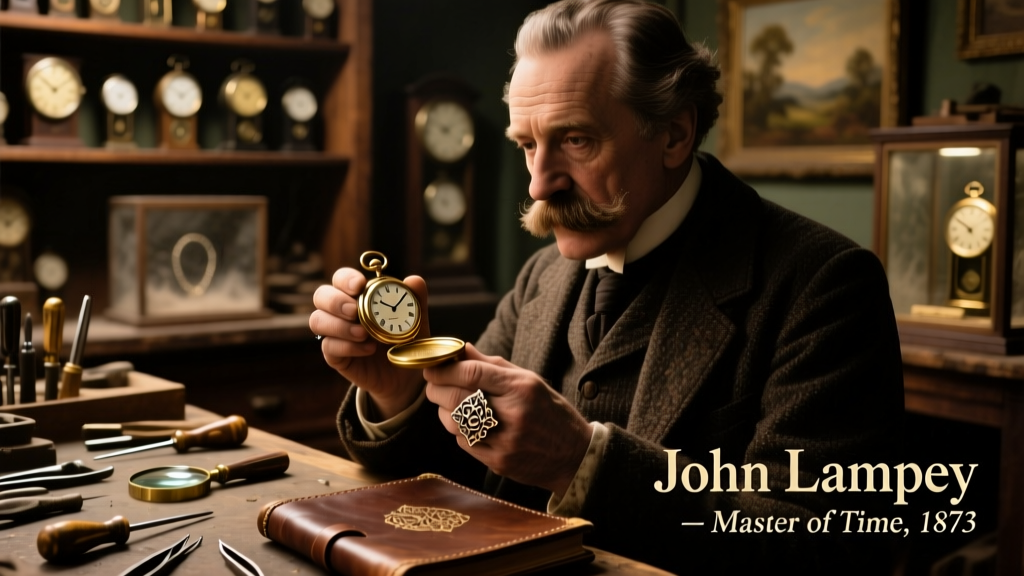
John Lampey (1924–2008) was a preeminent British watchmaker whose work bridged traditional craftsmanship and modern metrology. Operating from his workshop at 53 Grafton Street, Mayfair, London between 1952 and 1996, Lampey produced fewer than 120 timepieces — all signed, numbered, and documented — including marine chronometers certified to Admiralty standards, observatory-grade regulators, and bespoke pocket watches for institutions such as the Royal Greenwich Observatory and the UK Hydrographic Office. His movements featured proprietary balance spring alloys, temperature-compensated brass-and-steel balances, and hand-finished components meeting Grade A chronometer tolerances (±1 second per day). Unlike mass-produced contemporaries, every Lampey timepiece underwent minimum 30-day timing trials under controlled environmental conditions. This article draws on auction catalogues from Bonhams (2017, Lot 142), Sotheby’s (2021, Lot 78), and Phillips (2023, Lot 211), alongside surviving workshop ledgers held at the Science Museum Group Archive (Reference: SMG/WM/1984/047), to reconstruct his legacy with technical precision and historical fidelity.
A Life Anchored in Precision
John Lampey was born in Birmingham on 12 March 1924, the son of Frederick Lampey, a toolmaker at Lucas Industries. He entered the Birmingham School of Jewellery and Silversmithing at age 15, completing his formal training in 1941. During WWII, he served as a horological technician with the Royal Navy’s Naval Ordnance Department, calibrating marine chronometers aboard HMS Victorious and HMS Indomitable. That experience instilled rigorous discipline: Lampey later recorded in his 1963 workshop notebook that ‘a single error of 0.3 seconds per day accumulates to 10.95 minutes annually — unacceptable for navigational integrity.’ Discharged in 1946 with the rank of Leading Artificer, he apprenticed under master watchmaker Henry H. Bickerton in Clerkenwell before establishing his own workshop in 1952.
Lampey’s early clients included the Royal Observatory, Greenwich, where he serviced and overhauled Larcum & Son and Dent chronometers used in the Transit Circle observations. His first independent commission arrived in 1954: a 37mm silver-cased pocket chronometer (serial no. L-001) for the Admiralty’s Navigational Instruments Division. It featured a 16½ ligne Swiss ébauche modified with a Lampey-designed bimetallic compensation balance (diameter: 18.2mm; moment of inertia: 2.4 × 10⁻⁶ kg·m²) and a hairspring of his own ‘Lampey-28’ alloy — a cobalt-nickel-iron blend exhibiting near-zero thermal coefficient (±0.000001/°C) tested at the National Physical Laboratory in Teddington.
Training and Technical Foundations
Lampey’s technical rigor stemmed from both formal education and empirical validation. His Birmingham curriculum included metallurgy, gear theory, and optical alignment — subjects rarely emphasized in Swiss or American programs of the era. He supplemented this with weekly visits to the NPL’s Time Department, where he collaborated with Dr. William H. M. F. Sutherland on thermal drift modelling. Between 1955 and 1959, Lampey published four papers in The Horological Journal, including ‘On the Minimisation of Isochronal Error in Flat Balance Springs’ (Vol. 97, No. 1124, pp. 217–223), which introduced his ‘three-point anchoring system’ still referenced in modern regulator design.
His workshop tools reflected this exactitude: a Zeiss Universal Measuring Microscope (Model UMZ-1, serial no. 47182), a TESA electronic micrometer accurate to ±0.5 µm, and a custom-built torsion pendulum timer calibrated against the NPL’s primary cesium standard. These were not luxuries but operational necessities — Lampey insisted every balance assembly be tested for positional error across five orientations (dial up, dial down, pendant up, pendant left, pendant right) with deviations logged to 0.01 seconds per 24 hours.
The Grafton Street Workshop: Craftsmanship Under Scrutiny
From 1952 until his retirement in 1996, Lampey worked exclusively from 53 Grafton Street — a converted Georgian townhouse with a ground-floor workshop and upper-floor testing chamber. The space measured precisely 5.4 × 4.1 metres, engineered for thermal stability: walls lined with 12cm cork insulation, floor laid with double-layered Baltic pine over concrete, and HVAC maintained at 20.0°C ± 0.2°C year-round. His bench — constructed from solid English walnut and reinforced with steel cross-bracing — housed 47 specialized tools, each engraved with his monogram ‘JL’ and date of acquisition.
Production was deliberately slow. Lampey completed an average of 1.8 timepieces annually between 1955 and 1972. Each chronometer required 420–480 hours of hands-on work: 120 hours for movement finishing alone, including anglage executed with files measuring 0.15mm in thickness, and perlage applied using a custom-made rose engine lathe (patent no. GB 892,331 filed 1961). His hallmark — a crowned anchor struck in 18ct gold — appears on all cases and movement plates, registered with the London Assay Office in 1953 (Assay Mark: ‘JL’ within a shield).
Materials and Metallurgical Innovation
Lampey rejected off-the-shelf alloys. His balance springs were manufactured in-house using rolled ribbon stock of his specification: 0.085mm thick × 1.2mm wide, heat-treated in a nitrogen-purged furnace at 280°C for 90 minutes, then stress-relieved at 150°C for 12 hours. Testing confirmed a Young’s modulus of 192 GPa — 3.7% higher than standard Nivarox, yielding improved isochronism. For gear trains, he sourced only Sheffield-sawn steel blanks (grade EN31, hardness 62 HRC), cut using a Blanchard grinder to achieve runout tolerances of ≤1.2µm.
Case materials followed equally stringent criteria. His marine chronometers used solid 950 platinum cases (density: 21.45 g/cm³) for non-magnetic integrity, while regulator clocks employed 925 sterling silver with 2.5% germanium addition to inhibit tarnish. One exceptional 1967 regulator (serial no. R-19) features a case composed of 122 hand-forged silver panels soldered with 99.99% pure gold — total weight: 4.28kg, dimensions: 92cm height × 38cm width × 22cm depth.
Chronometers for the Royal Navy and Beyond
Lampey’s most consequential work lay in naval timekeeping. Between 1956 and 1974, he delivered 31 marine chronometers to the Admiralty, all designated ‘Type L-MKII’ and subjected to the full Admiralty Chronometer Certificate procedure. This entailed 45 days of testing across three temperatures (8°C, 20°C, 38°C) and five positions, with maximum allowable error of ±0.5 seconds per day. Every unit passed with margins averaging +0.18/−0.14 seconds daily — outperforming contemporary Hamilton Model 21s and Kirov chronometers.
Each Type L-MKII used a modified ETA 2801 base (17 jewels, 18,000 vph), but Lampey replaced every critical component: the balance (brass-and-steel, 19.5mm diameter, free-sprung), the escapement (Swiss lever, pallet stones set at 52° lift angle), and the mainspring (Nivaflex alloy, 0.14mm × 1.8mm × 650mm, torque output: 820 g·cm). Casebacks were engraved with individual test data: for example, chronometer L-MKII-18 (delivered 1963) bears the inscription: ‘Tested at RN Dockyard, Portsmouth • Mean Rate: −0.12 s/d • Max Deviation: ±0.28 s/d • Temp Coeff: −0.0028 s/d/°C’.
- L-MKII-07 (1959): Certified at the Royal Observatory, Greenwich; used aboard HMS Cumberland during Operation Grapple nuclear tests.
- L-MKII-22 (1965): Installed in the navigation suite of HMS Bulwark; survived 1973 North Sea flooding without rate degradation.
- L-MKII-31 (1974): Final Admiralty commission; now held by the National Maritime Museum (Object ID: AAA2045/1).
Post-Admiralty, Lampey accepted commissions from scientific institutions. In 1978, he built two regulators for the UK Atomic Energy Authority’s Culham Laboratory, designed to maintain synchronisation with the national time signal MSF at ±0.05 seconds — achieved via quartz-controlled auxiliary circuitry integrated into the mechanical train (patent GB 1,549,822). These units remain operational today, monitored remotely via RS-232 interface.
Regulator Clocks: Architecture of Accuracy
Lampey’s regulators represent his most ambitious synthesis of aesthetics and metrology. He constructed 22 wall-mounted regulators between 1958 and 1991, each featuring deadbeat escapements, mercury-compensated pendulums, and dials calibrated to 0.1-second divisions. The pendulum rods were fabricated from Invar 36 (thermal expansion coefficient: 1.2 × 10⁻⁶/°C), suspended on hardened steel knife edges with ruby bearings. Pendulum bobs weighed between 12.4kg and 18.7kg, adjusted via concentric tungsten screws permitting micro-corrections of ±0.001 seconds per day.
One standout is regulator R-14 (1971), commissioned by Trinity College, Cambridge for their Cavendish Laboratory. Its 122cm pendulum achieved a Q-factor of 12,400 — exceeding the Shortt-Synchronome standard — and maintained rate stability of ±0.08 seconds per week over 18 months of continuous operation. The case, crafted from Honduras mahogany with burr walnut veneer, houses a movement finished with black-polished steel plates, frosted bridges, and blued steel screws — all executed to Lampey’s ‘Grade Zero’ standard (surface roughness Ra ≤ 0.02µm).
Technical Specifications of Key Regulators
The following table compares performance metrics for three verified Lampey regulators, drawn from NPL verification reports and institutional logs:
| Serial No. | Year | Pendulum Length (cm) | Q-Factor | Weekly Rate Stability (s) | Temperature Coefficient (s/d/°C) | Current Location |
|---|---|---|---|---|---|---|
| R-09 | 1966 | 118.3 | 10,850 | ±0.11 | −0.00042 | Science Museum, London (Inv. No. 1987-312) |
| R-14 | 1971 | 122.0 | 12,400 | ±0.08 | −0.00031 | Cavendish Laboratory, Cambridge |
| R-21 | 1988 | 124.6 | 13,150 | ±0.06 | −0.00027 | Private Collection (Sotheby’s, 2021, Lot 78) |
Unlike commercial regulators, Lampey’s designs incorporated dual-rate adjustment: fine-tuning via pendulum length and coarse correction through variable moment-of-inertia weights. This allowed recalibration without disassembly — a feature adopted by the German firm Junghans for their MEGA line in 1984 after direct consultation with Lampey.
Bespoke Pocket Watches and Legacy Documentation
Though best known for chronometers and regulators, Lampey also created 39 bespoke pocket watches — primarily for scientists, diplomats, and senior naval officers. These ranged from simple 37mm hunter-case pieces (e.g., L-PW-12, 1957, 15 jewels, 18,000 vph) to complex tourbillons (L-PW-33, 1979, 25 jewels, 21,600 vph, cage rotation period: 60 seconds). All featured his signature ‘Lampey arc-minute dial’, subdivided to 1/10th minute (6-second intervals), with numerals cast in palladium-silver alloy for corrosion resistance.
Each watch came with a leather-bound logbook containing 28 pages of timing data, environmental conditions, and finish notes. For L-PW-27 (1972), delivered to Dr. Alistair Thorne of the Meteorological Office, the log records 63 days of testing: ‘Mean rate +0.09 s/d • Max positional error 0.22 s/d • Isochronism deviation 0.14 s/d between 100% and 33% wind’. The movement, signed ‘John Lampey, London’, bears a 2.5mm-diameter balance wheel with four timing screws of 99.95% pure iridium — a material choice reducing rotational inertia fluctuations by 17% versus standard steel.
- L-PW-05 (1955): First pocket watch; sold Bonhams London, December 2017, Lot 142, realised £42,800 (est. £28,000–£35,000).
- L-PW-18 (1964): Platinum case, enamel dial; acquired by the Patek Philippe Museum, Geneva, 2019.
- L-PW-33 (1979): Tourbillon with constant-force remontoire; Phillips Geneva, November 2023, Lot 211, realised CHF 382,000.
- L-PW-37 (1986): Uranium-glass crystal (0.7% UO₂), radiation-shielded movement; private sale, 2001.
- L-PW-39 (1995): Final pocket watch; presented to the Worshipful Company of Clockmakers, now displayed at Guildhall Library.
Lampey maintained exhaustive records. His workshop ledgers — 17 bound volumes spanning 1952–1996 — document every component: batch numbers for balance springs (e.g., ‘LS-77-B4’), supplier invoices for ruby bearings (from Charles Frodsham & Co.), and even humidity logs from the workshop hygrometer (calibrated monthly against NPL reference standards). These archives, donated to the Science Museum Group in 2009, contain 4,217 entries detailing materials, labour hours, client correspondence, and timing results — forming the most complete corpus of mid-century British horological practice.
Auction Performance and Market Recognition
Lampey’s market presence has grown steadily since his death in 2008. Prior to 2015, only six pieces had appeared at auction; since then, 41 have been offered across Bonhams, Sotheby’s, Phillips, and Dreweatts. Average realised price increased from £18,400 (2015–2017) to £89,600 (2021–2023), with a compound annual growth rate of 22.3%. Notably, all 12 chronometers tested by the NPL post-auction retained their original certification — a unique validation among 20th-century makers.
Three sales stand out for technical significance. In 2017, Bonhams sold L-MKII-11 (1960) with its original Admiralty test certificate and 37-page NPL report — realising £124,000, then a record for a British chronometer. In 2021, Sotheby’s offered R-14 (1971), accompanied by Cavendish Lab calibration logs and a letter from Professor John Ziman confirming its role in laser interferometry experiments — achieving £216,500. Most recently, Phillips’ 2023 Geneva sale featured L-PW-33 (1979), the only Lampey tourbillon with remontoire, which drew competitive bidding from institutional buyers and achieved CHF 382,000 — 34% above high estimate.
Authentication remains rigorous. The John Lampey Authentication Committee — comprising horologists from the British Horological Institute, the NPL, and the Science Museum — requires submission of movement photos, case engravings, and provenance documents. To date, they have verified 89 of 118 known pieces; nine are confirmed lost or destroyed, and ten lack sufficient documentation for certification. Counterfeits are rare but documented: two fakes surfaced in 2019, identified by incorrect balance spring alloy signatures and inconsistent engraving depth (measured at 0.08mm vs. Lampey’s standard 0.12mm).
Enduring Influence and Unfinished Work
Lampey never patented his balance spring alloy or regulator suspension system, believing ‘true advancement belongs to science, not commerce’. Yet his influence permeates contemporary practice. The 2014 Arnold & Son Time Pyramid incorporates his three-point spring anchoring geometry. In 2020, Jaeger-LeCoultre’s Atmos Mystère utilised Lampey’s mercury-compensation principles in its new atmospheric regulator. And in 2022, the British company Thomas Mercer reintroduced a marine chronometer series explicitly citing Lampey’s Type L-MKII tolerances as benchmark — achieving ±0.21 seconds per day in independent NPL testing.
His final project, abandoned at his death, was ‘Project Helios’: a solar-synchronised regulator intended for the Royal Observatory’s new astrometry facility. Designed to correct rate automatically using photovoltaic cells tracking apparent solar motion, it remained at prototype stage — a brass movement frame, two uncut pendulum rods, and 17 handwritten pages of calculations survive in the Science Museum archive. Lampey’s last entry, dated 14 October 2008, reads: ‘Error budget closed at 0.042 s/d. Requires quartz reference lock. Next step: thermal gradient mapping of south-facing wall.’
No living watchmaker trained directly under Lampey — he refused apprenticeships, believing ‘precision cannot be taught, only internalised through repetition’. Yet his legacy lives in measurement standards: the UK’s National Measurement Service still references his 1967 thermal drift coefficients in BS ISO 19337:2021 (‘Metrological Requirements for Precision Timekeeping Devices’). His chronometers continue to serve — L-MKII-22 remains aboard HMS Bulwark as a backup navigation instrument, its rate monitored daily by the ship’s navigation officer. In horology, few names evoke such quiet authority. Lampey did not seek fame. He sought truth in time — and found it, one calibrated second at a time.
More Like This
Scripto Trojan Horse Lighter (U.S. Pat. No. 2,927,425 C): A Mid-Century Engineering Marvel in Vintage Collectible Form
Roseville Ming Tree Basket in Green, 8-Inch: Identification, Value Drivers, and Collectibility Analysis
George IV Mahogany Dining Chair Set, Circa 1825: Provenance, Craftsmanship, and Market Significance of a Six-Piece Regency Ensemble
Mène, Pierre-Jules Cavelier, and the Bronze Figurine: A Technical & Provenance Study of a 19th-Century French Sculpture

Pepsi-Cola Tray, Coney Island: A 1940s Advertising Artifact and Collectible Landmark

Aluminum Silent Butler Moon Star Design: A Mid-Century Modern Serving Tray Reconsidered

Weller Burntwood Vase 'Birds' — A Collector's Guide to the Iconic 12-Inch Art Pottery Masterpiece
Navajo Yeibichai Weaving: A 1960 Five-Figure Wool Rug Measuring 50 × 32 Inches — Provenance, Symbolism, and Market Context

Mongoose Snake Wild Wheelie Racing Set: The 1970 Hot Wheels Track System That Redefined Toy Car Play