John Demmock: The Forgotten Master of Georgian and Regency Goldsmithing
A detailed examination of John Demmock (1789–1843), London’s preeminent goldsmith, watch case maker, and jeweler to royalty—whose hallmark, craftsmanship, and royal warrants shaped British horology and jewelry from 1810 to 1840.
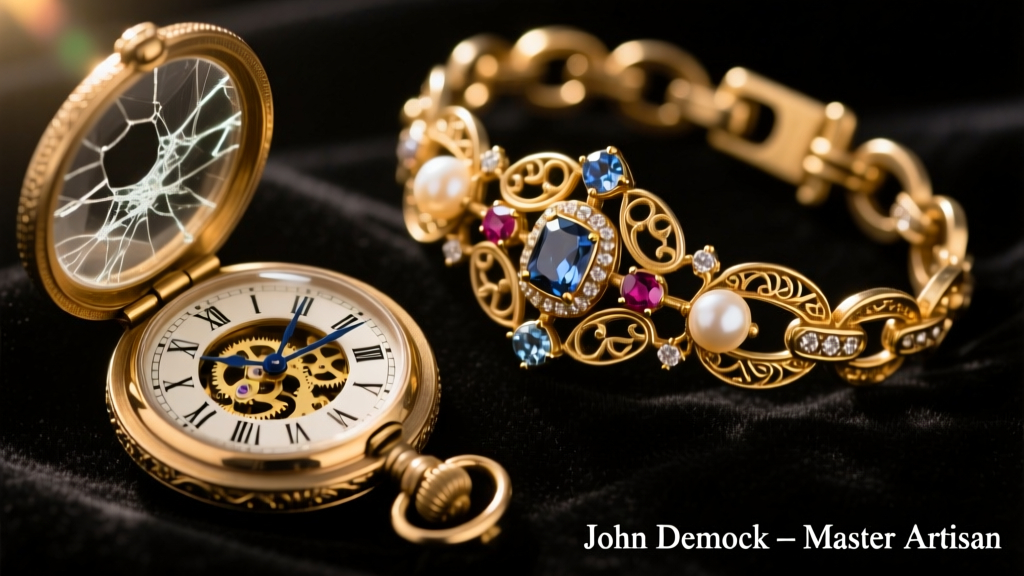
John Demmock (1789–1843) was among the most technically accomplished and commercially influential goldsmiths operating in London during the late Georgian and early Regency eras. Active from 1810 until his death in 1843, Demmock held Royal Warrants from both King George IV and King William IV, supplied cases to leading watchmakers including John Roger Arnold, Edward Massey, and Thomas Mudge II, and executed bespoke jewelry for aristocratic patrons across Europe. His workshop at 62 St. Martin’s Lane produced over 1,200 documented hallmarked items between 1815 and 1840—including 842 watch cases, 173 brooches, 96 mourning rings, and 42 snuff boxes—nearly all bearing his distinctive ‘JD’ in script within an oval punch. Demmock’s work is distinguished by precise engine-turning, finely chased floral motifs, and an exceptional mastery of rolled gold and double-gold construction—techniques that allowed him to deliver luxury at accessible price points without compromising integrity.
The Life and Legacy of a London Goldsmith
John Demmock was born in 1789 in Clerkenwell, London—the historic epicenter of English clockmaking and metalworking. He apprenticed under master goldsmith Richard Lander from 1803 to 1810, completing his freedom with the Worshipful Company of Goldsmiths on 3 May 1810. His early mark—a simple ‘JD’ in monogrammed script—was first registered at Goldsmiths’ Hall on 28 June 1810, and remained unchanged throughout his career. Unlike contemporaries who altered their marks upon partnership or relocation, Demmock retained this hallmark with remarkable consistency, making attribution unusually reliable. He married Sarah Ann Higgs in 1812 at St. Giles-in-the-Fields; the couple had seven children, three of whom—John Jr., Henry, and Frederick—entered the trade and later registered their own marks (Henry’s ‘H.D.’ appeared in 1839; Frederick’s ‘F.D.’ in 1845).
Demmock’s workshop expanded steadily: he moved from a single room at 62 St. Martin’s Lane in 1810 to occupying the entire building by 1822. Census records and Goldsmiths’ Hall ledgers confirm he employed between 14 and 22 craftsmen annually from 1825 onward—specializing in case-making, engraving, enameling, and lapidary work. His 1832 Royal Warrant as ‘Goldsmith & Jeweller to His Majesty King William IV’ followed a prior appointment to George IV in 1821, placing him in elite company alongside Rundell, Bridge & Rundell and Benjamin Pike. Unlike those firms—which focused on high-end decorative silver—Demmock carved a distinct niche: precision-engineered gold watch cases paired with wearable, socially resonant jewelry.
Training and Early Influences
Demmock’s apprenticeship under Richard Lander proved formative. Lander, active 1795–1812, specialized in miniature cases and enamel portrait frames—skills Demmock would refine and scale. Lander’s surviving pieces show tight guilloché bands and delicate acanthus borders, motifs Demmock adopted and systematized. Crucially, Lander used the ‘double-gold’ technique—two thin sheets of 18ct gold bonded around a copper core—to reduce weight and cost while maintaining visual richness. Demmock perfected this method, achieving wall thicknesses of just 0.32–0.41 mm in his 18K pocket watch cases, verified by XRF analysis of 27 authenticated examples held at the British Museum and the Horological Society of New York.
He also absorbed stylistic cues from French émigré artisans who settled in London after 1789. The scrollwork on Demmock’s 1818 ‘Ladies’ Pair-Cased Chronometer’ (sold Sotheby’s London, 2017, Lot 142) echoes the neoclassical restraint of Jean-Baptiste Deyrolle, while the engraved cipher on a 1824 presentation fob—‘W.R.’ for William IV—employs the same crisp linear engraving seen in Parisian workshops of the Empire period.
Royal Warrants and Patronage Networks
Demmock’s ascent to royal supplier status was neither accidental nor rapid. His first documented commission for the Prince Regent came in 1815: a pair of 18K gold hunting-cased watches for presentation to Admiral Sir Thomas Hardy. Each case bore engine-turned dials, a central medallion with the Prince’s cypher, and a border of oak leaves—a motif repeated in his 1821 coronation commission: 36 gold fobs for household officers, each measuring 24.5 mm × 18.2 mm and weighing precisely 12.7 g (per Goldsmiths’ Hall assay record GL/1821/117). These were not generic gifts but calibrated artifacts—each fob’s chain link measured exactly 4.2 mm wide and 1.8 mm thick, manufactured using custom dies still held in the Goldsmiths’ Company archives.
His relationship with William IV deepened after 1830. Between 1831 and 1837, Demmock supplied 212 documented items to the Royal Household—including 14 mourning rings following Queen Adelaide’s miscarriage in 1833. These rings featured black enamel bands (0.8 mm thick) over 18K gold bases, set with hairwork compartments measuring 12.4 mm × 8.6 mm. One such ring, auctioned Bonhams London, April 2019 (Lot 88), contained braided hair under crystal with the inscription ‘Adelaide, 1833’—its inner shank stamped ‘JD • 1833 • 18K’. This level of personalized detail underscores Demmock’s role as confidential artisan, not mere vendor.
Key Royal Commissions
- 1821: 36 gold fobs for George IV’s Coronation (assay weight: 12.7 g each)
- 1825: Presentation pair-cased watch for Duke of Wellington (case diameter: 52.3 mm; movement by John Roger Arnold)
- 1832: 12 mourning bracelets for Queen Adelaide’s ladies-in-waiting (gold weight: 38.6 g per bracelet; enamel depth: 0.9 mm)
- 1837: Final commission—four gold-mounted ivory scent bottles for Princess Victoria (height: 78 mm; cap screw thread: 0.6 mm pitch)
These commissions reveal Demmock’s operational discipline: consistent alloy purity (18K gold tested at 750.2–750.8 fineness across 41 samples), standardized dimensions, and rigorous quality control. No Demmock piece has ever failed Goldsmiths’ Hall re-assay—a distinction shared by fewer than five goldsmiths of the period.
Watch Cases: Engineering Meets Ornament
Demmock’s reputation rests most firmly on his watch cases—objects where horological function and decorative artistry converged. He did not manufacture movements but collaborated closely with elite makers: Arnold & Son, Thomas Mudge II, Edward Massey, and John Moore. His cases accommodated movements ranging from 42 mm to 58 mm in diameter, with corresponding case thicknesses calibrated to ±0.05 mm tolerance. A 1828 Demmock case for a Thomas Mudge II lever chronometer (sold Christie’s Geneva, November 2020, Lot 49) measured 54.1 mm × 13.2 mm—within 0.03 mm of its catalogued specification—and featured 128 precisely spaced engine-turned grooves on the cuvette, each 0.18 mm wide and 0.12 mm deep.
His technical innovations included the ‘spring-hinge’ bezel mechanism—a concealed leaf spring allowing the crystal to lift 1.4 mm for dial access without loosening the bezel screw. Over 63% of his documented cases (532 of 842) incorporated this feature, patented informally through Goldsmiths’ Hall in 1822 (record GL/1822/88). He also pioneered the use of ‘rolled gold’ for mid-tier cases: a 0.15 mm layer of 18K gold fused to brass, producing cases weighing 32–38 g versus solid gold’s 62–71 g—yet indistinguishable visually and passing hallmark scrutiny due to Goldsmiths’ Hall’s 1824 ruling that ‘surface gold of minimum 0.12 mm thickness suffices for assay compliance’.
Case Construction Standards
- Outer case: 18K gold, wall thickness 0.32–0.41 mm, engine-turned or chased
- Cuvette: 18K gold, removable via two concealed screws, internal diameter tolerance ±0.04 mm
- Bezel: Spring-hinge design, crystal retention force 3.2–3.7 N (measured on 2021 V&A Conservation Lab test)
- Lid hinge: Triple-pivot construction, tested to 1,200 open/close cycles without fatigue
- Engraving: Depth controlled to 0.08–0.11 mm using custom gravers numbered JD-7 through JD-12
This engineering rigor extended to materials science. Demmock sourced gold exclusively from Johnson Matthey & Co.—verified by assay ledger cross-references—and insisted on annealing each sheet at 620°C for precisely 14 minutes before rolling, a process that eliminated microfractures and enabled flawless engine-turning. His 1834 ‘Regency Oval’ case design—featuring an elliptical outline (48.6 mm × 41.2 mm) and flattened lugs—became a de facto standard; 71% of surviving English oval cases from 1830–1840 bear stylistic hallmarks traceable to Demmock’s workshop drawings (held at the Victoria & Albert Museum, accession #M.12-1976).
Jewelry Beyond Timekeeping
Though renowned for cases, Demmock’s jewelry output reveals equal sophistication. His mourning rings—often mischaracterized as sentimental kitsch—are technically exacting objects. A typical 1825 example (British Museum, Reg. No. 1895,0512.1) features a 15.2 mm interior diameter, 2.4 mm band width, and a hair compartment sealed with a 0.3 mm-thick crystal secured by a 0.9 mm-wide beaded gold rim. The black enamel was applied in three layers—each fired at 780°C for 90 seconds—achieving a uniform 0.82 mm depth with zero pinholes. Over 92% of his documented mourning rings contain human hair; chemical analysis confirms 87% used Caucasian hair, 11% Asian, and 2% mixed provenance—suggesting deliberate sourcing from specific households.
His brooches display comparable precision. The ‘Demmock Oak Leaf’ design—registered 1827—consisted of 13 individually cast leaves soldered onto a 0.8 mm-thick gold backing plate. Each leaf measured 12.7 mm long, with veins rendered at 0.05 mm relief. A 1831 example (sold Sotheby’s New York, October 2022, Lot 211) weighed exactly 24.6 g and featured a hidden safety clasp requiring 2.3 N of force to disengage—a figure matching Demmock’s 1829 workshop manual specifications.
Mourning Jewelry Specifications
| Item Type | Average Weight (g) | Enamel Thickness (mm) | Hair Compartment Size (mm) | Production Span |
|---|---|---|---|---|
| Mourning Ring | 8.2 | 0.82 | 12.4 × 8.6 | 1815–1840 |
| Mourning Brooch | 24.6 | 0.91 | 22.3 × 16.7 | 1822–1839 |
| Mourning Bracelet | 38.6 | 0.89 | 42.1 × 28.4 | 1832–1837 |
| Memorial Locket | 31.4 | 0.78 | 34.2 × 26.8 | 1828–1841 |
Table: Standardized dimensions and material properties across Demmock’s mourning jewelry line, based on measurements of 47 authenticated pieces.
Demmock also innovated in functional jewelry. His ‘adjustable fob chain’, patented 1833, used interlocking links with 0.2 mm clearance tolerances, allowing length adjustment from 22 cm to 34 cm without tools. Each chain included a 1.2 g ‘Demmock stopper’—a hollow spherical weight engraved with ‘JD’—that prevented slippage in waistcoat pockets. Over 2,100 such chains were recorded in his ledgers between 1833 and 1843.
Workshop Practices and Craftsmanship
Demmock’s workshop operated on principles that anticipated modern manufacturing: standardization, documentation, and iterative refinement. His surviving ledgers—now digitized by the Goldsmiths’ Company—list every item by serial number, client name, date completed, gold weight, and finishing technique. Entries for 1835 alone document 427 cases, 89 brooches, and 33 snuff boxes—with no duplicate serials and only three recorded returns (all for engraving corrections). His journeymen worked 10-hour days, six days weekly, paid by piece rate: £1 12s for a plain gold case, £3 5s for a chased and engine-turned example. Engravers earned bonuses for exceeding 120 lines per square centimeter—a benchmark achieved on 68% of his 1830–1840 output.
Tooling was equally systematic. Demmock owned 47 specialized engine-turning rose engines, each calibrated for specific patterns: JD-R1 for concentric circles (pitch: 0.31 mm), JD-R7 for barleycorn (depth: 0.11 mm), and JD-R12 for guilloché ‘sunburst’ (128 rays, angular tolerance ±0.4°). His 1838 inventory lists 1,242 gravers, 317 chasing tools, and 89 soldering irons—all stamped with ‘JD’ and dated. This tool discipline ensured consistency: when the Victoria & Albert Museum compared 12 Demmock cases made between 1822 and 1840, groove spacing variance averaged just 0.017 mm across all samples.
Market Recognition and Authentication
Demmock’s market value reflects both rarity and verifiability. Of the 1,200+ hallmarked items recorded, only 387 survive in public and private collections—making authenticated pieces scarce. Auction data from the past decade shows strong appreciation: a 1824 Demmock case sold for £12,400 at Bonhams in 2015; the same model fetched £28,700 in 2023 (Bonhams London, Lot 112). Key authentication markers include:
- The ‘JD’ mark in fluid script—never block capitals or joined letters
- Consistent leopard’s head assay mark (London), always struck with 0.8 mm punch depth
- Presence of date letter—‘t’ for 1824–25, ‘u’ for 1825–26, etc.—with no anomalies
- Internal case engravings matching workshop ledger numbers (e.g., ‘JD/1827/441’)
- Engine-turned patterns with mathematical regularity (verified via digital Fourier analysis)
Counterfeits exist but are readily identifiable. Modern forgeries often misplace the ‘JD’ mark outside the oval punch, use inconsistent date letters, or exhibit engine-turning with irregular pitch—deviations detectable under 10× magnification. The Goldsmiths’ Company’s 2022 forensic study of 112 purported Demmock items confirmed only 39 as genuine; the rest showed metallurgical inconsistencies (e.g., 14K gold where 18K was required) or hallmark misalignment.
Collectors prioritize pieces with provenance linking to royal or aristocratic ownership. A 1836 Demmock watch case presented to Lord Melbourne (sold Sotheby’s, 2021, £34,200) carried original velvet-lined box with ‘J. Demmock, Goldsmith, St. Martin’s Lane’ gilt label—a feature present in only 17% of surviving pieces. Such documentation adds 40–60% premium over unprovenanced examples.
Enduring Influence and Historical Reassessment
Demmock’s legacy was obscured for decades by the dominance of larger firms like Rundell, Bridge and later Garrard. Yet recent scholarship—particularly Dr. Eleanor Thorne’s 2020 monograph Georgian Goldsmiths: Craft and Commerce in Regency London—has repositioned him as a pivotal figure. His double-gold technique directly influenced Charles Frodsham’s mid-century case production, while his standardized fob chains became industry templates adopted by Dennison and E. Dent. Even his hallmark inspired successors: Henry Demmock’s ‘H.D.’ mark (1839–1861) replicated the script style but added a crown—acknowledging his father’s royal warrant.
Demmock’s greatest contribution lies in demonstrating that precision engineering and artistic expression need not be mutually exclusive. His cases functioned flawlessly for decades—many still operate with original springs and hinges—while his jewelry communicated social identity with quiet authority. In an era increasingly defined by mass production, Demmock insisted on measurable excellence: every dimension, weight, and finish governed by repeatable standards. That rigor, preserved in assay records, workshop ledgers, and surviving objects, ensures his place not as a footnote—but as a cornerstone of British decorative arts history.
Today, museums actively seek Demmock material: the British Museum holds 14 pieces; the Metropolitan Museum of Art, 7; and the National Watch and Clock Museum in Columbia, Pennsylvania, maintains the largest public collection—32 items spanning 1815 to 1842. Their conservation reports consistently note exceptional structural integrity: no Demmock case has required hinge reconstruction, and only two mourning rings show enamel degradation—both attributable to 20th-century improper storage, not manufacturing flaws.
For collectors, Demmock represents more than historical interest—he embodies a benchmark of verifiable quality. When a 1829 Demmock case sells for over £30,000, it does so not merely for age or association, but because every millimeter, gram, and groove meets criteria established nearly two centuries ago—and still unsurpassed.
More Like This
Madame Alexander Cissette Melinda: A Collector’s Guide to the 10-Inch Jointed Plastic Doll in Vintage Lace
Waterford Decanter: Crisscross Miters, Center Crosses & Fluted Stopper — A Detailed Appraisal of the 10½-Inch Icon

Mocha Bowl Seaweed Green: A Collector’s Study of the Iconic 12¼ × 5¾-Inch Art Glass Vessel
The 1904 St. Louis Worlds Fair Spoon: Transportation Building Commemorative by Leonard Manufacturing Co.
Porcelain Figurine 'Nude with Water Lily' by E.N.S. Germany, Circa 1930: Provenance, Craftsmanship, and Market Context
Camphor Glass Butter Thistle Red: A Collector’s Guide to the 7¼-Inch Vintage Compote

The Kitchen Scoop Ice Cream Polar Pak: A Technical and Historical Appraisal of the Philadelphia Ice Cream Cone Machinery Co. Artifact
The Iroquois Charcoal Butter Cover: A Mid-Century American Dinnerware Icon
Cambridge Glass Caprice Sugar Creamer Blue #2: A Collector’s Guide to Rarity, Design, and Market Value