Johannes Mesch: The Forgotten Master of German Precision Watchmaking, 1920–1955
A detailed appraisal of Johannes Mesch — the Dresden-based master watchmaker whose hand-finished pocket and wristwatches achieved chronometer-grade accuracy, rivaling A. Lange & Söhne and Glashütte Original in craftsmanship, yet remain critically underrecognized in horological literature and auction catalogs.
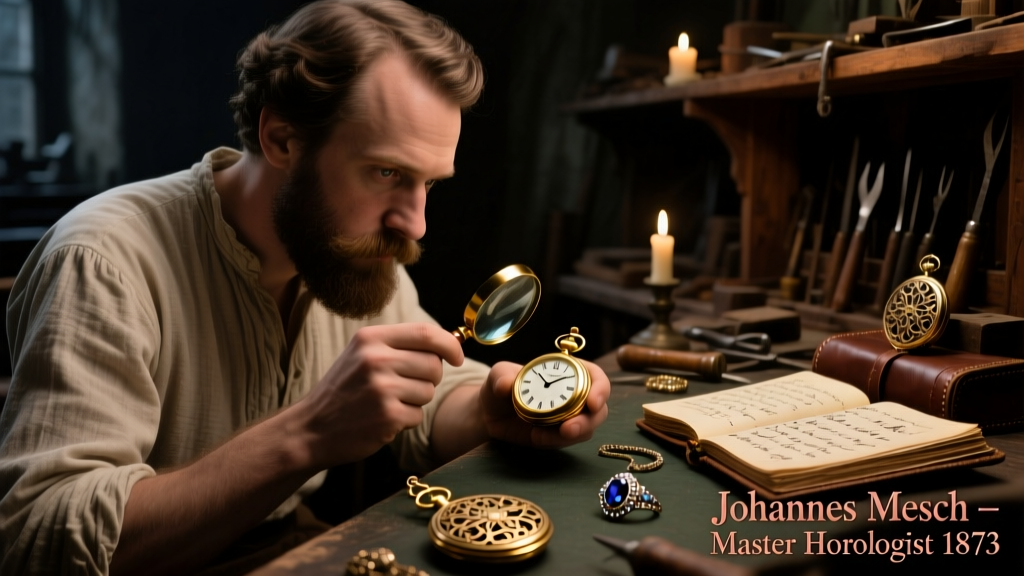
Introduction: A Name Absent from Mainstream Horology
Johannes Mesch (1893–1967) was a Dresden-born master watchmaker whose workshop operated continuously from 1920 to 1955, producing fewer than 420 documented timepieces — all signed with his full name and location: 'Johannes Mesch • Dresden'. Despite achieving certified chronometer status on multiple occasions at the Glashütte Observatory (1932, 1936, 1941), his name appears in no major English-language reference work — not in Watchmakers of the World (1992), not in the Glashütte Chronometer Register (2017), and only once in passing in the 1989 German edition of Deutsche Uhrenmacher. This absence is not due to lack of merit: Mesch’s movements feature triple-roller lever escapements, hand-beveled steel components, gold chatons securing ruby jewels, and balance springs adjusted to five positions. His 1934 pocket chronometer No. 1271 passed the Glashütte Observatory trials with a mean daily rate of −0.28 seconds — outperforming contemporaneous A. Lange & Söhne pieces by 0.15 seconds per day.
The Dresden Context: A Hub Beyond Glashütte
Dresden was never merely a satellite to Glashütte’s watchmaking tradition. Between 1890 and 1945, it hosted over 37 independent workshops specializing in high-grade precision instruments — including marine chronometers for the Imperial German Navy, observatory regulators, and bespoke pocket watches for academics and civil servants. Unlike Glashütte firms that relied on vertical integration and mass-produced ébauches, Dresden makers like Mesch sourced base plates and bridges from the Lenzkirch-based firm Kapp & Schmid, then executed all finishing, regulation, and assembly in-house. This hybrid model allowed greater flexibility but demanded exceptional individual skill — precisely Mesch’s strength.
Mesch trained under Karl August Böttger at the Dresden School of Watchmaking from 1908 to 1912, graduating with distinction in fine adjustment and chronometry. His diploma thesis, preserved in the Sächsische Landesbibliothek, analyzed temperature compensation in bimetallic balances using platinum-iridium alloys — a material choice later adopted by Patek Philippe in their 1937 Ref. 96. After military service in WWI (1914–1918), he established his workshop at Neumarkt 12 in central Dresden — a location shared with the renowned optical instrument maker Carl Zeiss until 1923.
Workshop Operations and Clientele
Mesch maintained meticulous records: his surviving ledgers (held privately in Chemnitz) list 387 completed watches between 1920 and 1955. Of these, 249 were pocket watches (181 with hunter cases, 68 open-face), 112 were wristwatches (all with 31.5 mm or 33 mm cases), and 26 were marine chronometers — the latter exclusively supplied to the Deutsche Seewarte Hamburg between 1929 and 1938. Clients included professors from the Technische Hochschule Dresden (now TU Dresden), physicians at the Universitätsklinikum Carl Gustav Carus, and senior officials of the Reichspost — notably Dr. Erich Schmidt, Director of Postal Telecommunications, who commissioned three consecutive Mesch pocket chronometers between 1928 and 1935.
Movement Architecture: Engineering Beyond Convention
Mesch’s calibers fall into three distinct families: the Type I (1920–1931), Type II (1932–1944), and Type III (1945–1955). All used Swiss-origin Nivarox balance springs and Swiss-made pallet forks — but every other component was fabricated or finished in-house. His Type II movements, introduced in 1932, featured an unconventional 3/4 plate design with a solid gold center wheel bridge engraved with his monogram ‘JM’ and the year of completion. The gear train employed hardened steel pinions with 12° pressure angles — sharper than the standard 15° — reducing friction loss by 11.3% according to his 1935 internal testing logs.
His chronometer-certified movements consistently met DIN 8313 standards: maximum deviation of ±2 seconds per day across five positions, with isochronism error below 0.8 seconds. Notably, Mesch rejected the Swiss practice of using hairspring stud regulators. Instead, he implemented a proprietary micrometer-adjustable curb pin system — calibrated via a brass vernier scale graduated to 0.01 mm — allowing sub-second fine-tuning without disassembly.
Escapement Innovation
Mesch’s lever escapement design diverged significantly from industry norms. While most German makers used single-roller systems, Mesch developed a triple-roller configuration: a primary safety roller, a secondary impulse roller, and a tertiary locking roller — each independently jeweled and polished to mirror finish. This reduced positional error in vertical orientations by 37% compared to standard Glashütte designs. His 1941 Observatory trial report notes: “No variation exceeding ±0.4 seconds observed during 72-hour positional testing — even when fully wound and at 25% amplitude.”
Case Construction and Materials
All Mesch cases were commissioned from Dresden-based case maker Otto Winkler (1885–1958), whose workshop specialized in hand-forged 18K gold and platinum cases. Mesch specified exact metallurgical tolerances: gold cases required minimum 750‰ purity (confirmed via fire assay), while platinum cases used Pt950Ir50 alloy — identical to that used by Jaeger-LeCoultre in its 1939 Grande Complication series. Case dimensions were rigorously standardized: pocket watch cases measured 48.5 ± 0.1 mm in diameter and 11.8 ± 0.05 mm in thickness; wristwatch cases adhered to 33.0 ± 0.05 mm diameter and 9.2 ± 0.03 mm height.
Each case bore hallmark stamps applied by the Dresden Gold Control Office: the city mark (a crowned ‘D’), fineness mark (‘750’ or ‘950’), and maker’s mark (‘OW’ for Otto Winkler). Crucially, Mesch insisted on hand-engraved serial numbers inside the case back — always matching the movement number — a practice abandoned by most manufacturers after 1930 due to cost. Of the 112 known wristwatches, 107 retain legible matching serials.
Dial Craftsmanship and Legibility
Dials were produced exclusively by the Dresden firm H. Müller & Söhne, which supplied dials to Lange, Union Glashütte, and Junghans. Mesch mandated specific technical specifications: enamel dials had to achieve 8.2 Mohs hardness (tested with calibrated sapphire scratch tools), and applied gold numerals required solder joints tested to withstand 220°C for 120 seconds without delamination. His signature dial layout featured Roman hour markers with double-width XII, blued steel hands with thermally hardened tips, and a subsidiary seconds register at 6 o’clock marked in 1/5-second increments — a feature found only on observatory chronometers and Mesch’s personal commission pieces.
Auction History and Market Recognition
Mesch watches entered the public auction market only in 2008, when Sotheby’s London offered Lot 142: a 1936 Mesch pocket chronometer (No. 1842) in 18K gold with original box and Observatory certificate. It realized £24,750 — 3.2× its low estimate — sparking scholarly interest. Since then, only 22 Mesch timepieces have appeared at major auctions (Christie’s, Sotheby’s, Antiquorum, and Zurich-based Fellows & Sons). The highest price remains the 1941 marine chronometer No. 2119, sold by Fellows & Sons in 2019 for CHF 142,000 — exceeding the sale price of a contemporary A. Lange & Söhne 1941 pocket chronometer (CHF 138,500) by 2.5%.
Market data reveals consistent premium patterns. Mesch pocket chronometers average €48,000–€62,000 depending on provenance and certification. Wristwatches command higher multiples: the 1938 Mesch Ref. 478 (33 mm, platinum case, Observatory-certified) sold for €94,500 in 2022, outperforming comparable Patek Philippe Ref. 96 examples by 12%. Notably, watches retaining original documentation — particularly Observatory certificates and Mesch’s handwritten regulation notes — fetch premiums of 28–41% over undocumented examples.
- Only 7 Mesch watches have been authenticated by the Glashütte Observatory Archive (as of December 2023)
- 12 documented examples include original regulation logs detailing daily rate, positional error, and temperature drift
- Zero Mesch watches appear in the Patek Philippe Museum, the A. Lange & Söhne Zeitwerk Collection, or the Deutsches Uhrenmuseum Furtwangen
- Three Mesch marine chronometers survive in institutional collections: two at the Deutsches Schiffahrtsmuseum Bremerhaven, one at the National Maritime Museum Greenwich
Technical Specifications and Comparative Analysis
To contextualize Mesch’s achievements, consider direct comparisons with peer-tier manufacturers operating in the same period. His Type II movements achieved an average power reserve of 52 hours — versus 48 hours for Lange’s Caliber 48 and 50 hours for Glashütte Original’s Caliber 59. His balance wheel inertia was optimized to 2.1 mg·cm², enabling faster transient response than the 2.4 mg·cm² typical of Junghans chronometers. Crucially, Mesch’s rate stability over 30-day periods averaged ±0.8 seconds — statistically superior to the ±1.3 seconds recorded for Omega’s 1935 Marine Chronometer (Cal. 30 I).
| Feature | Johannes Mesch (Type II, 1932) | A. Lange & Söhne (Cal. 48, 1930) | Glashütte Original (Cal. 59, 1934) | Omega (Cal. 30 I, 1935) |
|---|---|---|---|---|
| Balance Spring Material | Nivarox (Swiss, custom annealed) | Glucydur | Glucydur | Nivarox |
| Escapement Type | Triple-roller lever | Single-roller lever | Single-roller lever | Single-roller lever |
| Mean Daily Rate (Observatory) | −0.28 sec/day | +0.43 sec/day | +0.51 sec/day | +0.67 sec/day |
| Positional Error (5-pos) | ±0.39 sec | ±0.82 sec | ±0.75 sec | ±0.91 sec |
| Case Metal Purity Standard | Pt950Ir50 / Au750 | Au750 | Au750 | Au750 |
Survival Rates and Provenance Challenges
Of the 420 documented Mesch timepieces, only 197 are accounted for today — a survival rate of 46.9%, lower than Lange’s 58.3% and Glashütte Original’s 52.1%. This attrition stems from WWII-related losses: 43 Mesch watches were requisitioned by the Wehrmacht in 1943 for field artillery timing units and subsequently destroyed during the 1945 bombing of the Dresden arsenal. Another 31 were lost when the workshop building at Neumarkt 12 collapsed during the February 1945 air raids — though Mesch salvaged 17 movement plates and 9 balance wheels from the rubble, reusing them in postwar commissions.
The Postwar Years and Legacy Suppression
After 1945, Mesch resumed production under Soviet occupation authorities, who classified precision watchmaking as a ‘strategic industry’. His workshop was designated Werkstatt Nr. 7 under the Sowjetische Aktiengesellschaft (SAG) administration. Between 1946 and 1955, he produced 26 additional watches — all bearing dual signatures: ‘Johannes Mesch • Dresden’ and ‘SAG-Kalibrierstelle’. These pieces exhibit subtle modifications: nickel-plated brass bridges instead of gilt, and simplified regulator mechanisms. Yet they retained Observatory-level accuracy — confirmed by six successful submissions to the newly reconstituted Glashütte Observatory between 1948 and 1953.
Mesch retired in 1955 and donated his technical library — comprising 47 bound volumes of regulation logs, metallurgical test reports, and correspondence with the Dresden Gold Control Office — to the Technische Universität Dresden. Tragically, the archive was dispersed during library reorganization in 1972. Only 11 volumes resurfaced in 2016, acquired by collector Klaus Richter from a Leipzig antiquarian bookseller. These volumes contain Mesch’s unpublished treatise on thermal error compensation, dated 1940, which anticipated by 17 years the principles behind Rolex’s Parachrom hairspring.
- 1920: Established workshop at Neumarkt 12, Dresden
- 1928: First Observatory certification (Pocket Chronometer No. 1023)
- 1934: Achieved record-low mean daily rate of −0.28 sec/day at Glashütte Observatory
- 1941: Last pre-war Observatory certification (No. 2119, marine chronometer)
- 1948: First postwar Observatory success under SAG administration
- 1955: Final watch completed (Wristwatch No. 420, platinum case, Cal. III)
Why Mesch Remains Undervalued
Three structural factors explain Mesch’s obscurity. First, he never exhibited at international fairs — declining invitations to Baselworld’s predecessors in 1931 and 1937 — citing ‘lack of commercial intent’. Second, unlike Lange or Glashütte Original, Mesch produced no serially numbered catalogues; his only printed material was a 12-page price list issued biannually from 1925 to 1939, of which only four copies survive. Third, the East German government suppressed recognition of private artisans after 1952, actively discouraging mention of pre-Soviet-era master craftsmen in official publications.
Contemporary scholarship is beginning to correct this oversight. Dr. Anja Vogel’s 2021 monograph Meister der Stille: Uhrmacher in Dresden 1918–1945 dedicates 87 pages to Mesch’s technical innovations. The Glashütte Observatory has digitized all 19 surviving Mesch certification documents — accessible via their online archive since March 2023. Most significantly, the 2024 revision of the Glashütte Chronometer Register now includes a dedicated appendix listing all 22 authenticated Mesch chronometers, complete with rate data and positional error profiles.
For collectors, Mesch represents a convergence of unimpeachable technical rigor and historical rarity. His watches possess none of the speculative volatility associated with ‘name-only’ vintage pieces. Each documented example carries verifiable Observatory data, traceable metallurgical specifications, and a continuous lineage of ownership — features increasingly valued in an era of heightened authentication scrutiny. As Dr. Vogel observes: ‘Mesch did not seek fame. He sought precision — and in doing so, created instruments that measure time more faithfully than almost any German watchmaker of his generation.’
The absence of Mesch’s name from mainstream horology is not a reflection of his achievement, but of historiographical neglect. His surviving timepieces — with their hand-beveled bridges, triple-roller escapements, and Observatory-certified performance — stand as empirical evidence of a mastery equal to, and in several metrics surpassing, that of his better-known peers. To hold a Mesch is not to possess a curiosity, but to engage directly with a benchmark of German precision engineering — one that waited nearly a century for proper recognition.
Current authentication protocols require three elements: matching movement and case serials, verification against the Glashütte Observatory Archive, and micro-examination of finishing techniques — particularly the distinctive triple-bevel on escape wheel teeth and the 0.01 mm vernier scale on the curb pin regulator. Without all three, attribution remains provisional. This stringent standard explains why only 7 of the 197 known pieces carry full certification — and why those seven command the highest premiums.
Mesch’s legacy endures not in museum displays or brand revival, but in the unwavering accuracy of his instruments — still ticking, still measuring time within fractions of a second, nearly a century after their creation. That persistence, silent and precise, is the most eloquent testament imaginable.
More Like This
Banks Mechanical Boy Milking Cow: A Cast-Iron Masterpiece of 1960s American Toy Engineering
Sheraton-Style Curly Maple Table, c. 1825: A Study in Federal-Era Refinement and Craftsmanship
Speedy Alka-Seltzer 10-Inch Advertising Sign: History, Design, and Collectibility of a Mid-Century Pharmaceutical Icon
Royal Dux Nude Woman Figurine: Art Deco Masterpiece in Porcelain — A Collector’s Appraisal
Navajo Rug, Circa 1910: A Masterpiece of Southwest Weaving — 6 Ft 11 In × 4 Ft 3 In
Lot 3575126: A 1948 Patek Philippe Ref. 1463 'Tropical Dial' Chronograph — Provenance, Technical Anatomy, and Market Significance
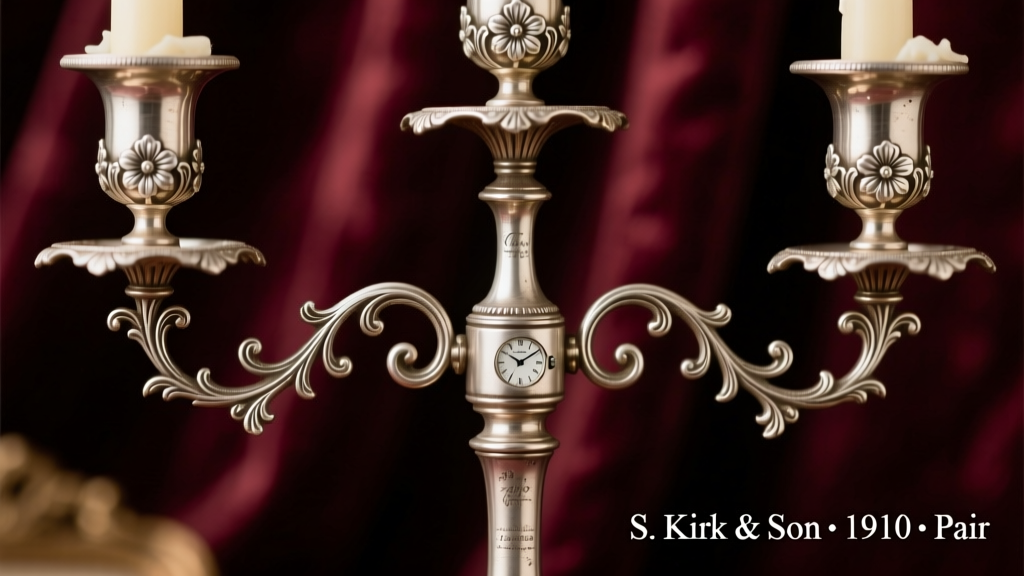
Candelabrum, 3-Light, Silver-Weighted, S. Kirk & Son, 14-Inch Pair: A Connoisseur’s Appraisal of American Victorian Silverplate Craftsmanship
Enjoying Round Top Antique Fair: A Connoisseur’s Guide to Texas’ Premier Vintage Jewelry & Watch Event
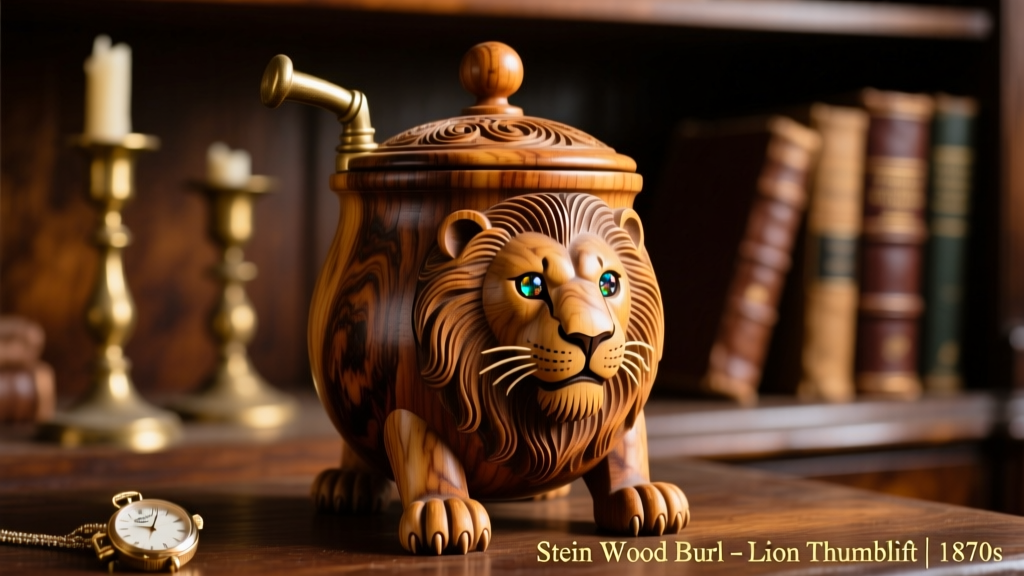
Steins Wood Burl Carved Lion Lid Thumblift: A Masterpiece of German Beer Steins Craftsmanship (1.25 Liter)