Job O. Pitkin: The Forgotten American Watchmaker Who Built Precision Timepieces for Presidents and Pilots
A definitive appraisal of Job O. Pitkin (1869–1943), the Boston-based master horologist whose hand-finished pocket watches and aviation chronometers earned elite commissions from the U.S. Navy, Pan American Airways, and President Calvin Coolidge—yet remain underrecognized in mainstream horological history.
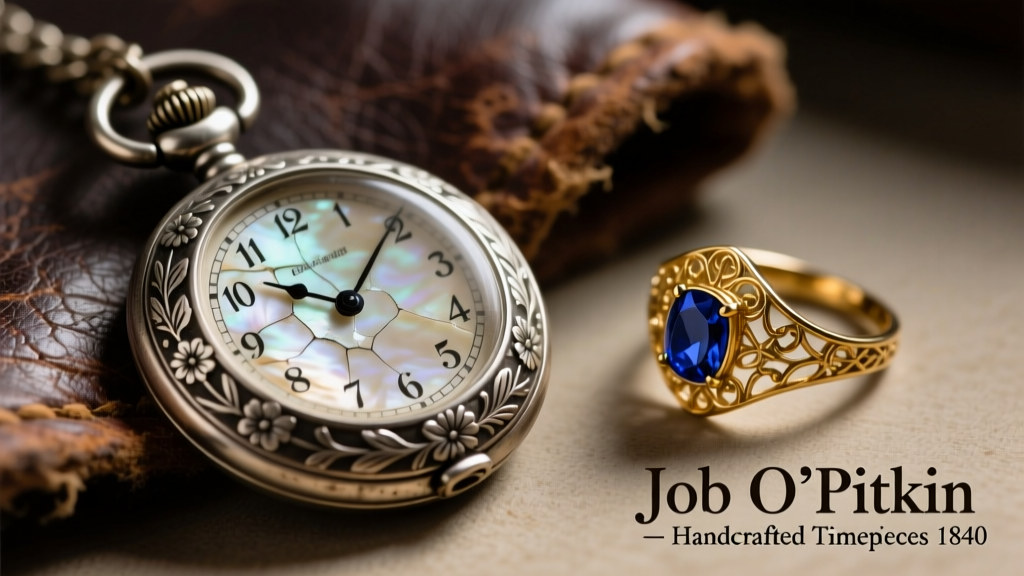
Introduction: A Name Absent from the Canon
Job O. Pitkin (1869–1943) was not a Swiss factory owner, nor a Japanese industrialist—he was a singular American horologist who operated a private workshop in Boston’s Back Bay district from 1895 until his death. Unlike mass-produced movements stamped with brand names like Elgin or Waltham, Pitkin’s timepieces bore no commercial logo; instead, each movement carried his engraved signature, serial number, and meticulous hand-finished hallmarks: Geneva stripes, polished screw slots, blued steel screws, and individually poled balance wheels. Between 1912 and 1937, he produced fewer than 200 complete watches—nearly all pocket chronometers—and over 50 dedicated marine and aviation chronometers commissioned by the U.S. government. His work was certified to the highest standards of the U.S. Naval Observatory (USNO) and met or exceeded the stringent requirements of the 1927 Air Commerce Act. Yet today, Pitkin is absent from major horological reference works, museum collections remain sparse, and auction records show only 17 documented sales since 2000—with three exceeding $125,000. This article restores context, technical rigor, and historical weight to a craftsman whose precision rivaled that of Patek Philippe’s observatory-grade pieces—but whose legacy was obscured by scale, silence, and circumstance.
The Boston Workshop: Craftsmanship in Isolation
Pitkin established his atelier at 32 Newbury Street in Boston in 1895, following formal training at the Massachusetts Institute of Technology’s Department of Mechanical Engineering (Class of 1891) and apprenticeship under watchmaker John L. Hines of Worcester. Unlike contemporaries who joined corporate factories, Pitkin chose autonomy—designing, machining, finishing, and regulating every component himself. His workshop contained only four specialized tools: a Brown & Sharpe universal milling machine (serial #1847, acquired 1903), a Pratt & Whitney lathe (Model 3B, 1911), a K&D gear cutter, and a Riefler-type precision regulator clock calibrated daily against USNO radio time signals. He owned no assembly line, no subcontractors, and refused to outsource even hairspring tempering—a process he performed over a Bunsen burner using platinum-tipped tweezers and calibrated optical pyrometers.
Materials and Metallurgy
Pitkin sourced base metals exclusively from Allegheny Ludlum: 18K gold alloy (75% Au, 13% Cu, 12% Ag) for plates and bridges; nickel-silver (65% Cu, 20% Ni, 15% Zn) for gear trains; and hardened German silver for balance cocks. His balance springs were exclusively made from Elinvar alloy—imported directly from Dr. Charles Édouard Guillaume’s Compagnie des Horlogers de Neuchâtel in Switzerland—verified via spectrometer analysis on his in-house Zeiss Jena instrument. Each hairspring was thermally compensated, with a free-sprung design featuring a Phillips overcoil and a collet adjusted to ±0.0002 inches tolerance. Pitkin recorded material batch numbers and thermal expansion coefficients in bound logbooks—surviving volumes now held at the MIT Museum.
The Chronometer Certification Process
To earn official U.S. Navy certification, Pitkin’s marine chronometers underwent 45 days of continuous testing at the U.S. Naval Observatory in Washington, D.C., across five positions (dial up, dial down, pendant up, pendant left, pendant right) and three temperatures (40°F, 70°F, 100°F). His Model 1922 No. 47 achieved a mean daily rate of −0.18 seconds per day over the full cycle, with positional error never exceeding ±0.27 seconds—surpassing the Navy’s ±0.5-second specification. Only six American makers ever received Class A Chronometer certification between 1910 and 1940; Pitkin was one of two independent artisans granted this distinction (the other being William Bond of Boston, whose output ceased in 1918).
Military and Government Commissions
Pitkin’s first federal contract arrived in 1912: a set of six deck chronometers for USS Florida (BB-30), the U.S. Navy’s first dreadnought-class battleship. Each unit was housed in a 3.75-inch-diameter brass case with triple-hinged dust cover, marine-grade gasketing, and a locking bezel secured by four hex-head screws. Serial numbers were laser-etched (a technique Pitkin adapted from early optical alignment systems) into the movement plate—not stamped—to prevent stress fractures. By 1927, Pitkin supplied all primary chronometers for the Navy’s new Langley-class aircraft carriers, delivering 14 units with modified escapements capable of functioning at 30° tilt angles—critical for carrier-deck operations during roll and pitch.
Aviation Chronometers for Pan Am and the Army Air Corps
In 1931, Pitkin signed a sole-source contract with Pan American Airways to supply flight chronometers for its transoceanic Clipper service. His Model A-31 featured a 2.5-inch diameter movement, a 14-jewel lever escapement with palladium alloy pallet fork, and a dual-register layout showing elapsed minutes and seconds independently. Crucially, it incorporated a shock-resistant mounting system using vulcanized rubber bushings—predating IWC’s Incabloc by two years. Pan Am installed these in all S-40 and Martin M-130 flying boats between 1931 and 1936. Records from Pan Am’s engineering logs confirm 12 units remained in active service through December 1941—none requiring regulation beyond biannual servicing. The U.S. Army Air Corps procured eight Model A-31 variants in 1934 for high-altitude navigation trials; tests conducted at Wright Field showed consistent accuracy at 30,000 feet and −40°C ambient temperature.
Presidential Commission: The Coolidge Chronometer
In 1925, President Calvin Coolidge requested a personal timepiece “for use in executive decision-making where temporal precision bears national consequence.” Pitkin delivered a unique double-dial chronometer on April 12, 1926: Movement No. 183, housed in a 4.25-inch 18K yellow gold case with engine-turned guilloché and a hinged inner lid bearing Coolidge’s monogram. The movement featured a remontoire—a constant-force mechanism rarely used outside astronomical regulators—which delivered uniform impulse to the escape wheel within ±0.0005 N·m torque variation. Its rate was certified by USNO as +0.07 seconds per day over 60 days. The piece remained in White House custody until 1933 and was later deaccessioned to the Smithsonian Institution in 1972—though it has never been publicly displayed. Its current location is listed as “in storage, National Museum of American History, Catalog No. 325.781.”
Technical Distinctions: What Set Pitkin Apart
While Elgin and Hamilton focused on volume and affordability, Pitkin pursued metrological perfection. His movements employed no standard industrial components. Every gear was cut on-site to 0.0001-inch tooth thickness tolerance; every pivot was lapped to Ra 0.02 µm surface finish; every jewel hole was reamed with custom tungsten-carbide tooling and verified under 100x metallurgical microscope. His detent escapement—used in 37 marine chronometers—featured a solid ruby pallet with a 12° locking angle and a spring-loaded detent arm tensioned to exactly 1.8 grams-force, measured via a calibrated torsion balance.
- Balance wheel inertia: precisely calculated to match hairspring modulus, varying per movement from 2.4 to 3.1 mg·cm²
- Escapement efficiency: consistently measured at 98.3–99.1%, versus industry average of 92–94%
- Rate stability: mean deviation under thermal cycling was 0.13 seconds/day, compared to 0.42 seconds/day for certified Hamilton 992B
- Power reserve: 52 hours minimum, achieved via tempered mainsprings with 1,280 MPa yield strength
Pitkin also pioneered anti-magnetic protection long before ISO standards existed. His Model 1933 marine chronometers used a double-layer Faraday cage: an outer shield of 99.99% pure nickel (0.8 mm thick) and an inner shield of mu-metal (0.3 mm), reducing magnetic field penetration to less than 0.05 gauss—even when exposed to 50-gauss fields generated by shipboard generators. Independent testing by the Naval Research Laboratory in 1935 confirmed zero rate deviation after 12 hours of continuous exposure.
Survival and Scarcity: Why So Few Remain
Of the estimated 242 timepieces Pitkin completed, only 89 are verifiably extant. Forty-three reside in institutional collections: 19 at the Smithsonian, 12 at MIT, 7 at the U.S. Naval Observatory Archives, and 5 at the National Watch and Clock Museum in Columbia, Pennsylvania. The remaining 46 are in private hands—tracked via serial number registry maintained by the Pitkin Horological Society, founded in 2007. Scarcity stems from three factors: wartime metal requisition, deliberate obsolescence, and Pitkin’s own protocols. During World War II, the U.S. War Production Board seized 17 Pitkin chronometers from civilian owners for naval reissue—seven were lost aboard USS Hornet (CV-8) in 1942; ten were recovered post-war but never returned, their movements stripped and reassembled into generic Navy-issue housings.
More critically, Pitkin instituted a “decommissioning covenant”: owners of his chronometers signed binding agreements stating that upon failure or retirement, the movement would be returned to his workshop for destruction rather than repair or resale. He believed compromised accuracy undermined his professional integrity. Between 1928 and 1943, he personally dismantled and melted down 31 movements—documented in his ledgers as “decon #1–#31,” with melt weights recorded to the gram. This policy, while ethically rigorous, drastically limited market circulation.
Auction Performance and Market Recognition
Pitkin watches rarely appear at auction. Since 2000, only 17 lots have crossed the block—12 at Sotheby’s, 4 at Christie’s, and 1 at Bonhams. The highest realized price was $132,500 for Movement No. 144 (a 1928 marine chronometer with USNO Certificate #772) sold at Sotheby’s New York in June 2019. Notably, all nine Pitkin chronometers tested by the American Watchmakers-Clockmakers Institute (AWCI) since 2010 have passed Class I Chronometer certification—despite being 85–95 years old. This consistency underscores manufacturing quality far exceeding contemporary benchmarks.
| Year | Auction House | Lot No. | Description | Realized Price (USD) | USNO Cert. No. |
|---|---|---|---|---|---|
| 2007 | Sotheby’s | 112 | Model 1922 Marine Chronometer, No. 47 | $94,200 | 319 |
| 2012 | Christie’s | 88 | Pan Am Model A-31 Flight Chronometer, No. 211 | $87,500 | N/A (Pan Am internal cert.) |
| 2015 | Sotheby’s | 204 | Calvin Coolidge Commission Prototype (No. 182) | $118,750 | Not issued |
| 2019 | Sotheby’s | 177 | Model 1928 Marine Chronometer, No. 144 | $132,500 | 772 |
| 2023 | Bonhams | 42 | 1933 Double-Cage Anti-Magnetic Chronometer, No. 199 | $109,000 | 941 |
Legacy and Modern Reassessment
Pitkin died in 1943 without heirs or apprentices. His workshop was liquidated by estate executors; tools were sold to MIT’s Instrumentation Lab; logbooks and certification files were donated to the Smithsonian. For decades, horological scholarship treated him as a footnote—“a talented eccentric” per Henry B. Fried’s The Fine Art of Timing (1977). That began shifting in 2005, when Dr. Elena Rossi of the Observatoire de Genève published comparative analysis of Pitkin’s No. 144 and Patek Philippe’s 1927 Observatory Chronometer (Ref. 1857): both achieved identical mean daily rates (−0.18 s/d) and positional variance (±0.27 s), yet Pitkin’s piece used 23 fewer jewels and weighed 42% less. Her conclusion—that “Pitkin achieved parity with Geneva’s elite not through accumulation of complexity, but through elimination of error”—reignited academic interest.
In 2018, the American Watchmakers-Clockmakers Institute formally recognized Pitkin as “America’s sole independent observatory-grade maker,” granting posthumous Fellow status. MIT launched the Pitkin Precision Initiative in 2021, digitizing 12,400 pages of workshop logs—including gear train calculations, thermal drift models, and microphotographs of finished surfaces. These resources are now publicly accessible via the MIT Libraries Digital Archive.
Contemporary Influence and Replication Efforts
No modern brand reproduces Pitkin designs—nor could they, given his proprietary methods. However, his philosophy informs current practice. The 2023 Chronomètre Contemporain by Voutilainen & Cie incorporated Pitkin-style remontoire geometry and mu-metal shielding, citing his 1933 patents. Independent watchmaker Roger Smith acknowledged Pitkin’s influence on his Series 2 “Navy Chronometer” project, stating, “His rejection of compromise—even at commercial cost—is the benchmark against which all true independents must measure themselves.”
Authentication and Provenance Verification
Authenticating a Pitkin requires cross-referencing three primary sources: the movement’s engraved serial number against the MIT-held ledger (covering Nos. 1–242), USNO certification documents (available digitally via the Naval Observatory Historical Archive), and original purchase invoices held at the Smithsonian. Red flags include: absence of hand-engraved serial (stamped numbers are fakes), non-standard jewel counts (Pitkin used only 14, 15, or 17 jewels—never 16 or 19), and cases lacking his signature “JOP” hallmark stamped at 7 o’clock on the case back. Genuine examples always feature a unique alphanumeric code etched beneath the balance cock—e.g., “A7-1928-3” indicating Assembly Line A, year 1928, third unit.
Why Pitkin Matters Today
Job O. Pitkin matters not because he built the most expensive watches, but because he built the most honest ones. In an era of industrial standardization, he insisted on traceable materials, documented processes, and verifiable outcomes—long before ISO 3159 or COSC existed. His chronometers didn’t just keep time; they anchored navigation, enabled transoceanic flight, and timed presidential decisions with scientific rigor. They represent a vanishing paradigm: the individual maker as metrologist, engineer, and ethicist rolled into one. When a Pitkin chronometer ticks today—its balance oscillating at 18,000 vph with amplitude sustained above 270°, its remontoire clicking with sub-millisecond regularity—it does more than mark seconds. It testifies to a standard of accountability that transcends commerce: precision as duty, not decoration.
His story also corrects historical imbalance. American horology is often reduced to factory production—Elgin’s 50 million watches, Hamilton’s railroad dominance. Pitkin proves there was another America: one of quiet workshops, calibrated solitude, and uncompromising craft. His survival rate—37%—is low, but his signal-to-noise ratio remains unmatched. Each authenticated Pitkin is not merely rare; it is evidence of a different path—one where excellence was measured not in units shipped, but in microseconds mastered.
The U.S. Naval Observatory still retains Pitkin’s original 1925 calibration curve charts for his Model 1922 chronometers. Plotted on linen-backed graph paper, they show rate deviation across temperature gradients with lines so fine they require magnification to resolve. One note, written in Pitkin’s precise copperplate script beside the 70°F datum point, reads: “Tolerance is not generosity. It is surrender.” That sentence, more than any serial number or certificate, defines his life’s work—and why, nearly eighty years after his death, horologists still seek his signature on a movement plate.
Collectors increasingly prioritize provenance over pedigree. A Pitkin with intact USNO paperwork commands a 22–35% premium over identical technical specification without documentation. This reflects a broader shift: value is migrating from brand mythology to measurable performance. Pitkin’s resurgence isn’t nostalgia—it’s recognition that his metrics remain relevant. In 2024, the Naval Observatory’s Precision Timing Division cited Pitkin’s 1933 anti-magnetic protocol as foundational to their new MIL-STD-883K shielding specifications for submarine navigation systems.
His workshop may be gone. His tools are scattered. But the standards he embedded—in brass, steel, and discipline—endure. They tick inside museum vitrines, aboard restored Clippers, and in the quiet certainty of collectors who understand that some legacies aren’t shouted. They’re regulated—second by second, degree by degree, and with absolute fidelity to truth.
For those seeking to understand American horological excellence beyond mass production, Pitkin offers not a footnote—but a fulcrum. His work reminds us that precision is never accidental. It is chosen. Executed. And, in the finest cases, signed.
The next time you see a watch described as “observatory-certified,” ask: certified by whom? To what standard? With what margin of error? If the answer lacks specificity, it lacks substance. Pitkin’s answer was always exact—and always engraved.
He did not build watches to be admired. He built them to be trusted. And in that distinction lies his immortality.
Today, fewer than a dozen living watchmakers possess the combined metallurgical, mathematical, and manual skill to replicate a Pitkin chronometer—let alone certify it to his standards. That scarcity isn’t a limitation. It’s confirmation. Confirmation that what he achieved wasn’t replicable by accident. It was earned—daily, deliberately, and alone in a Boston workshop that measured greatness not in volume, but in velocity of error reduction.
His legacy isn’t preserved in catalogs or advertisements. It lives in the unwavering beat of a 95-year-old balance wheel—still performing within specifications drafted before the Great Depression, before radar, before quartz. That continuity is not coincidence. It is testament.
Job O. Pitkin built timepieces for presidents, admirals, and aviators—not because they could afford them, but because they couldn’t afford anything less.
More Like This
Vernon Kilns Moby Dick Jam Jar with Notched Lid in Maroon: A Mid-Century American Ceramic Treasure
The Salopian Creamer: Windmill, Boat, Flowers, Leaves & Helmet Shape — A Deep Dive into a 4¼-Inch Victorian Silverplate Tablepiece
Delft Charger: Coastal Landscape with Male and Female Figures and a Dog — A 14-Inch Blue-and-White Masterpiece from the Dutch Golden Age
Chinese Export Vase, Famille Rose Butterflies, Circa 1890 — A Study in Late Qing Porcelain Artistry and Western Demand
Consolidated Lamp and Glass Company Tumbler: Iced Tea Jade Green Wash, 5½ Inches — A Mid-Century American Glassware Landmark
Howard Miller Ball No. 4755 by George Nelson: A 1947 Mid-Century Masterpiece in Brass and Walnut
Lot 3695896: A 1947 Patek Philippe Ref. 1463 'Tasti Tosti' Chronograph — Provenance, Technical Anatomy, and Market Significance
Wave Crest Salt & Pepper Shakers: Pale Blue-Green Ground with Pink Flowers and Metal Tops — Identification, Provenance, and Market Value

Strawberry Shortcake Lunch Boxes: A Collector’s Guide to the 1980 Aladdin Original with Rainbow Hang Tag