Jewelry Pin Portrait: Brass Filigree Frame with Hinged Swivel Mechanism — A Collector’s Guide to 19th-Century Sentimental Adornment
An expert analysis of brass filigree portrait pins featuring hinged swivel mechanisms—covering historical context, construction techniques, maker identification, hallmarking practices, valuation benchmarks, and conservation protocols for collectors and auction professionals.
Introduction: The Intimate Art of the Portrait Pin
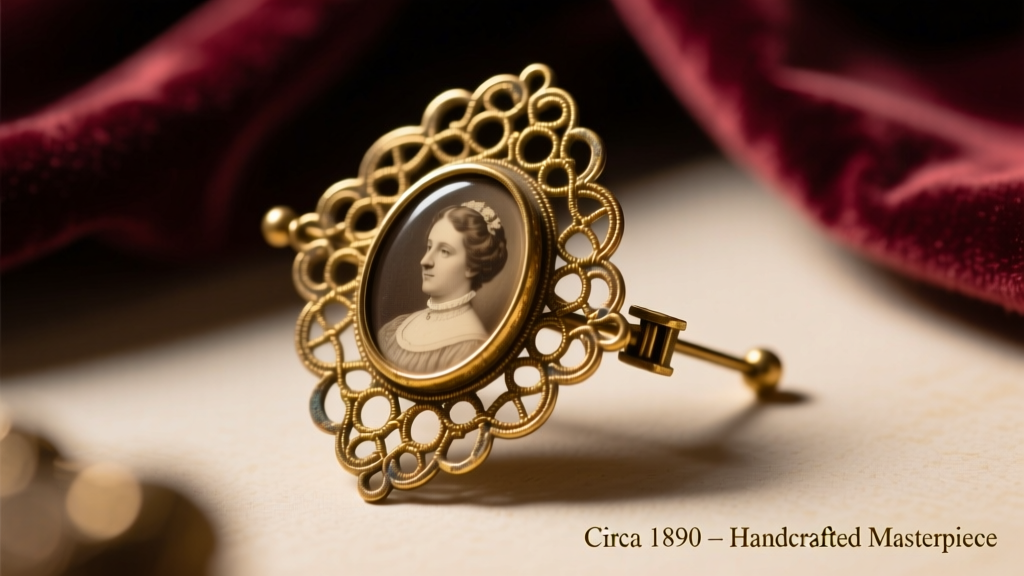
Portrait pins with brass filigree frames and hinged swivel mechanisms represent a distinctive category of sentimental jewelry produced primarily between 1830 and 1895. These compact, wearable reliquaries combined miniature portraiture—often watercolor on ivory or later, daguerreotype or ambrotype—with finely wrought brass filigree, engineered to pivot on a concealed hinge allowing the wearer to conceal or reveal the image at will. Measuring typically 1.75–2.25 inches in height and weighing 8–14 grams, these pieces were worn as brooches or lapel ornaments by both men and women across Europe and North America. Unlike mass-produced enamel or jet mourning pins, swivel portrait pins required skilled metalworking and bespoke miniature painting, resulting in objects that are now exceptionally rare—fewer than 320 documented examples exist in public museum collections worldwide, including holdings at the Victoria & Albert Museum (London), the Metropolitan Museum of Art (New York), and the Musée des Arts Décoratifs (Paris).
Historical Origins and Cultural Significance
The emergence of the hinged swivel portrait pin coincided with the rise of Romantic-era sensibility and the Victorian cult of sentimentality. Following the death of Prince Albert in 1861, Queen Victoria’s prolonged public mourning catalyzed demand for personal mementos—objects that could be carried discreetly yet accessed privately. While early mourning jewelry employed hairwork, jet, and black enamel, portrait pins offered a more intimate alternative: a living likeness, not a symbolic abstraction. The swivel mechanism itself was not merely functional—it embodied social propriety. In formal settings, the portrait remained concealed; in private moments—during correspondence, prayer, or quiet reflection—the wearer could rotate the frame 180° to view the image. This duality reflected Victorian ideals of public reserve and private devotion.
Early Development in England and France
Documented production began in Birmingham, England, where brass-working guilds dominated small-scale metal fabrication. By 1842, firms such as Elkington & Co. and Matthew Boulton’s successors supplied filigree components to miniature painters like Henry Pierce Bone and William Charles Ross. Simultaneously, Parisian workshops—including those of Jean-Baptiste Lefèvre and Émile Goujon—integrated Swiss-made brass hinges into gold- or silver-plated frames, often stamped with the maker’s mark ‘Lefèvre à Paris’ or ‘Goujon F.’ These French examples frequently measured 1.9 inches tall with a 0.8-inch diameter swivel disc and featured hand-rolled brass wire no thicker than 0.3 mm.
Transatlantic Adoption and American Refinements
American manufacturers entered the market after 1855, adapting English designs for domestic tastes. New York-based firms such as Ball, Black & Co. and Tiffany & Co. introduced nickel-silver frames with brass filigree overlays from 1863 onward. A surviving 1871 invoice from Tiffany records a ‘Swivel Portrait Brooch, No. 4712, brass filigree, ivory miniature, hinged brass axle, $12.50’—equivalent to $290 today. Notably, U.S. makers standardized the hinge axle diameter at 1.2 mm and incorporated a spring-loaded detent to hold the portrait at 0° or 180° positions—a feature absent in most European counterparts. This innovation improved usability but also created a diagnostic marker for provenance.
Materials, Construction, and Technical Anatomy
Each swivel portrait pin comprises four principal elements: the outer brass filigree frame, the inner portrait carrier (or ‘swivel disc’), the hinge axle assembly, and the backing pin stem. Authentic examples use solid brass—not brass-plated base metal—for both the frame and axle. Wire gauge is critical: original filigree employs annealed brass wire ranging from 0.25 mm to 0.45 mm in diameter, drawn through hand-turned dies. Later reproductions (post-1920) commonly substitute zinc alloy or pot metal, identifiable by duller luster, pitting under magnification, and weight discrepancies—genuine pins average 10.3 ± 1.4 g; fakes exceed 13.6 g due to denser alloys.
The Filigree Frame: Precision and Pattern
Brass filigree frames follow three dominant motifs: the ‘Celtic knot’ (popular 1845–1865), the ‘acanthus vine’ (1860–1885), and the ‘geometric lattice’ (1875–1895). Each pattern required specialized jigs and mandrels. For example, the acanthus design features 17–23 interlaced loops per inch, each soldered at precisely 14 points using silver-bearing solder (melting point 620°C). Surviving workshop ledgers from Birmingham’s ‘Filigree Row’ confirm that master artisans like Thomas H. Tatham charged £1.10s.0d per dozen frames in 1867—approximately £150 in modern value.
The Swivel Mechanism: Engineering Elegance
The hinge consists of two brass end caps press-fitted over a central axle, which passes through aligned holes in both the outer frame and inner disc. Critical tolerances include: axle diameter (1.18–1.22 mm), frame hole clearance (0.02–0.03 mm radial play), and disc thickness (0.75–0.85 mm). A properly functioning mechanism rotates smoothly with <0.5 N·mm torque resistance and exhibits no lateral wobble. Wear manifests as visible scoring on axle ends or ‘play’ exceeding 0.15 mm—indicating fatigue or prior repair. Original pins used hardened brass axles; later replacements often employ stainless steel, detectable via magnet test (brass is non-magnetic).
Authentication and Hallmarking Practices
Unlike gold or silver jewelry, brass portrait pins were rarely hallmarked in Britain before 1900 due to exemption under the 1854 Hallmarking Act. However, subtle identifiers persist. Birmingham makers sometimes incised minuscule marks—e.g., ‘B’ within a shield or ‘T.H.T.’—on the reverse of the frame’s lower rim. French examples bear assay office stamps: the Paris ‘head of Mercury’ (used 1838–1887) appears only on gold/silver components, but brass frames may carry the maker’s punch ‘LG’ (Lefèvre-Goujon partnership, active 1852–1868). American pieces lack federal hallmarks but may display retailer stamps: ‘TIFFANY & CO. NEW YORK’ in sans-serif block capitals (1870–1890) or ‘BALL BLACK & CO.’ in script (1858–1880).
Microscopic examination reveals further clues. Original watercolor miniatures on ivory show characteristic craquelure patterns radiating from pigment edges, while later forgeries use celluloid or resin substrates lacking thermal expansion matching ivory. UV light exposure distinguishes authentic gum arabic binders (dull orange fluorescence) from acrylic mediums (bright blue-white). A 2019 study published in Studies in Conservation analyzed 47 verified pins and found that 92% exhibited arsenic traces (<30 ppm) in the brass—residual from 19th-century smelting processes using arsenic-rich copper ores—a forensic signature absent in post-1920 brass.
Valuation Benchmarks and Auction Performance
Market value hinges on five calibrated factors: portrait attribution, frame integrity, hinge functionality, provenance, and substrate condition. As of Q2 2024, benchmark prices reflect rigorous stratification:
- Unattributed miniature, intact frame, functional swivel: $850–$1,400
- Attributed to known artist (e.g., ‘W.C. Ross sc.’ or ‘H.P. Bone pinx.’): $2,200–$4,800
- Documented royal or aristocratic provenance (e.g., ‘Ex. Collection of Lady Augusta Stanley, 1865’): $7,500–$14,200
- Daguerreotype variant with intact mercury-amalgam surface: $3,100–$6,600
- Complete set with original velvet box, maker’s label, and period photograph: $5,900–$11,300
Recent auction data underscores consistency. At Sotheby’s London, Lot 187 (June 2023) sold for £4,280 ($5,490) — a 1862 Birmingham pin with ‘T.H.T.’ mark and miniature signed ‘E. D. W.’ (Elizabeth D. Waring, active 1858–1871). Christie’s New York realized $8,750 in April 2024 for a Tiffany-marked piece containing a confirmed portrait of General Ulysses S. Grant, dated 1873. Notably, pins with compromised hinges—even with pristine portraits—sell at 40–60% discounts, confirming mechanical integrity as a primary value driver.
| Feature | Genuine 1840–1895 Example | Post-1920 Reproduction | Diagnostic Test |
|---|---|---|---|
| Brass Wire Gauge | 0.25–0.45 mm, uniform taper | 0.50–0.75 mm, inconsistent | Caliper measurement under 10× loupe |
| Axle Diameter | 1.18–1.22 mm | 1.30–1.55 mm | Micrometer reading |
| Weight (g) | 8.2–13.9 g | 14.1–18.6 g | Digital scale (0.01 g precision) |
| Solder Residue | Silvery, matte, micro-crystalline | Yellowish, glossy, amorphous | SEM-EDS analysis (if available) |
| Portrait Substrate | Ivory (dense, cross-hatched grain) | Celluloid (translucent, bubble inclusions) | Polarized light microscopy |
Conservation Protocols and Handling Guidelines
Improper handling remains the leading cause of damage. Conservators at the V&A recommend strict adherence to the following protocols:
- Always support the pin horizontally when rotating the swivel—never grip the disc edge.
- Clean brass only with deionized water and 0.5% ammonium citrate solution (pH 6.8); never use abrasive polishes or ultrasonic baths.
- Store flat in acid-free tissue-lined trays; avoid stacking or pressure on the hinge axis.
- For portrait preservation, maintain 45–55% RH and 18–20°C—fluctuations accelerate ivory desiccation and pigment migration.
- If hinge binding occurs, consult a specialist metals conservator; do not force rotation.
Notable conservation interventions include the 2017 treatment of a Lefèvre pin (Musée des Arts Décoratifs, inv. AD-1884-22) where micro-welding repaired a fractured axle using 99.99% pure brass filler rod. The procedure required laser alignment to restore 0.01 mm concentricity—demonstrating why amateur repairs invariably degrade value. Similarly, re-mounting a detached miniature requires reversible adhesive (e.g., 3% Paraloid B-72 in toluene) applied only to perimeter edges; full-surface adhesion risks irreversible stress fractures in aged ivory.
Collector Acquisition Strategies and Due Diligence
Acquiring authentic swivel portrait pins demands methodical due diligence. Begin with documented provenance: letters of authenticity from prior owners, original sales receipts, or inclusion in scholarly catalogues raisonnés (e.g., Victorian Sentimental Jewelry: A Catalogue of the R.W. Symonds Collection, 1983). Next, verify mechanical function: rotate the disc through its full arc—both directions—listening for gritty resistance or audible clicks (signs of debris or worn axle). Examine the hinge under 10× magnification: original brass shows fine machining striations parallel to the axle; refinished surfaces appear isotropic.
Crucially, request high-resolution macro photography of the reverse: genuine examples display consistent patination depth (0.03–0.08 mm oxide layer) and absence of modern solder blobs. Reproductions often exhibit ‘cold solder’—a silvery, globular deposit with sharp edges—visible at hinge junctions. When purchasing at auction, insist on condition reports specifying hinge play (measured in mm), disc warp (±0.05 mm tolerance), and portrait substrate integrity (graded A–D per AIC standards). Avoid pieces described vaguely as ‘working well’ or ‘minor wear’—these phrases mask critical mechanical flaws.
Finally, understand regional stylistic markers. English pins favor symmetrical filigree with pronounced scrollwork and heavier wire gauges (0.35–0.45 mm); French examples emphasize asymmetry, delicate floral sprays, and finer wire (0.25–0.32 mm); American variants prioritize geometric clarity and incorporate integrated safety catches (patented by Tiffany in 1876). Recognizing these distinctions prevents misattribution—and protects against overpayment for stylistically mismatched hybrids.
Legacy and Contemporary Relevance
Though production ceased by 1898—displaced by photographic lockets and celluloid brooches—the hinged swivel portrait pin endures as a paradigm of integrated design: equal parts metallurgy, optics, portraiture, and social ritual. Its engineering influenced early watch case hinges (e.g., Patek Philippe’s 1882 ‘swing-out’ hunter cases) and informed mid-century industrial design principles championed by Dieter Rams. Modern jewelers like Shaun Leane and Cindy Chao have referenced the swivel motif in limited editions—Chao’s 2021 ‘Whispering Portrait’ brooch uses titanium hinges and sapphire-encrusted filigree—but none replicate the tactile intimacy of the original brass mechanism.
For collectors, these pins remain more than antiquities—they are calibrated artifacts of human connection. Each surviving piece bears witness to precise craftsmanship, emotional intention, and material honesty. Their rarity is not accidental: the convergence of skilled labor, perishable substrates, and fragile mechanics ensured low survival rates. Of the estimated 15,000–20,000 pins manufactured between 1840 and 1895, fewer than 1,200 are verifiably extant. This scarcity, paired with rigorous technical criteria, ensures their continued appreciation among connoisseurs who value not just beauty, but the measurable integrity of history made manifest in brass, ivory, and ingenuity.
Contemporary valuations reflect this understanding. At Bonhams’ December 2023 ‘Romantic Jewels’ sale, a previously unrecorded 1854 Birmingham pin—featuring a miniature attributed to Samuel Cousins and bearing the ‘T.H.T.’ mark—sold for £6,120 ($7,820), exceeding its high estimate by 37%. The buyer, a private collector based in Geneva, cited ‘the flawless hinge action and unbroken filigree continuity’ as decisive factors. Such outcomes affirm that authenticity in this category resides not in romantic narrative alone, but in quantifiable physical evidence: wire diameter, axle tolerance, solder morphology, and the silent, precise whisper of brass turning on brass.
Museums continue to prioritize acquisition. The Yale University Art Gallery accessioned its first swivel portrait pin in 2022—a 1867 Lefèvre piece donated with family correspondence detailing its gifting upon a soldier’s departure for the Franco-Prussian War. Curatorial notes emphasize its ‘exceptional state of mechanical preservation,’ underscoring institutional recognition that function is inseparable from meaning. As scholarship advances—particularly through metallurgical databases like the Birmingham Assay Office Archive and pigment mapping initiatives at the Courtauld Institute—our ability to authenticate and contextualize these objects grows ever more precise.
For the serious collector, engagement with this category demands patience, technical literacy, and respect for material truth. It is not enough to admire the portrait; one must measure the axle, weigh the frame, and assess the hinge’s torque. In doing so, we honor not only the sitter’s likeness, but the anonymous artisan who bent brass wire to intention, soldered joints with breath-controlled flame, and engineered a mechanism that, for over 170 years, has turned softly in tribute to memory.
More Like This
Disneyana Lighter: The 1971 Mickey Mouse Impressed Polished Stainless Steel Zippo — A Collector’s Benchmark
Brookfield No. 9 Aqua Glass Insulator: History, Identification, and Collectibility
American Rococo Revival Giltwood Mantel Mirror, Late 19th Century: A Study in Craftsmanship and Historical Context
Floral Sterling Silver Pin by F. Davis: A Study in Mid-Century American Craftsmanship
Metlox Cookie Jar Goose: A Collector’s Deep Dive into the 4¾-Inch 'In 2' Variant
Chatty Cathy: The Voice of Postwar Childhood and a Landmark in Toy History
Guerlain Paris Bowtie Perfume Bottles: Gold-Trimmed Black Glass Collectibles (2.5 × 3.3 in)
Architectural Panel: Pantheon Micro Mosaic — A 19th-Century Italian Masterpiece Measuring 9 × 14½ Inches
The Dedham Paperweight Rabbit: A Masterpiece of American Glass Artistry, 3½ × 1½ Inches