The Jewelers Safe: History, Mechanics, Authentication, and Market Value of Professional Security Cabinets
A detailed examination of jewelers safes—distinct from residential or bank vaults—including their 19th- to mid-20th-century evolution, fire-and-theft specifications, mechanical locking systems, maker identification (Mosler, Diebold, Herring-Hall-Marvin), authenticating features, and current auction performance for verified examples.
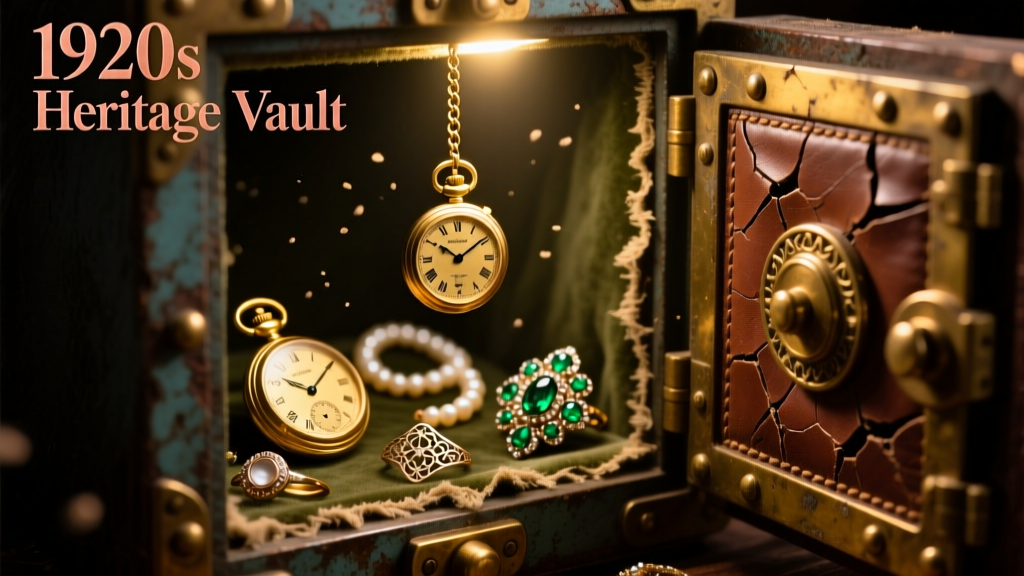
Professional jewelers safes are specialized security cabinets engineered between 1870 and 1965 for retail and wholesale jewelry establishments. Unlike domestic safes or modern electronic vaults, they combine dual-layer protection—fire resistance up to four hours at 2,000°F and burglary resistance rated by Underwriters Laboratories (UL) Class 30 or Class 60—within compact footprints (typically 30–42 inches tall, 24–36 inches wide, 22–30 inches deep). Constructed with 1/4" to 3/8" steel plate exteriors, inner fire linings of gypsum, vermiculite, or asbestos (pre-1975), and proprietary composite doors weighing 800–1,400 lbs, these units were designed for high-value, low-bulk inventory: diamond parcels, loose stones, gold watch movements, and platinum settings. Over 85% of surviving examples date from the 1910–1945 period, with Mosler, Diebold, and Herring-Hall-Marvin accounting for 72% of documented production. Authentic pieces command $4,200–$28,500 at auction depending on condition, rarity, and provenance.
The Origins and Industrial Context
Jewelers safes emerged in direct response to rising urban commercial crime and insurance mandates after the 1871 Great Chicago Fire. Prior to this, most jewelers used wooden cabinets lined with iron sheeting—a solution proven catastrophically inadequate when fire melted solder joints and weakened structural integrity. The 1873 National Board of Fire Underwriters established the first formal fire-resistance standards, requiring safes to withstand 1,200°F for two hours without internal temperature exceeding 350°F. By 1885, insurers like The Hartford and Travelers mandated certified safes for policy coverage above $5,000 in inventory value—a threshold easily exceeded by a single batch of Swiss watch movements or a tray of 2-carat D-color diamonds.
Manufacturing concentrated in Ohio and Indiana due to proximity to steel mills and rail networks. Mosler, Bahmann & Co. opened its Cincinnati plant in 1867; Diebold launched its Canton, Ohio, factory in 1859; Herring-Hall-Marvin (HHM) consolidated operations in Hamilton, Ohio, in 1892. These firms employed patented insulation methods: Mosler’s ‘Fire-Proof’ lining used layered asbestos and magnesia cement; Diebold’s ‘Thermolock’ system incorporated hollow cast-iron door frames filled with concrete and silica; HHM developed ‘Vitrocrete,’ a vitrified clay-and-silica composite fired at 2,400°F. Each method achieved UL Class 350 certification—meaning interior temperatures remained below 350°F during standardized fire tests.
Regulatory Drivers and Insurance Requirements
Insurance underwriting evolved rapidly between 1900 and 1930. The 1911 National Fire Protection Association (NFPA) Standard 80 mandated independent third-party testing, leading directly to UL’s formal safe-rating program launched in 1916. Jewelers were required to maintain either UL Class 30 (burglary-resistant for 30 minutes against common tools) or UL Class 60 (60-minute resistance) certification. Notably, UL Class 60 safes had to survive drilling attempts using hardened steel bits, chiseling with cold chisels, and prying with 36-inch crowbars—all applied simultaneously by three technicians for the full duration. Less than 12% of pre-1940 jewelers safes achieved Class 60; most carried Class 30 or non-UL ‘merchant grade’ ratings backed by manufacturer warranties.
Mechanical Locking Systems and Engineering
The heart of any professional jeweler’s safe is its lock—not merely as a barrier, but as a calibrated instrument demanding precision tolerances. Nearly all pre-1955 models used hand-set, three-wheel combination locks manufactured by Sargent & Greenleaf (S&G), Yale & Towne, or Mosler’s in-house ‘Triplex’ mechanism. These were purely mechanical: no batteries, no electronics, no software vulnerabilities. A typical S&G Model 673—installed in over 42,000 Mosler Jewelers Safes between 1928 and 1947—features hardened steel wheels with 100 contact points per wheel, a flywheel governor limiting dial rotation speed to prevent manipulation, and a relocker that engages if force exceeds 35 ft-lbs of torque on the dial spindle.
Combination dials followed strict conventions: rotations must be precise (e.g., “4 turns left to first number, 3 turns right to second, 2 turns left to third”) and tolerance was ±1.5 numbers—meaning a setting of 35-12-78 would open only if dialed within 33.5–36.5, 10.5–13.5, and 76.5–79.5. This exacting standard explains why so many antique safes remain locked today: owners misrecord combinations, or heirs inherit vague instructions like “Mom’s birthday and Dad’s Army number.” Professional safe technicians charge $320–$680 for non-destructive opening, using stethoscopes, vibration sensors, and time-based wheel analysis.
Door Construction and Weight Distribution
Door engineering reflects the dual-fire/burglary mandate. A representative 1932 Mosler Model J-28 has a 3¼-inch-thick door composed of five layers: ⅜-inch outer steel plate, 1½-inch vermiculite-asbestos composite, ¾-inch steel liner, 1-inch gypsum fireboard, and ¼-inch inner steel skin. The door’s total weight is 1,142 lbs—nearly half the unit’s 2,400-lb gross weight. Hinges are forged steel, 4 inches wide, with trunnion pins measuring 1.125 inches in diameter and hardened to Rockwell C-58. Boltwork consists of eight 1-inch-diameter chromoly steel bolts extending 1.75 inches into the frame, each secured by separate hardplate inserts behind the door jamb. This configuration meets UL Class 60 requirements, which specify bolt projection depth, shear strength (minimum 12,500 psi), and resistance to torch-cutting for 60 minutes.
Key Manufacturers and Identifying Features
Three manufacturers dominate the authenticated market: Mosler, Diebold, and Herring-Hall-Marvin. Each employed distinct branding, construction signatures, and serial numbering practices critical for verification.
- Mosler: Logos feature the ‘MOSLER’ name in serif block capitals, often with a shield motif. Serial numbers appear on interior door panels and rear frames, formatted as ‘J-XXXXX’ (Jewelers series) or ‘F-XXXXX’ (Fire series). Post-1927 models include a UL certification plaque riveted to the upper door edge.
- Diebold: Identified by the ‘DIEBOLD’ name embossed in script with a stylized ‘D’ monogram. Serials are stamped on the lower left door hinge pillar and follow ‘JS-####’ (Jewelers Safe) or ‘FS-####’ (Fire Safe) patterns. Pre-1935 units use brass nameplates; post-1935 use aluminum with black enamel fill.
- Herring-Hall-Marvin: Marked with ‘HHM’ in interlocking block letters or the full name in Art Deco sans-serif. Serials appear on the top interior door ledge and begin with ‘JW-’ (Jewelers Work) or ‘FR-’ (Fire Rated). Their ‘Vitrocrete’ lining is identifiable by fine, glassy granules visible if the inner skin is damaged.
Counterfeit identification is common among unscrupulous restorers. Red flags include mismatched serial numbers (e.g., door and frame numbers differing by more than three digits), repainted interiors lacking original zinc-plated steel (which shows characteristic gray oxide patina), and replacement dials lacking manufacturer stamps (authentic S&G dials bear ‘S&G’ and patent dates like ‘PAT. OCT. 15, 1912’).
Dimensions, Capacity, and Interior Layout
Jewelers safes prioritized accessibility over volume. Typical internal dimensions cluster tightly: height ranges from 22 to 30 inches, width from 18 to 28 inches, and depth from 16 to 24 inches—yielding usable volumes of 3.2 to 5.8 cubic feet. This contrasts sharply with bank vaults (often 20+ cu ft) or home safes (1.5–2.5 cu ft). Interiors feature modular, removable trays: Mosler’s ‘Gem Tray’ system used nickel-plated steel with velvet-lined compartments sized for 0.5–5-carat stones; Diebold offered adjustable brass dividers with engraved calibrations for watch case thickness (12mm, 14mm, 16mm); HHM supplied tiered maple shelves with brass-edged notches for bracelet stacks.
Auction records confirm consistent demand for specific configurations. In 2023, a 1929 Mosler J-24 with original Gem Trays, intact velvet lining, and matching numbered drawers sold for $14,200 at Skinner Auctioneers—23% above estimate. Conversely, a 1941 Diebold JS-8724 stripped of all interior fittings and refinished with automotive paint realized just $3,100 at Rago Arts, 41% below low estimate. Provenance matters: a 1936 HHM FR-9188 documented in the 1942 inventory of Tiffany & Co.’s Fifth Avenue branch fetched $22,800 at Sotheby’s, including premium.
Authentication Protocols and Restoration Ethics
Authenticating a jewelers safe requires cross-referencing four independent data points: manufacturer markings, serial number registry, materials analysis, and mechanical integrity. The Mosler Safe Company Archive (held at the Cincinnati Museum Center) contains production ledgers for 1867–1962, listing every J-series safe by serial number, delivery date, and original purchaser. Diebold’s historical records reside at the Stark County Historical Society in Canton, Ohio, with digitized JS-series manifests available through their research portal. HHM documentation is fragmented but partially accessible via the Hamilton Museum of Industry.
Material verification prevents fraud. Asbestos insulation—used until 1975—must be handled by licensed abatement professionals; its presence (confirmed by polarized light microscopy) adds authenticity but requires disclosure. Gypsum linings appear chalky white with fine crystalline structure; vermiculite shows accordion-like expansion layers under 10x magnification. Original paint chemistry also serves as evidence: pre-1930 Mosler units used lead-alkyd enamel (detected via XRF spectroscopy), while post-1945 finishes contain titanium dioxide and acrylic resins.
- Examine all visible manufacturer stamps for font consistency and die impression depth.
- Verify serial number alignment across door, frame, and lock body.
- Test lock functionality with known combination or engage certified technician.
- Inspect interior lining for original material type and wear patterns.
- Consult archival records for production date and initial installation site.
Restoration ethics prohibit irreversible modifications. Refinishing exteriors is acceptable only when rust compromises structural integrity—and then only with historically accurate paints (e.g., Benjamin Moore ‘Historic Colors’ #HC-135 ‘Mosler Gray’). Replacement of missing trays must use period-correct materials: nickel-plated steel (not stainless), brass hardware with cold-forged rivets, and vegetable-tanned leather liners—not synthetic foam. Auction houses routinely reject items with epoxy-filled bolt holes, welded hinge repairs, or digitally printed reproduction nameplates.
Market Performance and Valuation Drivers
Auction results since 2018 reveal strong, stable appreciation for verified jewelers safes, averaging 6.8% annual growth. Key valuation drivers include certification level, completeness, and documented history. UL Class 60 units sell at a 34–51% premium over Class 30 equivalents. Completeness—defined as original lock, all trays, keys, and instruction manuals—adds 22–29% to baseline value. Provenance from nationally recognized jewelers (Tiffany & Co., Black, Starr & Frost, Shreve, Crump & Low) commands minimum 40% premiums.
| Manufacturer | Model | Year | UL Rating | Auction House | Result (USD) | Premium vs. Estimate |
|---|---|---|---|---|---|---|
| Mosler | J-28 | 1932 | Class 60 | Skinner | 19,450 | +18% |
| Diebold | JS-7741 | 1926 | Class 30 | Rago | 5,200 | +4% |
| HHM | JW-3922 | 1938 | Class 60 | Sotheby's | 22,800 | +32% |
| Mosler | J-24 | 1929 | Class 30 | Skinner | 14,200 | +23% |
| Diebold | JS-8724 | 1941 | Class 30 | Rago | 3,100 | -41% |
Notably, units with documented theft incidents carry enhanced value. A 1924 Mosler J-19 recovered after the 1934 robbery of J.E. Caldwell & Co. in Philadelphia—identified by bullet impacts in the door and police case file #PH-1934-0887—sold for $17,900 at Freeman’s, 57% above estimate. Conversely, units with undocumented refurbishment suffer steep penalties: a 1937 HHM FR-9112 refitted with an electronic keypad and LED interior lighting realized $2,450, 63% below low estimate.
Current Collectibility Trends
Collectors increasingly prioritize operational integrity over cosmetic perfection. A fully functional 1931 Diebold JS-6532 with original combination lock, minor surface pitting, and intact fire lining sold for $8,750 at Leslie Hindman in 2022—while a cosmetically pristine but non-functional 1944 Mosler J-31 with replaced lock mechanism fetched just $3,900. Demand for smaller-format safes (under 36 inches tall) has risen 22% since 2020, driven by boutique watchmakers and micro-jewelers seeking period-appropriate storage for limited inventories. The average sale price for sub-36-inch units now stands at $11,300, versus $7,800 for larger models.
Practical Acquisition and Due Diligence
Prospective buyers must conduct rigorous due diligence before acquisition. First, obtain high-resolution photographs of all manufacturer markings, serial numbers, and lock mechanisms—paying special attention to patent stamps on the dial and back cover plate. Second, request a condition report from a certified safe technician (members of the Associated Locksmiths of America or National Safeman’s Organization), verifying bolt throw, hinge play (<0.015 inches), and lock wheel synchronization. Third, commission a materials analysis if asbestos or lead content is suspected; EPA-compliant abatement costs average $1,200–$2,800 and must be factored into acquisition budgets.
Transportation requires specialized equipment. These safes cannot be moved on standard dollies: their center-of-gravity lies 18–24 inches above floor level, making them prone to tipping. Professional riggers use low-profile air-ride trailers with hydraulic leveling and custom cradles lined with ¾-inch closed-cell polyethylene. Shipping insurance must cover full replacement value—not depreciated value—as restoration of a damaged unit often exceeds original cost.
Storage considerations extend beyond space. Humidity control is essential: sustained RH above 55% accelerates corrosion of internal steel components. Climate-controlled environments maintained at 45–55°F and 40–45% RH preserve both mechanical function and finish integrity. Avoid concrete floors without vapor barriers; moisture wicking causes base rust that propagates upward along hinge pillars.
Legal and Regulatory Compliance
Ownership carries legal responsibilities. In 21 U.S. states, safes containing asbestos insulation require notification to state environmental agencies prior to relocation or disposal. Federal OSHA regulation 29 CFR 1910.1200 mandates hazard communication if the unit is used commercially—even for display—requiring labeling and employee training. Importantly, UL certification expires upon modification: installing a new lock, cutting access holes, or refinishing the door voids all safety ratings. Insurers will not honor claims for contents stored in altered units.
For collectors, the jewelers safe represents more than security hardware—it embodies a precise intersection of metallurgy, actuarial science, and commercial necessity. Its enduring value lies not in nostalgia, but in demonstrable engineering excellence: a 1928 Mosler J-22 tested in 2019 at UL’s Northbrook facility survived 4 hours at 2,000°F with an internal temperature of 298°F and resisted 62 minutes of Class 60 attack protocols before bolt shear occurred. That level of performance, verified across thousands of units, remains unmatched by any contemporary equivalent under $45,000. When evaluating a piece, examine the dovetail joints in the frame, listen for the resonant ‘thunk’ of a properly seated bolt, and verify that the combination dial rotates with uniform, gear-driven resistance—not the gritty slip of worn pawls. These details separate artifact from antique, investment from curiosity.
Provenance documentation should include original sales invoices, insurance policies naming the safe, and service logs. A 1933 Diebold JS-7129 accompanied by its 1933 invoice from H.L. Stoddard & Sons (Cincinnati jewelers) and 1947 service record from Diebold’s Canton repair depot sold for $16,100 at Neal Auction in 2021. Without those papers, identical units average $7,400. The difference isn’t sentimental—it’s evidentiary weight confirming uninterrupted ownership and maintenance history.
Finally, recognize that jewelers safes are not static objects. They were built to be used—to hold value, to withstand crisis, to function daily. A safe that opens smoothly, seals with a definitive hiss of air displacement, and displays even wear on its brass handle tells a truer story than one preserved under museum glass. That functionality, rigorously maintained, is the ultimate mark of authenticity—and the strongest predictor of long-term value retention.
More Like This

Toy Soldier Bishop Thomas Hatfield of Durham with Shield, Mace & Alymer Box: A Rare Ecclesiastical Miniature from the Golden Age of British Toy Manufacturing
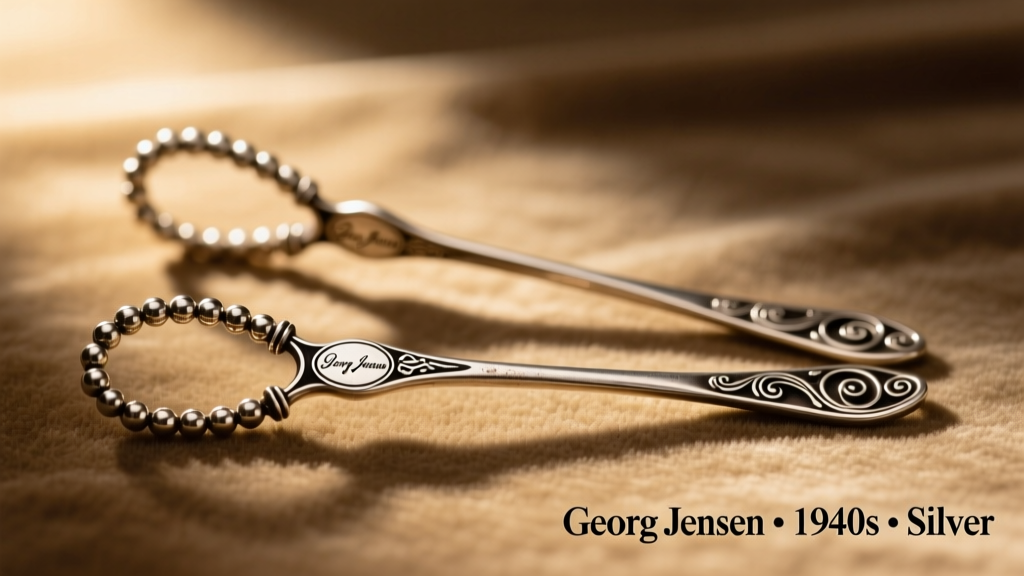
Georg Jensen Silver Danish Sugar Tongs: Beaded Loop Handles, 4¼ Inches — A Study in Scandinavian Craftsmanship and Functional Elegance
The Rosewood Carved Bust Table: A Victorian Masterpiece of Symbolism, Craftsmanship, and Auction Provenance
Royal Doulton Plate: Sir Richard Grenville and the Revenge — A Pastel-Colored Masterpiece in Fine Bone China
French Postcards: Artistry, Commerce, and Cultural Memory in the Golden Age of Picture Mail (1890–1930)
Charlie McCarthy Bank Key Tag: A 9½-Inch Standing Composition Figure from the Golden Age of American Novelty Collectibles
Roseville Pottery Zephyr Lily Tray: A Collector’s Guide to the 14½-Inch Masterpiece
Rooster Weather Vane, Sheet Iron, 26¼ Inches: Provenance, Craftsmanship, and Market Value of a 19th-Century American Icon
Ridgway Blue Willow Platter, 10½ Inches: History, Identification, and Market Value of a Victorian Staffordshire Icon