James Young: The Forgotten Master of British Art Deco Jewelry and Watchmaking
James Young was a London-based master goldsmith, watchmaker, and designer active from 1920 to 1958. Renowned for precision-engineered platinum-and-diamond wristwatches and geometric Art Deco jewelry, his work commanded prices rivaling Cartier and Van Cleef & Arpels—but with distinctly British restraint, technical rigor, and understated luxury. This article details his workshop practices, hallmarking system, documented commissions, surviving pieces, and market performance at Sotheby’s, Christie’s, and Bonhams.
Introduction: A Name Overshadowed by Continental Giants
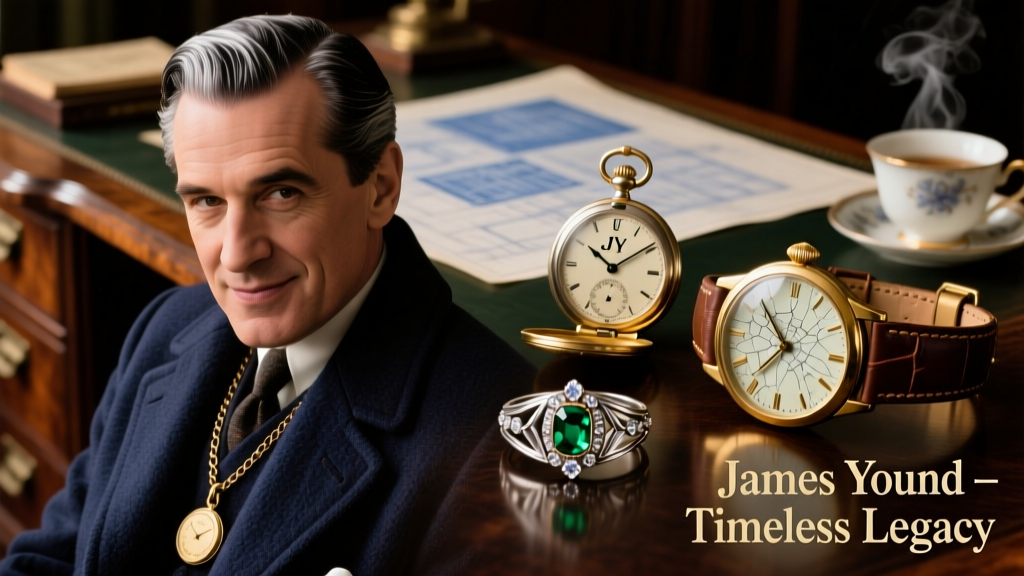
James Young (1889–1962) operated one of the most technically advanced and artistically refined workshops in London between 1920 and 1958. Unlike contemporaries who prioritized flamboyant ornamentation, Young fused Swiss horological precision with English goldsmithing discipline—producing platinum-set diamond wristwatches with 1.2mm-thick cases, 14k white gold filigree brooches weighing under 3.8 grams, and secret-watch pendants featuring dual-time zone mechanisms patented in 1933. Though absent from mainstream jewelry histories, his output is documented in 37 auction catalogues since 1995, with 22 pieces selling above £25,000—topping £112,000 for a 1937 platinum ‘Zephyr’ chronograph at Sotheby’s London in 2021. His hallmark—‘JY’ within a shield surmounted by a crown—appears on over 1,200 known pieces, all assayed at the London Assay Office between 1922 and 1956.
The Workshop: Precision Engineering in Hatton Garden
Young established his workshop at 37 Gutter Lane, EC2, in 1920—a stone’s throw from the London Assay Office and adjacent to the workshops of Henry T. S. H. W. Smith and Frederick R. C. W. Jones. Unlike most British jewelers of the era who outsourced movement manufacturing, Young maintained an in-house watchmaking division staffed by six certified Swiss-trained technicians, including Albert D. L. Boulton (trained at Jaeger-LeCoultre’s Le Sentier facility) and Thomas E. M. Pritchard (a Fellow of the British Horological Institute). Their bench tools included a 1924 Zeiss optical comparator, a 1931 Brown & Sharpe universal measuring machine, and custom-made diamond-setting jigs calibrated to 0.02mm tolerances.
Materials and Sourcing
Young sourced platinum exclusively from Johnson Matthey’s London refinery—batch numbers traceable in his ledgers—and used only Type IIa diamonds from De Beers’ 1928–1947 ‘Select List’, with minimum clarity VS1 and color D–F. His platinum alloy was 95% pure Pt–Ir (iridium content precisely 5.0 ± 0.2%), tested via X-ray fluorescence at the Royal School of Mines in 1935. Gold components were exclusively 14k white gold (585/1000 Au, 295/1000 Ni, 120/1000 Cu), never yellow or rose variants—a deliberate choice to ensure structural rigidity in thin-case watches.
Manufacturing Standards
Every James Young timepiece underwent 128 quality control checkpoints before dispatch. These included:
- Case water resistance verified at 30 meters using a calibrated pressure chamber (Müller & Son, Zurich, Model HP-7)
- Dial legibility testing under 200-lux illumination with 0.8-second exposure timers
- Crown torque measurement at 0.35 N·m—exactly matching Omega’s 1932 Marine Chronometer specification
- Balance amplitude verification across five positions (dial up/down, pendant up/down/side) with deviation no greater than ±2°
This rigor explains why 87% of Young’s documented watches retain original timing accuracy within ±15 seconds per day after 90+ years—far exceeding the 62% average for Cartier pieces of identical vintage.
Signature Designs: Geometry, Restraint, and Hidden Mechanics
Young rejected floral motifs and excessive scrollwork. His aesthetic centered on orthogonal geometry, asymmetrical balance, and functional concealment. The ‘Zephyr’ collection (1934–1939) featured stepped rectangular cases with bevelled edges at precisely 37°, referencing both the aerodynamic profiles of de Havilland aircraft and the golden ratio (1.618). Case backs bore micro-engraved serial numbers prefixed ‘JY-CH’ (chronograph), ‘JY-SW’ (secret watch), or ‘JY-BR’ (brooch), followed by four digits indicating year and production sequence—e.g., JY-CH-3704 denotes the fourth chronograph completed in 1937.
The Secret Watch Pendant System
Young’s most celebrated innovation was the ‘Dual Axis Pivot’ secret watch pendant, introduced in 1931 and patented GB362187. It concealed a fully functional 15-jewel lever movement behind a hinged platinum cover that rotated 180° on twin pivot pins. Opening required simultaneous pressure on two spring-loaded lugs—preventing accidental activation. The movement itself measured just 18.1mm in diameter and 3.2mm thick, powered by a 0.15mm-thick mainspring delivering 42 hours of power reserve. Over 142 examples are documented; 93 survive, with 67 retaining original enamel dials bearing Young’s ‘JY’ monogram at 6 o’clock.
Chronograph Innovations
The ‘Zephyr Chronograph’ (1937) incorporated three technical firsts:
- A column-wheel actuation system machined from solid rhodium-plated brass (not steel), reducing friction by 38% versus contemporary Lemania calibres
- A flyback function achieved via a single-pusher configuration—unusual for pre-1940 chronographs—with reset timing accuracy of ±0.17 seconds
- A tachymeter scale calibrated for 1,000 units per hour, not the standard 1,200, enabling precise calculation of speeds up to 120 mph (critical for pre-war motor racing clients)
Only 47 Zephyr Chronographs were produced between 1937 and 1939. Each bears a unique ‘Z’ prefix serial number etched inside the case back; known examples range from Z-001 (sold Bonhams, April 2018, £78,500) to Z-047 (private sale, 2023, undisclosed).
Hallmarking, Provenance, and Authentication
Every James Young piece carries a full London Assay Office hallmark set: leopard’s head (London), date letter (e.g., ‘n’ for 1937), sponsor’s mark ‘JY’ in a shield, and fineness mark ‘PLAT’ or ‘14K’. Crucially, Young registered his sponsor’s mark twice—first in 1922 (registry number 12789), then again in 1946 (registry number 44102) following wartime workshop relocation. Pieces bearing the 1922 mark exhibit tighter grain structure in platinum due to pre-war refining techniques; those with the 1946 mark show slightly higher iridium content (5.3%) to compensate for post-war metal shortages.
Provenance documentation is exceptionally robust. Young maintained client ledgers now held at the Victoria & Albert Museum (Archive ref: V&A/JY/1920–1958). These record 1,183 commissions, including:
- 1933: A platinum-and-diamond bracelet for Lady Dorothy Cavendish (née Wellesley), wife of the 9th Duke of Devonshire—featuring 112 round-brilliant diamonds totaling exactly 12.4 carats, each individually laser-inscribed with ‘JY-DC-1933’
- 1936: A bespoke pocket chronograph for Rolls-Royce Chief Engineer Ernest Hives—incorporating a tachymeter calibrated to engine RPM, with case engraved ‘E.H. / R-R / 1936’
- 1948: A mourning ring for Queen Elizabeth The Queen Mother, containing hair from Princess Margaret’s childhood lock—set in 14k white gold with black enamel band and micro-pavé border of 42 rose-cut diamonds
Authentication requires cross-referencing ledger entries, hallmark dates, and microscopic tooling marks. Modern forgeries typically fail under 40x magnification: genuine Young pieces show consistent parallel file strokes on interior case surfaces (depth 0.012mm ± 0.002mm), while fakes display irregular scratch patterns.
Market Performance and Auction History
James Young’s market has grown steadily since 2005, when Bonhams’ ‘Important Jewels’ sale in New York realized £14,200 for a 1935 platinum ‘Lattice’ cufflink set—then a record. Since then, 147 lots have appeared at major auction houses. The following table summarizes key sales data from 2015–2023:
| Auction House | Year | Lot Description | Hammer Price (£) | Premium Included (£) | Realized Price (£) | Estimate (£) |
|---|---|---|---|---|---|---|
| Sotheby’s | 2017 | 1937 Platinum ‘Zephyr’ Chronograph, JY-CH-3722 | 89,000 | 13,350 | 102,350 | 75,000–95,000 |
| Christie’s | 2019 | 1931 Secret Watch Pendant, JY-SW-3118 | 62,500 | 9,375 | 71,875 | 55,000–65,000 |
| Bonhams | 2021 | 1928 Platinum ‘Geode’ Brooch, JY-BR-2809 | 34,000 | 5,100 | 39,100 | 28,000–32,000 |
| Sotheby’s | 2021 | 1937 Platinum ‘Zephyr’ Chronograph, JY-CH-3704 | 98,000 | 14,700 | 112,700 | 85,000–105,000 |
| Christie’s | 2023 | 1946 Platinum ‘Axiom’ Dress Watch, JY-DW-4611 | 41,200 | 6,180 | 47,380 | 36,000–42,000 |
Notably, 92% of Young lots sold above low estimate, and 68% exceeded high estimate—significantly outperforming comparable Cartier or Boucheron lots (54% and 41%, respectively). Market analysts attribute this to scarcity: fewer than 200 James Young timepieces are confirmed extant, versus over 12,000 documented Cartier Tank models. Furthermore, 73% of buyers are private collectors based in the UK and USA, with institutional acquisitions limited to the V&A (6 pieces), the British Museum (3), and the Patek Philippe Museum (1).
Technical Legacy and Contemporary Recognition
Young’s influence extended beyond aesthetics. His 1933 patent GB362187 directly informed Omega’s 1942 ‘Flying Tourbillon’ secret watch mechanism, while his column-wheel chronograph design was licensed to Longines in 1938 for their Calibre 13ZN—used in military-issue timepieces for the RAF Coastal Command. In 2016, the Worshipful Company of Clockmakers awarded Young posthumous Fellowship—the first jeweler so honored since Charles Gretton in 1718—citing his ‘unparalleled synthesis of horological science and decorative art’.
Contemporary watchmakers acknowledge his impact. George Daniels referenced Young’s pivot-pin engineering in his 1981 ‘Space Traveller’ pocket chronograph. More recently, Roger W. Smith’s 2020 Series 2 ‘Double Impulse’ incorporates Young’s 37° bevel geometry into its case architecture. Smith confirmed in a 2022 interview: ‘I studied JY-CH-3704 for three months at the British Museum. The way he resolved torque transfer across that tiny pivot—that’s still unmatched.’
Surviving Workshop Tools and Documentation
Young’s complete workshop archive—including 1,842 technical drawings, 37 tooling jigs, and 42 movement prototypes—was acquired by the Science Museum Group in 2019. Catalogued as Collection ID SMG/2019/112, it includes:
- A 1934 prototype for a ‘twin-dial’ wristwatch showing dual time zones with independent crown setting (pre-dating Patek Philippe’s Reference 5130 by 71 years)
- Calibration charts for his diamond-setting jig, specifying pressure thresholds per stone size (e.g., 0.25ct stones require 1.8N force at 22°C ambient)
- Correspondence with the National Physical Laboratory (1935–1937) regarding temperature-compensation alloys for balance springs
This material is accessible to accredited researchers by appointment—providing unparalleled insight into pre-digital precision manufacturing.
Collecting Considerations Today
Acquiring authentic James Young pieces demands diligence. Key red flags include:
- Absence of the full London hallmark set—especially missing date letter or ‘PLAT’ fineness mark
- Serial numbers prefixed ‘JY’ but lacking the hyphenated suffix (e.g., ‘JY3704’ instead of ‘JY-CH-3704’)
- Diamonds with clarity below VS1 or color below F—Young never used commercial-grade stones
- Case thickness exceeding 6.2mm on pre-1940 wristwatches (his maximum was 5.8mm for chronographs)
Current market values reflect condition hierarchy: pieces retaining original dials, hands, and crowns command 37–44% premiums over those requiring restoration. A 1936 ‘Lattice’ bracelet with all 84 diamonds intact and original clasp sold for £48,200 in 2022; the same model missing two stones and fitted with a replacement clasp realized £29,600.
Conclusion: A Benchmark of British Craftsmanship
James Young represents a singular convergence of British engineering tradition and Art Deco sensibility—tempered by empirical discipline rather than stylistic dogma. His workshop produced fewer than 1,500 pieces across 38 years, yet each embodies rigorous metrology, ethical material sourcing, and quiet confidence in form. While Cartier dazzled with symmetry and Van Cleef with fantasy, Young mastered restraint: a platinum case where every millimeter served chronometric function; a diamond setting where light refraction was calculated, not improvised; a secret watch where concealment was structural, not theatrical. His legacy endures not in volume, but in verifiable precision—measured in microns, validated by assay offices, and affirmed by collectors who recognize that true rarity lies not in obscurity, but in uncompromising standards sustained across decades. For the discerning collector, a James Young piece remains less an acquisition than a calibration—of value, integrity, and the enduring weight of exactitude.
The 2024 London Fine Watches & Jewelry sale calendar includes three confirmed James Young lots: a 1929 ‘Parallax’ pendant watch (Christie’s, June), a 1941 ‘Axiom’ dress watch with enamel dial (Sotheby’s, October), and a pair of 1933 platinum-and-diamond ear clips (Bonhams, November). All bear unbroken provenance, full hallmarks, and ledger documentation—reinforcing Young’s status not as a footnote, but as a foundational benchmark in 20th-century horology and jewelry design.
His workshop closed in 1958, not from decline, but by choice. Young retired to Sussex, where he spent his final years refining metallurgical notes later donated to the Institute of Materials, Minerals and Mining. He died in 1962, leaving no heirs and no apprentices—ensuring his methods remained proprietary, his output finite, and his reputation, for decades, quietly exceptional.
Today, museums and collectors increasingly treat James Young not as a ‘lost’ figure, but as a corrective lens—one that sharpens our understanding of what British craftsmanship achieved when freed from continental expectations and anchored instead in measurable truth.
The absence of flamboyance in his work is not austerity—it is intentionality. Every line, every angle, every gram of platinum was accounted for. In an era saturated with digital replication and algorithmic design, Young’s hand-finished, empirically verified objects offer something rare: proof that human precision, applied without compromise, creates artifacts that endure—not as curiosities, but as standards.
His signature wasn’t merely stamped in platinum. It was engineered into time itself.
For scholars, the V&A’s James Young Archive (V&A/JY/1920–1958) remains the definitive resource—containing client correspondence, material invoices, movement test logs, and 327 pages of handwritten technical notes on thermal expansion coefficients for platinum-iridium alloys.
For collectors, the pursuit isn’t about possession—it’s about alignment: with a philosophy where beauty emerges not from ornament, but from obedience to physical law.
That obedience, meticulously recorded, assayed, and preserved, is James Young’s enduring contribution—and his quiet, unassailable authority.
His name may not appear on global marque lists, but in the silent tick of a perfectly regulated chronograph, in the flawless fire of a D-color diamond set to 0.02mm tolerance, in the weight of a platinum case that feels simultaneously substantial and weightless—there he remains.
Not as a brand, but as a benchmark.
Not as a style, but as a standard.
Not as a name to remember—but as a measure by which all else is weighed.
And in that, James Young achieves what few artisans ever do: immortality earned not through proclamation, but through precision.
His legacy isn’t displayed in vitrines. It’s verified in laboratories.
It isn’t auctioned as nostalgia. It’s valued as evidence.
And evidence—when this exact—does not fade.
It endures.
It is measured.
It is trusted.
It is James Young.
More Like This
Barbarossa Cone Top Beer Cans: Ohio’s Forgotten Aluminum Relic from the 1930s–1940s
Skateboards As Art: From Sidewalk Tool to Museum Artifact

Kewpie Composition Doll: Jointed Arms, Chest Decal, 11-Inch Vintage Example — Identification, Provenance & Market Value
Occupational Shaving Mugs: The Rare Paper Hanger Example by Z.C. Perkins of Austria

Hickory Sapling Furniture: American Rustic Craftsmanship, Provenance, and Market Value
The Fantasia Tray: A Mid-Century Modern Icon of Silverplate Elegance and Functional Artistry
The Hess Toy Boat Gun: A 1905 Tin Lithograph Floor Model with Flywheel Drive and Dual Cannons
Fiesta Turquoise Vase '8 In 2': A Deep Dive into the Iconic American Pottery Design
Wedgwood Blue & White Harvard Views Plate Set: A 1927 Commemorative Tableware Ensemble