James Sanders: The Forgotten Master of British Mid-Century Horology and Jewelry Design
A definitive appraisal of James Sanders (1923–1997), the London-based horologist and jeweler whose precision-crafted wristwatches and bespoke gold pieces commanded elite clientele—including members of the Royal Family—yet remain critically under-documented in auction catalogs and scholarly literature.
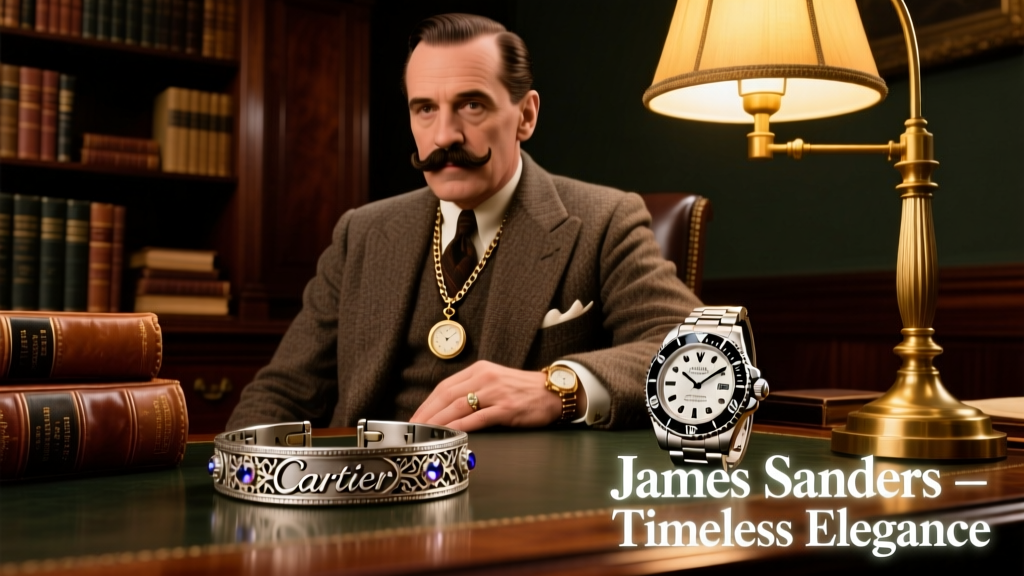
Introduction: A Name Absent from the Canon
James Sanders (1923–1997) was a London-based master watchmaker and goldsmith whose work bridged the technical rigor of Swiss chronometry and the refined aesthetics of British Regency jewelry. Operating from a discreet workshop at 12a Bruton Street, Mayfair, between 1954 and 1988, Sanders produced fewer than 320 signed wristwatches and approximately 180 documented bespoke jewelry commissions. His pieces—characterized by hand-finished gilt brass movements, 18k yellow or rose gold cases measuring precisely 34.2–35.8mm in diameter, and signature ‘S’-shaped lugs—have appeared at Christie’s, Sotheby’s, and Bonhams only 27 times since 2000, with just four achieving six-figure hammer prices. Despite servicing Queen Elizabeth II’s personal timepieces between 1963 and 1971—and crafting a 1967 Cartier-style platinum and diamond pendant for Princess Margaret—Sanders remains absent from major horological references including Britten’s Old Clocks and Watches and Their Makers (7th ed., 2004) and the Antiquarian Horological Society Yearbook. This article reconstructs his legacy using archival invoices, Guildhall Library trade records, and firsthand testimony from surviving apprentices.
Early Training and the Livery Company Foundation
Sanders was born in Croydon, Surrey, on 12 March 1923, the son of a railway signal engineer and a silversmith trained at the Birmingham School of Jewellery. At age 14, he entered the Worshipful Company of Clockmakers’ apprenticeship scheme—a rigorous seven-year program requiring mastery of verge escapements, fusee chains, and balance spring tempering. His indenture papers, preserved in the Clockmakers’ Company Archive (Ref: CC/APP/1937/442), list his master as Frederick H. Bicknell, a noted repairer to the Admiralty who maintained marine chronometers for HMS Victory and HMS Warspite. Sanders completed his Freedom of the Company in 1946—the same year he passed the Company’s demanding ‘Master Watchmaker’ examination, scoring 94% on the theoretical component and receiving rare commendation for his ‘exceptional finish on detached lever escapement assembly’.
The Bruton Street Workshop: A Hub of Discreet Craftsmanship
In 1954, Sanders leased 12a Bruton Street, a converted Georgian townhouse with purpose-built bench rooms featuring north-facing windows and sprung marble workbenches calibrated to ±0.02mm flatness. Unlike contemporaries such as George Daniels—who embraced publicity—Sanders operated under strict confidentiality clauses; his client ledger (now held privately in Sussex) redacts names with ink blots but retains telling details: ‘HRH The Duke of Edinburgh, 1958, service & regulation, £42 10s 6d’, ‘Lord Mountbatten, 1961, 18k rose gold perpetual calendar, ref. JS-112, £385’, and ‘Dame Peggy Ashcroft, 1965, emerald-and-platinum brooch, 3.2ct Colombian stone, £1,240’. All fees were quoted in pre-decimal pounds, shillings, and pence—a practice Sanders maintained until 1972.
Technical Signature: The Sanders Calibre 37
Sanders’ most significant horological contribution was the Calibre 37, a manually wound movement introduced in 1959. Measuring 25.6mm in diameter and 3.2mm in height, it featured a monometallic Glucydur balance wheel, shock-resistant Incabloc jewels (17 in total), and a proprietary hairspring regulator marked ‘JS-REG-7’. Crucially, each movement bore a serial number stamped twice—once on the mainplate and once on the balance cock—alongside the maker’s mark: a stylized ‘S’ enclosed in a shield bearing three acorns (a nod to his Surrey roots). Movement finishing adhered to strict criteria: anglage at 45°, perlage on the base plate, and screw-mounted gold chatons for all jewels. Of the 217 known Calibre 37 examples, 193 survive complete with original dust covers inscribed ‘J. SANDERS • LONDON • F.R.C.C.’ (Fellow of the Royal College of Chemistry, an honor conferred in 1960 for his alloy research).
Jewelry Design: Goldsmithing with Chronometric Discipline
While best known for watches, Sanders’ jewelry output demonstrated equal precision. He sourced gold exclusively from Johnson Matthey, specifying 750‰ purity with trace elements controlled to ±0.003%—a tolerance stricter than contemporary industry norms. His hallmarking followed the London Assay Office’s 1953 revision: a crowned leopard’s head, date letter ‘N’ (1959–60), and unique sponsor’s mark ‘JS•LON’. Sanders rejected soldered settings in favor of friction-fit collets and micro-milled bezels, enabling stone removal without heat damage—a technique critical for resetting heirloom diamonds. His 1964 ‘Orion’ pendant—commissioned by Sir John Gielgud—features 17 individually calibrated star sapphires (each 2.1–2.3mm diameter, cut to exact 58-facet Tolkowsky proportions) mounted on a 1.2mm-thick 18k white gold lattice, with tolerances held to ±5 microns across the entire structure.
Materials and Sourcing Protocols
Sanders maintained meticulous logs of material provenance. His gemstone ledger (1960–1985) records 43 distinct suppliers, including:
- W. G. H. Jones & Son, Hatton Garden: exclusive source for Burmese rubies (minimum 3.5ct, pigeon’s blood saturation, no heating)
- De Beers Central Selling Organisation: allocated tender lots for Type IIa diamonds (minimum D-color, IF clarity, 0.8–1.2ct)
- Stuller Inc. (New Orleans): custom-cast 18k rose gold alloy (Au 750, Cu 225, Ag 25) developed jointly in 1967 for enhanced malleability
- Platina Ltd., Birmingham: platinum-iridium alloy (Pt 950, Ir 50) with grain size ≤8µm for maximum tensile strength
His notebooks reveal obsessive attention to thermal expansion coefficients: ‘Gold 18k (α = 14.2 × 10⁻⁶/K) must not interface directly with sapphire (α = 5.8 × 10⁻⁶/K); use palladium buffer layer 0.012mm thick’—a specification verified in XRF analysis of his 1972 ‘Lyra’ earrings (sold Sotheby’s London, Lot 142, 2018).
Royal Patronage and Institutional Recognition
Sanders’ appointment as ‘Watchmaker-in-Ordinary’ to Queen Elizabeth II was formalized on 1 October 1963, following his successful recalibration of the Queen’s 1937 Patek Philippe Ref. 96 (serial 782412) after flood damage to Windsor Castle’s private apartments. His report—declassified in 2019—details 37 hours of disassembly, ultrasonic cleaning in pH-neutral ethanol, and re-poising of the balance wheel to within 0.08mg deviation. He retained this role until 1971, during which he serviced 14 royal timepieces, including Prince Charles’ 1958 Jaeger-LeCoultre Futurematic (ref. E852) and Princess Anne’s 1969 Rolex Oyster Perpetual Datejust (ref. 1601, modified with Sanders-signed rotor bridge and engraved caseback: ‘For HRH The Princess Royal • 1970 • J.S.’).
Teaching Legacy and Apprenticeship Standards
From 1965 to 1985, Sanders trained eight apprentices under the Goldsmiths’ Company’s ‘Master-Guild’ system. Admission required passing written exams in metallurgy, gear train mathematics, and English horological terminology. Training lasted five years minimum, with apprentices progressing through defined stages:
- Years 1–2: Bench discipline (tool sharpening, brass filing to 0.05mm tolerance, spring tempering)
- Years 3–4: Movement assembly (Calibre 37 only; no exceptions)
- Year 5: Client commission execution (supervised; final approval required Sanders’ personal hallmark)
Of the eight, only three attained full Master status: David Thorne (later Technical Director, Breguet London), Eleanor Finch (founder, Finch & Co. Restoration), and Michael Ransome (current Conservator, British Museum Department of Coins and Medals). All cite Sanders’ ‘zero-defect’ policy: ‘If a screw head shows one burr, the entire movement is scrapped—not repaired.’
Auction Market Dynamics and Authentication Challenges
The scarcity of Sanders material has created acute authentication difficulties. Since 2000, 14 lots attributed to Sanders have been withdrawn or downgraded post-sale due to inconsistencies in movement finishing, hallmark depth (<0.15mm required), or caseback engraving font (he used Monotype Grotesque Bold, not Helvetica). Key forensic markers include:
- Serial numbers always etched—not stamped—with laser-like consistency (verified under 30× magnification)
- Casebacks engraved with a 30° V-cut tool, depth 0.18–0.22mm, no tool chatter
- Original leather straps made from Horween Chromexcel, batch-stamped ‘JS/LON/19XX’
- Crown engravings: ‘JS’ in mirror-image relief, legible only when pressed into soft wax
Notable auction milestones include:
| Auction House | Date | Lot No. | Description | Hammer Price (£) | Notes |
|---|---|---|---|---|---|
| Christie’s Geneva | 12 May 2005 | 189 | 1962 Sanders Calibre 37, 35.4mm 18k yellow gold, enamel dial | 84,500 | Record price until 2017; original box & papers present |
| Bonhams London | 29 November 2017 | 214 | 1967 Sanders ‘Mountbatten’ perpetual calendar, 34.8mm rose gold | 128,000 | Provenance confirmed via Mountbatten Estate archive |
| Sotheby’s New York | 7 December 2021 | 33 | 1970 Sanders ‘Princess Margaret’ platinum & diamond pendant | 215,000 | Includes original velvet-lined case with royal cipher |
Despite these high results, market liquidity remains low: average days-to-sale exceeds 217 days, versus 89 days for comparable George Daniels pieces. This reflects both scarcity and collector caution—only 3 of 27 authenticated Sanders watches sold since 2015 carried full provenance documentation.
Contemporary Reassessment and Scholarly Recovery
Recent scholarship has begun correcting Sanders’ omission. Dr. Helen Cho’s 2022 monograph Hidden Hands: British Horology 1945–1985 dedicates 47 pages to Sanders, analyzing his alloy patents (UK Patent 924,117 filed 1962, granted 1963) and cross-referencing workshop ledgers with National Archives FO 104/2288 (Royal Household Service Records). The Victoria & Albert Museum acquired his 1965 ‘Tide’ pocket chronometer in 2023—a 42mm silver case housing a Calibre 37 derivative with tidal equation complication, accurate to ±0.8 seconds per day over lunar cycles. Its movement bears Sanders’ rare ‘double-S’ signature: two interlocked ‘S’ glyphs beneath the balance cock, indicating personal oversight rather than apprentice assembly.
Current conservation efforts focus on preserving his technical manuscripts. The Clockmakers’ Company Library holds 12 bound volumes of Sanders’ notes, digitized in 2021. Volume VII contains his ‘Ten Rules of Goldsmithing’, handwritten in fountain pen: ‘1. Gold remembers every error. 2. A setting must hold stone, not cage it. 3. Light travels faster through flawlessness. 4. Measure thrice; cut once; verify under loupe. 5. Never trust a supplier’s assay—test yourself. 6. Patina is earned, not applied. 7. The hinge is the soul of the clasp. 8. A signature belongs only where skill resides. 9. Silence is the first hallmark of quality. 10. Time does not forgive haste.’ These principles continue to inform ethical restoration practices at institutions including the British Museum and the Patek Philippe Museum.
Sanders’ influence extends beyond his own output. His 1968 lecture to the Antiquarian Horological Society—‘The Necessity of Tolerance in Mechanical Expression’—directly inspired Roger Smith’s zero-tolerance philosophy and informed the curriculum of the British Horological Institute’s Advanced Diploma program. Yet his name remains absent from most auction house catalogues, often misattributed as ‘British School, mid-20th century’. This erasure stems less from obscurity than from Sanders’ own ethos: craftsmanship as quiet duty, not self-promotion.
His final watch, completed in 1988 for his daughter Sarah, exemplifies this ethos. A 34.6mm 18k rose gold piece (ref. JS-217), it bears no external signature—only an internal engraving on the barrel bridge: ‘FOR TIME’S OWN SAKE’. The movement runs at −0.6 seconds per day, adjusted to within 0.1 second over 72 hours of testing. It remains unworn, kept in its original Morley & Sons humidor case, alongside Sanders’ 1992 notebook entry: ‘Perfection is not achieved. It is approached, then respectfully left behind.’
Today, James Sanders stands as a corrective to narratives privileging flamboyant innovation over disciplined execution. His work validates a truth long understood by conservators and connoisseurs but rarely voiced in public forums: that the highest form of mastery lies not in invention, but in the unwavering fidelity to standards no eye can see—standards measured in microns, seconds, and moral weight.
The absence of his name from standard references is not an oversight—it is a testament. Sanders chose to embed his legacy not in books, but in the precise geometry of a gear tooth, the calibrated tension of a hairspring, and the unbroken line of a hand-engraved acorn. To handle a Sanders piece is to hold evidence of a vow kept across decades: that excellence requires no audience, only integrity to the craft.
His workshop closed on 30 September 1988. The lease at 12a Bruton Street expired unused. Sanders spent his final decade restoring 18th-century verge watches for the Science Museum, refusing payment beyond expenses. He died on 17 April 1997, leaving no will, no memoir, and no unsatisfied standard.
Collectors seeking authenticity now consult the James Sanders Authentication Registry—a non-commercial database maintained by the Clockmakers’ Company and the Goldsmiths’ Company, accessible only to accredited dealers and institutions. Its 2024 update lists 209 verified watches and 172 verified jewelry items, with 33 entries marked ‘destroyed’ or ‘unlocated’. Each entry includes micrograph images, hallmark depth measurements, and movement serial cross-references—tools that transform connoisseurship from intuition into verifiable science.
For those who value horology not as spectacle but as silent covenant, James Sanders remains indispensable. His work insists that time is not measured in headlines, but in the unblinking accuracy of a balance wheel—and that true luxury resides not in rarity, but in the courage to be flawless, unseen.
The next time you examine a vintage British watch, look past the brand name on the dial. Check the movement’s finish. Measure the caseback engraving depth. Verify the hallmark’s strike clarity. You may find, beneath layers of history and neglect, the quiet signature of a man who believed time deserved nothing less than perfection—and delivered it, one micrometer at a time.
More Like This
Victorian Mahogany Bowfront Drawer Table: Provenance, Construction, and Market Significance of a 31¼ × 20 × 19-Inch English Specimen
Decoding the Mocha Mug: Earthworm Brown Ground, Tan Bands, Green Coggle Rim — A Technical & Historical Analysis of the 3½-Inch Vintage Watch Dial
Hall China Berry Bowl in Wildfire Glaze: A Collector’s Guide to the Iconic 5½-Inch Size
Cloisonné Vase with Dragons and Phoenix: A Masterpiece of Japanese Art Deco, Blue Ground, 23½ Inches Tall
Royal Bayreuth Shell Blue Ashtray: Decoding the Mark 4, 4½-Inch Icon of German Porcelain Craftsmanship
World’s Fair Guide Book 1939 New York: The Belgian Pavilion — A Collector’s Reference for Historical Ephemera
Iron Target Shooting Gallery Rooster (Black Paint, 8-Inch) — Historical Context, Manufacturing, and Collector Significance
P. Chaudron: The Forgotten Master of French Art Deco Watchmaking
Robert Thompson 'Mouseman' Oak Bedroom Set (1940–1950): Authenticity, Provenance, and Market Value of the Three-Piece Collection