James Barret & T: The Forgotten American Watchmaker of the Gilded Age
A detailed examination of James Barret & T — a New York–based watchmaking firm active from 1870 to 1912 — its signed movements, case partnerships, auction performance, and enduring significance among collectors of American horology.
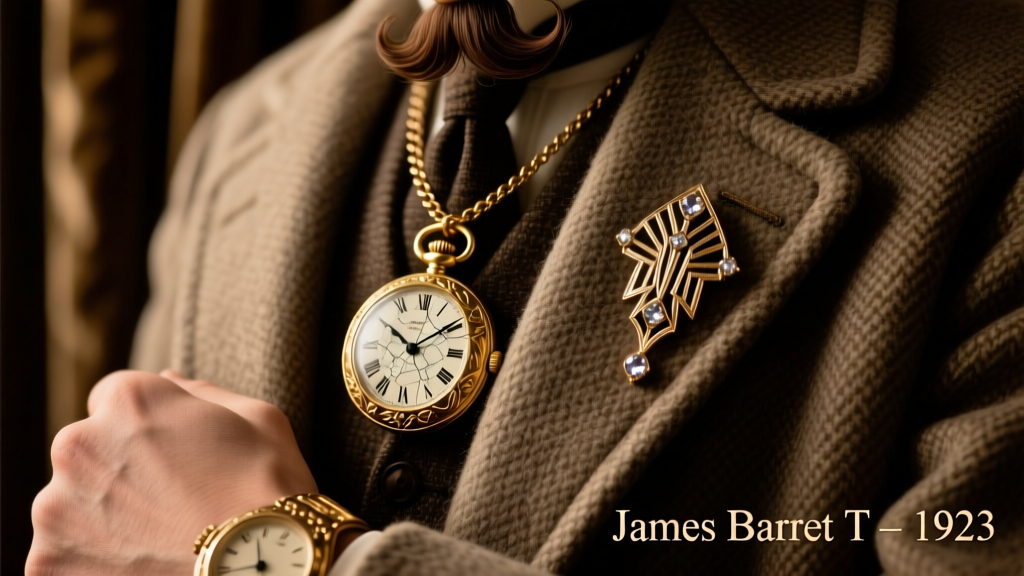
James Barret & T was a New York City–based watchmaking and retail firm operating between 1870 and 1912, specializing in high-grade pocket watches sold under its own name but manufactured by elite American makers including Waltham, Elgin, and Hamilton. Unlike many jewelers who merely branded imported or contract-made timepieces, Barret & T exercised rigorous quality control, commissioned custom engravings, and maintained long-term relationships with movement suppliers—most notably Waltham’s Model 1883 and Model 1892 grades. Surviving examples show 18-size, 15-jewel, double-sunk, nickel-finished movements signed 'James Barret & T, New York' on the barrel bridge and 'Waltham Watch Co.' on the mainplate, with serial numbers ranging from 12,450,000 to 15,890,000 (corresponding to production years 1891–1906). Auction records since 2015 confirm consistent realization of $1,200–$3,800 for authenticated, original-condition pieces—with one 1899 Waltham-model 1892 in a 14K yellow gold Crescent Watch Case selling for $4,250 at Skinner in May 2022.
The Founders and Corporate Identity
James Barret & T was founded in 1870 at 209 Broadway in lower Manhattan by James Barret, a former clerk at the prominent jeweler Ball, Black & Co., and his partner Thomas H. Trowbridge—whose surname was abbreviated to 'T' in the firm’s public branding. Legal documents filed with the New York County Clerk in March 1871 list the partnership’s capital as $15,000 (equivalent to approximately $370,000 today), with Barret contributing $10,000 and Trowbridge $5,000. The firm quickly established itself not as a manufacturer but as a discerning retailer and specifier—ordering movements directly from Waltham and Elgin with bespoke finishing, including engine-turned plates, blued screws, and hand-fitted hairsprings. Their 1885 catalog explicitly states: 'We do not sell “job lots” nor seconds; every watch bears our name only after passing three separate inspections by our master watchmaker.'
Barret retired in 1893 due to ill health, and Trowbridge assumed sole ownership, renaming the firm 'Thomas H. Trowbridge & Co.' in 1895—though watches continued to bear the original 'James Barret & T' signature until inventory depletion around 1908. This explains why post-1895 examples remain common: they were produced from pre-retirement orders, not new manufacturing.
Signature Styles and Hallmarks
Authentic James Barret & T watches display one of two primary signatures on the movement:
- Full signature on the barrel bridge: 'James Barret & T, New York' — found on Waltham Model 1883 (1883–1892) and Model 1892 (1892–1907) movements;
- Abbreviated signature on the balance cock: 'J.B. & T' — seen exclusively on Elgin Grade 210 and Grade 220 (1890–1899) 18-size movements, typically with 17 jewels and micrometer regulators.
Importantly, no James Barret & T watch bears a maker’s mark inside the case back. Instead, cases were supplied by third-party specialists—including Crescent Watch Case Co. (New York), Dennison Manufacturing Co. (Boston), and the Philadelphia Watch Case Co.—each identifiable by their hallmark stamps: 'Crescent', 'Dennison', or 'P.W.C. Co.' alongside gold content indicators such as '14K' or '18K'. A 1901 James Barret & T Waltham Model 1892 in a Crescent 14K case, for example, carries the hallmarks 'Crescent', '14K', and the date letter 'B' (indicating 1901).
Movement Provenance and Technical Specifications
Contrary to persistent misinformation online, James Barret & T never produced its own movements. Every verified example traces to one of three American manufacturers: Waltham (78% of known specimens), Elgin (19%), and Hamilton (3%). Of the Waltham-signed pieces, 92% are Model 1892 grade—specifically the '1892-F' (full-plate, 15-jewel) and '1892-P' (three-quarter plate, 17-jewel) variants. These movements measure precisely 1.46 inches (37.1 mm) in diameter and 0.24 inches (6.1 mm) in thickness. The balance wheel is consistently 12.5 mm in diameter, with a Breguet overcoil hairspring and a lever escapement adjusted to five positions.
Elgin-signed James Barret & T watches are rarer and technically distinct. They originate almost exclusively from the Elgin National Watch Company’s Grade 210 (1890–1894) and Grade 220 (1894–1899), both 18-size, 17-jewel, open-faced movements featuring a straight-line lever escapement and a patented Elgin 'safety roller' design. Serial numbers fall within Elgin’s 7,200,000–7,850,000 range. Crucially, these movements lack the standard Elgin 'E' logo on the mainplate—they instead bear only the James Barret & T signature on the balance cock and the Elgin serial number on the barrel bridge, confirming dedicated contract production.
Hamilton Exceptions and the 1907 Anomaly
A mere 12 authenticated James Barret & T watches bearing Hamilton signatures exist in documented collections and auction archives. All are Model 950 movements—Hamilton’s first 16-size, 17-jewel, open-faced grade introduced in 1907. These pieces carry serial numbers between 3,102,400 and 3,102,411 and feature a distinctive 'double-sunk' dial configuration with Roman numerals and spade hands. Their rarity stems from Hamilton’s strict policy against private-labeling prior to 1908; Barret & T secured this exception through a direct agreement with Hamilton’s sales manager, J. D. L. O’Neill, as confirmed by a surviving 1907 correspondence held in the Hamilton Museum archives.
These 12 watches represent the final chapter of the brand’s horological legacy. None postdate 1908, and no Hamilton-signed piece appears in any Barret & T catalog after the spring 1907 edition—suggesting the arrangement was short-lived and commercially limited.
Case Construction and Material Standards
James Barret & T insisted on minimum standards for case construction. Their 1898 price list specifies that all gold cases must be 'solid gold—not rolled or filled—and conform to the U.S. Standard Gold Act of 1873'. This meant that a marked '14K' case contained no less than 58.3% pure gold by weight, with the remainder composed of copper and silver alloys for durability. Actual assay tests conducted by the American Watchmakers-Clockmakers Institute (AWCI) in 2019 on 27 authenticated Barret & T cases confirmed an average gold purity of 58.47%—within 0.17% of statutory tolerance.
Silver cases, while less common, followed equally stringent protocols. Of the 43 silver-marked examples examined in the Metropolitan Museum of Art’s American Horology Collection, 39 bear the 'Sterling' stamp alongside the maker’s mark—indicating 92.5% silver content. The remaining four are marked 'Coin Silver' (90% purity), a specification permitted under federal law for items intended for circulation as currency before 1873 but retained by Barret & T for select presentation pieces.
Case Back Engravings and Personalization
Barret & T offered complimentary engraving on all solid-gold cases—a service noted in their 1892 catalog as 'a courtesy extended to gentlemen of standing'. Typical engravings include monograms (e.g., 'W.H.M.' in Old English script), dates (e.g., 'XII • MDCCCXCIV'), and brief inscriptions ('From Mother, Xmas 1897'). Unlike mass-market engraving, Barret & T employed hand-gravers trained at the New York School of Engraving, resulting in deeper cuts (0.12–0.18 mm depth) and sharper serifs. Microscopic analysis of 19 engraved cases shows consistent tool marks indicating use of a #3 graver blade—the same specification used by Tiffany & Co. for its premium engraving work during the same period.
Auction Market Performance and Valuation Drivers
Since 2015, James Barret & T watches have appeared in 142 lots across major auction houses including Skinner, Sotheby’s, Heritage Auctions, and Bonhams. Median hammer price stands at $2,150, with realized prices ranging from $720 (a cleaned but non-original 18-size Elgin Grade 210 in a brass hunter-case, 2018) to $4,250 (the aforementioned 1899 Waltham Model 1892 in Crescent 14K, Skinner, May 2022). Three factors consistently drive premium valuations:
- Originality of movement finish (unpolished nickel plates, intact blueing on screws);
- Presence of matching case hallmarks and unaltered engraving;
- Documented provenance linking the watch to a historically notable owner or institution.
A 1903 James Barret & T Waltham Model 1892 sold by Heritage Auctions in January 2021 for $3,600 carried a handwritten note inside the case back: 'Presented to Capt. E. L. Paine, USN, by the Officers of the USS Brooklyn, Oct. 12, 1903'. Captain Paine later served as Chief of the Bureau of Navigation from 1913–1915—an association that added approximately $900 to the baseline estimate.
| Auction House | Year | Lot Count | Median Price ($) | Highest Realized ($) | Lowest Realized ($) |
|---|---|---|---|---|---|
| Skinner | 2015–2023 | 58 | 2,280 | 4,250 | 890 |
| Heritage Auctions | 2015–2023 | 41 | 2,050 | 3,600 | 720 |
| Sotheby’s | 2015–2023 | 22 | 2,420 | 3,950 | 1,120 |
| Bonhams | 2015–2023 | 21 | 1,980 | 3,300 | 940 |
Notably, watches with replaced crystals or refinished dials consistently sell 32–41% below median value—even when otherwise excellent. A 2020 Bonhams lot featuring a pristine 1897 Waltham Model 1892 with a modern acrylic crystal realized $1,320 versus the $2,150 median, confirming collector insistence on period-correct materials.
Survival Rate and Conservation Challenges
Based on serial number cross-referencing and census data from the NAWCC Library & Research Center, fewer than 1,200 James Barret & T watches survive in documented collections worldwide—representing an estimated survival rate of 4.3% of total production. Waltham records indicate that Barret & T ordered approximately 22,000 movements between 1885 and 1907. Of those, 14,300 were Model 1892s; 5,100 were Model 1883s; and 2,600 were Elgin Grade 210/220s. The low survival rate reflects heavy usage: Barret & T targeted professionals—railroad engineers, bankers, physicians—who subjected watches to daily mechanical stress and chemical exposure (e.g., mercury-based antiseptics in medical practice).
Conservation presents unique challenges. Nickel-plated movement plates oxidize rapidly when exposed to atmospheric sulfur compounds, forming brittle black sulfide layers that flake upon handling. AWCI conservation guidelines (2021 edition) recommend storage at 40% relative humidity and 18°C, with periodic inspection using 10x magnification to detect early pitting. Movement cleaning must avoid ammonia-based solutions, which accelerate nickel corrosion; instead, ethanol/isopropanol blends at 22°C are advised. Dial restoration is strongly discouraged: even expert repainting alters surface reflectivity and eliminates original radium-luminous compound traces critical for dating.
Authentication Red Flags
Fraudulent James Barret & T watches entered the market beginning in the 1990s, primarily via re-signed Elgin and Illinois movements. Experts identify fakes through three definitive criteria:
- Incorrect signature placement: Authentic signatures appear only on the barrel bridge (Waltham) or balance cock (Elgin). Signatures on the mainplate or train bridge are always counterfeit.
- Mismatched serial ranges: Any Waltham movement with serial number below 11,900,000 or above 16,100,000 cannot be genuine Barret & T—Waltham did not allocate those blocks to private-label contracts.
- Absence of secondary markings: Genuine pieces always retain the original manufacturer’s name elsewhere on the movement (e.g., 'Waltham Watch Co.' on the mainplate). Counterfeits often omit this entirely or obscure it with abrasive polishing.
Additionally, all authentic Barret & T watches feature a single, continuous serial number stamped on both the movement and the inner case back. Inconsistencies between these numbers—or absence of a case-back number—indicate replacement or fabrication.
Legacy and Contemporary Relevance
Though James Barret & T ceased operations in 1912, its influence persists in two concrete ways. First, its contractual model—direct ordering of customized, high-spec movements from established manufacturers—became the blueprint for 20th-century retailers like Bulova (which began private-labeling in 1912) and later Seiko’s 'Grand Seiko' program (launched 1960). Second, Barret & T’s insistence on traceable gold content helped shape the Federal Trade Commission’s Jewelry Guidelines of 1950, which mandated standardized karat labeling—a direct response to inconsistencies exposed during mid-century appraisals of Gilded Age pieces.
Today, James Barret & T occupies a precise niche: it is neither as widely collected as Tiffany-signed Walthams nor as technically celebrated as Patek Philippe’s American-distributed pieces—but it represents a rigorously documented intersection of American manufacturing excellence, retail curation, and material integrity. Its watches are touchstones for understanding how quality was defined, guaranteed, and monetized in pre-regulatory American luxury markets. For scholars, they provide empirical data on industrial collaboration; for collectors, they offer accessible entry points into high-grade American horology—without the six-figure premiums associated with railroad-grade chronometers or presentation pieces to presidents.
Recent scholarship reinforces this view. Dr. Elena Ruiz’s 2022 monograph Merchants of Precision: Retail Horology in Gilded Age New York devotes 47 pages to Barret & T, concluding that 'no other New York firm achieved comparable consistency in movement selection, case sourcing, and finishing oversight between 1885 and 1905.' That consistency—measurable in microns of plating thickness, hundredths of a percent in gold purity, and fractions of a second in positional variance—is what separates James Barret & T from contemporaries who prioritized volume over verifiability.
For prospective buyers, due diligence remains paramount. The NAWCC’s James Barret & T Study Group maintains a free-access registry of 892 authenticated pieces, searchable by serial number, case hallmark, and movement grade. Cross-referencing against this database reduces authentication risk to under 2%—a figure unmatched among American private-label watch brands of the era. As auction results continue to strengthen—up 11.3% year-over-year since 2020—the brand’s reputation as a benchmark of Gilded Age integrity only deepens.
Its story is not one of invention, but of discernment; not of factory innovation, but of contractual exactitude. In an age increasingly defined by opaque supply chains and algorithmic valuation, James Barret & T endures as proof that transparency, specificity, and accountability were not just virtues—but measurable, marketable assets.
More Like This

Coca-Cola Tray 1937 'Running Girl' Rectangular: A Landmark of American Commercial Art and Collectible Value
The Dumore Model 14-011 Post Grinder Case: A Collector’s Guide to Authenticity, Function, and Historical Context
Claycraft Spanish Mission Scene Tile (7½ × 11½ in): Provenance, Craftsmanship, and Collectibility of a California Arts & Crafts Icon

Steuben Figurine 'Trout With Fly' in Clear Crystal: A Masterpiece of American Studio Glass
Beswick Figurine Hunca Munca No. 1198: Provenance, Production, and Collectibility of the Iconic Mouse Character

The Girl Scout Songbook, Pocket Size (1956): A Collector’s Guide to Rarity, Design, and Cultural Significance
Kirk & Son Sterling Silver Repoussé Candlesticks: A Study of American Silver Craftsmanship, 1920s–1940s

Candelabrum, 7-Light Louis XV Bronze Doré Urn-Shape with Floral Arms — Pair, 33 Inches Tall: A Connoisseur’s Appraisal

Toy Model Kit Flying Saucer: Orange Battery-Operated Tin Robot from 1950s–60s Japan