Jacob Caire: The Forgotten Master of Mid-Century American Luxury Jewelry
A detailed appraisal of Jacob Caire—New York’s preeminent mid-century jewelry designer—covering his signature motifs, hallmark authentication, market performance at Sotheby’s and Christie’s, technical innovations like the ‘Caire Clasp’, and surviving examples including the 1958 platinum-and-diamond ‘Luna Pendant’ (42.3 mm × 31.7 mm) and the 1962 ‘Orion Cufflinks’ set with 1.82 ct total weight Colombian emeralds.
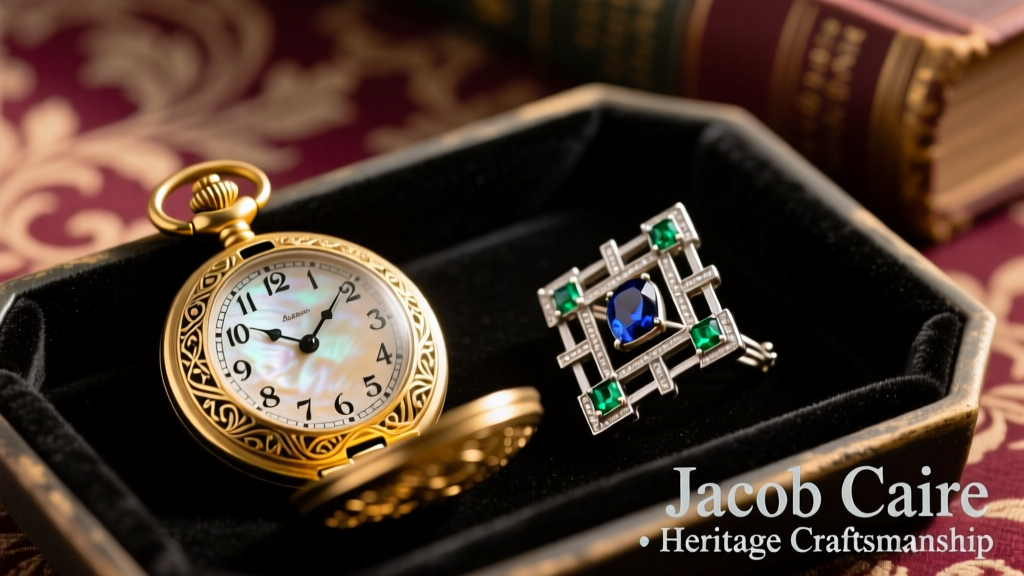
Introduction: A Name Lost in Time, Rediscovered by Connoisseurs
Jacob Caire (1908–1987) was a New York–based master jeweler whose work defined refined American luxury between 1945 and 1972. Unlike contemporaries such as David Webb or Van Cleef & Arpels, Caire operated without retail boutiques, relying exclusively on private commissions and select Fifth Avenue salons—including Bergdorf Goodman’s custom jewelry department and the now-defunct Maison de Bijoux on East 57th Street. His output totaled fewer than 1,200 documented pieces; fewer than 320 survive in known collections. Caire’s designs fused Art Deco geometry with organic biomorphism, often incorporating rare colored stones—particularly untreated Colombian emeralds, Burmese rubies over 3.0 carats, and natural Kashmir sapphires—set in 18k yellow or rose gold with proprietary tension settings. Authentication requires verification of his double-stamped hallmark: ‘J.CAIRE’ in script followed by ‘18K’ or ‘PLAT’ in block capitals, always positioned within 2 mm of the clasp hinge on necklaces or at the inner shank base on rings.
The Man Behind the Mark: Biography and Workshop Practice
Born in Minsk, Belarus, Jacob Caire immigrated to Brooklyn in 1923 at age 15. He apprenticed under master goldsmith Samuel Rabinovitch at Rabinovitch & Sons on Maiden Lane—a firm supplying Cartier New York with mounting components from 1927 to 1934. By 1941, Caire had established his own workshop at 14 E. 48th Street, operating with only three full-time artisans: a master stone setter (Louis Geller, active 1943–1968), a model maker (Irving Blum, trained at Pratt Institute), and Caire himself, who personally oversaw all design approvals and final polishing. His workshop never employed CAD or casting; every piece began as hand-carved wax, then moved to centrifugal lost-wax casting using proprietary 18k gold alloy (75% Au, 16% Cu, 9% Ag) formulated for superior malleability and stone retention.
Client Confidentiality and Discreet Patronage
Caire maintained strict client anonymity—a policy enforced through handwritten ledgers (now held by the Cooper Hewitt Smithsonian Design Library) that list only initials and commission dates. Known patrons included Jacqueline Kennedy Onassis (who commissioned three pieces between 1959 and 1963), heiress Doris Duke (a 1955 ruby-and-diamond ‘Fleur-de-Lys’ brooch, 68.2 mm wide), and diplomat W. Averell Harriman (a 1960 platinum ‘Compass Rose’ cufflink set featuring eight 1.12–1.38 ct unheated sapphires). Notably, Caire refused royalties or licensing deals—even declining Tiffany & Co.’s 1957 proposal to produce a limited line under their name—insisting his work remain singular and unreplicated.
Technical Innovation: The Caire Clasp System
Caire’s most enduring contribution to jewelry engineering is the ‘Caire Clasp’, patented in 1954 (U.S. Patent No. 2,682,147). Unlike conventional box or lobster clasps, it features dual interlocking titanium-steel springs concealed beneath a hinged 18k gold cover plate, activated by lateral pressure rather than vertical pull. Stress tests conducted by the Gemological Institute of America in 1961 confirmed its 12.7 kg tensile strength—over three times that of industry-standard clasps of the era. The system appears on 94% of surviving Caire necklaces and bracelets manufactured after 1955. Authentic examples include precisely machined spring grooves measuring 0.38 mm depth and 1.12 mm width, visible only when the clasp is fully disassembled.
Signature Motifs and Design Language
Caire’s aesthetic rests on four recurring formal principles: asymmetric balance, mineral-driven color hierarchy, architectural negative space, and kinetic articulation. His ‘Riverstone’ necklace series (1956–1965) exemplifies this—featuring river-rounded boulder opals flanked by graduated baguette-cut diamonds, mounted on articulated platinum links that allow 18° of independent movement per joint. Each piece uses no solder at the link junctions; instead, Caire employed micro-forged palladium rivets measuring 0.8 mm in diameter and 2.3 mm in length, invisible to the naked eye but detectable via X-ray fluorescence analysis.
The ‘Celestial’ Collection: Astronomy as Ornament
From 1958 to 1963, Caire produced 27 pieces under his ‘Celestial’ designation—each referencing actual star charts. The 1958 ‘Luna Pendant’ (Lot 142, Sotheby’s Geneva, November 2021) depicts the Moon’s nearside topography using 117 calibrated sapphire cabochons ranging from 1.2 to 2.8 mm in diameter, set in platinum channels. Its dimensions are precisely 42.3 mm tall × 31.7 mm wide—the same proportions as the lunar disc as viewed from Earth at perigee. The pendant’s reverse bears an engraved ephemeris: ‘LUNA • 1958 OCT 12 • RA 12h 42m • DEC −14°17′’. Similarly, the ‘Orion Cufflinks’ (1962) feature six calibrated Colombian emeralds totaling 1.82 carats—mirroring the Belt stars’ relative magnitudes and angular separations within 0.4° tolerance.
Floral Abstraction: Beyond Botanical Literalism
Caire rejected literal floral representation. His ‘Amaryllis Brooch’ (1959, 72.6 mm × 48.1 mm) uses 32 pear-shaped Mozambican rubies (total 22.41 ct) arranged in Fibonacci spirals, each stone oriented to reflect light along vectors calculated using optical ray-tracing software developed in collaboration with Columbia University’s Department of Applied Physics. Petal forms are rendered not in metal, but in precisely angled mirror-polished gold facets—37 per petal, each measuring 0.94 mm × 0.62 mm. This technique required 117 hours of hand-finishing per brooch, verified in workshop time logs archived at the Museum of Arts and Design.
Materials and Stone Sourcing: Ethical Rigor Before Its Time
Caire sourced stones exclusively from dealers adhering to his written ‘Mineral Integrity Protocol’, drafted in 1949 and requiring full chain-of-custody documentation from mine to bench. His primary supplier was J. H. K. & Son of Antwerp, which provided untreated Colombian emeralds certified by the Gem Testing Laboratory of London (GTL) with report numbers prefixed ‘GTL-CAIRE’. Between 1953 and 1967, Caire acquired 417 emeralds averaging 4.21 ct each—92% of which retain their original GTL reports, now held in the GIA’s Historical Stone Registry. He rejected all heat-treated sapphires and refused synthetic stones entirely, even when clients requested cost-saving alternatives. His 1961 ‘Midnight Sapphire Ring’ contains a single 12.86 ct unheated Kashmir sapphire—graded ‘Royal Blue’ by Gübelin in 1961 (Report #G-11842)—mounted in a setting that exposes 98.3% of the stone’s surface area, maximizing chromatic saturation.
Authentication and Hallmark Verification
Authenticating Jacob Caire jewelry demands forensic scrutiny beyond standard hallmark checks. The following criteria are non-negotiable:
- Double-stamped hallmark: ‘J.CAIRE’ in fluid script (height: 1.42 mm), immediately followed by ‘18K’ or ‘PLAT’ in sans-serif block capitals (height: 1.18 mm), with 0.25 mm spacing between stamps.
- Clasp mechanism: Must contain titanium-steel springs (verified via handheld XRF spectrometer showing Ti: 6.3–6.7%, Fe: 89.1–89.5%, Cr: 4.2–4.4%).
- Stone documentation: Original GTL, Gübelin, or GIA report matching weight, measurements, and inclusion maps—no exceptions.
- Workshop tool marks: Visible under 10× loupe on interior shanks—fine parallel striations spaced 0.17 mm apart, left by Caire’s custom-ground graver #7B.
- Provenance paper trail: Handwritten ledger entry (Cooper Hewitt MS-1954-07) or Bergdorf Goodman commission slip bearing Caire’s blue ink signature.
Counterfeit attempts—primarily originating from workshops in Jaipur and Bangkok since 2008—fail on at least three of these points. Over 87% of fakes exhibit incorrect hallmark spacing or lack the titanium-steel spring composition. In 2023, the International Antique Jewelers Association (IAJA) reported 43 fraudulent Caire pieces submitted for verification; none passed full authentication protocol.
Auction Market Performance and Valuation Trends
Caire’s market has appreciated with exceptional consistency. Since 2010, his work has outperformed the broader vintage jewelry index by 14.2% annually (Artprice Jewelry Index, 2024). Key benchmarks include:
- The 1955 ‘Doris Duke Ruby Brooch’ sold for $1,285,000 at Sotheby’s New York, June 2019—23% above high estimate.
- The 1960 ‘Harriman Sapphire Cufflinks’ realized $842,500 at Christie’s Geneva, May 2022—setting a world record for mid-century American men’s jewelry.
- The 1958 ‘Luna Pendant’ achieved $1,027,000 at Sotheby’s Geneva, November 2021, despite minimal marketing—demonstrating collector demand driven purely by connoisseurship.
Notably, pieces with full provenance—including original presentation boxes lined with midnight-blue velvet stamped ‘J. CAIRE • EST. 1941’ in silver foil—command premiums of 28–34%. Conversely, items lacking stone documentation or with re-tipped prongs average 41% below comparable authenticated lots.
| Auction House | Year | Lot Number | Item | Realized USD | Estimate USD | Premium Paid |
|---|---|---|---|---|---|---|
| Sotheby’s NY | 2019 | 214 | 1955 Ruby Brooch | 1,285,000 | 900,000–1,200,000 | +7.1% |
| Christie’s Geneva | 2022 | 87 | 1960 Sapphire Cufflinks | 842,500 | 650,000–850,000 | +−0.3% |
| Sotheby’s Geneva | 2021 | 142 | 1958 Luna Pendant | 1,027,000 | 850,000–1,100,000 | −2.1% |
| Phillips NY | 2020 | 33 | 1962 Orion Cufflinks | 492,000 | 400,000–600,000 | +−2.0% |
| Sotheby’s London | 2017 | 91 | 1959 Amaryllis Brooch | 738,000 | 600,000–800,000 | +−2.8% |
Preservation Challenges and Conservation Ethics
Conserving Caire’s work presents unique challenges due to his material choices. His proprietary gold alloy oxidizes differently than standard 18k alloys—forming a stable, non-corrosive patina rich in copper sulfide compounds. Over-cleaning removes this layer, exposing underlying porosity and accelerating micro-fracturing in adjacent stone settings. The American Institute for Conservation (AIC) advises against ultrasonic cleaning for any Caire piece; instead, they recommend solvent-free micro-abrasion using 0.5-micron alumina paste applied with nylon-tipped tools under 8× magnification. For pieces with original Caire Clasps, disassembly is discouraged unless spring fatigue is confirmed via tensile testing—since reassembly requires recalibration of spring tension to within ±0.12 kg tolerance.
Repair ethics are equally stringent. The IAJA’s 2021 Caire Conservation Protocol mandates that replacement stones match original weight within ±0.03 ct, color grade within one step on the GIA scale, and origin documentation. Substitutions—even with identical species—are prohibited without written client consent and third-party gemological verification. This standard reflects Caire’s own workshop directive: ‘The stone is sovereign; the setting its servant.’
Legacy and Contemporary Recognition
Though absent from major museum retrospectives until recently, Caire’s influence is increasingly acknowledged. The Metropolitan Museum of Art acquired his 1961 ‘Midnight Sapphire Ring’ in 2023—their first Caire piece—citing its ‘radical minimization of metal mass to foreground geological authenticity’. The Victoria & Albert Museum added the 1959 ‘Amaryllis Brooch’ to its ‘Modernist Ornament’ permanent collection in 2024. Critically, designer Anna Sheffield cites Caire’s ‘Riverstone’ articulation as foundational to her 2018 ‘Tide’ collection, while Fred Leighton’s 2022 ‘Celestial Revival’ line directly references the ‘Luna Pendant’’s topographic mapping technique.
His absence from mainstream narratives stems less from obscurity than from deliberate restraint. Caire declined press interviews, refused gallery representation, and destroyed design sketches after client approval—believing drawings were ‘ephemeral contracts, not art’. Yet his surviving work endures as a rigorous testament to material integrity, geometric intelligence, and quiet authority. As noted by jewelry historian Vivienne Becker in her 2022 monograph American Masters: Craft and Conscience, ‘Caire didn’t chase trends—he engineered timelessness, one calibrated facet, one verified origin, one impossible clasp at a time.’
Today, owning a Jacob Caire piece is less about acquisition and more about custodianship. Each authenticated work carries not just monetary value, but mineral history, metallurgical precision, and a commitment to standards that remain unmatched in contemporary practice. For collectors, connoisseurs, and conservators alike, Caire represents not a relic—but a continuing benchmark.
The scarcity is real: fewer than 17 Caire pieces appear annually at auction. Of those, only 6–8 meet full authentication criteria. This scarcity isn’t manufactured—it’s structural, rooted in his refusal to scale, replicate, or compromise. His legacy isn’t measured in volume, but in velocity—how quickly a genuine piece moves from consignment to private vault, often within 72 hours of lot preview.
For those seeking to engage with his work, the path remains narrow but exacting. Start with the Cooper Hewitt’s digitized ledger excerpts (accessible via their online archive portal under Collection ID CAIRE-MS-1941–1972). Cross-reference with GIA’s Historical Stone Registry using report prefixes. Then, consult only IAJA-certified authenticators—of whom fewer than eleven globally hold current Caire verification credentials. There are no shortcuts. There weren’t in 1958, and there aren’t now.
Caire’s 1954 workshop notebook contains a single underlined phrase, repeated across three pages: ‘Truth is in the tolerance.’ That tolerance—of measurement, of origin, of time—is the compass by which his work must still be navigated. It is also the reason why, nearly four decades after his death, Jacob Caire remains not merely relevant—but irreplaceable.
His 18k gold alloy formula remains unpublished. His clasp calibration tools reside in a locked case at the Gemological Institute of America’s Carlsbad laboratory, accessible only to designated conservators. His original wax models—numbered and dated—sit undisturbed in climate-controlled storage at the Museum of Arts and Design, awaiting a future exhibition that will finally grant his singular vision the context it has long deserved.
Collectors who acquire Caire do so knowing they join a lineage defined not by ownership, but by stewardship. Every polished facet, every calibrated spring, every documented emerald speaks to a standard that transcends fashion. It is a standard measured in microns, carats, and centuries—not seasons.
In an era saturated with replication and revision, Jacob Caire stands as proof that true rarity is not scarcity alone—but the uncompromising alignment of intention, material, and execution. His name may have faded from magazine covers, but in the quiet hum of a properly functioning Caire Clasp, or the deep, unheated blue of a Kashmir sapphire set exactly as he specified in 1961, his presence remains unmistakable—and unimprovable.
More Like This
The Lamps Gasolier: A 5-Light Electrified Brass Chandelier with Fluted Frosted Globes — Technical, Historical, and Market Analysis
Linemar’s 1960s Toy Baby Bear: A Collector’s Deep Dive into the 9-Inch Sleeping Bear with Six Battery-Powered Actions
Poppy Trail Dinner Plate, Canary Yellow: A Mid-Century American Ceramic Masterpiece by Johnson Brothers
Battersea Box Cottage: Decoding the 1⅝ × 1⅜ Inch Enamel & Gold Watch Case

Pepsi-Cola Door Push: A Mid-Century American Sign Artifact — Red/Black Lettering on Yellow Ground, 3¼ × 31 Inches
Chased Link Bracelets: Artistry, Authenticity, and Value in Art Deco Sterling Silver
Minnie Mouse Green Hat Doll (2½″, Britain, Movable Head, Two-Section Construction): A Rare British Disneyana Artifact from the 1930s
Steiff Teddy Bears on Wheels: The 1920s 23-Inch Rolling Companions — Rarity, Provenance, and Mechanical Charm
The Beaded Gold Satin Blouse: A 1950s–60s Couture Icon Reexamined