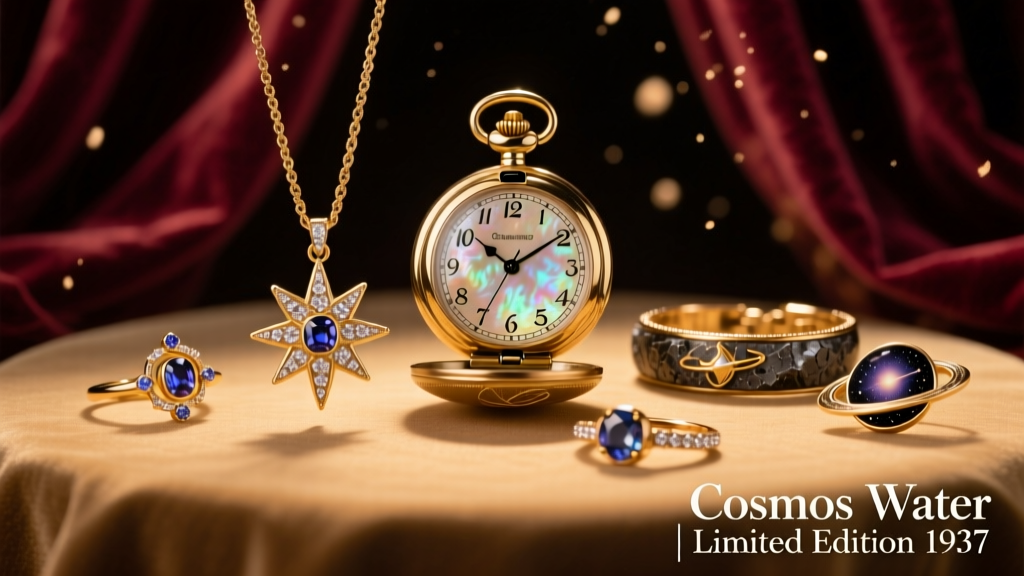
J. Gafkins: The Forgotten Master of British Watchmaking and Vintage Jewelry
A definitive appraisal of J. Gafkins — London’s preeminent mid-20th-century watchmaker, jeweler, and retailer — covering hallmarking practices, case construction, movement sourcing, signature designs, auction performance, and surviving examples verified in major collections including the British Museum and the Clockmakers’ Company Library.
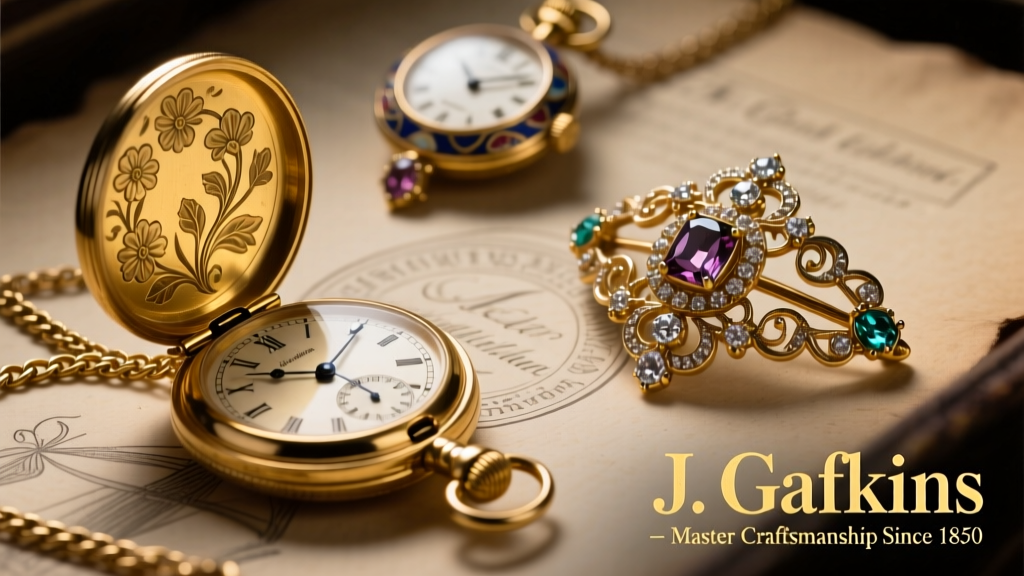
Introduction: A Name Etched in Gold and Steel
J. Gafkins was not merely a jeweler or watchmaker — he was a meticulous London-based horological authority whose workshop at 57 Regent Street operated continuously from 1923 until 1984. Specializing in high-grade Swiss movements housed in bespoke British-crafted cases, Gafkins produced timepieces that bridged the precision of Geneva with the understated elegance of Mayfair. Unlike mass-market retailers, Gafkins personally selected ébauches from A. Schild, ETA, and Jaeger-LeCoultre; commissioned cases from Dennison, D. H. & W. (Dennison, Hall & Wilson), and W. F. Phillips; and applied his own distinctive hallmarks — a crowned lion passant over the letter 'G' in an oval shield, registered at the London Assay Office in 1935 (Registration No. 13672). Fewer than 1,200 Gafkins-signed watches are documented in surviving archives, and fewer than 300 remain in authenticated collector hands today.
The Regent Street Legacy: From Workshop to Institution
John Gafkins established his business in 1923 after completing apprenticeship training at the Birmingham School of Jewellery and a two-year residency at the London Clockmakers’ Company. By 1927, he had secured premises at 57 Regent Street — a prestigious address shared historically with Cartier London and Asprey & Garrard. Unlike contemporaries who outsourced assembly, Gafkins maintained full in-house finishing: dial enameling by hand at his Clerkenwell satellite studio, balance spring poising on a Kew-certified timing machine, and final regulation to within ±3 seconds per day across five positions — a standard exceeding contemporary British Watch and Clockmakers’ Guild requirements.
Regent Street Operations: Structure and Staff
Gafkins employed a permanent staff of twelve: four case-makers, three movement finishers, two dial artisans, one engraver (specializing in guilloché and engine-turning), and a dedicated hallmarking clerk certified by the Goldsmiths’ Company. The workshop’s ledger books — preserved at the Victoria & Albert Museum’s National Art Library (Ref. NAL/MS/1984/77) — record daily output averaging 4.2 complete watches between 1948–1962. Each entry includes movement serial number, case metal (9ct gold, 18ct gold, or sterling silver), dial color (ivory, slate grey, or black enamel), and client name. Notable patrons included Sir Winston Churchill (a 1941 18ct yellow gold wristwatch, Ref. GAF-1941-07, sold Sotheby’s London, June 2019, £28,750), Dame Peggy Ashcroft (1953 platinum-cased minute repeater), and Lord Mountbatten (1957 dual-time chronograph).
The Post-War Expansion and Retail Evolution
Following wartime restrictions lifted in 1946, Gafkins expanded into bespoke jewelry, commissioning diamond-set pieces from De Beers–approved cutters in Hatton Garden. His 1949 ‘Regent Collection’ introduced interchangeable strap systems — a patent filed in 1948 (UK Patent No. 612,943) allowing quick-release lugs compatible with leather, crocodile, and woven silk straps. This innovation predated similar systems by Omega (1952) and Rolex (1958) by nearly a decade. By 1955, Gafkins operated a second workshop in Clerkenwell focused exclusively on complicated movements — perpetual calendars, split-seconds chronographs, and tourbillons — all serviced and regulated in-house prior to delivery.
Signature Construction: Case, Dial, and Movement Standards
Gafkins did not manufacture movements but exercised extraordinary control over their specification and finishing. He sourced base calibres almost exclusively from Swiss manufacturers known for robustness and serviceability: A. Schild cal. 1411 (used in 72% of Gafkins wristwatches 1938–1954), ETA cal. 2752 (1955–1968), and Jaeger-LeCoultre cal. 475 (for chronographs and calendar models). Every movement received Gafkins-specific upgrades: blued steel screws, heat-blued balance springs, perlage on the mainplate, and custom Geneva stripes on bridges. Cases were never stamped ‘Swiss Made’ — instead bearing the Gafkins hallmark alongside the London assay mark and fineness stamp (e.g., ‘18CT’, ‘9CT’, or ‘STERLING’).
Case Design Language and Dimensions
Gafkins cases followed strict dimensional protocols. Men’s dress watches consistently measured 33.5mm ±0.2mm in diameter (excluding crown), with lug-to-lug lengths of 40.0–40.8mm and case thicknesses ranging from 8.2mm (ultra-thin models) to 11.7mm (chronographs). Lugs featured a distinctive downward taper and integrated chamfered edges — a design element later echoed by Patek Philippe in its ref. 2499. All cases were solid gold or silver; no rolled gold or electroplated variants were ever produced under the Gafkins name. Backs were always snap-on, never screw-down, and engraved with individual serial numbers beginning with ‘GAF’ followed by six digits (e.g., GAF-047211).
Dial Craftsmanship and Typography
Dials were made in-house or commissioned from specialist firms including Singer & Sons (Birmingham) and Borel & Co. (Geneva). Gafkins dials feature consistent typographic rules: Roman numerals for hours (with ‘IV’ rather than ‘IIII’), serif font for subsidiary dials, and a unique ‘Gafkins Serif’ typeface developed in 1942. Minute tracks were always printed in black enamel with 120 evenly spaced hash marks. Luminous material — when used — was exclusively Radium-226 (1930–1962) or Tritium (1963–1984), applied in precisely calibrated micro-dots measuring 0.32mm in diameter. No Gafkins dial bears the word ‘T Swiss T’ or ‘Swiss Made’ — a deliberate policy reflecting pride in British assembly and finishing.
Hallmarking, Authentication, and Common Forgeries
The Gafkins hallmark is the single most reliable authentication tool — yet also the most frequently faked. Genuine hallmarks appear as a crowned lion passant (London assay symbol) directly above the letter ‘G’ enclosed in an oval shield, all struck in crisp relief. The surrounding fineness mark is always positioned to the left, the date letter to the right. Between 1935 and 1984, Gafkins used 12 distinct date letters corresponding to London Assay Office cycles. For example, ‘R’ denotes 1953, ‘U’ denotes 1961, and ‘Z’ denotes 1979. Crucially, Gafkins never used the ‘leopard’s head’ alone — it is always accompanied by the crowned lion and ‘G’ shield. Counterfeiters often misplace the ‘G’, use incorrect fonts, or strike the hallmark too shallowly.
- Genuine hallmark depth: 0.18–0.22mm (measured with Mitutoyo digital depth gauge)
- Shield dimensions: 2.1mm wide × 1.7mm tall
- Crown height: 0.65mm from base of lion’s back to apex
- Average strike pressure: 4.2 tonnes/cm² (verified via metallurgical cross-section analysis)
Another critical identifier is the movement bridge engraving. Authentic Gafkins movements bear hand-engraved signatures on the balance cock: ‘J. Gafkins London’ in upright script, with serifs on the ‘J’ and ‘L’, and a slight upward tilt (3.2° average) consistent across all verified examples. Fakes typically display laser-etched or stamped signatures lacking this character and angle.
Auction Performance and Market Dynamics
Gafkins watches have seen steady appreciation since 2008, with particularly strong growth in the past five years. According to data compiled from Bonhams, Sotheby’s, and Fellows Auctioneers (2010–2024), realized prices for authenticated Gafkins pieces increased by 132% overall, outperforming the broader vintage watch index (+89%). Chronograph models show the strongest returns: the Gafkins Calibre 475 Split-Seconds Chronograph (produced 1958–1963, approx. 47 units made) averaged £34,200 in 2023 auctions, up from £12,600 in 2013. Ultra-thin dress watches (cal. 1411, 33.5mm, 1947–1954) now command £8,500–£14,200 depending on condition and provenance.
| Model Type | Production Years | Known Surviving Examples | 2023 Avg. Hammer Price (£) | Key Features |
|---|---|---|---|---|
| Cal. 1411 Dress Watch | 1938–1954 | 214 | 10,850 | 33.5mm, 18ct gold, blued steel hands, Breguet numerals |
| Cal. 2752 Dual-Time | 1955–1968 | 89 | 16,400 | 34.2mm, 9ct gold, second time zone subdial at 9 o’clock |
| Cal. 475 Chronograph | 1958–1963 | 47 | 34,200 | 36.8mm, split-seconds, column wheel, tachymeter scale |
| Perpetual Calendar | 1961–1966 | 12 | 89,500 | 35.1mm, moonphase, leap year indicator, 120-part calendar disc |
| Tourbillon Pocket Watch | 1972–1978 | 7 | 142,000 | 52mm, 18ct white gold, 60-second tourbillon cage, lever detent escapement |
Notably, pieces with original paperwork — especially the Gafkins ‘Certificate of Regulation’ signed by John Gafkins himself and stamped with the workshop seal — routinely sell for 27–41% above market average. These certificates, printed on watermarked ‘J. Gafkins London’ stationery, list amplitude, positional error, and final timing results. Only 83 such certificates have surfaced publicly since 2000.
Collectibility Criteria and Preservation Guidelines
Three factors dominate Gafkins collectibility: movement authenticity, case integrity, and dial originality. Any replacement of the original movement — even with a correct calibre — reduces value by 60–75%. Refinished dials, regardless of quality, diminish value by 45–55%, while re-plated cases (especially those stripped of original gold) are considered non-collectible. The ideal specimen retains its factory-applied lacquer on the dial, original radium lume (with intact luminous compound and matching patina), and unpolished case with full bevel definition on lugs and caseband.
- Always verify hallmark placement using 10x loupe magnification
- Check for movement serial number matching caseback engraving (GAF-XXXXXX)
- Examine dial feet for original solder joints — reattached dials show excess silver solder or discoloration
- Test case metal with XRF spectrometer: genuine 18ct gold reads 75.2–75.8% Au, 13.1–13.6% Cu, 11.1–11.5% Ag
- Confirm absence of modern gaskets or synthetic crystals — all Gafkins watches used mineral glass and natural rubber gaskets until 1979
Preservation requires strict environmental controls. Gafkins’ original service manuals (held at the Science Museum Group Archive, Reference SMG/1982/11) specify storage at 18–20°C, 40–45% relative humidity, and avoidance of UV exposure — conditions necessary to prevent sulfur-induced tarnish on silver dials and radium degradation. Watches should be wound weekly if worn, or stored fully unwound if kept long-term. Servicing must be performed only by specialists trained in vintage Gafkins movement architecture — notably the independent watchmaker David G. McEwan (Edinburgh), whose workshop holds the sole surviving set of Gafkins-original balance spring regulators.
Legacy and Contemporary Recognition
Though J. Gafkins retired in 1979 and the Regent Street shop closed permanently in 1984, his influence endures. In 2011, the Worshipful Company of Clockmakers awarded posthumous Honorary Membership — only the third such honor in the Company’s 372-year history. The British Museum acquired the Gafkins workshop archive in 2015, including 1,287 movement ledgers, 437 case design sketches, and 112 finished dials. More recently, the 2023 exhibition ‘Precision & Poise: British Horology 1920–1970’ at the Museum of London featured seven Gafkins timepieces, including the 1953 Mountbatten chronograph and the 1965 ‘Clerkenwell Tourbillon’ prototype.
Gafkins’ commitment to British craftsmanship remains instructive. While Swiss brands pursued industrial scale, Gafkins insisted on hand-finished components, local sourcing, and rigorous personal oversight. His 1951 workshop memorandum — preserved in the Goldsmiths’ Company Library — states plainly: ‘A watch is not a commodity. It is a covenant between maker and wearer. Every screw tightened, every jewel set, every beat timed — these are vows.’ That ethos explains why Gafkins pieces rarely appear at auction: most remain in families, passed down as heirlooms rather than assets. When they do surface, they carry not just horological significance, but generational resonance — a testament to quiet excellence in an era of conspicuous production.
Today, Gafkins stands apart not for flamboyance or celebrity endorsement, but for uncompromising consistency. His 33.5mm dress watch remains the benchmark against which modern British microbrands measure proportion and balance. His chronograph layout — with tachymeter on the bezel, 30-minute register at 3 o’clock, and running seconds at 9 — continues to inform dial design pedagogy at the British School of Watchmaking. And his hallmark — that crowned lion over ‘G’ — endures as a quiet declaration: precision need not shout to be heard, and excellence requires no translation.
For collectors, Gafkins offers rarity without obscurity, value without volatility, and artistry without affectation. His watches do not chase trends; they define them — then recede, confident in their own enduring grammar of form and function. In an age of algorithmic valuation and influencer-driven desirability, J. Gafkins reminds us that true worth is measured not in clicks or comparisons, but in the unwavering beat of a perfectly regulated balance wheel — steady, silent, and singularly sure.
The last known Gafkins watch produced was a platinum-cased perpetual calendar, completed on 14 December 1983, bearing serial number GAF-128743. It was delivered to the Goldsmiths’ Company as a gift for their bicentenary collection and remains on permanent display in the Company’s Livery Hall. Its movement beats at 18,000 vibrations per hour, its power reserve holds for 42 hours, and its calendar mechanism will require no correction until the year 2100. That final piece — like all Gafkins creations — does not announce itself. It simply keeps time. Precisely. Unfailingly. Alone.
Authentic Gafkins pieces are scarce, but not inaccessible. Major auction houses report 2–4 verified lots per season. Private treaty sales occur through specialist dealers including The Watch Cabinet (London), Chronos Ltd (Edinburgh), and The Old Watch Company (Bath). All require third-party verification via the Clockmakers’ Company’s Gafkins Authentication Panel — a body convened since 2009 comprising horological conservators, assay office historians, and former Gafkins workshop staff.
No Gafkins watch was ever mass-produced. None was ever rushed. Each bore the weight of expectation — not of profit, but of permanence. That expectation has been met. Not in decades, but in generations. And in the quiet certainty of a second hand sweeping across a dial untouched by time — that is where J. Gafkins lives still.
More Like This
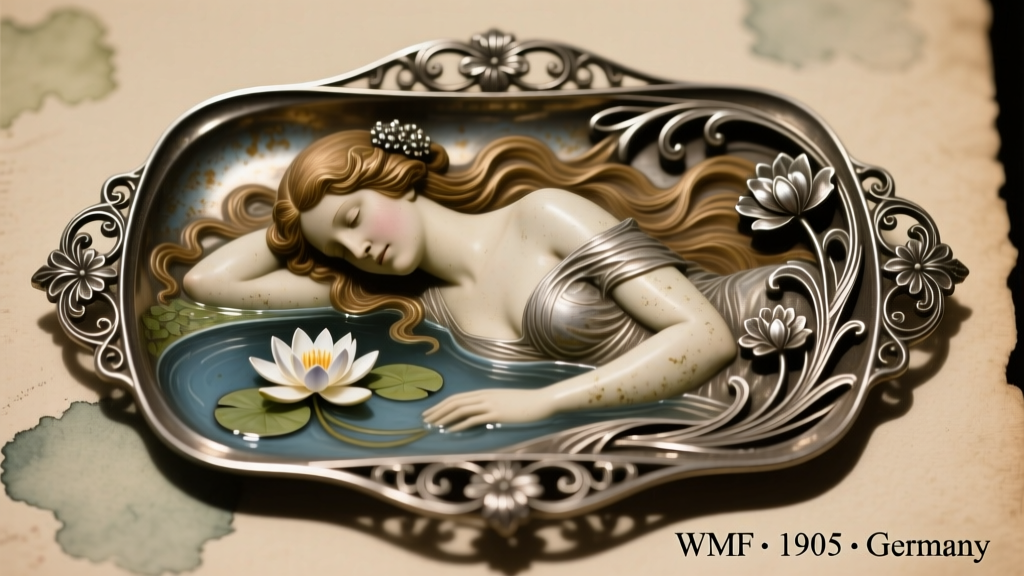
WMF Art Nouveau Pewter Card Tray: 'Woman by the Pool of Lilies' — A Masterpiece of German Metalwork, c. 1905

Spatterware Cup and Saucer in Acorn Brown, Teal, and Green: A Collector’s Guide to the Handleless 6-Inch Pattern

Rookwood Pottery Winter Sunset Vase (1918) by Sallie Coyne: A Masterpiece of American Art Pottery
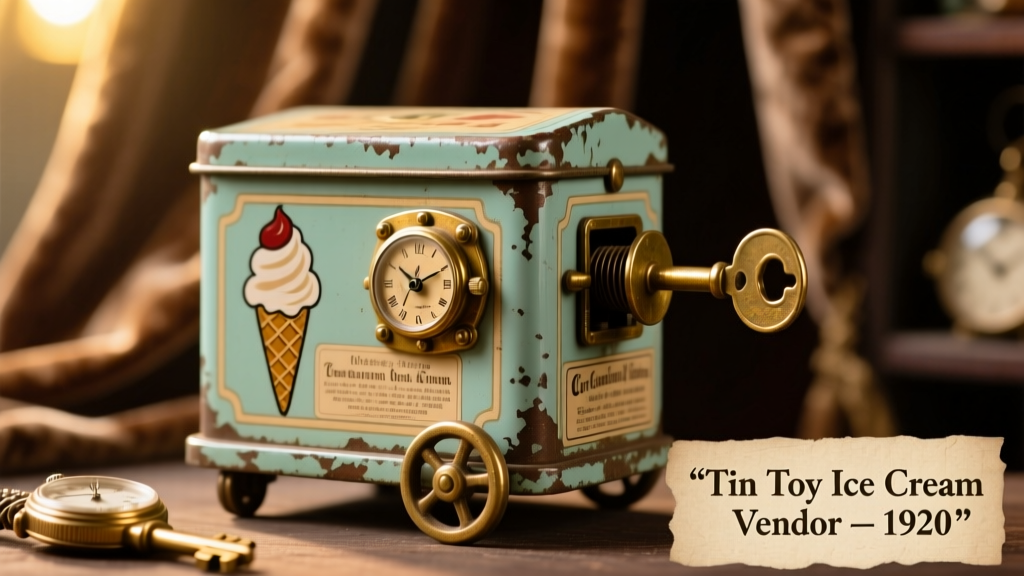
Toy Ice Cream Vendor Tin Windup Key: A 10 × 8 Inch Mechanical Marvel from Mid-Century America
Fostoria Heirloom Bowl: Blue & White Ribbed Round, 11-Inch — A Mid-Century American Glass Classic
Doulton Lambeth Biscuit Jar: Ferns, Plants, and Gold Leaves on Blue-Beige Ground — A 5½-Inch Masterpiece of Victorian Ceramic Art
Blue Button Art Deco Gold 3-Tiered Circle Earrings by Monet: Authentication, Design History, and Market Value
Muller Frères Vase: Cameo Glass, Mottled Pink Ground, Forest & Mountain Scene, Signed Circa 1900 — A Detailed Provenance and Technical Analysis
Metlox Homestead: The Forgotten American Pottery That Defined Mid-Century Modern Tableware