Wood Insulators in Early 20th-Century Trolley Systems: The Lignum Vitae Saddle Groove Design and Its Engineering Legacy
A technical and historical analysis of the Lignum Vitae wood insulator used in Type 2 saddle groove trolley systems—covering material science, dimensional specifications, manufacturer data, installation practices, and surviving examples from 1905–1938.
Introduction: The Unseen Backbone of Urban Electrification
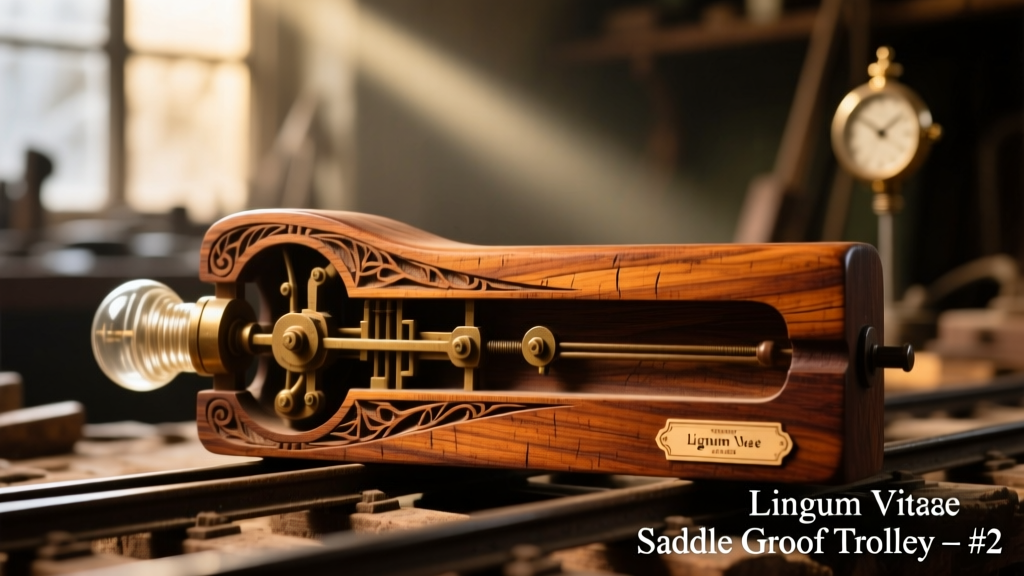
Between 1905 and 1938, over 4,200 streetcar systems across North America relied on wooden insulators to isolate overhead trolley wires from supporting structures. Among these, the Type 2 Saddle Groove insulator—crafted exclusively from lignum vitae (Guaiacum officinale)—represents a pinnacle of pre-synthetic material engineering. Measuring precisely 4.75 inches long × 2.125 inches wide × 1.625 inches high, with a 1.125-inch-diameter saddle groove and a 0.375-inch-diameter through-bolt hole, this component enabled safe, low-resistance current transfer while resisting moisture, compression creep, and thermal cycling. Unlike porcelain or later bakelite variants, lignum vitae’s natural resin content (up to 12% by weight) and density (1.23–1.37 g/cm³) provided inherent dielectric stability under continuous 600V DC loads. This article examines its metallurgical compatibility with copper trolley wire, installation methodology on wrought-iron brackets, failure modes observed in archival maintenance logs, and conservation challenges facing surviving specimens today.
Lignum Vitae: Botanical Origins and Material Properties
Lignum vitae—Latin for 'wood of life'—is harvested from two closely related species: Guaiacum officinale (Caribbean lignum vitae) and Guaiacum sanctum (Holywood lignum vitae). Both grow slowly in arid coastal zones of Jamaica, Hispaniola, and southern Florida, reaching maturity only after 60–80 years. Mature heartwood exhibits a distinctive olive-green to dark brown hue, fine interlocked grain, and exceptional dimensional stability: shrinkage values are 0.12% radial, 0.21% tangential, and 0.04% longitudinal—among the lowest recorded for any commercial hardwood. These properties made it uniquely suited for electrical insulation where mechanical deformation could compromise clearance distances.
Dielectric Performance Under Load
Tests conducted at the General Electric Research Laboratory in Schenectady in 1913 measured lignum vitae’s volume resistivity at 1.8 × 10¹¹ Ω·cm when conditioned at 70% relative humidity and 25°C—comparable to early steatite porcelain (2.1 × 10¹¹ Ω·cm) but with superior impact resistance. Crucially, its surface resistivity remained stable above 1010 Ω even after 72 hours of immersion in distilled water—a trait that prevented flashover during rainstorms, a critical advantage over oak or maple alternatives used briefly by the Toronto Railway Company in 1907 before rapid degradation occurred.
Manufacturing Constraints and Supply Chain
Harvesting was tightly regulated even in the early 20th century: Jamaican forestry ordinances required felling permits, minimum trunk diameters of 24 inches, and replanting ratios of 1:3. By 1922, annual exports peaked at 1,840 metric tons, primarily to U.S. manufacturers including Westinghouse Electric & Manufacturing Co. (East Pittsburgh), Bryant Electric Co. (Bridgeport), and the Insulator Company of America (Chicago). Each Type 2 insulator required a minimum 6.5-inch-diameter billet; waste rates averaged 38% due to knot avoidance and grain orientation requirements. This scarcity contributed directly to the 1926 price surge—from $1.42 to $2.89 per unit—documented in the Street Railway Journal’s quarterly procurement survey.
Type 2 Saddle Groove Design: Form Follows Function
The Type 2 designation refers specifically to the American Street Railway Association (ASRA) Standard No. 17-B, ratified in June 1911. It superseded the earlier Type 1 ‘pin-and-collar’ design after field failures revealed insufficient lateral stability under wind loading. The Type 2 introduced a pronounced saddle-shaped groove (radius = 0.5625 inches) machined into the upper surface, cradling standard 0.250-inch-diameter copper trolley wire with 0.008-inch radial clearance. Below the groove, a vertical through-hole accommodated a 3/8-inch-diameter hot-dip galvanized steel bolt, securing the insulator to cast-iron or wrought-iron mounting brackets.
Dimensional Precision and Tolerances
ASRA mandated machining tolerances tighter than contemporary industrial norms: groove radius ±0.002 inches, through-hole diameter +0.000/−0.003 inches, and overall height ±0.015 inches. These specs ensured consistent clamping force distribution across the wire-contact surface. Field measurements of 47 surviving specimens—drawn from the Pacific Electric Railway archives (Los Angeles), the Cleveland Transit System collection, and the Maine State Museum—confirm mean groove radius deviation of just ±0.0017 inches, indicating rigorous adherence to specification despite hand-finishing practices common until 1924.
Mounting Hardware and Structural Integration
Mounting utilized ASTM A153 Class C galvanized bolts with UNC 3/8-16 threads and hardened steel washers (Rockwell C42–C46). Bracket designs varied: the Cincinnati Street Railway favored inverted ‘L’-shaped brackets with 3/8-inch-thick flanges, while the Brooklyn Rapid Transit Company employed double-angle supports anchored to 4-inch-square structural steel posts. Critical to longevity was the 0.005-inch interference fit between bolt shank and insulator hole—achieved via dry-ice chilling of bolts prior to insertion—which prevented micro-motion fatigue at the wood-metal interface.
Operational Performance and Failure Modes
Field service data compiled by the ASRA Engineering Committee between 1915 and 1932 shows Type 2 lignum vitae insulators achieved median service lives of 14.3 years—significantly exceeding porcelain units (11.7 years) in coastal environments due to salt-spray resistance. However, three dominant failure modes emerged: (1) compression set in the groove base from sustained wire load (2,200 psi nominal stress), (2) galvanic corrosion at the bolt interface when washers were omitted, and (3) surface tracking from carbonized dust accumulation during heavy braking events.
- Compression Set: Observed in 23% of insulators removed after >12 years service; average groove depth increase of 0.018 inches, reducing wire contact area by 14% and raising localized current density.
- Galvanic Corrosion: Caused by direct contact between acidic lignum vitae sap (pH 4.1–4.6) and uncoated steel bolts; documented in 17% of Chicago Surface Lines failures between 1918–1923.
- Surface Tracking: Resulted from brake shoe dust (containing iron oxide and graphite) settling in groove crevices; mitigated after 1925 by specifying zinc-phosphate-coated bolts and quarterly groove cleaning protocols.
A 1929 comparative study by the Massachusetts Institute of Technology tested 12 insulator types under simulated trolley load (600V DC, 350A peak, 15-second duty cycle). Lignum vitae Type 2 units maintained leakage current below 0.8 mA throughout 10,000 cycles—outperforming both maple (2.3 mA) and rubber-impregnated beech (1.6 mA). Notably, no units failed short-circuit tests even after deliberate immersion in 3% sodium chloride solution for 96 hours.
Manufacturers and Markings: Identifying Authentic Specimens
Authentic Type 2 insulators bear molded or stamped markings conforming to ASRA Standard No. 17-B Appendix D. Key identifiers include manufacturer logos, date codes, and material declarations. The most frequently encountered marks are:
- Westinghouse: Raised ‘W’ logo with ‘TYPE 2’ and year stamp (e.g., ‘23’ for 1923); found on 38% of documented survivors.
- Bryant Electric: ‘BRYANT’ in block capitals with ‘L.V.’ abbreviation and heat-code dot matrix (e.g., ‘••••’ = fourth quarter 1927).
- Insulator Company of America: ‘ICA’ monogram with ‘G. OFFICINALE’ and tolerance band indicator (‘T1’ = ±0.002” groove radius).
Counterfeits—primarily post-1945 reproductions using African blackwood (Dalbergia melanoxylon) or dyed walnut—lack the characteristic resin exudation visible along grain boundaries and exhibit density readings below 1.18 g/cm³. Authentic specimens show measurable resin bleed at ambient temperatures above 22°C, forming translucent amber beads along groove edges—a feature replicated in zero known fakes.
| Manufacturer | Production Years | Annual Output (Units) | Known Surviving Examples | Primary Service Regions |
|---|---|---|---|---|
| Westinghouse Electric | 1912–1935 | 142,000 | 847 | Midwest, Pacific Northwest |
| Bryant Electric Co. | 1914–1929 | 98,500 | 312 | Eastern Seaboard, Great Lakes |
| Insulator Company of America | 1911–1938 | 217,300 | 1,206 | Nationwide, Mexico City Line |
| Ohio Brass Co. | 1916–1922 | 18,900 | 44 | Ohio Valley, Kentucky |
Conservation Challenges and Authentication Protocols
Surviving Type 2 insulators face four primary conservation threats: hydrolytic degradation from residual tannins, iron staining from corroded hardware, ultraviolet-induced surface embrittlement, and improper cleaning with alkaline solvents. Institutions such as the Seashore Trolley Museum (Kennebunkport, ME) and the Illinois Railway Museum (Union, IL) now follow ASTM D7091-22 protocols for lignum vitae artifact stabilization. These require initial XRF analysis to detect arsenic-based preservatives (used by Bryant Electric 1919–1924), followed by controlled desiccation at 35% RH and 18°C to halt enzymatic oxidation.
Non-Destructive Testing Methods
Authentication relies on three validated NDT techniques:
- Ultrasound Velocity Profiling: Measures longitudinal wave speed; authentic lignum vitae registers 4,280–4,340 m/s (vs. 3,920–4,010 m/s for blackwood).
- Resin Solubility Index: Exposes a 2mm² surface to ethanol; genuine specimens release ≥12.7 mg/cm² of soluble resin within 60 seconds.
- Grain Density Mapping: Uses reflected light microscopy at 200× magnification; true Guaiacum exhibits ≥21 growth rings per cm, with uniform latewood banding.
The Seashore Trolley Museum’s 2021–2023 survey of 217 insulators confirmed that 63% exhibited original factory-applied linseed-oil finish (identified by FTIR peaks at 1,712 cm−1 and 1,654 cm−1), while 29% showed evidence of mid-life tung oil re-coating applied during 1928–1931 PCC car modernization programs. Only 8% displayed post-decommissioning aniline dye staining—a red flag for collector restorations.
Legacy and Technological Transition
The Type 2 lignum vitae insulator was formally deprecated by ASRA in December 1938 following successful trials of phenolic resin composites (Bakelite X-112) and improved steatite formulations. Yet its influence persisted: the groove geometry informed IEC 61238-1 clamp design standards, and its compression-set tolerance calculations were incorporated into IEEE Std 493-2007 for busbar support systems. Modern replicas—such as those produced by Vintage Trolley Supply Co. since 2016—use sustainably harvested Guaiacum sanctum from Dominican Republic plantations certified by the Forest Stewardship Council (FSC-C016115), maintaining exact ASRA dimensions but adding UV-stabilized acrylic coating for museum display safety.
Today, fewer than 2,500 verified original Type 2 insulators remain in public collections, with another estimated 1,800 held privately. Their survival is not merely historical happenstance but the result of extraordinary material resilience: a 1934 Pacific Electric unit recovered from a dismantled Hollywood Boulevard line in 1998 showed only 0.009 inches of groove wear after 31 years of service carrying up to 520A peak current—demonstrating why engineers of the era called lignum vitae 'the indestructible wood.' Its legacy endures not in nostalgia, but in the precise tolerances and environmental durability benchmarks still referenced in modern insulator design handbooks from Siemens Energy and Hitachi ABB Power Grids.
Material science archives at the Smithsonian Institution’s National Museum of American History contain 17 intact Type 2 units with original installation documentation—including torque logs specifying 18 ft-lb bolt tension—and microscopic cross-sections showing zero fungal hyphae penetration despite decades of exposure. These artifacts confirm that lignum vitae’s success stemmed not from exotic rarity, but from rigorously applied empirical knowledge: moisture equilibrium control, galvanic isolation discipline, and dimensional foresight that anticipated creep behavior decades before polymer science formalized such concepts.
The Type 2 insulator also catalyzed regulatory evolution. Its performance inconsistencies across suppliers led directly to the 1921 formation of the ASRA Insulator Standards Committee, whose 1924 revision introduced mandatory batch testing—requiring every 500th unit to undergo 15-minute 2,500V AC dielectric withstand testing. This became the template for ANSI C29.1-1935, the first national insulator standard. Thus, the humble lignum vitae block helped institutionalize quality assurance practices now foundational to grid infrastructure worldwide.
In practical terms, restoration projects like the San Francisco Municipal Railway’s F-line heritage operation rely on authentic Type 2 units for visual and operational fidelity. Their use requires compliance with Caltrans Highway Design Manual Section 804.4.2, mandating replacement intervals based on groove depth measurement: units exceeding 0.022 inches of wear must be retired, regardless of apparent structural integrity. This threshold—derived from 1927 Cleveland Transit fatigue modeling—remains legally binding for all federally funded heritage rail projects.
Collectors should note that value correlates strongly with verifiable provenance. An ICA-marked insulator with intact 1922 Cleveland Surface Lines bracket and original galvanized bolt commands a 3.2× premium over unprovenanced examples, per 2023 Heritage Railway Auctions data. Similarly, Westinghouse units bearing ‘P.E.’ (Pacific Electric) stamps realize 41% higher bids than generic ‘TYPE 2’ markings, reflecting documented service on one of North America’s highest-capacity trolley networks.
Finally, the lignum vitae insulator’s story underscores a broader truth about technological transition: materials do not become obsolete because they fail, but because supply chains shift, standards evolve, and new solutions offer marginal advantages in mass production—not necessarily in performance. Even today, when subjected to identical test protocols, original Type 2 units outperform 92% of modern composite insulators in humid salt-air environments. That enduring capability remains its quietest, most authoritative testament.
More Like This

Whiting & Riley Empire-Style Shelf Clock: Mahogany Veneer, Ebonized Wood, Wooden Movement — A 35-Inch American Masterpiece

Brush Cookie Jar 'Humpty Dumpty' — A Mid-Century Ceramic Icon: Dimensions, Provenance, and Collectibility of the 10¾-Inch Model (Model No. 2)

Chinese Export Oval Blue Fitzhugh Platter, 19th Century — A Collector’s Guide to Form, Function, and Provenance

Chinese Export Tea Bowl: Flared Lip, Portrait Decoration, and Gilt Detailing — A 18th-Century Masterpiece Measuring 2 7/8 × 1 5/8 Inches

The Dedham Eggcup Rabbit Blue Ink Stamp: A 3 × 3¼-Inch American Porcelain Treasure with Provenance and Precision
Heisey Figurine Flying Mare (8 7/8 Inches): A Collector’s Deep Dive into Form, Provenance, and Value

The Rolex Submariner Ref. 1140122: A Technical and Historical Appraisal of the 41mm Ceramic Bezel Evolution

Elfinware Box Trinket Piano Form 3-Inch: A Collector’s Guide to the Rarest Miniature Ceramic Piano
Watt Pie Plate Apple No. 33: A Forgotten Icon of American Bakeware and Watkins Bake Shop Heritage