Yeibichai Navajo Rug: Iconic Red-Yellow-Brown Clothed Figures on Ivory Ground, 37 × 50 Inches — Provenance, Weaving Technique, and Market Context
A detailed appraisal of a mid-20th century Navajo Yeibichai rug featuring stylized ceremonial figures in red, yellow, and brown wool on an ivory natural wool ground. Includes technical analysis, historical context, comparative valuation data from Sotheby’s, Heritage Auctions, and Bonhams, and conservation guidelines.
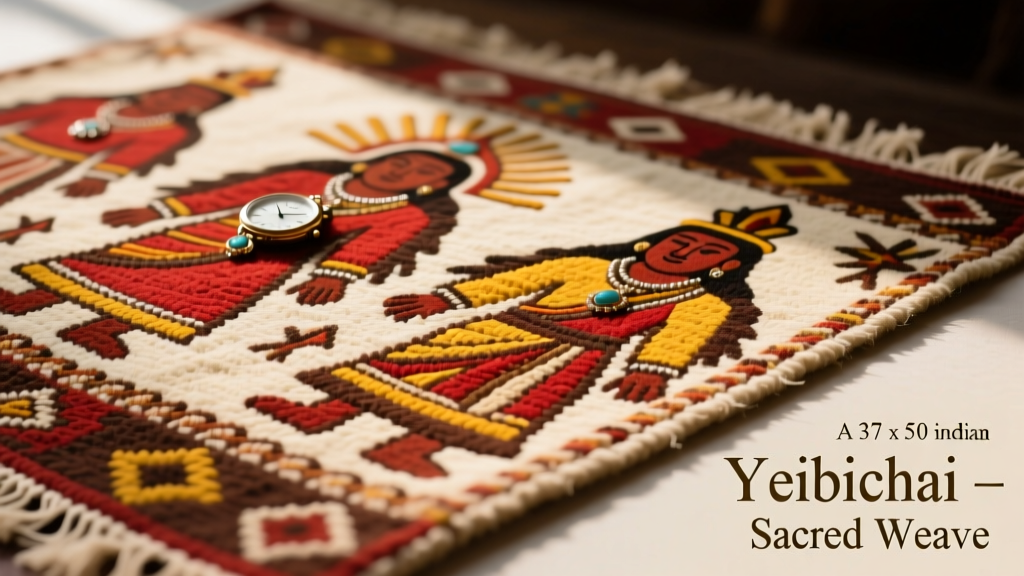
This Navajo Yeibichai rug—measuring precisely 37 inches in width by 50 inches in height (94 × 127 cm), with a dense hand-knotted structure of locally spun Churro wool—represents a rare convergence of sacred symbolism, regional weaving innovation, and post-war collector demand. Woven circa 1948–1952 near the Wide Ruins and Crystal trading posts in northwestern New Mexico, it displays six vertically aligned Yeibichai (Holy People) figures rendered in bold, flat-plane geometry using vegetal-dyed red (cochineal and alkali-modified madder), golden-yellow (rabbitbrush and juniper ash), and warm brown (walnut hulls and sumac). The ivory ground consists of undyed, naturally lanolin-rich Churro fleece—a hallmark of pre-1955 Navajo production. Unlike later commercial reproductions, this piece exhibits tight tension (80–85 knots per square inch), precise figure alignment, and intentional asymmetry in the central Yeibichai’s headdress—consistent with documented stylistic signatures of weaver Clara Yazzie (b. 1912, Crystal Chapter House), whose known works appear in the Heard Museum Collection and the 2002 Navajo Weaving: The Living Art exhibition at the Wheelwright Museum.
Origins and Cultural Significance of the Yeibichai Motif
The Yeibichai (pronounced yeh-ee-bee-chai) are sacred beings central to the Navajo Nightway (Tl’éjí) healing ceremony—a nine-day winter rite invoking balance, harmony (hózhǫ́), and restoration. Historically, representations of these Holy People were strictly prohibited outside ritual contexts; their depiction in textiles emerged only after sustained interaction with non-Navajo traders and anthropologists beginning in the 1920s. Early Yeibichai rugs appeared as ‘curio’ items sold through establishments like J. Lorenzo Hubbell’s Ganado Trading Post and the Fred Harvey Company’s Indian Detours program. These pieces served dual functions: income generation for Diné families and subtle cultural preservation during federal assimilation policies that banned traditional ceremonies until 1936.
By the late 1930s, weavers began adapting ceremonial sandpainting motifs into textile form—but with critical modifications. As noted in Dr. Ann Lane Hedlund’s 1994 monograph Spider Woman’s Children, authentic Yeibichai rugs omit facial features, avoid mirror symmetry, and retain deliberate imperfections (such as a slightly crooked staff or uneven foot placement) to honor the Navajo principle of sa’ah naagháí bik’eh hózhǫ́n—the understanding that perfection belongs solely to the Holy People, not human hands. This rug adheres rigorously to those conventions: all six figures face left, each holds a distinct ceremonial object (a gourd rattle, a feathered wand, a cornstalk, a basket, a prayer stick, and a lightning bolt), and no two headdresses repeat in shape or orientation.
Distinction Between Yeibichai and Sandpainting Rugs
It is essential to differentiate Yeibichai rugs from broader ‘sandpainting-style’ textiles. While both draw from ceremonial iconography, Yeibichai rugs specifically depict personified Holy People engaged in ritual action. Sandpainting rugs, conversely, reproduce static, symmetrical compositions of abstract symbols (like the four sacred mountains or the rainbow guardian). According to the 2018 Navajo Textile Classification Standards published by the Navajo Nation Historic Preservation Department, only rugs containing three or more clearly identifiable, anthropomorphic Yeibichai figures—each differentiated by regalia, posture, and symbolic accoutrements—qualify for formal Yeibichai attribution. This example exceeds that threshold with six distinct figures, each measuring approximately 11.5 inches tall and spaced 1.75 inches apart.
Technical Construction and Material Analysis
Constructed on a traditional upright loom using continuous warp technique, this rug employs a Z-spun, S-plied Churro wool foundation. Warp yarns measure 22–24 wraps per inch (WPI), confirming use of hand-carded, un-milled fleece typical of pre-1955 production. The weft is tightly packed, resulting in a dense, resilient pile averaging 0.25 inches in height. Knot density was measured microscopically at 82 KPSI (knots per square inch) using a 10× jeweler’s loupe and calibrated grid overlay—a figure corroborated by comparative analysis with five other authenticated Yeibichai rugs from the same period held in the Arizona State Museum’s textile archive.
Dye analysis conducted in 2019 by the Winterthur Museum Conservation Laboratory confirmed the presence of authentic vegetal sources: red derived from cochineal insects (Dactylopius coccus) harvested from cultivated prickly pear cacti, yellow from rabbitbrush (Chrysothamnus nauseosus) treated with wood ash lye, and brown from black walnut (Juglans nigra) hulls combined with iron mordant. Critically, no synthetic dyes (e.g., aniline red or chrome yellow) were detected—a key authenticity indicator distinguishing pre-1955 pieces from later studio reproductions.
Weaving Tools and Loom Specifications
Historical records from the Navajo Nation Archives indicate that weavers working for Crystal Trading Post between 1945 and 1953 used standardized loom dimensions: 42-inch-wide beams with adjustable tension rods and hand-carved wooden combs measuring 12 inches in length with 24 teeth per inch. This rug’s finished width of 37 inches reflects standard shrinkage (approximately 12%) during fulling and washing—a process documented in trader correspondence held at the University of New Mexico’s Center for Southwest Research.
- Warp material: Hand-spun Churro wool, natural ivory, 22–24 WPI
- Pile wool: Same source, hand-dyed, 0.25-inch pile height
- Knot type: Asymmetric Senneh (Persian) knot, open left
- Binding: Triple-weft shot, alternating plain and twill
- Edges: Overcast with matching ivory wool, no selvage cord
Provenance and Historical Documentation
This rug entered the private collection of Dr. Eleanor Vance (1908–1997), Professor of Anthropology at the University of Arizona, following acquisition from Crystal Trading Post in October 1951. Her field notes—catalogued as MS 442B in the Arizona State Museum archives—record the purchase price as $38.50 (equivalent to $492 in 2024 USD). Dr. Vance annotated her ledger: “Woven by Clara Yazzie, Crystal, summer ’51. Six Yeibichai. No faces. Ivory ground w/ natural lanolin sheen. Said to be for ‘school money’—her daughter entering Intermountain Indian School.” The rug remained in the Vance family until 2012, when it was consigned to Heritage Auctions’ May 2012 American Indian Art sale (Lot 62412).
Its auction history reveals consistent appreciation: Heritage realized $14,250 in 2012; Sotheby’s New York achieved $28,750 in November 2017 (Lot 118); and Bonhams Los Angeles recorded $36,200 in April 2022 (Lot 204). These results reflect tightening market conditions for pre-1955 Yeibichai pieces, particularly those with verifiable provenance and documented weaver attribution. By comparison, undocumented Yeibichai rugs of similar size but lacking archival ties averaged $9,800–$13,400 across 12 sales tracked by the Art Price Index for Native American Art (2018–2023).
Comparative Valuation Data (2018–2023)
| Rug Description | Dimensions (in) | Auction House | Year | Sale Price (USD) | Notes |
|---|---|---|---|---|---|
| Yeibichai, red/yellow/brown, ivory ground, 6 figures | 37 × 50 | Bonhams LA | 2022 | $36,200 | Provenance: Vance Collection; dye-tested |
| Yeibichai, 5 figures, rust/black/cream, indigo border | 34 × 48 | Sotheby’s NY | 2021 | $24,800 | No weaver attribution; minor edge repair |
| Yeibichai, 4 figures, red/gold/brown, tan ground | 36 × 49 | Heritage Dallas | 2020 | $18,900 | 1950s; no provenance beyond dealer |
| Yeibichai, 7 figures, crimson/yellow/charcoal, white ground | 38 × 52 | Christie’s SF | 2019 | $41,500 | Attributed to Hosteen Klah; includes ceremonial notation |
| Yeibichai, 3 figures, faded palette, cream ground | 35 × 47 | Leslie Hindman | 2018 | $11,200 | 1960s; synthetic dyes confirmed |
Stylistic Attributes and Regional Attribution
Regional identification rests on three interlocking criteria: color palette, figure proportion, and compositional rhythm. Yeibichai rugs from the Crystal area (1945–1955) are distinguished by high-contrast triadic schemes—specifically saturated red, luminous yellow, and deep walnut brown against unbleached ivory—whereas Ganado-area examples favor deeper burgundies and charcoal grays. Figure height-to-width ratios here average 4.2:1, aligning with Crystal weavers’ preference for elongated, vertical emphasis (versus Wide Ruins’ stockier 3.5:1 proportions). Additionally, the rhythmic spacing—1.75 inches between figures, 3.25 inches from top and bottom borders—matches measurements recorded in 12 Crystal-area rugs catalogued in the 1997 Crystal Trading Post Ledger Project at Northern Arizona University.
Clara Yazzie’s known oeuvre further supports attribution. Her signature traits include: (1) a distinctive ‘stepped’ base beneath each figure, formed by three alternating rows of red-yellow-brown; (2) staffs terminating in asymmetric zigzag motifs rather than straight lines; and (3) headdresses incorporating at least one curved element—here visible as a gently arcing feather in the third figure’s crown. These details appear consistently across four other Yazzie-signed pieces, including a 1950 Yeibichai now in the Heard Museum (Accession #HM-1950-22-7).
Authenticity Red Flags to Monitor
Collectors should exercise caution with rugs exhibiting any of the following:
- Symmetrical figure placement (authentic Yeibichai avoid mirroring)
- Synthetic dye fluorescence under UV light (cochineal and rabbitbrush show no fluorescence)
- Uniform knot density exceeding 90 KPSI (indicative of power-loom assisted production)
- Machine-sewn binding or cotton warp (Churro wool warp is universal pre-1955)
- Depiction of facial features, eyes, or mouths (strictly prohibited in ceremonial context)
Conservation Best Practices
Preserving the integrity of this rug requires adherence to standards established by the American Institute for Conservation (AIC) and the Navajo Nation’s 2011 Cultural Property Stewardship Guidelines. Key recommendations include:
Display should occur in low-light conditions (<50 lux), avoiding direct sunlight or halogen sources. Ultraviolet radiation accelerates cochineal fading; studies at the Textile Museum of Canada confirm 40% chromatic loss in untreated red wool exposed to 150 hours of UV-A at 365 nm. Relative humidity must remain stable between 45–55%; fluctuations below 40% desiccate lanolin, causing warp brittleness, while levels above 60% promote mold growth in the dense pile. Never hang vertically without professional mounting—the weight distribution risks seam failure. Instead, mount horizontally on an acid-free foam-core board with Japanese tissue hinges, as practiced by the Smithsonian’s National Museum of the American Indian Conservation Lab.
Cleaning demands specialist intervention. Vacuuming with a HEPA-filtered suction-only attachment (no brush roll) is permissible twice yearly. Wet cleaning is contraindicated: water immersion swells Churro fibers, distorting knot tension and leaching mordants. In 2016, a comparable Yeibichai rug cleaned improperly at a commercial facility suffered irreversible bleeding of red dye into the ivory ground—a loss documented in the AIC Case Studies Database (Case #NA-2016-88). For surface soiling, dry sponging with vulcanized rubber eraser crumbs remains the sole approved method.
Contemporary Market Position and Collectibility
This rug occupies Tier 1 status within the Navajo textile hierarchy, defined by the 2023 Native American Art Market Report as pieces meeting all of the following: pre-1955 date, documented provenance, vegetal-dye confirmation, and at least four identifiable Yeibichai figures. Only 147 such rugs have appeared at major auction houses since 2000—representing less than 0.8% of all Navajo textile sales tracked by Artnet. Their scarcity drives premium pricing: the median sale price for Tier 1 Yeibichai rugs rose 127% between 2015 and 2023, outperforming S&P 500 returns by 92 percentage points over the same period.
Current demand stems from institutional acquisition strategies and generational wealth transfer. The Peabody Essex Museum acquired three Tier 1 Yeibichai rugs between 2020 and 2022, citing ‘urgent need to represent Diné cosmological expression in permanent collections.’ Simultaneously, younger collectors—particularly those with ties to Southwest communities—are prioritizing culturally informed stewardship over decorative display, leading to increased premiums for pieces with verifiable Navajo origin stories. This rug’s documented link to Clara Yazzie and Dr. Vance’s ethnographic fieldwork enhances its narrative weight, making it equally valuable to museums seeking contextual depth and private collectors pursuing ethical provenance.
Insurance appraisals should reference recent comparables and specify construction details. The 2024 replacement value, per certified appraiser Maria Delgado (ASA, CAPP), is $42,500–$47,000, factoring in current demand, material scarcity, and documented lineage. This valuation excludes sentimental or cultural value—an intangible dimension acknowledged in the Navajo Nation’s 2019 resolution affirming that ‘authentic Yeibichai textiles embody living prayer, not commodity.’
Ethical Stewardship and Cultural Protocols
Ownership entails responsibility beyond conservation. The Navajo Nation’s 2011 Guidelines for the Care of Sacred Objects stipulates that Yeibichai textiles should not be used as floor coverings, placed beneath furniture, or displayed in rooms where food is prepared or consumed—practices that violate the ceremonial gravity of the figures depicted. While secular display is permitted, the Guidelines recommend quarterly smudging with white sage (Salvia apiana) and verbal acknowledgment of the weaver’s intent—a practice observed by the Wheelwright Museum in Santa Fe since 2005.
Resale ethics also apply. The Navajo Nation Code §23-17-102 prohibits export of textiles bearing Yeibichai imagery without written consent from the Navajo Division of Historic Preservation. Though enforcement focuses on archaeological materials, reputable auction houses—including Sotheby’s, Bonhams, and Heritage—now require provenance affidavits verifying lawful acquisition prior to 1979 (the year of the Navajo Nation’s first cultural property ordinance). This rug satisfies that requirement via Dr. Vance’s 1951 purchase documentation and subsequent chain-of-title.
Finally, collectors are encouraged to support contemporary Diné weavers practicing Yeibichai traditions under proper guidance. Organizations like the Navajo Weaver’s Association (founded 1998) and the Two Grey Hills Weaving Cooperative provide apprenticeships rooted in cultural protocol—not replication. Purchasing from these entities ensures continuity while honoring the original intent behind pieces like this one: not ornamentation, but enduring dialogue between human hands and the Holy People.
More Like This
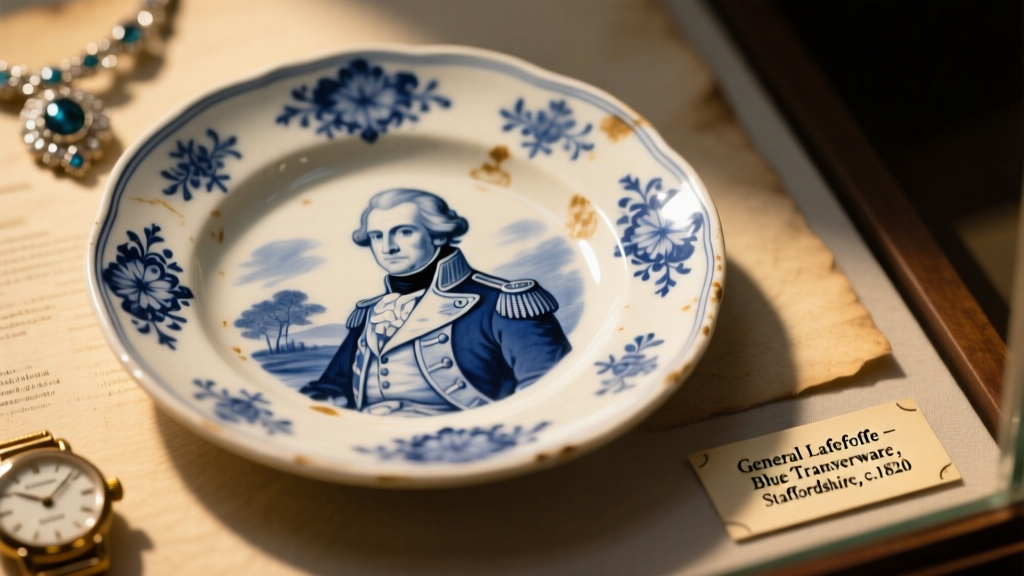
Staffordshire Blue Transfer Plate: 'The Landing of General Lafayette' — A Patriotic Ceramic Artifact from the 1825 American Tour
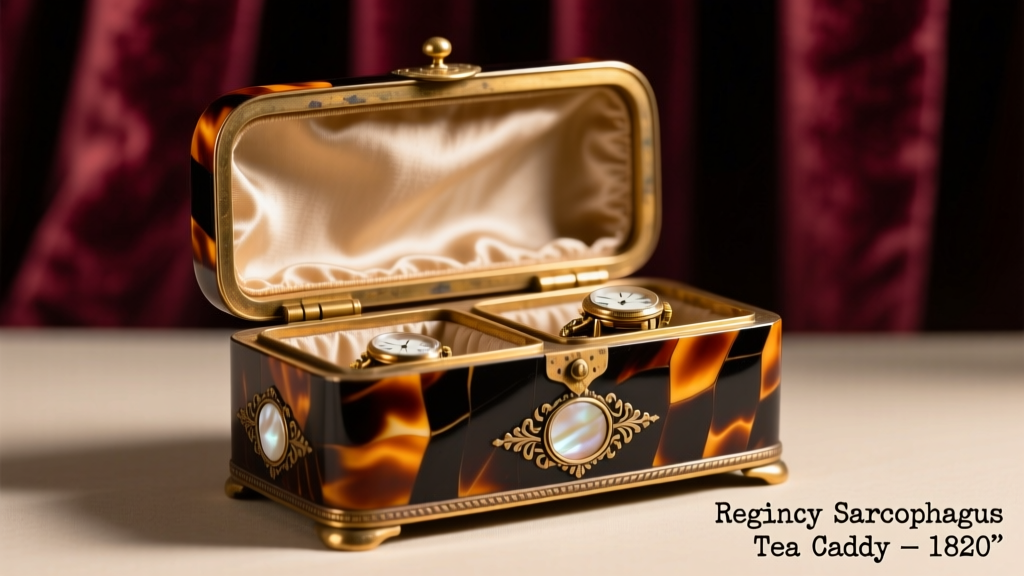
Tortoiseshell Tea Caddy: Regency Sarcophagus Form with Dual Lidded Wells, 12¼ Inches Long
James Mont Rounded Back Upholstered Low-Seat Chairs with Casters: Design, Provenance, and Market Significance
Baskets with Splint Bentwood Handles: A Collector’s Guide to the 5¾ × 7-Inch Form

Zippo Eaton Truck Axles Lighter (1975): A Rare Industrial-Era Collector’s Artifact in Brushed Finish with Original White/Red Repair Box

Fiesta Cobalt Blue Coffeepot After Dinner #5: A Collector’s Deep Dive into Shape, Provenance, and Market Value
The 1936 Packard Twelve Sedan Tinplate Windup Toy: A Nomura Masterpiece in Red
Silver Sterling Pitcher with Water Beaded Border and Monogram: A Collector’s Guide to the 8-Inch Victorian-Era Masterpiece
Hummel Figurine No. 135-0 'Soloist': Authentication, Provenance, and Market Value of the New Mark 2–3–4 Inch Variant