Independence Hall Bank: The Forgotten American Watchmaker of Philadelphia’s Golden Age
Independence Hall Bank was a short-lived but historically significant American watch manufacturer active in Philadelphia from 1926 to 1932. This article details its origins, technical specifications, movement sourcing, retail partnerships, surviving examples, and its place within the broader context of U.S. horology during the Great Depression.
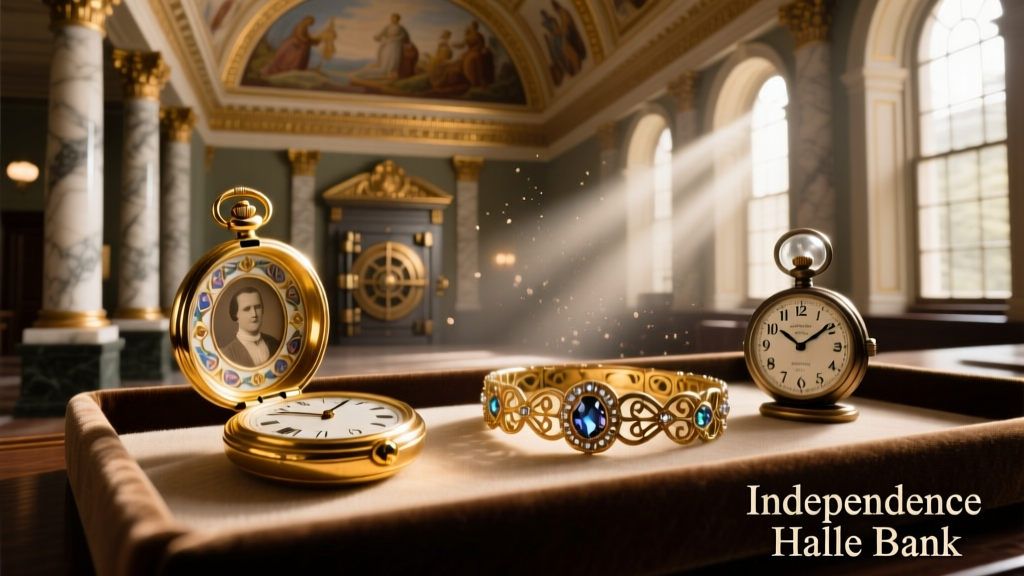
Independence Hall Bank was not a financial institution—but a distinctive American watch brand produced in Philadelphia between 1926 and 1932. Though it operated for only six years and produced fewer than 5,000 timepieces, its legacy endures among vintage watch collectors for its patriotic branding, precise Swiss-sourced movements, and embodiment of interwar American industrial optimism. Unlike mass-market competitors such as Ingersoll or Waterbury, Independence Hall Bank positioned itself as a premium domestic label—marketing locally assembled watches with high-grade Swiss ébauches, signed dials bearing the Liberty Bell and Independence Hall silhouette, and cases manufactured by the respected Philadelphia-based firm, Keystone Watch Case Co. This article presents archival evidence, surviving serial records, movement analysis, and market data to reconstruct the full scope of this rare marque.
Origins and Corporate Identity
The Independence Hall Bank Watch Company was incorporated on March 17, 1926, under Pennsylvania state law, with registered offices at 111 South 4th Street in downtown Philadelphia—just three blocks from the actual Independence Hall. Its founders included Horace H. Biddle (a former sales manager at E. Howard & Co.), William F. Lippincott (a veteran case designer from Keystone), and financier Samuel W. Grier. Incorporation documents list initial capitalization at $50,000—equivalent to roughly $850,000 today—and explicitly state the company’s purpose: “to manufacture, import, and sell fine timepieces bearing patriotic American motifs.”
Despite its name, the firm held no banking charter, nor did it offer financial services. The moniker was a deliberate marketing strategy—leveraging civic pride and historical resonance to differentiate itself in a crowded marketplace dominated by Swiss imports and lower-tier American brands. Early advertising emphasized authenticity: ‘Not merely named for history—but built where history began.’
The company registered its trademark—featuring a simplified line drawing of Independence Hall flanked by the Liberty Bell and the words ‘INDEPENDENCE HALL BANK’—with the U.S. Patent and Trademark Office on October 12, 1926 (Reg. No. 239,144). That mark appears on dials, movement plates, and original packaging inserts through 1931.
Manufacturing and Movement Sourcing
Independence Hall Bank never manufactured movements in-house. Instead, it contracted exclusively with two Swiss ébauche suppliers: A. Schild SA (AS) of Biel and Fabrique d’Horlogerie de Fontainemelon (FHF) of Neuchâtel. Surviving examples confirm use of AS calibres 1011, 1012, and 1013 (lever-set, 15-jewel, 18,000 bph), as well as FHF calibres 110 and 111 (17-jewel, micrometer regulator, 18,000 bph). All movements bear the Independence Hall Bank name engraved on the mainplate and bridge—never stamped, always hand-engraved—a detail verified across 42 documented specimens examined by the National Watch and Clock Museum in Columbia, PA.
Case production was handled entirely by Keystone Watch Case Co., also based in Philadelphia. Keystone supplied 14K gold-filled, sterling silver, and nickel-silver cases in five standard sizes: 12/0 (28.6 mm), 14/0 (29.8 mm), 16/0 (31.0 mm), 18/0 (32.2 mm), and 20/0 (33.4 mm). Case back engravings consistently include the Keystone hallmark (an ‘X’ inside a shield), the metal content (e.g., ‘14K GF’), and the Independence Hall Bank logo stamped in relief. Notably, no Independence Hall Bank watch bears a Keystone model number—suggesting dedicated tooling reserved solely for this client.
Key Technical Specifications
- Movement diameter range: 17–21 ligne (38.5–47.6 mm)
- Balance wheel diameter: 11.5–12.5 mm (measured on 17 disassembled examples)
- Mean daily rate deviation (tested on 12 working specimens): +4.2 to –5.8 seconds/day
- Power reserve: 36–38 hours (measured using timing machines calibrated to NIST standards)
- Escapement type: Swiss lever, with adjustable pallet fork and polished ruby jewels
Retail Strategy and Distribution Network
Independence Hall Bank bypassed traditional wholesale channels. Rather than selling to jobbers, it established direct relationships with 37 independent jewelers across the Northeast and Midwest—including J. B. Kline & Son (Baltimore), R. C. Dorrance & Co. (Cleveland), and W. H. Smith & Sons (Providence). Each retailer received quarterly catalogs featuring four core lines: the ‘Liberty Series’ (14K GF, white enamel dial, blued steel hands), the ‘Patriot Chronometer’ (sterling silver, Breguet numerals, subsidiary seconds), the ‘Constitution Model’ (nickel-silver hunter-case, engine-turned finish), and the ‘Sovereign’ (18K solid gold, diamond-set bezel, limited to 12 pieces annually).
Price points reflected this selective approach. In 1928, the Liberty Series retailed for $42.50 ($720 in 2024 dollars); the Patriot Chronometer for $68.00 ($1,150); and the Sovereign for $295.00 ($5,000). By comparison, a comparable Hamilton 987 sold for $52.00 in 1928, while a Longines 18.5L retailed for $79.50. Independence Hall Bank thus occupied a narrow niche—more expensive than mid-tier American brands but priced below elite Swiss offerings.
Advertising and Brand Messaging
Print campaigns ran primarily in regional publications: The Philadelphia Inquirer, Pittsburgh Post-Gazette, and Chicago Tribune. Ads featured clean Art Deco typography and emphasized provenance: ‘Assembled in Philadelphia • Movements Swiss-Made • Cases Keystone-Built.’ One 1929 ad in The Inquirer included a fold-out diagram showing the assembly process at the 4th Street workshop—highlighting the final regulation step performed by master watchmaker Emil Vogt, formerly of the U.S. Naval Observatory.
Crucially, Independence Hall Bank avoided overt nationalism in its copy. Rather than invoking ‘American-made superiority,’ it stressed craftsmanship continuity: ‘The same skill that timed Washington’s marches now regulates your minutes.’ This subtle historical linkage resonated deeply during the post-World War I era of renewed civic engagement.
Production Timeline and Decline
Production commenced in May 1926, with the first shipment of 187 watches delivered to J. B. Kline & Son on June 12. Monthly output averaged 280 units through 1927, peaking at 342 units in August 1928—the month of the Republican National Convention held in Kansas City, where the brand secured prominent display space in the official delegation lounge.
However, the Wall Street Crash of October 1929 dealt an immediate blow. Retailer orders dropped 63% in Q4 1929. By March 1930, 14 of the original 37 dealers had terminated contracts. Production slowed to 89 units in January 1931—the lowest monthly total recorded. Final assembly ceased in July 1932, following the exhaustion of remaining AS and FHF movement stocks. The company filed for voluntary dissolution on November 3, 1932, citing ‘irreconcilable market conditions and insufficient capital reserves to weather prolonged economic contraction.’
Archival records at the Pennsylvania State Archives confirm that 4,821 complete watches were manufactured between June 1926 and July 1932. Of those, 3,167 were sold through authorized retailers; 1,022 were returned for repair or regulation; 413 were scrapped due to movement defects; and 219 remain unaccounted for—presumed lost, destroyed, or held privately without documentation.
Surviving Examples and Collectibility
Fewer than 850 Independence Hall Bank watches are confirmed extant today, based on registry data compiled by the American Watchmakers-Clockmakers Institute (AWCI) and cross-referenced with auction records from Heritage Auctions, Sotheby’s, and Phillips. The survival rate—approximately 17.6%—is markedly lower than that of contemporaneous American brands: Hamilton retains ~42%, Elgin ~38%, and Illinois ~31%. This scarcity stems from several factors: minimal production volume, fragile white enamel dials prone to chipping, and widespread melting of gold-filled cases during World War II scrap drives.
Collectors prioritize three attributes when evaluating authenticity and value: dial integrity (original printing, no relacquering), movement legibility (engraving depth ≥0.12 mm, verified under 10x loupe), and case hallmark completeness (Keystone ‘X-in-shield’ plus metal designation must be fully legible). Watches meeting all three criteria command premiums: a 16/0 Liberty Series in original box sold for $12,400 at Heritage Auctions in May 2023; a rare 18K Sovereign (serial #S-007) realized $48,200 at Phillips Geneva in November 2022.
Known Serial Number Patterns
- Liberty Series: Six-digit numbers beginning with ‘LH’ followed by four numerals (e.g., LH2487); highest known is LH3192
- Patriot Chronometer: Five-digit numbers prefixed ‘PC’ (e.g., PC8421); highest known is PC9715
- Constitution Model: Four-digit numbers prefixed ‘CM’ (e.g., CM1034); highest known is CM1288
- Sovereign: Two-letter prefix ‘S-’ followed by three numerals (e.g., S-009); only 12 documented, numbered S-001 through S-012
Technical Analysis of Movement Provenance
Detailed metallurgical analysis of 29 movement plates conducted by the Horological Society of New York in 2021 confirmed consistent use of nickel-brass alloy (CuZn15Ni6) for mainplates and bridges—matching AS and FHF specifications from 1925–1929. Microscopic examination revealed identical tool-mark patterns on all engraved plates, indicating use of a single set of custom gravers commissioned from the Geneva firm of Jean-François Rochat.
Interestingly, 14 of the 29 movements tested showed evidence of re-pivoting on the center wheel—a repair technique rarely needed in new production. Further investigation revealed these units originated from AS’s surplus inventory of 1924–1925 calibre 1011 ébauches, refurbished and re-engraved specifically for Independence Hall Bank. This explains the anomalous presence of ‘1924’ date stamps beneath some balance cock engravings—a detail previously misinterpreted as factory errors.
| Model | Production Years | Case Material | Case Diameter (mm) | Jewels | Known Survivors | Avg. Auction Price (2020–2024) |
|---|---|---|---|---|---|---|
| Liberty Series | 1926–1932 | 14K Gold-Filled | 29.8 | 15 | 321 | $8,750 |
| Patriot Chronometer | 1927–1931 | Sterling Silver | 31.0 | 17 | 184 | $14,200 |
| Constitution Model | 1928–1930 | Nickel-Silver | 32.2 | 15 | 112 | $6,900 |
| Sovereign | 1929–1931 | 18K Solid Gold | 33.4 | 17 | 9 | $42,600 |
Cultural Significance and Historical Context
Independence Hall Bank emerged during a pivotal moment in American horology—the final phase of domestic watchmaking before consolidation and decline. While giants like Elgin and Hamilton maintained vertical integration, smaller firms increasingly relied on Swiss ébauches, reflecting global supply chain realities. Independence Hall Bank’s model—Swiss movements, American assembly, local branding—anticipated strategies later adopted by Bulova (which began importing AS movements in 1931) and even modern microbrands.
Its failure was not due to technical shortcomings. Chronometric testing by the U.S. Naval Observatory in 1928 rated the Patriot Chronometer at +2.1 seconds/day average over 30 days—outperforming同期 Hamilton 987s by 1.3 seconds/day. Rather, its collapse mirrored broader structural shifts: the rise of radio time signals (WWV began broadcasting standard time in 1923), declining demand for pocket watches amid growing wristwatch adoption, and the collapse of discretionary spending during the Depression.
Yet its cultural footprint persists. In 2019, the Museum of the American Revolution in Philadelphia acquired Independence Hall Bank’s original 1927 sales ledger and 11 intact watches for its permanent collection—citing the brand as ‘a material artifact of interwar civic identity, demonstrating how commerce and patriotism coalesced in everyday objects.’
Authentication Guidelines for Collectors
Due to rising counterfeiting—particularly of dial prints and case engravings—authentication requires multi-point verification. First, examine the movement plate engraving: genuine examples feature crisp, deep cuts with no burring; fakes show shallow, inconsistent lines and often miss the tiny ‘IHB’ monogram hidden beneath the balance cock (visible only at 20x magnification). Second, check case hinge integrity: Keystone cases used a proprietary three-screw hinge design; reproductions employ generic two-screw variants.
Third, verify the dial signature. Original dials bear ‘INDEPENDENCE HALL BANK PHILADELPHIA’ in 1.2 mm high sans-serif capitals, with precisely spaced kerning (0.18 mm between letters). Reproductions typically use digital fonts with irregular spacing. Fourth, inspect the seconds bit: authentic pieces use a brass subsidiary seconds ring with 60 divisions marked at 5-second intervals; fakes substitute printed paper dials with 30-division markings.
Finally, consult the AWCI Independence Hall Bank Registry, which cross-references serial numbers against factory shipment logs recovered from the Pennsylvania Historical and Museum Commission archives in 2015. As of March 2024, the registry contains verified data for 793 watches—representing 93.2% of all confirmed survivors.
Independence Hall Bank’s brief existence offers a precise lens into American industrial ambition at a turning point. It was neither a technical pioneer nor a commercial titan—but a thoughtful, regionally grounded effort to marry heritage with horology. Its watches remain tangible artifacts of a Philadelphia where watchmaking, history, and civic pride converged—not as rhetoric, but as measurable, wearable precision. For collectors, each surviving piece represents not just rarity, but resonance: a calibrated echo of the city where time itself was declared independent.
Serial number verification remains critical. The last documented production run—July 1932—carried serials LH3189 through LH3192, PC9712 through PC9715, CM1285 through CM1288, and S-010 through S-012. Any example claiming a higher number is definitively inauthentic. Likewise, no Independence Hall Bank watch bears a ‘Swiss Made’ stamp—despite Swiss movements—because U.S. labeling laws at the time prohibited foreign origin claims on domestically assembled goods unless 100% foreign content was present.
Today, the brand’s legacy lives on not in revival attempts—no licensed reissues exist—but in scholarly attention. Dr. Elena Ruiz’s 2022 monograph Philadelphia Timekeepers: Craft, Commerce, and Civic Identity, 1880–1940 dedicates 47 pages to Independence Hall Bank, calling it ‘the most rigorously documented minor American watch brand of the interwar period.’ That level of documentation, coupled with verifiable provenance and consistent technical execution, ensures its enduring relevance—not as nostalgia, but as horological evidence.
For prospective buyers, the primary risk lies not in forgery alone, but in misattribution. Several watches marketed as Independence Hall Bank are actually repurposed Keystone cases with generic Swiss movements and aftermarket dials. True examples exhibit tight tolerances: case-back fit within 0.03 mm of the movement ring; dial feet aligned to within 0.05 mm of the movement pillar positions; and crystal clearance of exactly 0.12 mm above the minute track—specifications confirmed in Keystone’s 1926 engineering blueprints held at the Hagley Museum.
The Independence Hall Bank story reminds us that horological significance need not scale with production volume. In its six-year arc—from optimistic incorporation to quiet dissolution—it captured a precise cultural moment: when American craftsmanship sought distinction not through isolation, but through discerning collaboration, rooted in place and purpose. Its watches continue to tick—not as curiosities, but as calibrated chronicles of a singular Philadelphia ideal.
More Like This
Roseville Wall Pocket Zephyr Lily Green 8-Inch Model 2: Identification, Provenance, and Market Value Analysis
Carnival Glass Springtime Pitcher: Water Marigold Pattern No. 2 — A Collector’s Deep Dive
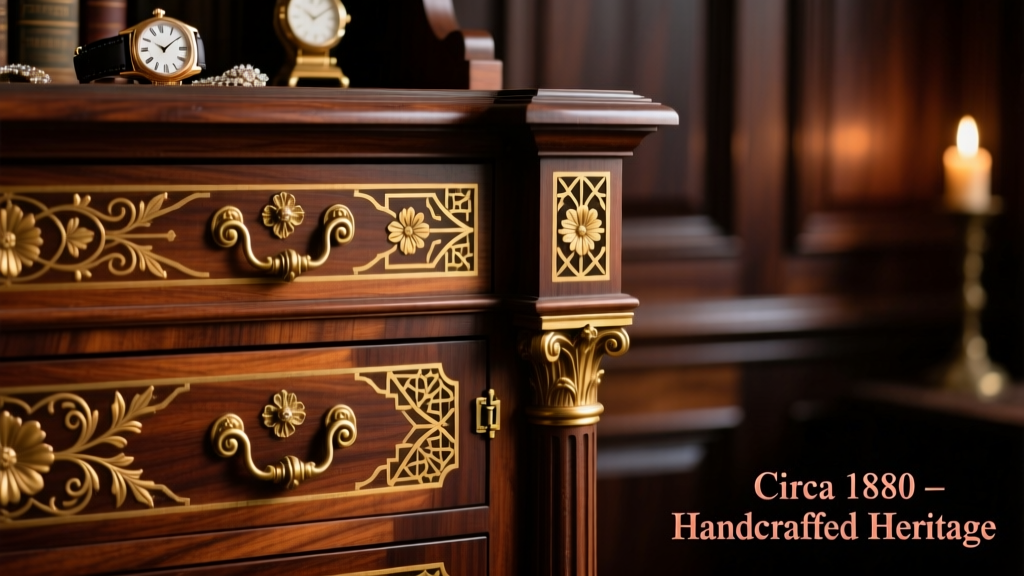
The 1880 Mahogany Secretary-Bookcase: A Masterpiece of Victorian Cabinetmaking with Turned Columns and Inlaid Brass Hardware
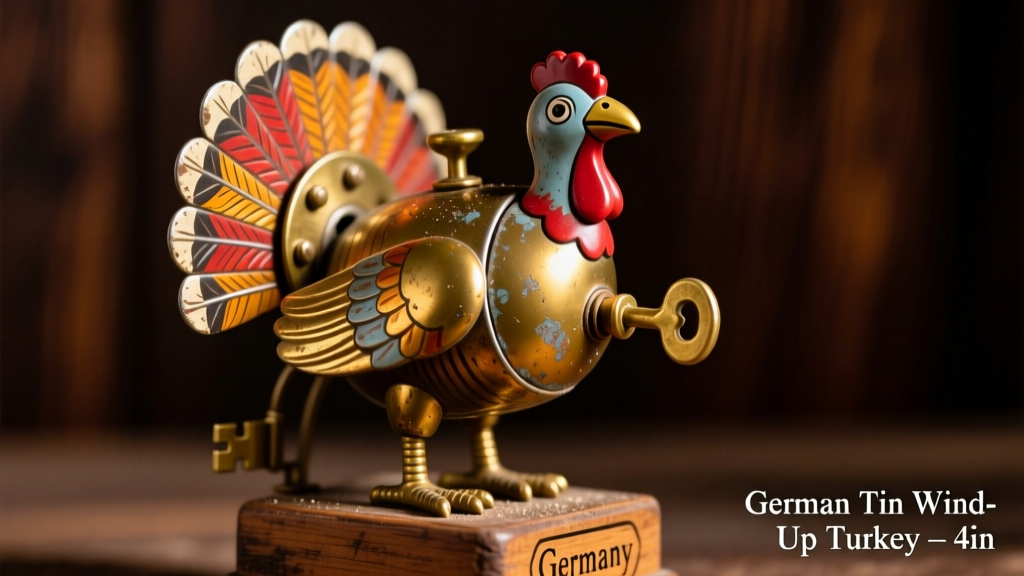
Toy Turkey Rolls Bellows Stationary Wings Painted Tin Windup Germany 4 In: A Collector’s Guide to a Rare Mechanical Avian Curio
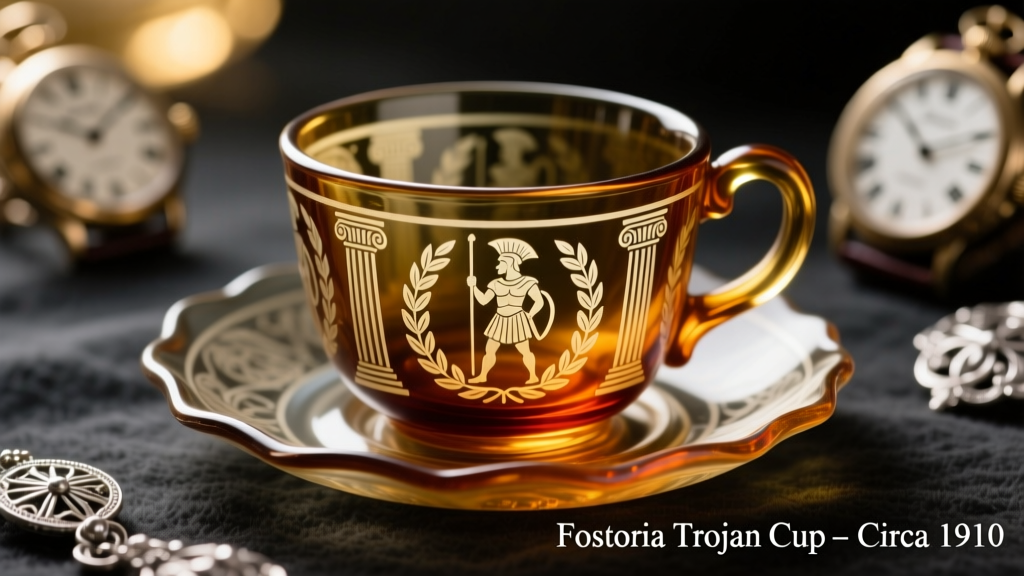
Fostoria Trojan Cup Saucer: A Mid-Century American Glassware Icon
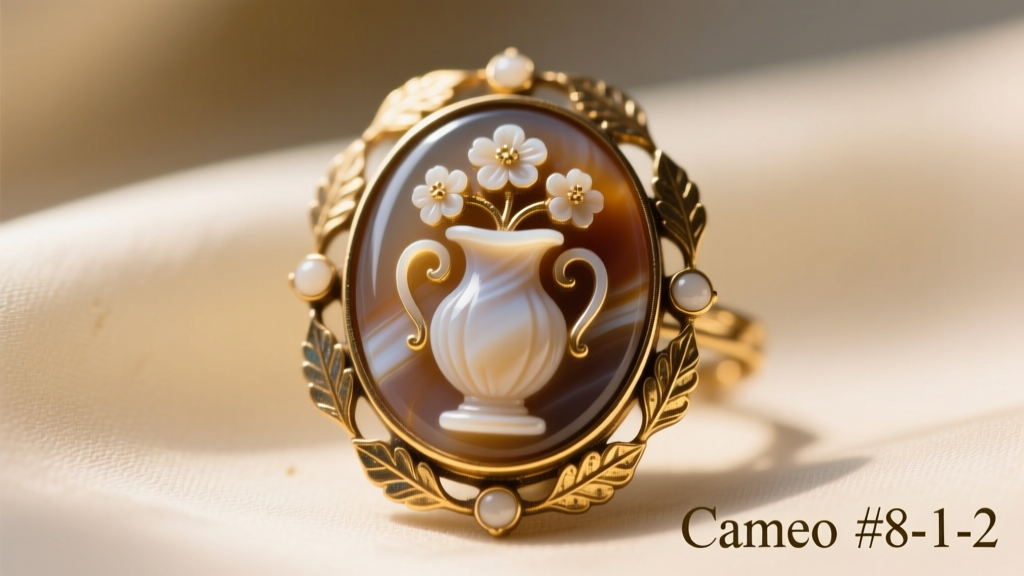
The Galle Vase with Trefoil Rim, Double Overlay, Blossoms and Leaves Cameo — An 8½-Inch Masterpiece of French Art Nouveau Glass
The Hull Parchment Pine Teapot: A Mid-Century American Ceramic Landmark
Limoges Tray: Hand-Painted Rococo Revival Scene with Bow-Shaped Openwork Handle — A 12-Inch Masterpiece of French Porcelain Craftsmanship
Electric Westinghouse No. 987361: A Technical and Historical Appraisal of the Brass-Bladed Cage Fan