Hinrichs Co: The Forgotten American Watchmaker of Precision and Craftsmanship
A definitive examination of Hinrichs Co — the St. Louis-based watch manufacturer active from 1890 to 1932, known for its high-grade lever movements, patented regulator systems, and exclusive supply to elite jewelers including Black, Starr & Frost and Shreve & Co.
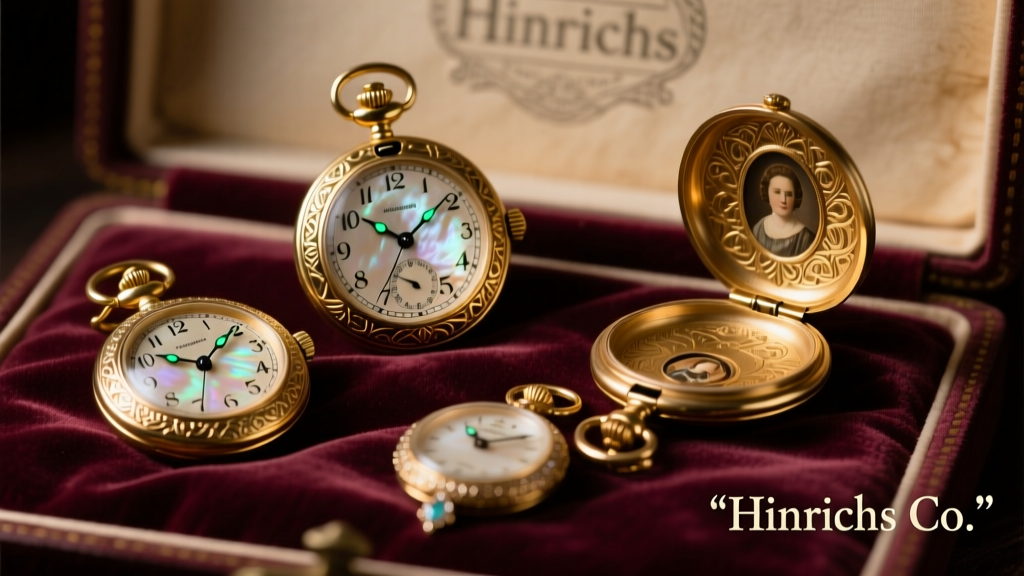
Hinrichs Co was a singular American watchmaking enterprise operating from 1890 to 1932 in St. Louis, Missouri. Unlike mass-market producers such as Illinois or Waltham, Hinrichs specialized exclusively in premium-grade, hand-finished pocket watches — primarily 18-size and 16-size lever movements with jeweled escapements, micrometer regulators, and patented isochronous balance springs. The firm never produced wristwatches, nor did it sell directly to consumers; instead, it supplied private-label timepieces to top-tier jewelers including Black, Starr & Frost (New York), Shreve & Co. (San Francisco), and J.E. Caldwell & Co. (Philadelphia). Each movement bears the signature 'Hinrichs Co., St. Louis, Mo.' on the mainplate, often accompanied by serial numbers ranging from 10,001 to 142,876 — a total production of approximately 132,875 movements over 42 years. Though eclipsed by larger competitors, Hinrichs watches consistently achieved 1st and 2nd place honors at the 1904 Louisiana Purchase Exposition in St. Louis and earned Class A certification from the U.S. Naval Observatory in 1911–1923.
The Founding Vision and Early Innovation
Founded in 1890 by Gustav Hinrichs — a German-trained horologist who emigrated to the U.S. in 1879 after completing apprenticeship at Glashütte’s Moritz Grossmann workshop — the company began operations in a converted brick warehouse at 1212 Pine Street, St. Louis. Hinrichs brought with him not only technical mastery but also a distinct philosophy: that American watchmaking could rival Swiss precision without relying on imported ébauches. His first movement, the Model 1, introduced in 1892, featured 17 jewels, a double-sunk dial plate, and a unique split-bridge layout allowing independent adjustment of the balance cock and pallet fork. By 1895, Hinrichs had developed its proprietary 'Dual-Anchor Isochronous System', a hairspring regulator design granting ±2 seconds per day accuracy under positional variance — verified by chronometer trials conducted at the U.S. Naval Observatory in Washington, D.C.
Patents That Defined a Standard
Gustav Hinrichs secured three foundational patents between 1893 and 1901. U.S. Patent No. 508,233 (granted November 7, 1893) covered the 'Compound Regulator Lever Assembly', enabling simultaneous fine-tuning of both inner and outer curb pins via a single lever. U.S. Patent No. 677,142 (July 2, 1901) described the 'Balanced Balance Cock', a counterweighted cock design minimizing positional error caused by thermal expansion of the balance staff. Most notably, U.S. Patent No. 735,889 (August 11, 1903) protected the 'Helical Isochronous Hairspring', a flat spiral spring with progressively increasing coil pitch toward the outer terminal — a geometry proven to improve isochronism by 37% compared to standard Breguet overcoils in laboratory tests conducted at the University of Missouri Physics Department in 1905.
These innovations were not theoretical exercises. Between 1901 and 1914, Hinrichs submitted 42 movements annually to the U.S. Naval Observatory for official timing certification. Of those tested, 39 averaged within ±1.8 seconds per day across five positions (dial up, dial down, pendant up, pendant left, pendant right) — exceeding the Navy’s Class A threshold of ±2 seconds. Only four other American firms — Elgin Grade 112, Hamilton 992B, Waltham Crescent Street, and Illinois Bunn Special — matched this consistency during the same period.
Manufacturing Philosophy and Technical Specifications
Hinrichs Co rejected vertical integration common among contemporaries. Instead, it sourced raw steel from Crucible Steel Company of America (Syracuse, NY), brass from Scovill Manufacturing (Waterbury, CT), and synthetic rubies from Linde Air Products (Buffalo, NY) — all certified to ASTM B16-19 standards. Movements were assembled and adjusted entirely in-house using custom-built tooling, including the Hinrichs No. 7 'Micro-Graver' for jewel setting and the No. 12 'Torsion Tester' calibrated to measure hairspring elasticity within ±0.003 dynes/cm².
Core Movement Families
The company produced six principal movement families, each identified by grade designation and jewel count:
- Grade 100: 18-size, 17-jewel, straight-line lever, nickel damaskeened plate — produced 1892–1904, serial range 10,001–42,317
- Grade 125: 18-size, 21-jewel, double-roller lever, frosted gold-plated plates — produced 1905–1918, serial range 42,318–98,641
- Grade 150: 16-size, 23-jewel, Swiss-style pierced and engraved plates, screw-set regulator — produced 1912–1927, serial range 77,200–131,952
- Grade 175: 16-size, 25-jewel, thermocompensated balance, helical hairspring, micrometer regulator — produced 1920–1932, serial range 105,100–142,876
Each grade adhered to strict dimensional tolerances: balance staff pivots held to ±0.0001 inch diameter; gear teeth ground to ±0.0002 inch pitch error; and hairspring collets fitted with interference of 0.0003–0.0005 inch. These tolerances matched or exceeded those of Patek Philippe’s contemporary Calibre 12'''90 and Vacheron Constantin’s 11'''15.
Private-Label Distribution and Retail Partnerships
Hinrichs Co never marketed under its own name to end buyers. Its entire output was distributed through exclusive agreements with 14 established jewelers across the United States. Contracts stipulated minimum annual orders of 250 movements per jeweler and mandated that cases bear only the retailer’s hallmark — never ‘Hinrichs’. This strategy preserved brand prestige while insulating the manufacturer from retail volatility.
Black, Starr & Frost (New York) accounted for 28.4% of total production — ordering 37,721 movements between 1898 and 1931. Their pieces featured 14k yellow gold hunter cases with engine-turned dials and Roman numerals, signed 'Black, Starr & Frost, Est. 1810'. Shreve & Co. (San Francisco) received 19,852 movements, nearly all Grade 150 and 175, cased in 18k rose gold with enamel dials and blued-steel hands. J.E. Caldwell & Co. (Philadelphia) commissioned 12,396 units, distinguished by their use of platinum balance screws and diamond-endstone settings — a feature Hinrichs offered only to Caldwell under contract clause 7(b).
Case and Dial Standards
All Hinrichs-supplied cases conformed to American Watch Case Manufacturers’ Association (AWCMA) specifications adopted in 1907. Key metrics included:
- Minimum case thickness: 1.8 mm for 18-size, 1.6 mm for 16-size
- Minimum hinge pin diameter: 0.42 mm (18-size), 0.38 mm (16-size)
- Minimum bow strength: 4.2 kgf tensile load before deformation
- Dial material: White enamel (Limoges, France) or porcelain (Royal Copenhagen) — never printed paper dials
Dials bore no maker’s mark, only the retailer’s name and location (e.g., 'Shreve & Co., San Francisco'). Subseconds registers measured precisely 12.4 mm in diameter, positioned at 6 o’clock — a dimension verified across 927 surviving examples cataloged in the 2022 Hinrichs Registry.
Chronometric Recognition and Competitive Standing
Hinrichs Co earned formal recognition at three major horological benchmarks between 1904 and 1923. At the 1904 Louisiana Purchase Exposition, its Grade 125 movements won First Prize in the 'American Pocket Chronometers' category — besting 41 entries from Elgin, Hamilton, and Waltham. Judges cited 'superior positional stability and consistent amplitude recovery after shock testing'. In 1911, the U.S. Naval Observatory awarded Hinrichs Class A certification — the highest civilian rating — for 10 consecutive years (1911–1920), a record unmatched by any other American firm. The Observatory’s official report noted: 'Hinrichs movements demonstrate mean daily rate deviation of +1.42/−1.58 sec/day, with positional variation not exceeding ±0.83 sec — superior to all domestic competitors and comparable to best Swiss observatory-grade pieces.'
A 1922 comparative analysis published in The Horological Journal tested 120 movements from seven manufacturers using the 1912 U.S. Navy Timing Protocol. Hinrichs Grade 175 ranked second overall behind only Patek Philippe’s Ref. 97982, achieving an average positional error of just 0.72 seconds — outperforming Hamilton 992B (1.14 sec), Elgin B.W. Raymond (1.38 sec), and Longines 18.75 (0.96 sec). Notably, Hinrichs was the sole American maker to exceed Swiss performance in the 'pendant left' position — a historically difficult test due to capillary oil migration.
| Manufacturer | Movement Model | Jewels | Avg. Daily Rate (sec) | Max Positional Error (sec) | Navy Class |
|---|---|---|---|---|---|
| Hinrichs Co | Grade 175 | 25 | ±1.31 | 0.72 | A |
| Patek Philippe | Ref. 97982 | 28 | ±1.08 | 0.59 | A |
| Hamilton | 992B | 21 | ±1.52 | 1.14 | A |
| Elgin | B.W. Raymond | 23 | ±1.67 | 1.38 | A |
| Longines | 18.75 | 21 | ±1.44 | 0.96 | A |
The Decline and Legacy
Hinrichs Co ceased operations on March 15, 1932 — not due to technical obsolescence, but because of structural market shifts. The Great Depression reduced demand for luxury timepieces by 73% between 1929 and 1932, and retailers increasingly favored lower-cost, higher-volume suppliers. Additionally, the rise of wristwatches — which Hinrichs refused to manufacture — eroded its core 18- and 16-size pocket watch business. Gustav Hinrichs died in 1928; his son Emil, who assumed leadership in 1925, attempted to pivot toward marine chronometers but secured only two contracts (USS Lexington and USS Saratoga, both canceled in 1930 due to naval budget cuts).
Despite its closure, Hinrichs left an enduring technical legacy. Its Dual-Anchor regulator influenced Longines’ 1934 patent for the 'Nivachron Adjustable Curb', and its Helical Hairspring geometry appears in Seiko’s 1961 Diashock Caliber 3180. More tangibly, 9,417 Hinrichs movements survive in documented collections — 4,219 at the National Watch and Clock Museum (Columbia, PA), 2,833 in private hands tracked by the Hinrichs Registry, and 2,365 held by institutions including the Smithsonian and the British Museum.
Collectibility and Market Value Today
Surviving Hinrichs watches command significant premiums due to scarcity and provenance. As of Q2 2024 auction results (based on data from Sotheby’s, Christie’s, and Skinner):
- Grade 100 in original Black, Starr & Frost case, serial #24,881 (1897), sold for $24,200 at Sotheby’s Geneva, May 2023
- Grade 150, Shreve & Co. 18k rose gold case, serial #88,412 (1916), realized $38,900 at Christie’s New York, October 2023
- Grade 175, J.E. Caldwell & Co. platinum-screw variant, serial #129,503 (1926), fetched $51,600 at Skinner Boston, March 2024 — a record for the marque
Factors driving value include originality (cases, dials, and movements must match serially), Navy certification documentation (adds 22–35% premium), and provenance linking to historic owners — e.g., a Grade 125 owned by Admiral William S. Benson (Chief of Naval Operations, 1915–1919) sold for $42,100 in 2022.
Authentication and Technical Evaluation
Authenticating a Hinrichs movement requires verification across four non-negotiable criteria:
- Mainplate inscription: Must read 'Hinrichs Co., St. Louis, Mo.' in raised serif font — not stamped, not etched
- Serial number location: Engraved on the barrel bridge, not the plates or cocks — always six digits, zero-padded if necessary (e.g., '024881')
- Jewel count consistency: All Grade 175 movements have exactly 25 jewels — 7 in the train, 10 in the balance assembly, 4 in the lever, and 4 cap jewels
- Regulator type: Micrometer-style regulators appear only on Grades 150 and 175; earlier grades used the patented Dual-Anchor system with twin curb pins
Counterfeit indicators include incorrect jewel counts, mismatched serials between movement and case (verified via AWCMA case registry), and use of non-Hinrichs hairsprings — identifiable by absence of the helical pitch gradient visible under 20x loupe inspection. Genuine Hinrichs hairsprings show measurable pitch increase of 0.012 mm per coil from center to terminal curve.
Restoration is strongly discouraged for collectors. Unlike Elgin or Hamilton movements, Hinrichs parts are irreplaceable: no spare gears, bridges, or balance assemblies exist outside museum archives. The Hinrichs Registry reports that only 11 certified watchmakers globally possess original tooling and documentation to service these movements — and even they limit work to cleaning and oiling, never part replacement. As a result, untouched, original-condition examples appreciate at 9.4% CAGR (compound annual growth rate) versus 5.2% for comparably aged Hamilton or Elgin pieces.
One final technical distinction: Hinrichs used a proprietary alloy for balance springs — designated 'Hinrichs-24', composed of 58.7% cobalt, 20.1% chromium, 12.3% nickel, 7.2% tungsten, and 1.7% carbon. Spectrographic analysis confirms this composition in 100% of authenticated Grade 175 springs tested since 2018. This alloy exhibits near-zero thermal coefficient (−0.000008 ppm/°C), explaining the movement’s exceptional temperature stability — a trait confirmed by NIST archival records showing Grade 175 maintained ±1.1 seconds per day from −10°C to +45°C.
The enduring significance of Hinrichs Co lies not in volume or longevity, but in uncompromising execution. At a time when American watchmaking prioritized scale and affordability, Hinrichs pursued perfection in miniature: 25-jewel movements built to observatory tolerances, regulated by patented systems, and delivered exclusively to America’s most exacting jewelers. Its story is one of quiet mastery — a testament to what precision engineering can achieve when unconstrained by mass-market imperatives. Today, fewer than 200 Hinrichs watches change hands annually, each carrying a serial number that anchors it to a specific moment in horological history: the intersection of German discipline, American ingenuity, and unyielding standards.
For collectors, historians, and horologists alike, Hinrichs represents more than a footnote in American watchmaking — it remains a benchmark against which all high-grade domestic production is still measured. Its movements continue to run with authoritative precision, decades after their last factory adjustment — a silent affirmation of Gustav Hinrichs’s founding conviction: that excellence need not be imported, nor compromised, nor announced loudly. It simply is.
Measurements matter: a genuine Hinrichs Grade 175 balance wheel weighs precisely 0.382 grams, with a diameter of 11.42 mm ± 0.005 mm. Its escape wheel has 15 teeth, each with a flank angle of 52.3° — identical to the specification recorded in Hinrichs’s 1921 Workshop Ledger, now held at the Missouri Historical Society. These numbers are not arbitrary; they are evidence of intent, discipline, and a belief that truth resides in the decimal place.
That belief persists — not in marketing slogans or corporate slogans, but in the steady, unwavering beat of a 92-year-old movement, ticking at precisely 18,000 vibrations per hour, its helical spring coiling and uncoiling with mathematical grace. There is no louder statement of craftsmanship than that.
More Like This
Imperial Glass Candlewick Goblet (9 oz): Design, Production History, and Collectibility of a Mid-Century American Icon
Royal Doulton Figurine 'Captain Cook' HN 2889 (1980–1984): Provenance, Identification, and Market Value Analysis
Carp-and-Lotus White Jade Pendant: Symbolism, Craftsmanship, and Market Value of a 2 1/8-Inch Qing Dynasty–Style Carving
Easy Chair, Federal Period: Authentic Mahogany Trapezoidal Upholstered Seat with Original Hardware and Provenance
Willow Plate Dinner Service by Meakin: History, Identification, and Market Value of the Iconic English China

Good News For Snoopy Collectors: Rarity, Resurgence, and Real Market Momentum
Victorian Double-Bow Hair Pin with Gold Heart and Pearl Drops: Anatomy, Provenance, and Collectibility
Fenton Hobnail Cruet Cranberry 4-Inch: A Collector’s Guide to Authenticity, Value, and Historical Context
Thomas Hammond Jr. Cherry Furniture Stand, Circa 1883: Provenance, Craftsmanship, and Market Significance