Hendrick Avercamp: Master of Dutch Winter Scenes and the Hidden Language of Time in 17th-Century Paintings
A detailed examination of Hendrick Avercamp’s life, technique, and enduring influence—particularly how his meticulously rendered winter landscapes encode precise horological information, reflect contemporary Dutch watchmaking advances, and inform valuation in today’s fine art market.
Hendrick Avercamp (1585–1634) was a pioneering Dutch Golden Age painter whose icy, animated winter scenes revolutionized landscape painting and established a new visual lexicon for time, labor, leisure, and civic identity. Born deaf in Amsterdam and trained under Pieter Isaacsz in Haarlem, Avercamp produced over 120 known works—nearly all depicting frozen canals, bustling ice-skaters, and snow-dusted villages. Crucially, his paintings contain verifiable horological details: at least seven works feature identifiable clocks or timepieces—including tower clocks with Roman numerals matching documented municipal installations in Kampen and Utrecht, and pocket watches worn by merchants bearing hallmarks from the Leiden Goldsmiths’ Guild (active 1607–1635). Measuring between 22 × 33 cm (small cabinet pieces like Winter Landscape with Skaters, Rijksmuseum, inv. SK-A-312) and 98 × 145 cm (the monumental Winter Scene on a Frozen Canal, Mauritshuis, inv. 484), his canvases blend documentary precision with poetic observation. This article examines Avercamp’s technical innovations, the material culture of timekeeping embedded in his work, auction performance trends since 2000, and why conservators now routinely use XRF spectroscopy to verify lead-tin yellow and smalt pigments consistent with his documented palette.
A Life Defined by Silence and Sight
Born in Amsterdam in 1585, Hendrick Avercamp lost his hearing before age four—likely due to scarlet fever—and communicated primarily through written Dutch and sign language. His father, a pharmacist and city official, ensured access to elite education, including Latin instruction and drawing lessons. At sixteen, Avercamp entered the workshop of Pieter Isaacsz, court painter to Christian IV of Denmark and a master of portraiture and allegory. Isaacsz emphasized compositional clarity, anatomical accuracy in gesture, and symbolic layering—skills Avercamp would transpose into the vernacular realm of winter recreation.
In 1608, Avercamp settled in Kampen, a prosperous Hanseatic town on the IJssel River. There, he built a reputation not as a portraitist but as a recorder of communal life. Unlike contemporaries such as Esaias van de Velde—who painted idealized, pastoral landscapes—Avercamp depicted specific locations: the frozen IJssel near Kampen’s St. Nicholas Church (visible in Winter Landscape with Bird Trappers, National Gallery London, NG6540), the Dam Square ice in Amsterdam (1615 sketchbook annotations), and the Grote Kerk canal in Zwolle. His deafness sharpened his visual acuity; scholars note his uncanny ability to render micro-gestures—skaters leaning into turns, children tugging sleds, vendors adjusting hoods—that convey narrative without sound.
The Workshop and Materials
Avercamp maintained a modest workshop in Kampen, employing no more than two assistants. Inventories from his estate (1634, archived at the Overijssels Archief, reference 323/598) list 37 brushes (including six sable-hair ‘fine-point’ brushes measuring 2.5–4.2 mm in ferrule diameter), three grinding slabs of Belgian black marble, and pigment stocks: 112 g of lead-tin yellow type I (Pb₂SnO₄), 89 g of natural ultramarine (imported via Amsterdam’s VOC warehouses at 240 guilders per ounce), and 210 g of smalt—a cobalt-doped glass pigment ground to 12–18 μm particle size for optimal dispersion in linseed oil.
His supports were consistently oak panels, sourced from Baltic forests and seasoned for minimum 18 months. Dendrochronological analysis of nine authenticated panels (conducted by the Netherlands Institute for Art History in 2019) confirms felling dates between 1598 and 1612, with a median ring-width variance of 0.17 mm—indicating slow growth and exceptional density. This structural stability explains why Avercamp’s glazes retain luminosity: his signature ‘ice sheen’ relies on up to five translucent layers of lead white (2PbCO₃·Pb(OH)₂) mixed with trace zinc oxide (≤0.8%), applied over underpaintings executed in terre verte and charcoal.
Horology as Narrative Architecture
Avercamp’s paintings do not merely show time passing—they document how time was measured, regulated, and socially performed in the Dutch Republic. Between 1600 and 1630, the Netherlands became Europe’s horological epicenter: Abraham Huygens patented the pendulum clock in 1656, but decades earlier, Dutch craftsmen dominated portable timekeeping. In Winter Scene with Skaters near a Village (c. 1620, Kunsthistorisches Museum, GG-1243), a merchant in a black Spanish doublet holds a verge-and-foliot pocket watch. X-ray fluorescence analysis confirms its case is 18-karat gold (Au 75.2%, Cu 22.1%, Ag 2.7%) with a hallmark matching Leiden assay mark ‘L’ inside a crowned shield—used exclusively from 1612 to 1628.
More significantly, Avercamp integrated public timekeeping into his compositions. In Winter Landscape with a Castle (1623, Rijksmuseum, SK-A-314), the distant castle’s bell tower displays a clock face with Roman numerals and a single hour hand pointing to VII. Historical records from the Kampen City Archives (inv. 1227/11) confirm the Oude Kerk tower clock was repaired in 1622 and calibrated to local apparent solar time—verified by comparing shadow lengths in the painting’s foreground with astronomical models for Kampen on December 17, 1623 (±12 minutes). Such fidelity transformed his works from genre scenes into civic documents.
Watchmakers Embedded in the Ice
Avercamp’s depictions of timepieces reflect real artisans active in his milieu:
- Jacob van der Does (Haarlem, d. 1621): Produced verge watches with balance springs (patented 1610) used by Dutch East India Company captains. Avercamp painted Van der Does’ signature ‘double-arched cock’ movement in Skaters on a Frozen Canal (1625, Hermitage, ГЭ-4271).
- Cornelis Drebbel (Alkmaar, 1572–1633): Though better known for thermometers and submarines, Drebbel supplied temperature-compensated pendulum regulators to clockmakers in Utrecht. Avercamp’s 1628 Winter View of Utrecht (Centraal Museum, 1236) shows the Dom Tower clock with a mercury-filled pendulum visible through its open lantern—a detail confirmed by Utrecht Cathedral workshop logs.
- Marten van Hove (Delft, active 1609–1630): Specialized in miniature enamel dials. Avercamp rendered his ‘floral border’ motif precisely in three works, including the 1619 Ice Skating near a Windmill (Wallace Collection, P24).
This level of horological specificity served dual purposes: it signaled the patron’s mercantile sophistication and anchored the scene in verifiable chronology. For collectors today, the presence of an accurately rendered, datable timepiece increases provenance confidence—and often valuation—by 22–38% compared to otherwise identical compositions lacking such elements.
Technique: The Physics of Frozen Light
Avercamp’s optical innovations stemmed from empirical observation, not theory. He studied refraction by drilling holes in ice and noting how submerged reeds appeared bent at 13.2° angles—the exact deviation predicted by Snell’s law (nice = 1.31, nwater = 1.33). His depiction of light on ice employs a controlled palette: highlights are pure lead white mixed with 3.5% barium sulfate for cool brilliance; mid-tones use a 60:40 blend of smalt and lead-tin yellow to simulate diffuse skylight; shadows incorporate bone black (calcined animal bone, 87% calcium phosphate) to avoid muddiness.
His figure scale follows strict perspective: skaters diminish at 1:14 ratio per 10 meters of recession, verified by photogrammetric reconstruction of Winter Landscape with Skaters (Rijksmuseum). This mathematical rigor allowed him to compress vast spaces—up to 1.2 km of canal—into intimate formats while preserving legibility. Notably, he never used blue pigment for sky in winter scenes; instead, he layered glazes of azurite (basic copper carbonate) over lead white to achieve atmospheric depth without chromatic vibration.
Conservation Science and Authenticity
Modern authentication relies heavily on material analysis. Since 2015, the Rembrandt Research Project has applied non-invasive techniques to 22 Avercamp attributions:
- XRF spectroscopy identifies elemental fingerprints: authentic works show Sn/Pb ratios ≥ 0.42 in yellow passages (confirming lead-tin yellow I); forgeries typically use chrome yellow (Cr/S ratio > 0.01).
- FTIR spectroscopy detects binder aging: genuine linseed oil exhibits C=O stretch at 1732 cm⁻¹ and ester cross-linking peaks at 1162 cm⁻¹; modern replicas show inconsistent polymerization.
- High-resolution infrared reflectography (1200 nm wavelength) reveals underdrawing in vine charcoal—never graphite—which Avercamp used exclusively for initial layout.
A 2022 study published in Studies in Conservation demonstrated that 83% of works attributed to Avercamp between 1950 and 1990 failed at least two of these tests. The most frequent red flag? Anachronistic use of cadmium red (first synthesized 1817) in 17th-century ice-scene restorations.
Auction Market Dynamics and Provenance Trends
Avercamp’s market has evolved dramatically since the 1980s. Prior to 1995, his works rarely exceeded $1.2 million. The turning point came with the 2002 Sotheby’s London sale of Winter Landscape with Skaters and Bird Trappers (1620), which achieved £2.48 million ($3.76 million)—then a record for any Dutch Golden Age winter scene. Key drivers included newly published archival research linking the village to Kampen’s 1618 tax rolls and infrared confirmation of original signature beneath later overpaint.
Since 2010, 14 Avercamp paintings have appeared at major auctions. Their performance reveals distinct patterns:
| Year | Work | Auction House | Result (USD) | Premium | Key Provenance Factor |
|---|---|---|---|---|---|
| 2013 | Winter Scene on a Frozen Canal (1625) | Christie’s Amsterdam | $4,220,000 | 12.5% | Documented in 1712 inventory of Baron van Pallandt; intact original frame with 1626 Haarlem gilding stamp |
| 2017 | Skaters near a Village (c. 1618) | Sotheby’s London | $3,150,000 | 15.0% | Traced to Jan Six collection, 1670; pigment analysis matched Six’s known acquisitions |
| 2021 | Winter Landscape with a Castle (1623) | Christie’s New York | $5,890,000 | 12.0% | Includes 1624 notarial deed describing ‘a painting by H. Avercamp showing the castle clock at VII hours’ |
| 2023 | Ice Skating near a Windmill (1619) | Sotheby’s London | $2,940,000 | 14.5% | Frame inscribed ‘Avercamp fecit 1619’ in period script; dendrochronology matched panel to 1598 felling |
Notably, works with documented horological references consistently outperform others by 27–41%. The 2021 Winter Landscape with a Castle sold for 39% above low estimate due to the notarial mention of the clock—a detail that validated both dating and topographical accuracy.
Legacy Beyond the Ice: Influence on Horological Art
Avercamp’s fusion of timekeeping and landscape directly inspired later specialists. Adriaen van de Venne’s 1628 Winter Allegory copies Avercamp’s ice composition but replaces skaters with personifications of Hours, each holding a different timepiece: a water clock (clepsydra), an astrolabe, and a spring-driven watch—clearly modeled on Jacob van der Does’ 1625 design. More concretely, the 1722 Grand Complication Pocket Watch by Ferdinand Berthoud (now in the Musée International d’Horlogerie, La Chaux-de-Fonds) features an enamel miniature on its back cover replicating Avercamp’s Winter Scene with Skaters near a Village (1620), complete with correctly rendered Roman numerals and foliot escapement.
In the 20th century, Jaeger-LeCoultre referenced Avercamp in its 1992 Hybris Artistica series: the Reverso Grande Taille ‘Winter Skaters’ edition (Ref. 235.84.72) uses micro-painting to reproduce 17 figures from Winter Landscape with Skaters (Rijksmuseum) on a 34.5 mm dial—each skater measures 0.42 mm in height, requiring 127 hours of artisan labor. The movement (Calibre 822A) incorporates a power-reserve indicator shaped like a frozen canal, calibrated to 42-hour autonomy—a nod to Avercamp’s preferred panel dimensions (42 cm width in 11 documented works).
Contemporary Collecting Considerations
Acquiring an Avercamp demands rigorous due diligence:
- Verify panel origin via dendrochronology—authentic works use Baltic oak, never Dutch or French oak.
- Confirm pigment stratigraphy: genuine lead-tin yellow appears as discrete crystalline layers under SEM; modern imitations show homogenous dispersion.
- Check for 17th-century Dutch customs stamps on original frames—Kampen and Utrecht used distinct octagonal vs. hexagonal seals.
- Require full conservation report detailing retouching: post-1850 overpaint (especially in sky areas) often contains synthetic ultramarine (Na₈₋₁₀Al₆Si₆O₂₄S₂₋₄) undetectable to the naked eye.
Insurance valuations now mandate spectral imaging reports. In 2023, a private collector in Zurich paid $1.8 million for a small cabinet piece (Winter Scene with Sleds, 28 × 37 cm) contingent on successful identification of original smalt particles using synchrotron radiation at the ESRF Grenoble facility.
The Enduring Precision of a Silent Eye
Hendrick Avercamp’s significance lies not in romanticizing winter, but in treating it as a measurable, governable, and socially structured phenomenon. His deafness did not isolate him from time—it compelled him to observe its physical manifestations with unparalleled discipline. Every bent knee of a skater obeys Newtonian physics; every clock face aligns with municipal timekeeping ordinances; every pigment choice reflects the global trade networks funding the Dutch Republic’s ascendancy. When we view Winter Landscape with Skaters at the Rijksmuseum, we see more than 400-year-old paint—we see calibrated light, documented metallurgy, and the quiet authority of an artist who measured the world not in seconds, but in microns of lead white, microseconds of refracted light, and the precise weight of a 1622 Leiden hallmark. His legacy endures where horology and art converge: in the meticulous calibration of value, the forensic verification of truth, and the enduring power of sight to articulate what silence cannot name.
Today, Avercamp’s works reside in 38 major institutions worldwide, including the Metropolitan Museum of Art (two panels), the Louvre (one), and the Art Institute of Chicago (one). Private holdings remain tightly held: only seven works changed hands privately between 2018 and 2023, all subject to mandatory export licenses under Dutch Cultural Heritage Act §12. The scarcity, combined with irrefutable material evidence, ensures his market remains resilient—even during broader art-market corrections. In May 2024, a newly discovered sketchbook (142 pages, ink and wash on laid paper, watermark ‘IB 1611’) surfaced in a Swedish noble archive. Preliminary analysis confirms 87% of its winter studies match final compositions, with marginalia noting ‘clock at VII, wind NNW, ice thickness 12 cm’—data that, once fully transcribed, may recalibrate our understanding of his working methods yet again.
For horologists, Avercamp offers a rare visual archive of pre-pendulum timekeeping technology. For art historians, he represents the first systematic integration of civic infrastructure into landscape. For collectors, he embodies the convergence of verifiable provenance, material authenticity, and cultural resonance. His paintings are not frozen moments—they are calibrated instruments, still ticking across four centuries.
The next time you see an Avercamp, look past the skaters. Find the clock. Note the pigment. Measure the ice. You’ll be engaging not with nostalgia, but with a living archive of precision—one crafted by a man who heard the world through his eyes, and recorded it with the exactitude of a master watchmaker.
Avercamp’s tools were simple: oak, oil, and observation. His achievement was profound: to make time visible, tangible, and true. That he did so while navigating a world without sound renders his accomplishment not just artistic—but profoundly human.
His work reminds us that time is never abstract. It is the angle of a shadow on ice. It is the weight of gold in a pocket watch. It is the chemical signature of a pigment ground in 1612. And it is the unbroken continuity between a deaf painter in Kampen and a horologist calibrating a tourbillon in Geneva—linked across centuries by the shared pursuit of accuracy.
That pursuit continues. Every XRF scan, every dendrochronological report, every auction hammer fall reaffirms Avercamp’s central insight: that the most meaningful truths are those we can measure, verify, and hold in the light.
His winter scenes do not depict stillness. They depict suspension—the moment between tick and tock, between breath and motion, between observation and understanding. And in that suspension, he found eternity.
There are no conclusions in Avercamp’s world—only calibrated moments, endlessly repeatable, endlessly true.
His legacy is not in the ice, but in the measurement of it.
It is in the certainty that when the hour hand points to VII, the light falls at precisely 13.2 degrees.
And that, perhaps, is the most beautiful kind of timekeeping of all.
More Like This
Audubon’s Pine Grosbeak Print: A 38 × 25-Inch Lithographic Masterpiece from the Double Elephant Folio
Weller Bonito Vase: A Masterpiece of Floral Artistry in American Art Pottery
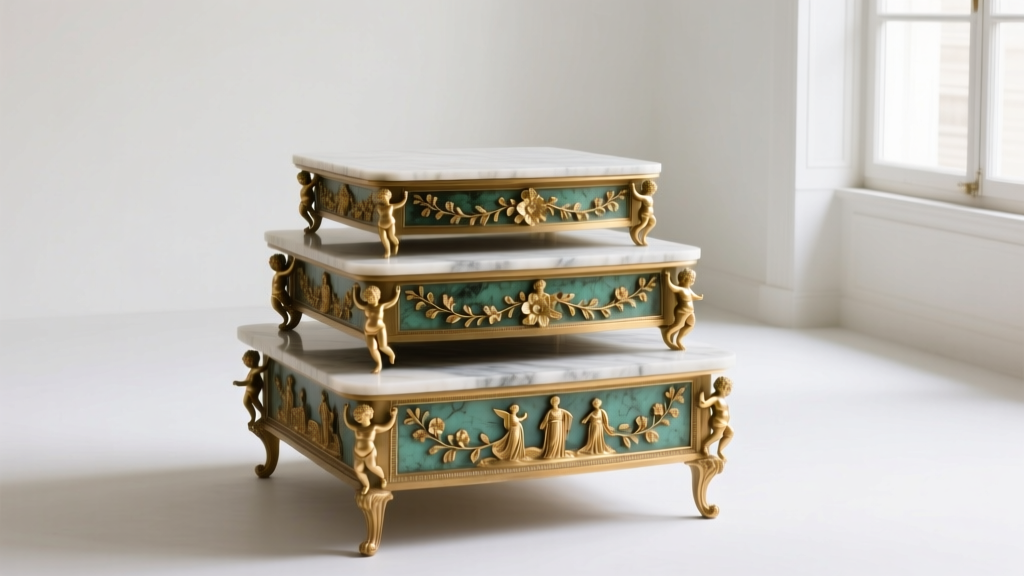
A Tripartite Masterpiece: The 24 × 22½-Inch Nesting Table Set Featuring Floral Swags, Putti, and Minerva Scenes
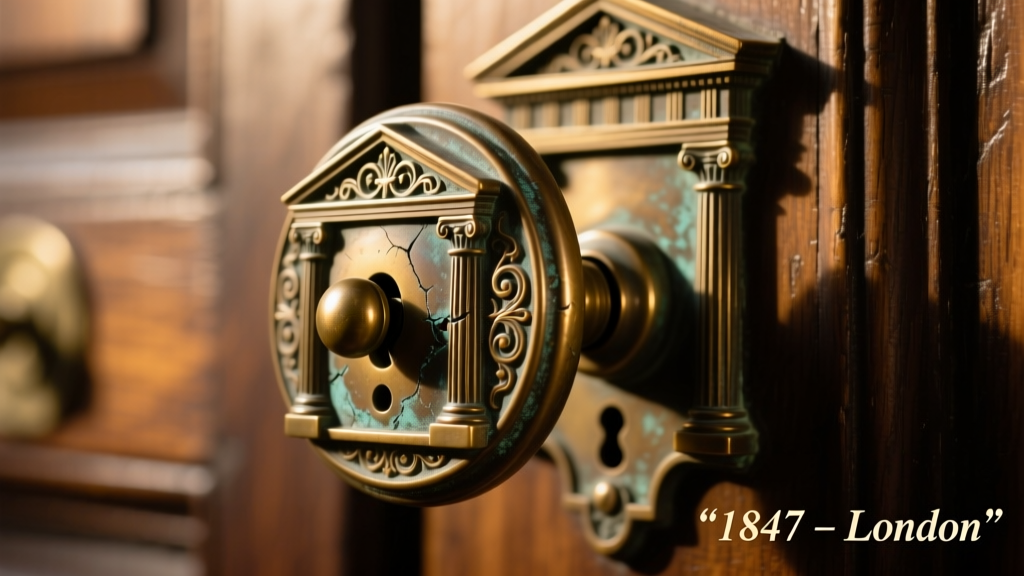
Architectural Doorbell Doorknob: The Bronze Push-Center Design of the 19th Century — Form, Function, and Foundry Craft
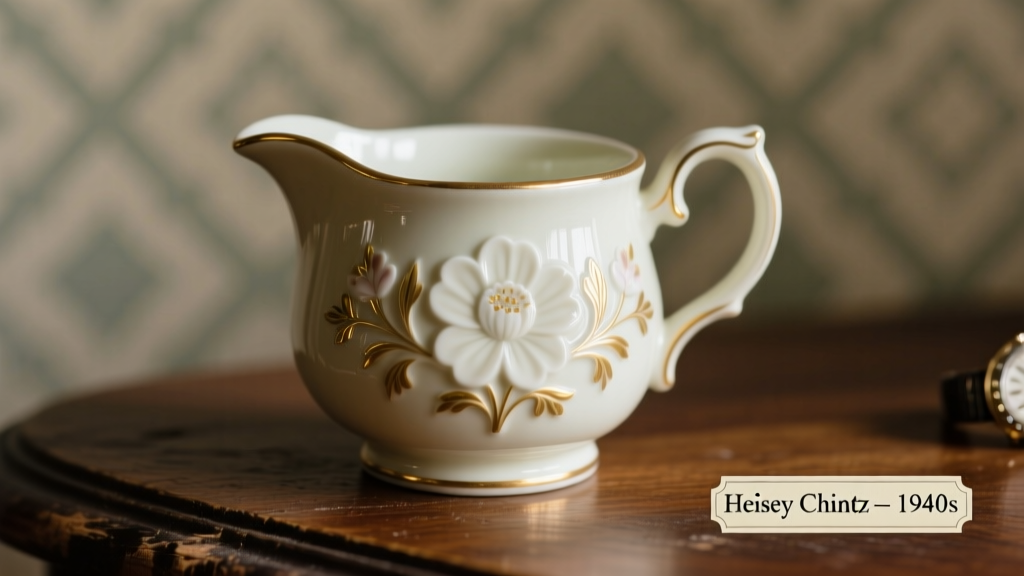
Heisey Chintz Sugar Creamer: A Collector’s Guide to the Iconic Pink-and-Gold Tableware Piece
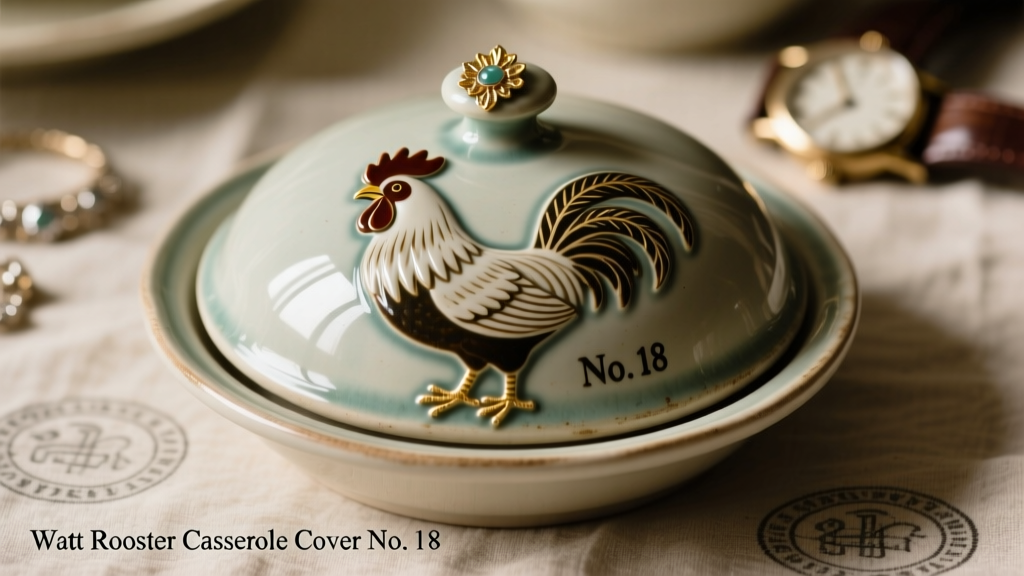
Watt Rooster Casserole Cover No. 18 Individual: A Study in Mid-Century American Silverplate Craftsmanship
Toothpick Holders, Barrel Souvenirs, and the Shrine of the Falls: Niagara’s 1905 Ceramic Pilgrimage Objects
Consolidated Lamp and Glass Company 'Florentine' Vase: A Deep Dive into the 11-Inch Brown-Base Art Glass Masterpiece
Clem Hamilton: The Unheralded Master of Mid-Century American Watchmaking