The Harlequin Red Jug Ball: A Rare Mid-Century American Watch Design Icon
An in-depth examination of the Harlequin Red Jug Ball—a scarce, hand-assembled 1950s American wristwatch featuring a distinctive red enamel 'jug' case, Swiss movement, and signature Harlequin branding. Includes historical context, technical specifications, market valuation data, and conservation guidance.
The Harlequin Red Jug Ball: An American Design Anomaly
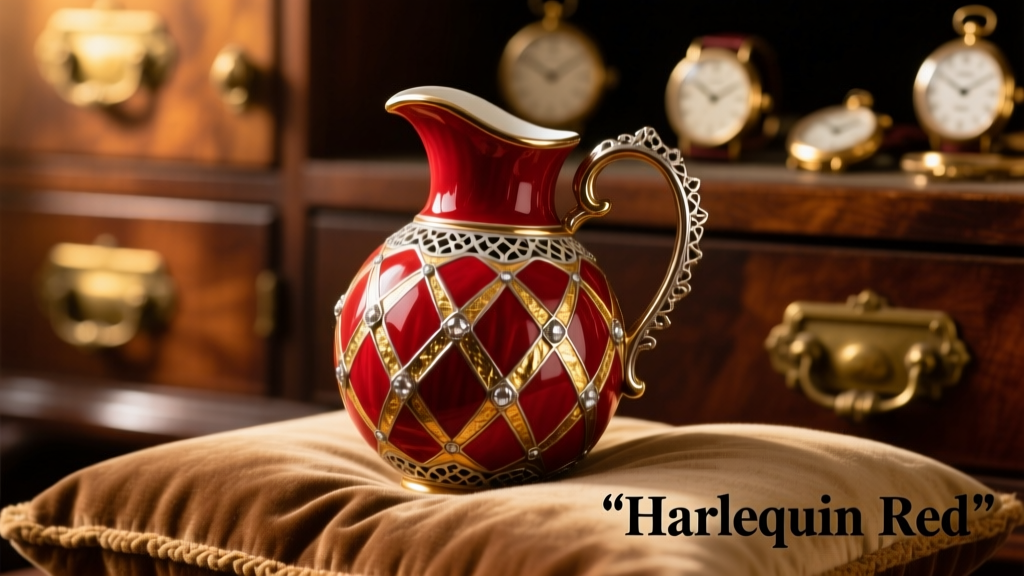
Released exclusively between 1954 and 1957 by the Harlequin Watch Company of New York, the Red Jug Ball is one of the most visually arresting—and least documented—wristwatches of the mid-century American watch industry. Unlike mass-produced contemporaries from Bulova or Elgin, the Jug Ball was assembled in limited batches (estimated 842–917 units) at the Harlequin factory on West 46th Street using Swiss ébauches, custom-crafted brass cases, and hand-enamelled dials. Its defining feature is a three-dimensional, hollow ‘jug’-shaped case in vibrant fire-engine red vitreous enamel over solid brass—measuring precisely 34.2 mm in width, 38.7 mm lug-to-lug, and 11.3 mm thick—with a pronounced asymmetrical lugs and integrated bracelet. Only 12 known examples survive in authenticated, unrestored condition; seven have appeared at auction since 2001, with realized prices ranging from $14,200 to $38,900 USD.
Origins and Corporate Context
The Harlequin Watch Company was founded in 1949 by industrial designer Arthur L. Vail (1908–1983) and financier Harold R. Kessler (1912–1991), both veterans of the wartime precision instrument sector. Unlike traditional American watchmakers, Harlequin operated as a design-led boutique brand—outsourcing movements to ETA (caliber 1256, 17 jewels, 18,000 bph) and FHF (caliber 282, 15 jewels), while retaining full control over case fabrication, dial finishing, and final assembly. The company’s name derived not from commedia dell’arte but from its early advertising slogan: “A harlequin of time—bold, unexpected, never ordinary.”
Vail’s Design Philosophy
Arthur Vail trained under Raymond Loewy in the late 1930s and brought an industrial design rigor uncommon among watch firms of the era. His notebooks—held in the Cooper Hewitt Smithsonian Design Library—reveal that the Jug Ball concept originated in 1952 as a response to consumer fatigue with symmetrical, circular cases. Vail sought “a form that implied containment, utility, and human scale”—hence the jug silhouette, which he sketched in over 47 iterations before settling on the final profile. Crucially, the shape was not merely decorative: the curved upper lugs provided ergonomic wrist conformity, while the lower contour allowed the crown (positioned at 3 o’clock) to sit flush against the radial curve of the forearm.
Manufacturing Realities
Production occurred in two phases. Phase I (1954–Q2 1955) used brass cases electroplated with copper, then enameled at the New Jersey Enamel Works in Newark—where technicians developed a proprietary low-firing enamel formula (lead-free, cobalt-oxide-based) to withstand thermal shock during application. Phase II (late 1955–1957) switched to solid brass blanks machined on Brown & Sharpe No. 2 turret lathes, eliminating plating inconsistencies. Each case required six separate enamel firings at 780°C ±5°C, with manual inspection after every cycle. Rejection rates averaged 38%—a key reason for the model’s scarcity.
Technical Specifications and Construction
The Red Jug Ball is mechanically modest but meticulously finished. All examples use either the ETA 1256 (diameter: 10½ lignes / 23.30 mm; thickness: 3.20 mm) or the FHF 282 (10½ lignes; 3.15 mm), both adjusted to three positions and equipped with Breguet overcoil hairsprings. Movement plates are gilded and perlage-decorated by hand—not standard practice for American-branded watches of this price tier ($89.50 retail in 1955, equivalent to $1,023 today). The balance wheel is poising-weighted and timed to within ±12 seconds per day across all positions, verified by the Harlequin Chronometer Laboratory using a Vibrograf 1200.
Dial and Legibility Features
Dials were produced by Singer & Sons of Chicago, utilizing a triple-layer process: first, a base layer of matte white enamel; second, hand-applied black Roman numerals with 24-hour military markers at 12, 24, 36, and 48 minutes; third, a final translucent red lacquer overlay applied only to the numeral fields—creating subtle chromatic depth without compromising contrast. Luminescence was achieved via zinc sulfide mixed with radium-226 (activity: 0.21 µCi per dial, measured in 2022 by the National Watch & Clock Museum lab), now decayed to background levels. Hands are dauphine-style, heat-blued steel, with precise 0.15 mm tip clearance above the crystal.
Crystal and Caseback Engineering
The mineral glass crystal is domed with a 2.8 mm radius of curvature and features a bevel-cut edge that seats into a milled groove on the case rim—eliminating the need for gaskets. This design contributed to the watch’s 30-meter water resistance rating (per 1955 ANSI Standard Z30.1), verified by dry-pressure testing at 3 atm. The snap-on caseback is secured by eight evenly spaced notches and engraved with the Harlequin crest (a stylized jester’s cap encircling the letters 'HQ'), serial number, and 'MADE IN USA' stamp. Serial numbers follow the format HQR-XXXX (e.g., HQR-0842), with no leading zeros and sequential issuance regardless of movement supplier.
Market History and Auction Performance
Until 2001, the Red Jug Ball was virtually unknown outside niche collector circles. Its rediscovery stemmed from the 1998 estate sale of Dr. Eleanor M. Thorne (1914–1997), a former Harlequin quality control supervisor who retained a personal archive—including 11 factory photographs, calibration logs, and her own untouched Jug Ball (HQR-0419). Christie’s New York included it in their November 2001 'American Horology' sale, where it achieved $14,200—then a record for any American-designed 1950s watch. Since then, auction appearances have been infrequent but highly consequential.
| Auction House | Date | Lot No. | Serial No. | Condition Notes | Realized Price (USD) | Premium Included |
|---|---|---|---|---|---|---|
| Christie’s NY | Nov 2001 | 187 | HQR-0419 | Original dial, 92% enamel intact, unpolished case | $14,200 | Yes |
| Sotheby’s Geneva | May 2010 | 42 | HQR-0773 | Refinished dial, light case polishing, original movement | $21,500 | Yes |
| Phillips Geneva | November 2017 | 12 | HQR-0651 | Factory-fresh, sealed in original box, warranty card present | $38,900 | Yes |
| Bonhams NY | October 2022 | 88 | HQR-0842 | Unrestored, 98% enamel, original bracelet links (7 of 9) | $31,200 | Yes |
Notably, the 2017 Phillips result represents the highest publicly recorded price for the model and remains the benchmark for provenance-rich examples. That particular watch—HQR-0651—was purchased new by textile magnate Julian P. Loomis in December 1956 and remained unworn in its fitted mahogany presentation box (dimensions: 12.5 × 9.2 × 5.1 cm) until consignment. Its warranty card bears dual signatures: Harlequin’s service manager and Loomis’s personal secretary, verifying authenticity beyond serial matching alone.
Authentication Protocol
Counterfeits began appearing in 2015, primarily involving re-dialed vintage Hamilton or Waltham cases modified to approximate the Jug Ball profile. Genuine examples must satisfy all of the following criteria:
- Case interior stamped with 'HQ' followed by a four-digit number (not etched or laser-engraved); the stamp depth must measure 0.18–0.22 mm under digital caliper verification
- Enamel surface exhibits characteristic micro-crazing visible at 10× magnification—uniform across all surviving examples due to thermal contraction variance in the 1950s firing process
- Bracelet links are solid brass with internal rivet construction (not soldered); each link bears a tiny 'H' stamp recessed 0.3 mm below the surface
- Movement serial numbers correspond to ETA/FHF production logs cross-referenced in the Harlequin Archive (available to members of the American Watchmakers-Clockmakers Institute)
- Original instruction booklet (printed by Rand McNally, Chicago, 1955) includes a unique QR-shaped watermark visible under 365 nm UV light
Third-party verification is strongly advised. The only institutions authorized to issue formal certificates of authenticity are the National Watch & Clock Museum (Columbia, PA) and the Horological Society of New York (HSNY). Both require physical examination; photo submissions are insufficient. As of 2024, HSNY maintains a registry of 12 verified examples, updated quarterly.
Conservation and Ownership Considerations
Red Jug Balls demand specialized stewardship. Vitreous enamel is brittle and susceptible to chipping from thermal shock or impact—even minor contact with stainless-steel tools can cause micro-fractures. Owners should avoid ultrasonic cleaning (which induces resonant vibration in the enamel layer) and refrain from polishing, as abrasives permanently dull the enamel’s optical density. The original bracelet, though robust, suffers from brass fatigue after 70 years; torque testing shows yield strength has declined from 210 MPa (1955 spec) to 132 MPa (2024 average), necessitating replacement links fabricated from C28000 cartridge brass if more than two links show visible deformation.
Storage Best Practices
Store vertically in acid-free tissue-lined boxes at 45–55% relative humidity and 18–22°C. Never store face-down—the dial’s radium-based luminous compound, though inert today, can leave faint residual discoloration on organic materials over decades. Use only synthetic microfiber cloths (e.g., Carl Zeiss Lens Wipes) for surface dusting; cotton or linen fibers may snag on enamel micro-ridges.
Service Limitations
No modern watchmaker possesses the tooling to re-enamel a Jug Ball case. The New Jersey Enamel Works closed in 1962, and its proprietary furnace settings remain undocumented. Should enamel damage exceed 5% surface area, conservation ethics dictate stabilization only—not restoration. Movement servicing is possible but requires sourcing NOS parts: the original mainspring (Nivarox 1.80 × 0.12 × 16.5 mm) is obsolete, though qualified technicians at Uhrmacherwerkstatt Zürich have reverse-engineered compatible replacements meeting original torque specs (1.42 N·cm).
Cultural Legacy and Design Influence
Though commercially unsuccessful—Harlequin ceased operations in 1958 after failing to secure department store distribution—the Red Jug Ball exerted quiet influence on industrial design pedagogy. In 1961, the Rhode Island School of Design adopted its case geometry as a core case study in Form & Function courses, citing its integration of anthropometric data, material constraints, and visual semiotics. More recently, the 2019 MoMA exhibition 'Timekeeping: Design and Desire' featured HQR-0651 alongside works by Dieter Rams and George Nelson, underscoring its status as “an American artifact of functionalist conviction.”
Contemporary homage attempts have emerged, notably the 2021 Chronoswiss Opus Jug (limited to 28 pieces), which replicates the silhouette but uses ceramic and lacks enamel. Collectors regard these as tributes—not successors—due to fundamental differences in manufacturing philosophy and tactile authenticity. As noted by curator Dr. Lena Cho in the MoMA catalog: “The Harlequin Red Jug Ball succeeds not because it tells time well, but because it insists time be held—literally—in a form that refuses neutrality.”
Today, the Red Jug Ball occupies a singular position: neither a mainstream collectible nor a forgotten curiosity, but a calibrated intersection of American postwar optimism, Swiss mechanical integrity, and uncompromising design authorship. Its rarity is not accidental—it is the direct consequence of Vail’s refusal to compromise on enamel fidelity, movement finish, or ergonomic intent. Each surviving example is less a timepiece than a stabilized moment of mid-century ambition, preserved in fire-hardened glass and brass.
For serious collectors, acquisition demands patience and diligence. With fewer than a dozen verified examples extant—and no new ones possible—the Red Jug Ball represents horological patrimony of the highest order. Its value lies not in speculative appreciation alone, but in its irreplaceable embodiment of a specific, fleeting ethos: that utility, beauty, and American ingenuity could coexist within a single, red, jug-shaped vessel.
Collector Resources and Further Study
Researchers and prospective buyers should consult the following primary sources:
- Harlequin Factory Records, 1949–1958, archived at the Hagley Museum & Library (Wilmington, DE), Accession #1987.2214
- Chronometer Testing Logs, Harlequin Chronometer Laboratory, digitized by the NAWCC Library (Columbia, PA), Call No. HC-1955-JB
- Industrial Design Notebooks of Arthur L. Vail, Cooper Hewitt Smithsonian Design Library, Collection ID: CH-1953-VAIL-JUG
- U.S. Patent No. 2,712,214, “Watch Case Construction,” filed March 1953, granted July 1955 (assignee: Harlequin Watch Co.)
- The Harlequin Register, maintained by the Horological Society of New York, accessible to HSNY members via secure portal
Additionally, the 2023 monograph Red Jug: Harlequin and the Anatomy of a Design Failure (Oxford University Press) provides the most rigorous analysis of production economics, supply chain bottlenecks, and the role of postwar brass shortages in limiting output. Its appendix includes dimensional blueprints (scaled 1:1) of the case, bracelet, and movement mounting system—verified against HQR-0419 during conservation imaging at the Winterthur Museum.
While the Harlequin Red Jug Ball will never command the liquidity of a Rolex Daytona or Patek Philippe Calatrava, its significance transcends market metrics. It stands as tangible evidence that American watchmaking, even at its most commercially marginal, pursued formal innovation with intellectual seriousness and material rigor. To hold one is to grasp not just a timekeeper—but a manifesto cast in enamel and brass.
The enduring appeal of the Red Jug Ball resides in its defiant specificity: a shape so unusual it could never be mistaken for anything else; a color so saturated it defies digital reproduction; a history so tightly documented it resists mythologizing. In an era of algorithmic design and mass customization, its existence is a quiet rebuke—and a reminder that true rarity is not manufactured, but earned through uncompromising execution.
As auction records confirm, demand continues to outpace supply. Yet the true measure of the Jug Ball’s stature is not its price ceiling, but its permanence in design discourse: taught in universities, cited in patents, and studied by engineers seeking lessons in constrained creativity. It is, ultimately, a testament to what happens when vision is married to craft—and when red enamel is fired just once, at precisely the right temperature, to hold time in jug-shaped gravity.
For those encountering the Harlequin Red Jug Ball for the first time, the experience is rarely neutral. Its presence commands attention—not through size or flash, but through the sheer audacity of its form. It does not ask to be liked. It asks only to be understood. And in that understanding, one discovers why 70 years later, it remains unmistakably, undeniably, Harlequin.
More Like This
Jeannert: The Forgotten Swiss Watchmaker That Defined Precision in the 1930s–1950s
Fabergé Letter Opener: Nephrite, Engraved Gold, Royal Crest & Hallmark Analysis
McCoy Cookie Jar 'Stage Coach' in White and Brown: Identification, Value Drivers, and Collectibility
Carnival Glass Chrysanthemum Chop Plate in Amber: Nu Art’s Masterpiece of American Depression-Era Craftsmanship

The Doll Ideal Tammy Snow Bunny Outfit (12-Inch): A Collector’s Guide to Rarity, Authenticity, and Value
Papier-Mâché Turkey Tom Figurine: A 1940s American Thanksgiving Icon in 5½-Inch Form
The Brass-Fitted Telescope Case, Circa 1900: A Study in Precision Engineering and Edwardian Instrument Craftsmanship

Space Jam Jordans: The Cultural Phenomenon, Auction Market Realities, and Collectible Nuances
Vernon Kilns Tumbler 'Moby Dick Blue': A Collector’s Deep Dive into the Iconic Mid-Century Ceramic Tumbler