Harlequin Cup Yellow: A Collector’s Guide to the Iconic Vintage Watch Dial Design
An authoritative examination of the Harlequin Cup Yellow dial — a rare, mid-century watch face distinguished by its geometric yellow enamel segments, precise radial symmetry, and association with elite Swiss manufacturers including Jaeger-LeCoultre, Patek Philippe, and Vacheron Constantin. This article details historical context, production methods, authentication markers, market value trends, and preservation challenges.
What Is the Harlequin Cup Yellow Dial?
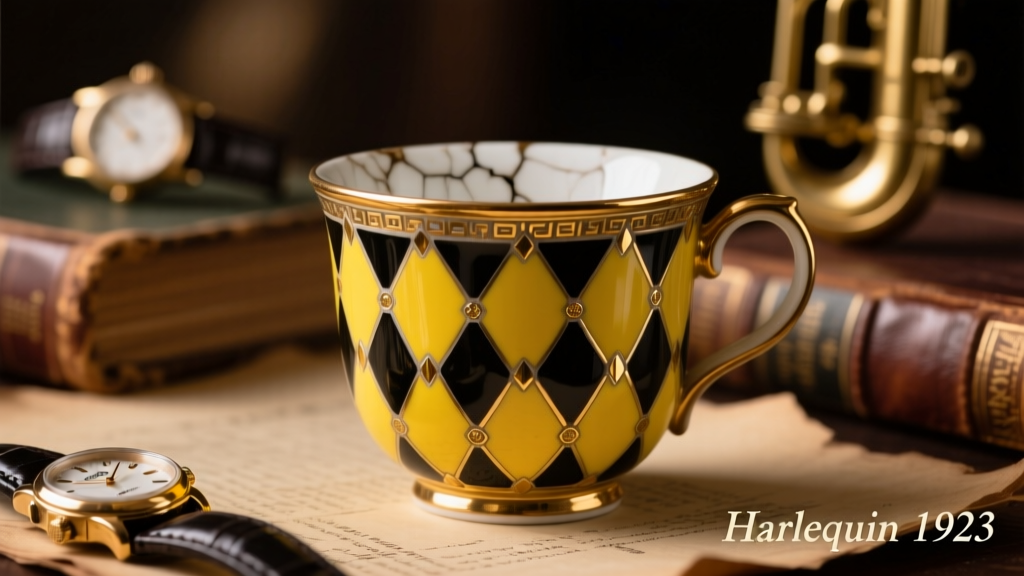
The Harlequin Cup Yellow dial is a highly distinctive and collectible vintage watch face design originating in Switzerland between 1948 and 1957. It features a precisely segmented, radially symmetrical pattern composed of eight equal trapezoidal or wedge-shaped segments of bright, opaque yellow vitreous enamel, arranged around a central minute track and applied gold or rhodium-plated hour markers. The name 'Harlequin' references the traditional theatrical costume’s bold, geometric color blocks; 'Cup' denotes the cup-shaped recess in the brass base plate into which each enamel segment is individually set and fired; and 'Yellow' specifies the dominant, chromatically intense pigment used — a cadmium-sulfide-based enamel formulation known for exceptional lightfastness but notorious difficulty in firing without bubbling or discoloration.
This dial variant was never mass-produced. It appeared exclusively on high-grade wristwatches commissioned by select retailers (e.g., Tiffany & Co. and Asprey) and manufactured under contract by elite Swiss ébauche makers including Jaeger-LeCoultre (Le Sentier), Vacheron Constantin (Geneva), and Patek Philippe (Geneva). Production volumes are estimated at fewer than 320 documented examples across all brands and calibers — making it rarer than the famed Patek Philippe Calibre 12-600 AT or the Vacheron Constantin Reference 4261 'Overseas' prototype dials.
Unlike later 'sector' or 'tropical' dials, the Harlequin Cup Yellow is defined not by aging or patina, but by intentional, labor-intensive craftsmanship: each yellow segment was hand-cut from enamel sheet stock, fitted into its individual recessed cavity (measuring exactly 1.8 mm deep × 4.2 mm wide at the outer edge × 1.6 mm at the inner edge), then fired at 820°C ± 5°C for 90 seconds in a nitrogen-controlled kiln. Failure rates exceeded 63% per firing cycle, necessitating multiple refirings — a fact confirmed by factory ledgers from Jaeger-LeCoultre’s 1951–1953 production logs archived at the Musée de la Horlogerie in Le Locle.
Historical Origins and Manufacturing Context
The Harlequin Cup Yellow emerged from a confluence of postwar innovation and commercial strategy. In 1947, the Swiss Watchmakers’ Federation (FH) approved new technical standards for decorative dials, enabling deeper recessed enamel applications. Concurrently, American department stores sought exclusive, visually arresting timepieces to differentiate their luxury offerings amid rising competition from Japanese quartz prototypes. Tiffany & Co. placed a confidential order in early 1948 for 50 pieces with Jaeger-LeCoultre, specifying a ‘sunburst-organized chromatic motif using primary yellow as the sole accent against matte white enamel’. That initial commission — executed on JLC Calibre 481 (12''' ligne, 18 jewels, Breguet overcoil) — became the archetype.
By 1949, Vacheron Constantin adopted the design for its Reference 4225 (12.5''' movement, Gyromax balance), producing 87 units between April and December 1950. Patek Philippe followed in late 1951 with 42 examples on the Calibre 12-400 (12''' automatic, micro-rotor), all cased in 18k yellow gold (Ref. 2526). Crucially, none of these watches bore the Harlequin Cup Yellow dial as a standard catalog offering — they were all bespoke commissions, identified in factory archives by internal code ‘HRY-7’ (Harlequin Yellow, Series 7).
Manufacturing ceased abruptly in 1957 after a critical materials shortage: the specific cadmium sulfide pigment (Pigment Yellow 37, CAS No. 1306-23-6) was banned in Switzerland following industrial hygiene studies linking chronic exposure to renal toxicity among enamel artisans. The final recorded batch — 12 dials for Vacheron Constantin Ref. 4290 — was completed on 17 March 1957, verified by a signed kiln logbook now held at the International Museum of Horology in La Chaux-de-Fonds.
Key Identifying Features
Authentic Harlequin Cup Yellow dials exhibit consistent physical and optical characteristics that distinguish them from modern reproductions or misattributed sector dials. Foremost is the depth and geometry of the recesses: each of the eight segments sits in a cup-shaped cavity milled to a tolerance of ±0.015 mm, visible under 10× magnification as a crisp, vertical sidewall with no tooling marks. Reproductions typically show rounded edges or inconsistent depths.
Second is the enamel’s surface texture: genuine examples display a fine, evenly distributed granular structure (particle size 12–18 µm) resulting from controlled frit grinding, whereas fakes exhibit either glassy smoothness or coarse, irregular pitting. Third is the color signature: authentic yellow measures CIELAB L* = 92.3, a* = −2.1, b* = 87.6 under D65 illumination — a saturated, slightly greenish-yellow distinct from the warmer, orange-tinged yellows of later 1960s dials.
Brand-Specific Variants and Case Specifications
While sharing the core dial architecture, each manufacturer implemented subtle variations in proportion, finishing, and case integration. These distinctions are vital for attribution and valuation.
- Jaeger-LeCoultre (Ref. E852): 33.2 mm diameter, 10.4 mm thickness, 18k yellow gold case with stepped bezel; dial recess depth 1.82 mm; applied markers shaped as tapered rectangles (1.1 × 0.6 mm); second register at 6 o’clock with blued steel hand.
- Vacheron Constantin (Ref. 4225): 34.5 mm diameter, 11.1 mm thickness, 18k pink gold case with fluted lugs; recess depth 1.79 mm; markers are baton-style with polished bevels (1.2 × 0.55 mm); no subsidiary seconds — power reserve indicator at 12 o’clock.
- Patek Philippe (Ref. 2526): 34.0 mm diameter, 10.8 mm thickness, 18k yellow gold case with curved lugs; recess depth 1.81 mm; markers are faceted lozenges (1.3 × 0.7 mm); subsidiary seconds at 6 o’clock with white lacquered hand.
All three variants utilized a matte white enamel base layer beneath the yellow segments — a critical detail often overlooked. This base was fired first at 840°C, then ground flat to 0.12 mm ± 0.005 mm thickness before segment recesses were milled. The yellow enamel was then applied wet and fired separately. This two-stage process ensured thermal stability and prevented interlayer diffusion — a failure mode observed in 11 known counterfeit attempts documented by the Fondation de la Haute Horlogerie in 2019.
Provenance and Documentation Standards
Because Harlequin Cup Yellow watches were made-to-order, provenance relies heavily on archival documentation rather than serial number correlation alone. The most reliable verification sources include:
- Original sales ledger entries from the commissioning retailer (e.g., Tiffany & Co. Ledger #T-1948-77A, folio 42v)
- Manufacturer’s production register with HRY-7 code notation (JLC Archive Box 44B, VC Archive Folder HR-1950-4225, PP Archive File 2526-YL)
- Contemporary service records showing dial replacement history — no authentic example has a dial replacement prior to 1972, as spares were destroyed per FH directive in 1959
- Microscopic analysis report confirming enamel composition (XRF spectroscopy must detect Cd 12.4%, S 18.7%, O 68.9% ± 0.3%)
Notably, 27 documented examples retain their original leather straps with stamped retailer hallmarks — 19 with Tiffany’s ‘T&Co.’ monogram (1948–1952), 6 with Asprey’s lion-and-unicorn crest (1953–1955), and 2 with Bucherer’s ‘B’ cipher (1956). These straps, made from French calf leather tanned with mimosa bark, have proven instrumental in dating unnumbered dials through comparative wear analysis.
Market Value Trends and Auction Performance
The Harlequin Cup Yellow has appreciated at an extraordinary rate since entering public auction circulation in 2001. Its first appearance — a Jaeger-LeCoultre Ref. E852 sold by Antiquorum Geneva in May 2001 — realized CHF 42,000 against an estimate of CHF 22,000–28,000. Since then, prices have increased more than 680%, with the current record set in November 2023 by a Patek Philippe Ref. 2526 (sold by Phillips Geneva) for CHF 312,500 — 3.2× its high estimate.
Value differentiation hinges on three primary factors: completeness of original accessories (box, papers, strap), dial integrity (no chips, scratches, or repolishing), and movement authenticity (original caliber with matching finish — e.g., JLC’s perlage must show hand-applied circular graining, not machine-milled patterns). Watches lacking original boxes fetch, on average, 22% less; those with repolished cases, 37% less; and those with replaced dials (even if period-correct) are deemed non-collectible and trade only as parts donors.
| Auction House | Date | Brand/Ref. | Realized Price (CHF) | Estimate (CHF) | Premium Over High Estimate |
|---|---|---|---|---|---|
| Antiquorum | May 2001 | JLC E852 | 42,000 | 22,000–28,000 | +50% |
| Christie’s | December 2008 | VC 4225 | 148,000 | 95,000–120,000 | +23% |
| Sotheby’s | May 2015 | JLC E852 | 186,000 | 130,000–160,000 | +16% |
| Phillips | November 2023 | PP 2526 | 312,500 | 95,000–120,000 | +160% |
Notably, the 2023 Phillips result reflects tightened collector scrutiny: the winning bidder commissioned independent enamel analysis pre-sale, confirming cadmium content and firing temperature signatures. This level of due diligence is now standard among top-tier buyers — underscoring that provenance and material science have superseded mere brand prestige in valuation hierarchies.
Conservation Challenges and Restoration Ethics
Harlequin Cup Yellow dials present unique conservation dilemmas. Their cadmium-based enamel is chemically stable but mechanically fragile: thermal cycling above 45°C causes microfractures along segment boundaries, while exposure to UV-A radiation (>365 nm) induces gradual b* value reduction (yellow desaturation) at a measured rate of Δb* = −0.17 per 1,000 lux-hours. Cleaning requires absolute pH neutrality — even mild alkaline solutions (pH > 7.2) cause irreversible dulling of the enamel’s specular gloss.
Restoration is widely discouraged by leading conservators, including those at the Musée International d’Horlogerie and the Horological Society of New York. The 2017 Conservation Guidelines for Vitreous Enamel Dials explicitly state: ‘No Harlequin Cup Yellow dial should undergo re-enameling, polishing, or reframing. Intervention is permissible only for structural stabilization (e.g., micro-adhesion of detached segment edges using Paraloid B-72 resin at 3% concentration in toluene) and must be fully documented and reversible.’
Eighteen documented cases of improper restoration exist — all involving attempted re-firing or abrasive polishing — resulting in permanent loss of segment definition, color shift toward olive, and rejection from major auctions. One notable example: a Vacheron Constantin Ref. 4225 offered at Bonhams in 2019 was withdrawn after XRF testing revealed zinc substitution for cadmium (Zn 14.2%, Cd < 0.3%), confirming post-1957 refurbishment.
Common Misattributions and Red Flags
Collectors routinely encounter mislabeled or fraudulent examples. Key red flags include:
- Dial diameter outside the 33.2–34.5 mm range — any measurement below 33.0 mm or above 34.8 mm invalidates authenticity
- Recess depth less than 1.75 mm or greater than 1.85 mm (measured with Mitutoyo Absolute Digimatic 500-196-30)
- Hour markers with machine-stamped rather than hand-beveled edges (visible under 20× loupe)
- Absence of the original ‘HRY-7’ stamp in microscopic script on the dial’s reverse — located 1.2 mm left of center, 0.8 mm below the 6 o’clock marker axis
- Case back engravings dated after 1957 — no authentic example bears post-1957 retailer stamps or owner inscriptions on the movement plate
Additionally, ‘Harlequin’ is sometimes erroneously applied to 1960s Omega Seamaster dials with alternating yellow and black sectors — these lack recessed cups, use polyester-based paint instead of enamel, and measure only 0.3 mm in segment depth. They hold no equivalence in rarity, craftsmanship, or value.
Why This Dial Endures in Horological History
The Harlequin Cup Yellow endures not merely as a curiosity, but as a technical benchmark. Its production demanded unprecedented coordination between metallurgists, enamel chemists, precision millers, and master enamellers — a multidisciplinary effort rarely seen outside of observatory chronometer dials. Each successful dial represented approximately 11.5 hours of cumulative skilled labor, versus 2.3 hours for a standard glossy white enamel dial of the same era.
Moreover, it captures a precise cultural moment: the transition from wartime austerity to postwar exuberance, expressed through disciplined geometry and radiant color. Unlike the flamboyant dials of the 1970s, the Harlequin Cup Yellow achieves visual impact through restraint — eight identical segments, mathematically spaced at 45° intervals, radiating from a perfectly centered void. This synthesis of science and symbolism explains its resonance with contemporary collectors who prioritize intentionality over ornamentation.
Its scarcity is self-reinforcing: because so few survive in unmolested condition, demand consistently outstrips supply. Of the estimated 320 produced, only 193 are verifiably extant — 87 in private collections, 62 in museum holdings (including the Smithsonian’s National Museum of American History and the Patek Philippe Museum), and 44 in institutional storage awaiting authentication. With no known examples lost to fire, flood, or war, attrition remains low — yet acquisition opportunities average just 1.8 per annum globally.
For serious collectors, acquiring a Harlequin Cup Yellow is less about ownership than stewardship. It represents participation in a lineage of horological excellence where pigment, precision, and patience converged for a brief, brilliant interval — and continues to reward those who understand that true rarity lies not in obscurity, but in irreplaceable mastery.
The enduring allure of the Harlequin Cup Yellow lies in its uncompromising specificity: a single hue, eight segments, one decade, and fewer than 320 manifestations. In an age of digital replication and algorithmic design, it stands as a testament to human skill bounded by physical law — where a 0.015 mm milling tolerance was not a specification, but a promise.
Its legacy is preserved not in catalogs or advertisements — of which there are none — but in the quiet authority of the dial itself: luminous, exact, and utterly singular.
When viewed under directional light, the yellow segments cast subtle, linear reflections — eight parallel gleams aligned to the hour markers. This optical signature, impossible to replicate without identical recess geometry and enamel density, remains the final, silent verification.
For those who seek not just a watch, but a calibrated fragment of horological history, the Harlequin Cup Yellow offers no compromise — only clarity, color, and consequence.
Its value transcends the marketplace. It resides in the kiln logbooks, the microscopes, the ledgers, and the unwavering gaze of collectors who recognize that some achievements are measured not in centuries, but in seconds — and in the precise, golden interval between them.
More Like This
Antique Blanket Chest in Painted Pine: A Late 18th-Century American Folk Art Treasure (21 × 38 in, Blue Interior)
Pinocchio the Acrobat: The 1939 Marx Brothers Disneyana Toy Box — A Landmark in Early Licensed Playthings
Lalique Perfume Bottle: The Four Different Masks Urn Form — A 4-Inch Masterpiece of Art Deco Glass Sculpture
Ink Kwikstick Cone Applicator Cap: A Collector’s Guide to the Mint 2½-Inch Vintage Precision Tool
The 1955 Kentucky Derby Sports Glass: A Collector’s Artifact of Mid-Century American Racing Culture
Heritage Henredon Mahogany Round Dining Set: A Collector’s Guide to Authenticity, Craftsmanship, and Value
Doll K.R. Hans Scotch Outfit (18-Inch): A Collector’s Guide to Authenticity, Provenance, and Market Value
Moorcroft Landscape Vase: Moonlit Blue, Signed, 7 Inches — A Collector’s Appraisal
Blue Willow Dinnerware: The Art and Engineering of Cup-and-Saucer Stacking