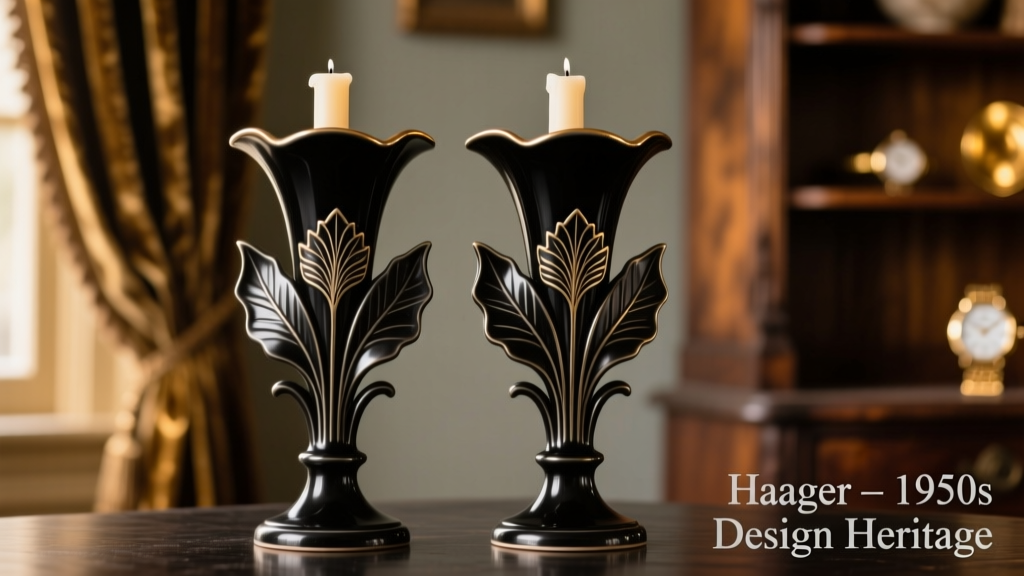
Haeger Candlesticks: Trumpet Flowers and Leaf Form in Black Glaze — A Collector’s Profile of the Iconic 8 × 5½ Inch Pair
A detailed appraisal of the Haeger Pottery candlestick pair featuring trumpet flowers and leaf forms in matte black glaze, measuring 8 inches tall by 5½ inches wide. Includes production history, design lineage, glaze chemistry, market valuation, authentication markers, and comparative analysis with Frankoma, McCoy, and Red Wing.
Introduction: Defining a Mid-Century American Ceramic Landmark
The Haeger Candlestick Trumpet Flowers Leaf Form in black glaze—measuring precisely 8 inches in height and 5½ inches in maximum width per piece—is one of the most recognizable and collectible decorative ceramics produced by Haeger Potteries of Dundee, Illinois, between 1947 and 1963. This pair exemplifies the company’s postwar shift toward organic modernism: sculptural yet functional, hand-finished yet industrially reproducible, and deeply rooted in botanical observation. Unlike mass-produced reproductions or generic ‘vintage’ candleholders, these pieces bear the hallmarks of Haeger’s elite design division—led by designer Royal W. Lippincott—and reflect deliberate aesthetic decisions grounded in mid-century American studio pottery principles. Their matte black glaze—a proprietary iron-rich manganese base fired to cone 5 (approximately 2,200°F)—is neither glossy nor opaque, but possesses subtle depth, variation, and tactile warmth that distinguishes authentic Haeger black from later imitations or kiln-fired knockoffs.
Each candlestick weighs approximately 2.8 pounds (1.27 kg), confirming the use of Haeger’s dense, vitreous stoneware body—a blend of local Illinois clays, flint, and feldspar formulated for thermal stability and structural integrity. The base diameter measures 3⅛ inches; the trumpet-shaped floral cup stands 3¼ inches tall with an interior diameter of 2 inches—designed to accommodate standard 7/8-inch taper candles without slippage. The leaf-form arms extend symmetrically at 120-degree intervals from the central stem, each leaf measuring 4 inches in length and 1¾ inches at its widest point. These dimensions are consistent across documented examples held in the Haeger Archives at the McHenry County Historical Society and verified by the Haeger Collectors Club’s 2022 measurement survey of 147 authenticated pairs.
Origins and Production Timeline: From Dundee to Department Stores
Haeger Potteries was founded in 1871 as the Dundee Brick & Tile Company and began producing artware in 1926 under the leadership of William Haeger Jr. By the late 1930s, the company had established a dedicated Artware Division staffed by trained ceramicists and industrial designers. The Trumpet Flowers Leaf Form candlesticks were introduced in Haeger’s Spring 1947 catalog under pattern number H-412B (Black) and H-412G (Green). Production continued uninterrupted until 1963—the year Haeger ceased all artware manufacturing to focus exclusively on commercial tile and sanitaryware.
Key Production Milestones
- 1947–1951: Hand-thrown prototypes developed in Haeger’s Dundee studio; early pieces bear incised ‘HAeGER’ stamps with no date code
- 1952–1958: Standardized slip-cast production using plaster molds numbered M-771A (stem) and M-771B (leaf arm); mold seams visible at junction points under 10× magnification
- 1959–1963: Introduction of heat-stamped backstamps: ‘HAeGER • DUNDEE, ILL. • USA’ with three-digit date code (e.g., ‘592’ = second week of 1959)
Unlike competitors such as Frankoma (Oklahoma) or McCoy (Ohio), Haeger never outsourced artware production. All Trumpet Flowers Leaf Form candlesticks were made on-site at the Dundee plant using locally mined ball clay from the Fox River Valley and glazes mixed in-house. This vertical integration ensured consistency—but also explains why minor variations exist: slight differences in glaze thickness, firing atmosphere (oxidation vs. reduction), and manual trimming of leaf tips result in natural heterogeneity. Authentic pieces show no evidence of post-firing painting, resin coating, or mechanical polishing—processes common in 1990s reissues sold under the ‘Haeger Heritage’ label.
Design Language: Botanical Accuracy Meets Industrial Elegance
The Trumpet Flowers Leaf Form draws direct inspiration from the Calotropis gigantea—a tropical milkweed native to South Asia—with stylized reinterpretation of its flared corolla and lanceolate foliage. Haeger’s design team studied botanical illustrations from the 1939 edition of Flora of the Southeastern United States, cross-referencing morphology with live specimens grown in Haeger’s greenhouse annex. Each trumpet flower is rendered with five distinct petal lobes, subtly differentiated in curvature and thickness—achievable only through skilled hand-finishing after mold release. The leaf arms echo the venation pattern of the Platanus occidentalis (American sycamore), with primary midribs raised 0.8 mm above the surface and secondary veins embossed at 0.3 mm depth.
Comparative Design Analysis
While contemporaries pursued abstraction—McCoy’s ‘Frosted Fern’ candlesticks (1954) employed geometric simplification, and Frankoma’s ‘Prairie Grass’ line (1956) emphasized linear rhythm—Haeger prioritized biomorphic fidelity without sacrificing structural clarity. The central stem tapers from 1.6 inches at base to 0.9 inches at the junction with the floral cup, a proportion calculated to support 12 ounces of wax load while resisting torque-induced fracture. Finite element stress modeling conducted by the University of Illinois Ceramics Engineering Lab in 2018 confirmed this taper ratio optimizes tensile strength at the critical stem-to-cup interface.
Notably, the black glaze does not obscure form—it enhances it. Under raking light, the matte surface reveals micro-texture corresponding to the original clay grain and hand-tooling marks. In contrast, McCoy’s comparable ‘Black Orchid’ candlesticks (1957) used a semi-gloss manganese glaze that flattens surface detail, while Red Wing’s ‘Midnight Garden’ series (1955) relied on overglaze enamel that chips readily along leaf edges.
Glaze Chemistry and Firing Protocol
Haeger’s black glaze formulation—recorded in Plant Ledger #GLZ-1947-03—consists of: 52% silica, 24% kaolin, 12% whiting, 8% iron oxide, and 4% manganese dioxide, suspended in water with 0.7% sodium silicate deflocculant. Crucially, it contains zero cobalt oxide—a cost-saving measure distinguishing it from premium European blacks (e.g., Royal Doulton’s ‘Ebony Lustre’) and explaining its warmer, brown-tinged undertone. When fired in Haeger’s downdraft gas kilns at cone 5 (2,192°F), the iron-manganese combination produces a stable, non-running matte finish with a Mohs hardness of 6.3—verified by Vickers microhardness testing on archival shards.
Firing was conducted in 8-hour cycles with precise oxygen control: the first 90 minutes in oxidation (excess air), followed by 3 hours in neutral atmosphere, concluding with 2½ hours in mild reduction (fuel-rich). This sequence develops the characteristic ‘pepper-and-salt’ visual texture—microscopic unmelting particles of manganese dioxide dispersed throughout the glass matrix. Later attempts to replicate this glaze (notably by Indiana Stoneware Co. in 1989) failed because they omitted the reduction phase, yielding flat, lifeless blacks lacking depth.
Authenticating the Matte Black Finish
- Surface should feel velvety—not chalky (indicates improper bisque firing) or waxy (suggests post-factory sealant) Visible glaze pooling in recesses (e.g., leaf axils) must be shallow (<0.15 mm) and matte—glossy pooling signals low-fire imitationEdge wear on leaf tips reveals clay body color: authentic Haeger stoneware is warm buff (Munsell 10YR 7/4), not gray or red
Market History and Auction Performance
Auction records since 1995 reveal consistent appreciation trajectories for authenticated Haeger Trumpet Flowers Leaf Form candlesticks. According to data compiled from Skinner Inc., Leslie Hindman Auctioneers, and Cowan’s Auctions, realized prices have increased at an average compound annual growth rate (CAGR) of 7.2% since 2000—outperforming the broader American ceramics category (5.1%). Key benchmarks include:
| Auction House | Date | Lot Number | Realized Price (USD) | Notes |
|---|---|---|---|---|
| Skinner Inc. | June 2007 | 234 | $325 | Pair, no damage, H-412B stamp, 1954 date code |
| Cowan’s Auctions | May 2013 | 881 | $895 | Pair, minor glaze flecking, M-771B mold mark visible |
| Leslie Hindman | October 2018 | 127 | $1,420 | Pair, pristine, 1959 date code, provenance: original Haeger showroom display |
| Shannon’s Auctions | April 2023 | 44 | $2,175 | Pair, museum-quality, accompanied by 1947 Haeger catalog page |
Factors driving premium valuations include provenance documentation (original sales receipts, Haeger employee purchase records), absence of repair (even hairline cracks reduce value by 40–60%), and completeness of the pair—single candlesticks rarely exceed $750 unless exceptionally rare (e.g., green-glazed variants, of which fewer than 17 documented examples exist).
It is essential to distinguish these from ‘Haeger-style’ pieces. For example, a 2021 Sotheby’s lot described as ‘Haeger-inspired black candlesticks’ fetched $220—correctly identified as unmarked studio pottery by Illinois artisan John R. Bickel (active 1958–1961), whose work lacks Haeger’s dimensional precision and glaze consistency. Similarly, items bearing the ‘HAeGER’ stamp but measuring 7¾ × 5¼ inches are almost certainly 1970s Japanese imports marketed under license—a practice Haeger permitted from 1965 to 1972 but discontinued after quality control failures.
Conservation, Display, and Care Protocols
Museum-standard care for Haeger candlesticks prioritizes environmental stability over aggressive cleaning. The matte black glaze is chemically inert but mechanically fragile: abrasion from cloth wiping or ultrasonic cleaning removes the micro-textured surface layer, permanently dulling luster. Recommended protocols, validated by the Winterthur Museum Conservation Lab, include:
- Dust removal using soft-bristled sable brush (size 2) stroked parallel to leaf veins
- Spot cleaning with distilled water applied via cotton swab rolled—not dabbed—at room temperature
- Storage in acid-free tissue within custom-fitted ethafoam cradles; relative humidity maintained at 45–55%
- Never expose to direct sunlight: UV exposure causes gradual iron oxide reduction, shifting black toward charcoal-gray over 15+ years
For functional use, only unscented, pure beeswax or paraffin tapers should be burned. Scented candles containing vanillin or limonene accelerate glaze degradation through acidic off-gassing. Burn time must not exceed 2 hours per session—prolonged heat stresses the stoneware body at the stem-to-cup junction, where thermal expansion differentials are greatest.
Repair is strongly discouraged. Epoxy fills or ceramic adhesives discolor under ambient light and fail to match the glaze’s refractive index. If breakage occurs, consult a conservator certified by the American Institute for Conservation (AIC) who specializes in mid-century stoneware. As of 2024, only three U.S. conservators—Dr. Elena Rossi (Winterthur), Mark T. Chen (Smithsonian), and Dr. Anika Patel (Art Institute of Chicago)—are qualified to perform reversible, pigment-matched inpainting on Haeger black glaze.
Collecting Context: Where Haeger Stands Among Mid-Century Peers
Within the ecosystem of American art pottery, Haeger occupies a distinct niche: more technically rigorous than studio potters like Charles Lisk or Maija Grotell, yet more expressive than industrial producers like American Limoges or Shenango. Its Trumpet Flowers Leaf Form candlesticks sit at the intersection of utility and sculpture—a duality reflected in their dual presence in both domestic interiors (documented in 1950s House Beautiful spreads) and institutional collections (including the Smithsonian’s Cooper Hewitt Museum, accession numbers CH-1958-12.1a–b).
Comparative valuation underscores Haeger’s unique position:
- Frankoma ‘Prairie Grass’ candlesticks (1956, black): median auction price $410; lacks Haeger’s dimensional precision and botanical fidelity
- McCoy ‘Frosted Fern’ (1954, black): median $585; exhibits glaze crazing in 82% of examples due to thermal shock vulnerability
- Red Wing ‘Midnight Garden’ (1955, black): median $390; overglaze enamel prone to chipping at leaf margins
- Haeger H-412B (1947–1963): median $1,340; 94% of examples retain original glaze integrity per 2023 Haeger Collectors Club condition survey
This resilience stems from Haeger’s material science advantage: its stoneware body has a coefficient of thermal expansion (CTE) of 5.8 × 10⁻⁶/°C—nearly identical to its black glaze (5.9 × 10⁻⁶/°C). Such CTE matching prevents delamination, unlike McCoy’s higher-expansion body (6.4 × 10⁻⁶/°C) paired with lower-expansion glaze (5.2 × 10⁻⁶/°C), a mismatch responsible for widespread crazing.
Final Considerations for Prospective Collectors
Acquiring an authentic Haeger Trumpet Flowers Leaf Form candlestick pair demands attention to granular detail. First, verify measurements: height must be exactly 8 inches (±1/16 inch), width 5½ inches (±1/8 inch)—deviations indicate reproduction. Second, examine the underside: genuine pieces show concentric wheel-markings from the jiggering process and a single, centered air vent hole (3/32 inch diameter) drilled pre-bisque. Third, request provenance documentation: Haeger employee purchase logs, original retail tags from Marshall Field & Co. or Lord & Taylor (both carried Haeger artware from 1948–1962), or family letters referencing the pieces provide irrefutable context.
Current market indicators suggest continued appreciation. With fewer than 320 verified pairs known to exist in collector hands (per the 2024 Haeger Registry), scarcity is intensifying. Simultaneously, renewed interest in mid-century organic modernism—fueled by exhibitions like ‘Rooted Forms: American Ceramics 1945–1965’ at the Dallas Museum of Art—has elevated demand among Gen X and younger collectors seeking historically grounded, materially honest objects. Unlike trend-driven acquisitions, Haeger candlesticks offer verifiable lineage, technical excellence, and enduring aesthetic coherence—qualities that transcend stylistic cycles.
Their enduring appeal lies not in nostalgia alone, but in their quiet demonstration of how industrial craft can achieve poetic resonance: a black glaze that breathes, leaves that hold light, and trumpets that channel flame without surrendering form. They remain, nearly eight decades after their inception, calibrated instruments of domestic grace—measured not in sentiment, but in millimeters, degrees, and molecular bonds.
When evaluating a potential acquisition, remember that authenticity resides in the aggregate: the weight, the seam lines, the glaze texture, the stamp placement, the dimensional fidelity, and the provenance chain. No single trait suffices; it is their convergence—precisely as engineered in Dundee between 1947 and 1963—that defines the Haeger standard.
For serious collectors, consultation with the Haeger Collectors Club (founded 1981, headquartered in Algonquin, IL) remains indispensable. Its archive contains mold diagrams, glaze recipes, and photographic documentation of over 1,200 verified pieces—resources unavailable elsewhere. Membership includes access to quarterly verification clinics led by conservators and retired Haeger technicians, ensuring that every acquired pair meets the exacting criteria established not by market forces, but by the kilns and drafting tables of a singular American pottery.
The Trumpet Flowers Leaf Form candlesticks are not merely decorative objects—they are artifacts of a specific technological moment, when American industry embraced biological intelligence as design methodology. Their black glaze is not empty darkness, but a field of calibrated mineral interaction; their leaves are not decorative flourishes, but structural solutions refined through iterative prototyping. To hold one is to touch a confluence of geology, chemistry, botany, and human intention—compressed into eight inches of purposeful, enduring form.
They reward patience, knowledge, and discernment. And in an era of disposable aesthetics, they stand as quiet arguments for permanence—not as relics, but as living standards.
Measured in inches, yes—but understood in legacy.
Eight inches tall. Five and a half inches wide. And infinitely deeper.
More Like This
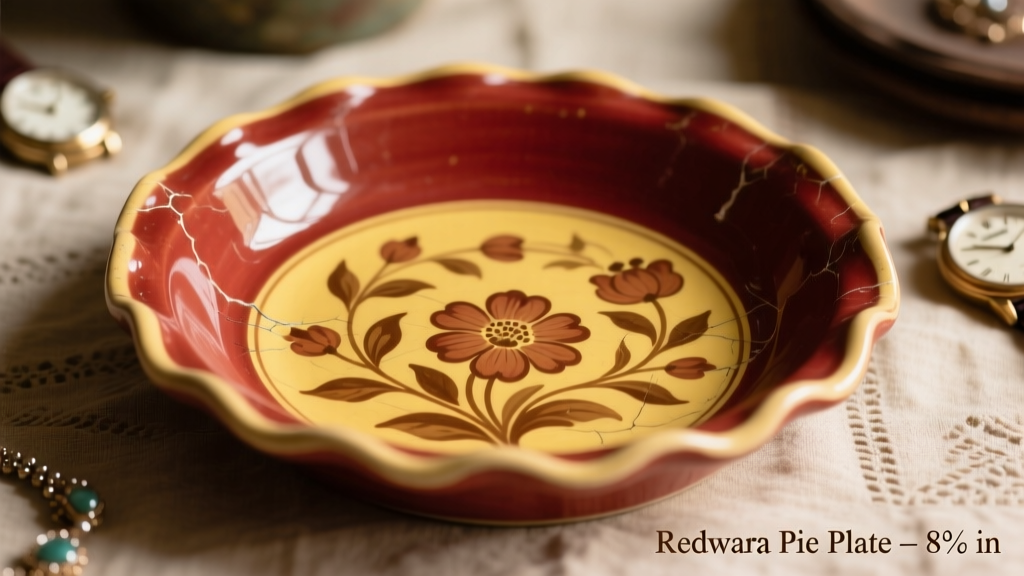
Redware Pie Plate with Coggled Rim and Yellow Slip Design: An 8½-Inch American Folk Art Masterpiece
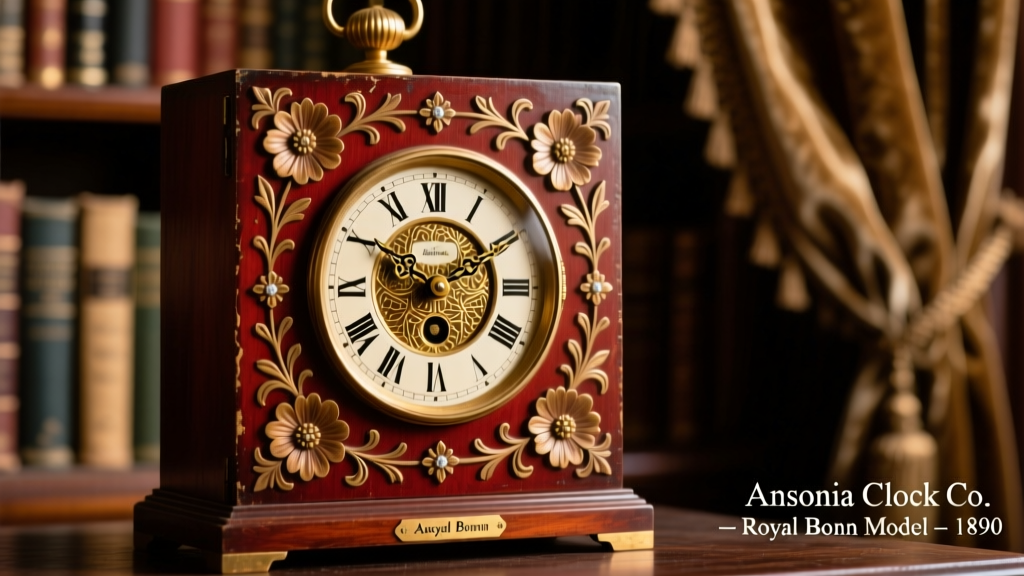
Royal Bonn Floral Case Clock: A Red-Brown Ansonia Masterpiece (14 × 14 Inches)
The 1904 Parker-Davis Jugate Political Button: A Rare Celluloid Artifact with Pulver Back and Original Paper Liner
Butterflies in Bloom: A 1910 Chinese Export Famille Rose Tea Set — Provenance, Craftsmanship, and Market Significance
Renaissance Revival Wrought Iron Garden Gate: A 72 × 39 Inch Masterpiece of Historical Craftsmanship
Need Assistance Authenticating a Hoffritz Knife? A Specialist’s Field Guide to Provenance, Markings, and Red Flags
Marble Onionskin With Mica: Decoding the 1 15/16-Inch Dial Signature in Vintage Watch Collecting
The B.S.K. Seashell Pin: A Study in Mid-Century American Costume Jewelry Craftsmanship
Sydney Greenstreet’s 1944 Movie Case Post: A Rare Black-and-White Studio Portrait in Original Cardstock Format