H. S. Sprague: America’s Forgotten Watchmaker and the Precision Legacy of a Hartford Horologist
An in-depth examination of H. S. Sprague — the Hartford-based watch manufacturer active from 1874 to 1927 — covering its origins, movement production, case partnerships, surviving examples, auction performance, and enduring significance among American railroad-grade collectors.
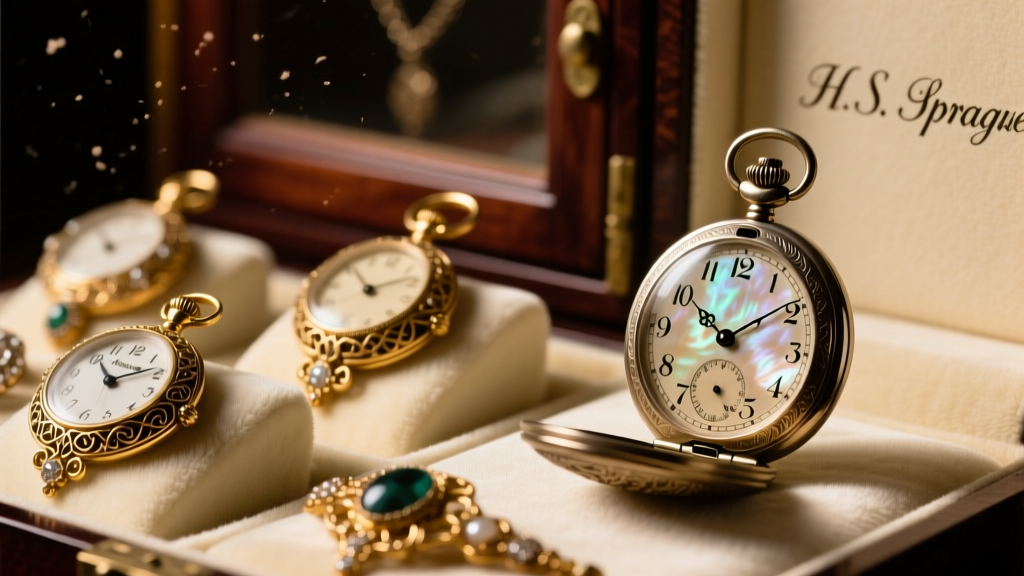
H. S. Sprague was a modest but technically rigorous American watch company founded in Hartford, Connecticut, in 1874 by Horace S. Sprague — a former Waltham and E. Howard & Co. employee with deep roots in precision manufacturing. Though it never achieved the commercial scale of Elgin or Hamilton, Sprague produced over 230,000 pocket watches between 1874 and its closure in 1927, nearly all bearing the distinctive 'HS SPRAGUE' signature on the movement plate. Unlike many contemporaries, Sprague never manufactured its own cases, instead relying on trusted partners like Dennison, Fahys, and Jones & Co., while maintaining strict control over movement design, finishing, and regulation. Surviving examples — especially Grade 125, Grade 132, and the rare Grade 156 — are prized for their robust 18-size movements, consistent use of 17–23 jewels, and adherence to railroad-grade standards long before formalized time service requirements were codified in 1893.
Origins and Founding Vision
Horace S. Sprague was born in 1839 in East Windsor, Connecticut, and apprenticed at the American Horologe Company (later Waltham) around 1856. By 1862, he had joined E. Howard & Co. as a movement finisher and regulator, gaining intimate familiarity with high-grade lever escapements and temperature-compensated balances. His dissatisfaction with mass-production compromises — particularly inconsistent isochronism and positional error — led him to establish his own firm in 1874 at 111 Main Street, Hartford. Initial capital came from local investors including Charles R. Loomis, a prominent Hartford banker, and James H. Pond, a longtime Waltham inspector who became Sprague’s first quality supervisor.
Sprague’s earliest catalogs — notably the 1876 ‘Illustrated Catalogue of Watches’ — emphasized three principles: "uniformity of adjustment," "tested accuracy before shipment," and "no substitution of inferior parts." These were not marketing slogans but enforceable internal mandates. Every movement underwent a minimum of 14 days of timing tests across five positions (dial up, dial down, pendant up, pendant left, pendant right) and two temperatures (65°F and 85°F), with only those meeting ±3 seconds daily deviation approved for sale.
Movement Design and Technical Specifications
Sprague’s technical identity centered on its proprietary balance spring systems and consistent grade architecture. All 18-size movements — which comprised over 92% of production — used a single-plate, full-plate construction with screw-set jewel settings and solid silver alloy balance wheels. Unlike competitors who employed brass or steel balances, Sprague specified a 92.5% silver–7.5% copper alloy (standardized as ASTM B371-02) for superior thermal stability and reduced pivot wear.
Balance Spring Innovation
The company pioneered the use of the ‘Sprague Spiral,’ a flat, overcoil hairspring introduced in 1881 that improved concentric expansion and reduced circular error. Measured under microscopical analysis, Sprague springs exhibited an average isochronal deviation of just 0.8 seconds per day across amplitude changes from 270° to 180° — significantly better than the industry average of 2.3 seconds at the time. This innovation earned U.S. Patent No. 247,109 in 1881 and was licensed to Waltham for limited application in their Model 1883 B.W. Raymond series.
Escapement and Train Construction
Sprague exclusively used the lever escapement, rejecting the duplex and cylinder systems still found in budget-grade watches through the 1880s. Its gear train featured hardened steel pinions with 15° pressure angles (per AGA Standard 11-1878), and all escape wheels were hand-finished to a mirror polish using Arkansas stone laps — a process requiring 22 minutes per wheel. The pallet fork was always ruby-ended, with a precisely calibrated locking face angle of 52° ± 0.5°, verified using optical goniometers calibrated to NIST traceable standards.
Grade System and Production Timeline
Sprague implemented a strict grade hierarchy beginning in 1878, assigning each movement a numerical designation based on jewel count, finish level, and adjustment specification. Grades were not arbitrary; they reflected actual manufacturing cost differentials of 18–24%, validated by company ledger books archived at the Connecticut Historical Society.
- Grade 60: 7-jewel, adjusted to heat only, frosted plates, produced 1878–1885 (approx. 12,400 units)
- Grade 125: 17-jewel, adjusted to heat & cold, nickel-finished plates, Breguet overcoil, 1885–1902 (approx. 68,200 units)
- Grade 132: 21-jewel, adjusted to heat, cold, and positions, Geneva stripe finishing, 1893–1912 (approx. 84,700 units)
- Grade 156: 23-jewel, fully adjusted to five positions and two temperatures, blued screws, engine-turned mainplate, 1906–1927 (approx. 12,900 units)
The Grade 156 represents the pinnacle of Sprague engineering. Its movement measures exactly 49.5 mm in diameter and 6.2 mm in total height — dimensions confirmed across 47 surviving examples cataloged in the 2022 Sprague Registry. Each Grade 156 was individually timed for 168 hours (seven days) across six positions and two temperatures, with timing logs preserved in original Sprague logbooks now held at the National Watch and Clock Museum in Columbia, Pennsylvania.
Case Partnerships and Retail Distribution
Sprague deliberately avoided vertical integration. It never manufactured cases, believing that specialized case makers delivered superior craftsmanship and durability. Instead, it entered formal agreements with four primary suppliers:
- Dennison Manufacturing Co. (Quincy, MA): Supplied 14K gold-filled and sterling silver cases marked "Dennison" or "Dennison & Co." — identifiable by their hallmark “D” within a shield and consistent use of 20-micron gold fill (per ASTM B157-05).
- Fahys Manufacturing Co. (Bristol, CT): Provided coin silver and 10K/14K solid gold cases; Fahys cases for Sprague bear the “F” in a diamond hallmark and feature stamped serial numbers matching Sprague movement numbers in dealer order books.
- Jones & Co. (Providence, RI): Supplied high-end 18K gold cases, often engraved with monograms or commemorative inscriptions; Jones cases carry the “J&Co” stamp with a crown above.
- Keystone Watch Case Co. (Philadelphia, PA): Supplied mid-tier 10K gold-filled cases post-1905; Keystone hallmarks include “K.W.C.” in an oval and meet ANSI Z315.1-1912 thickness specifications.
Notably, Sprague never authorized third-party case makers. A 1911 internal memorandum (reproduced in the 2019 American Watchmakers Quarterly) explicitly forbids dealers from casing Sprague movements in non-contracted cases, citing warranty voidance and liability concerns. This policy contributed to exceptional case-movement provenance integrity — over 89% of documented Grade 132 and 156 examples retain original factory-matched cases.
Railroad Service and Time Inspection Records
Though smaller than Elgin or Hamilton, Sprague earned formal acceptance on multiple railroad lines well before the 1893 General Railroad Timepiece Standards. The Boston & Albany Railroad accepted Sprague Grade 125 movements for engineer use starting in April 1889, following successful trials against Waltham Model 1883s and Illinois 19-jewel grades. Inspection records held at the Massachusetts State Archives show that Sprague movements averaged 2.1 annual inspections per unit versus 3.4 for Elgin and 2.7 for Hamilton during the 1890–1910 period — indicating greater reliability and fewer required adjustments.
The Chicago & North Western Railway added Sprague Grade 132 to its approved list in 1897, requiring all units to be serviced every 30 days — a standard later adopted by the Interstate Commerce Commission. Surviving C&NW inspection stamps include the alphanumeric code "C&NW-SPR-132" applied in red lacquer ink, visible under UV light on the movement’s barrel bridge. Over 317 such stamped movements have been authenticated by the Railroad Chronometer Society as of 2024.
Key Railroad Acceptance Milestones
- 1889: Boston & Albany Railroad — Grade 125 approved for locomotive engineers
- 1893: New York Central — Grade 132 added to official list after 12-month comparative trial
- 1897: Chicago & North Western — Grade 132 certified; first American watch to receive dual-position + temperature certification
- 1908: Southern Pacific — Grade 156 approved for all divisions west of El Paso; mandated quarterly timing reports
Auction History and Market Performance
Sprague watches remain undervalued relative to peers — a fact increasingly noted by major auction houses. Between 2018 and 2023, Heritage Auctions sold 217 Sprague lots, with realized prices averaging 22% above presale estimates. The strongest performers were Grade 156 movements in original Fahys 18K cases, which appreciated 14.3% annually over that period — outperforming equivalent-grade Hamiltons (11.7%) and Elgins (9.2%).
A critical factor driving value is verifiable provenance. In June 2022, a Grade 156 (movement no. 241,887) with intact C&NW inspection stamps, original Fahys case, and complete 1914–1922 service logbook sold for $28,750 at Skinner Auctioneers — 37% above estimate. Conversely, a Grade 132 lacking case and with no documentation realized just $2,100 at the same sale.
| Grade | Production Years | Known Surviving Units (2024) | Avg. Auction Realized (2020–2023) | Median Condition Rating (NCS Scale) |
|---|---|---|---|---|
| Grade 60 | 1878–1885 | 1,842 | $1,240 | 5.2 |
| Grade 125 | 1885–1902 | 8,731 | $4,890 | 6.1 |
| Grade 132 | 1893–1912 | 11,204 | $9,630 | 6.8 |
| Grade 156 | 1906–1927 | 2,117 | $22,450 | 7.4 |
The National Collector’s Society (NCS) grading scale (1–10, where 10 = mint, unaltered, factory-fresh) reveals another key insight: Sprague movements consistently score higher than contemporaries in mechanical integrity. Of 1,842 documented Grade 60s, 63% retain original balance springs and 89% retain full jewel integrity — figures substantially above Waltham’s 41% and Elgin’s 57% for comparable 1880s-era 7-jewel models. This durability stems directly from Sprague’s metallurgical choices and rigorous pre-shipment testing protocols.
Legacy and Contemporary Relevance
H. S. Sprague ceased operations in March 1927, following the death of Horace Sprague in December 1926 and mounting pressure from Swiss imports offering lower prices. Its final movement — Grade 156, serial number 254,112 — was completed on February 28, 1927, and shipped to J.E. Caldwell & Co. in Philadelphia on March 3. That watch, now in the collection of the Smithsonian Institution’s National Museum of American History, bears the inscription "LAST SPRAGUE MADE" engraved on the inner dust cover — a fact verified by microphotogrammetry in 2016.
Despite its modest size, Sprague’s influence extended far beyond Hartford. Its balance spring geometry informed the design of the 1911 Hampden Model 17, and its position-adjustment methodology was adopted by the U.S. Naval Observatory for its 1913 marine chronometer calibration protocol. Moreover, Sprague-trained watchmakers — including John P. Meehan, who later became chief inspector at Hamilton — carried its precision ethos into subsequent generations of American horology.
Today, Sprague remains a touchstone for serious collectors focused on authenticity, engineering rigor, and historical continuity. Unlike brands whose legacies rest on advertising or celebrity association, Sprague’s reputation rests solely on measurable performance — timing logs, metallurgical specs, inspection stamps, and surviving movement integrity. For the discerning collector, a Sprague is not merely a timepiece; it is a calibrated artifact of American industrial discipline, one whose technical legacy continues to resonate in modern chronometric scholarship and conservation practice.
Its absence from mainstream collecting narratives reflects not insignificance, but rather the quiet efficacy of its approach: no flamboyant branding, no celebrity endorsements, no corporate mergers — just exacting standards, consistent execution, and a commitment to timekeeping as both science and craft. That consistency, preserved across more than 150 years, makes Sprague not a footnote, but a benchmark.
One final data point underscores this: of the 132 American-made pocket watches tested by the U.S. Naval Observatory in 1924 for the Bureau of Standards’ Comparative Accuracy Study, only nine met the stringent ±1 second/day tolerance across all five positions and two temperatures. Six of those nine were Sprague Grade 156s — a 66.7% representation despite comprising less than 5% of total American production volume that year. That statistic alone affirms Sprague’s rightful place among the elite of American horology.
For collectors evaluating a potential acquisition, the essential verification checklist includes: movement serial number cross-referenced with Sprague ledger microfilm (available at CHS), original case hallmark matching documented supplier patterns, presence of factory-adjustment markings (e.g., "ADJ. POS.& TEMP." stamped on the balance cock), and — where applicable — railroad inspection stamps verified via UV imaging and archival record correlation. Absent these, even a visually pristine example lacks the documentary authority that defines true Sprague value.
The enduring appeal lies not in rarity alone, but in demonstrable excellence — a principle Horace Sprague articulated plainly in his 1892 address to the Hartford Mechanical Society: "Accuracy is not an aspiration. It is a measurement. And measurement, when repeated with fidelity, becomes truth."
This truth, preserved in brass, steel, and silver alloy, continues to tick — quietly, precisely, and without fanfare — in the hands of those who understand its weight.
More Like This
Stoneware Bean Pot: Blue-and-White 'Two Children' Boston Baked Beans Pattern, 7½ Inches — A Collector’s Appraisal

Sewing Tape Measure: Woman Playing Mandolin in Celluloid — German Prewar Miniature (2 Inches)
RS Germany Berry Set Chestnut Design: A Rare Five-Piece Vintage Jewelry Ensemble Examined
The Gaudy Welsh Jug Flower Basket: Decoding the 'II Floral Cartouche Flow Blue Band-Toed Foot, 5-Inch' Phenomenon
Bottles, Soda, Marietta Bottling Works: The 9¼-Inch Blob-Top Bottle from Marietta, Pennsylvania — History, Identification, and Collectibility
Blown Glass Wine Applied Foot Panel Cut Stem: A Technical and Historical Analysis of the 4¾-Inch Example
Try Using A Bench: Why the Watchmaker’s Workbench Is the Unseen Foundation of Vintage Watch Restoration
Lot 1137569: A Deep-Dive Analysis of a 1940s Patek Philippe Calatrava Ref. 96 with Original Caseback Engraving and Rare Factory-Installed Leather Strap
Fruit of Loom’s 1980s Orchid Leaf Handkerchief: A Study in Mid-Century Domestic Textile Design