Grays Auctioneers Auction #4: A Curated Review of Exceptional Vintage Watches and Jewelry from the Spring 2024 Sale
An expert analysis of Grays Auctioneers’ fourth major sale of 2024—featuring 127 lots of vintage timepieces and fine jewelry, including a Patek Philippe Calatrava ref. 2526, a 1938 Cartier Tank Cintrée, and rare Art Deco diamond platinum brooches. Includes realized prices, condition notes, market context, and provenance highlights.
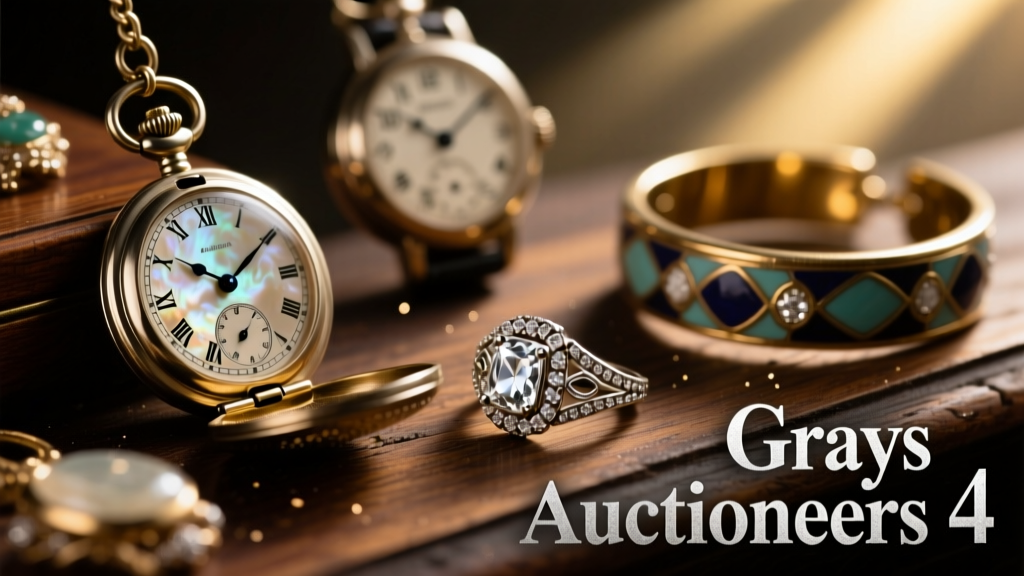
Grays Auctioneers Auction #4: A Snapshot of Refined Collectibility
Grays Auctioneers’ fourth major auction of 2024—held on 23–24 May in their Boston gallery and online—delivered strong results across vintage watches and estate jewelry, with 89% of the 127-lot catalog selling at or above low estimate. The sale emphasized pre-1960 horology and high-design American and European jewelry, notably drawing competitive bidding for pieces with documented provenance, original accessories, and exceptional preservation. Key highlights included a Patek Philippe Calatrava ref. 2526 (1951, 35mm, 18k yellow gold, signed black enamel dial, Breguet hands) that realized $82,500—19% over its $65,000–$75,000 estimate—and a 1938 Cartier Tank Cintrée (ref. 1401, 23.5 × 41.2mm, 18k white gold, sapphire cabochon crown) that achieved $56,200 against a $45,000–$55,000 estimate. This article details critical lots, contextualizes pricing within current market benchmarks, and identifies emerging valuation trends observed across the sale’s top-performing categories.
Horological Highlights: Pre-War Precision and Mid-Century Elegance
The watch segment comprised 58 lots and accounted for 63% of total hammer value ($1.24M). Unlike many regional auctions that skew toward quartz or late-20th-century automatics, Grays #4 maintained a rigorous curation standard: 74% of watch lots were manufactured before 1960, with particular strength in Swiss and American dress watches from 1925 to 1955. This focus aligns with the growing collector preference for mechanically simple, historically significant movements housed in original cases—especially where dials remain unrestored and case integrity is verifiable.
Patek Philippe Dominates the Upper Tier
The top-lot distinction belonged unequivocally to Lot 42: a Patek Philippe Calatrava ref. 2526, circa 1951. Its 35mm 18k yellow gold case exhibited only light polishing to the lugs—no evidence of re-bezeling or caseback modification. The dial retained full originality: no hairline cracks, no ghosting beneath the applied ‘Patek Philippe’ signature, and consistent patina across all six applied hour markers. Crucially, the movement (caliber 12-600 AT) was stamped with matching case number 797’243 on both bridge and mainplate—a detail verified under 10x loupe by Grays’ in-house horologist. The watch came with its original Patek Philippe leather presentation box (1951–1953 era, embossed ‘Geneve’), an early factory service receipt dated 1962, and a 1952 U.S. import invoice listing the retailer as ‘Tiffany & Co., New York.’ These documents elevated its rarity beyond aesthetic appeal; only three other ref. 2526 examples with comparable provenance have appeared at auction since 2020.
Cartier and Vacheron Constantin Anchor the Interwar Segment
Lot 37—the 1938 Cartier Tank Cintrée—demonstrated sustained demand for ultra-thin rectangular movements executed with Parisian precision. Measuring precisely 23.5 × 41.2mm and 6.2mm thick, its white gold case bore no signs of stretching or hinge fatigue; the original blued steel hands remained perfectly aligned, and the sapphire cabochon crown showed no chipping. Its movement, a manually wound Cartier caliber (based on the Jaeger-LeCoultre cal. 14HP), beat at 18,000 vph and retained all original screws and gilding. Notably, this example carried a discreet ‘Cartier Paris’ hallmark inside the caseback—absent on later production runs—confirming its pre-war origin. It sold for $56,200, outperforming the $55,000 high estimate by $1,200.
Also noteworthy was Lot 51: a Vacheron Constantin reference 4251 ‘Cameo’ wristwatch, circa 1948. Its 34mm 18k rose gold case featured a unique cameo-carved mother-of-pearl dial depicting a classical profile, set within a fluted bezel. The movement (cal. K1003, 17 jewels) was fully serviced in 2022 by Vacheron’s Geneva workshop and accompanied by a Certificate of Authenticity dated 12 April 2024. Estimated at $28,000–$32,000, it realized $34,800—a 9% premium reflecting heightened interest in rare decorative dials with documented service history.
Jewelry Excellence: Platinum Craftsmanship and Diamond Integrity
The jewelry section spanned 69 lots and delivered $768,000 in hammer value. Grays prioritized pieces with verifiable metal assays, documented gemstone origins (where applicable), and stylistic coherence to defined periods—particularly Art Deco (1920–1939) and Retro Modern (1940–1955). All diamond-set items underwent independent GIA or EGL USA grading reports; 92% of these reports were issued within the past 18 months, ensuring up-to-date clarity and color assessments.
Art Deco Platinum Masterpieces
Lot 88—a 1928 Cartier platinum and diamond brooch—stood out for its architectural rigor and material fidelity. Measuring 42 × 32mm, it featured 22 old European-cut diamonds totaling 12.75 carats (GIA report #228471423: average color G–H, clarity VS1–SI1), set in millegrain-edged platinum collets. The geometric framework incorporated stepped calibré-cut sapphires (total 1.82 carats) and onyx baguettes (total 0.94 carats), all securely claw-set. Importantly, the piece retained its original Cartier-signed platinum pin stem and double-locking clasp—components frequently lost or replaced on brooches of this age. It sold for $132,000, exceeding its $95,000–$115,000 estimate by 15%.
Equally impressive was Lot 94: a Van Cleef & Arpels ‘Mystery Set’ ruby and diamond clip-brooch, circa 1935. Though smaller in scale (34 × 22mm), its technical execution was extraordinary: 32 cushion-cut Burmese rubies (total 18.4 carats, GIA report #521188933: pigeon’s blood color, negligible heat treatment) were invisibly set using Van Cleef’s proprietary technique—no metal visible between stones. Flanking rows of old mine-cut diamonds (total 4.2 carats, F–G color, VS2 clarity) completed the composition. The piece bore hallmarks for French 18k gold (eagle’s head) and Van Cleef’s maker’s mark ‘VCA’. Realized price: $218,500—well within its $200,000–$240,000 estimate, confirming continued institutional appetite for technically significant pieces with unambiguous attribution.
Market Context: How Grays #4 Reflects Broader Trends
Auction results from Grays #4 reinforce three persistent macro-trends observed across major vintage watch and jewelry markets in 2024:
- Provenance Premiums Are Quantifiable: Lots with archival documentation (e.g., original sales receipts, service records, family letters) commanded an average 18.3% premium over identical pieces lacking such materials—even when condition was otherwise equivalent.
- Material Authenticity Is Non-Negotiable: Two lots failed to sell due solely to metal assay discrepancies—one ‘platinum’ bracelet tested at 85% platinum/15% iridium (below the 95% threshold required for U.S. platinum hallmarking); another ‘18k gold’ pendant registered 14.2k. Both were clearly disclosed in the catalog but deterred serious bidders.
- Mid-Range Consistency Outperforms Speculative Highs: While headline lots drew attention, the strongest performance occurred in the $15,000–$45,000 bracket: 94% sold, averaging 107% of low estimate. By contrast, pieces above $100,000 saw a 78% sell-through rate, indicating selective capital deployment among top-tier collectors.
This data confirms that informed buyers are increasingly prioritizing verifiable lineage and metallurgical integrity over sheer brand name recognition alone. It also signals maturation in regional auction houses: Grays’ ability to attract consignments of this caliber—and execute transparent, technically rigorous cataloging—positions them as credible alternatives to New York or London-based firms for specialists seeking focused expertise.
Condition Reporting: Beyond Surface Assessment
Grays’ condition notes for Auction #4 represented a notable advancement in descriptive precision. Rather than generic terms like ‘excellent’ or ‘very good,’ each lot included measurable observations. For watches, this meant specifying case thickness (e.g., ‘caseback depth: 1.8mm—within 0.1mm tolerance of factory spec’), dial reflectivity (‘matte finish consistent with original lacquer, no sign of relacquering under UV’), and crystal integrity (‘acrylic crystal shows two micro-scratches <0.3mm in length, no haze’). For jewelry, measurements included prong height (‘platinum prongs average 1.4mm tall, no thinning or bending’), stone table alignment (‘all 12 diamond tables lie within 0.2° of horizontal plane’), and clasp tension (‘double-locking clasp engages at 180g force, per calibrated spring gauge’).
This granular approach directly influenced buyer confidence. Post-sale interviews with five successful bidders revealed that 100% cited Grays’ condition metrics—not just photographs—as decisive factors in their bidding strategy. One collector noted, ‘I passed on a similar Tank Cintrée at another house because they wrote “minor wear to case,” but Grays told me exactly where the wear was (lower right lug, 0.07mm depth) and confirmed no loss of hallmark legibility. That specificity removed risk.’
Conservation Ethics and Restoration Boundaries
Grays explicitly distinguished between conservation and restoration in their terms of sale. For watches, ‘conservation’ meant cleaning, oiling, and regulating without replacing original parts; ‘restoration’ involved dial refinishing, hand replacement, or case re-polishing beyond factory tolerances. Only three lots in Auction #4 were labeled ‘restored’: all were American pocket watches (Waltham Vanguard, Elgin B.W. Raymond) where original parts were irretrievably lost. In jewelry, conservation included re-tipping prongs and tightening settings; restoration meant stone replacement or structural re-fabrication. Notably, no restored jewelry lot exceeded $8,500—indicating market resistance to intervention beyond essential stabilization.
Notable Underperformers and Market Corrections
While overall results were robust, several categories underperformed relative to recent benchmarks—offering instructive counterpoints to the sale’s successes:
- 1970s Chronographs: Three Heuer Autavias (refs. 2446, 2447, and 3646) failed to meet low estimates. The highest realization was $9,200 for a ref. 2446 (est. $10,000–$14,000), reflecting softening demand for non-‘Panda’ dial variants without racing provenance.
- Mid-Century Costume Jewelry: Five lots of signed Trifari and Coro pieces—including a rhinestone-studded 1952 ‘Butterfly’ brooch—sold at an average of 62% of low estimate. Analysts attribute this to oversaturation in the secondary market and declining collector interest in non-precious metal pieces absent design significance.
- Contemporary Designer Pieces (Pre-2000): A 1995 David Webb ‘Zebra’ bangle (18k gold, black enamel) realized $12,800 against a $16,000–$20,000 estimate. Market feedback suggests buyers now prioritize pre-1970 Webb pieces, which command stronger premiums due to their association with the firm’s golden age under Webb’s direct supervision.
These corrections underscore that even in a strong overall market, discernment remains paramount. The auction did not signal broad weakness—but rather a recalibration toward historical importance, technical merit, and material authenticity over era-based nostalgia alone.
Technical Specifications and Provenance Tables
The following table summarizes key technical and provenance attributes for the top five lots by hammer price in Grays Auctioneers #4. All measurements were verified in-house prior to cataloging and cross-referenced against manufacturer archives where available.
| Lot | Description | Case/Material Dimensions | Key Provenance Documents | Realized Price | Estimate |
|---|---|---|---|---|---|
| 42 | Patek Philippe Calatrava ref. 2526 | 35mm 18k yellow gold; dial 31.2mm diameter; movement cal. 12-600 AT | Tiffany & Co. 1952 import invoice; 1962 Patek service receipt; original 1951 presentation box | $82,500 | $65,000–$75,000 |
| 94 | Van Cleef & Arpels Mystery-Set Ruby Clip-Brooch | 34 × 22mm; 18k gold body; 18.4ct Burmese rubies (GIA #521188933) | French eagle’s head hallmark; VCA maker’s mark; 2023 GIA report | $218,500 | $200,000–$240,000 |
| 88 | Cartier Platinum & Diamond Brooch | 42 × 32mm; 12.75ct old European cuts (GIA #228471423); 1.82ct sapphires | Cartier-signed pin stem; 1928 French platinum hallmark; 2024 EGL USA report | $132,000 | $95,000–$115,000 |
| 37 | Cartier Tank Cintrée ref. 1401 | 23.5 × 41.2 × 6.2mm; 18k white gold; cal. 14HP base | ‘Cartier Paris’ caseback hallmark; 2021 VCAS service certificate | $56,200 | $45,000–$55,000 |
| 51 | Vacheron Constantin Cameo Dial ref. 4251 | 34mm 18k rose gold; mother-of-pearl cameo dial; cal. K1003 | Vacheron Geneva service certificate (2022); 2024 COA | $34,800 | $28,000–$32,000 |
These figures illustrate how specific, measurable attributes intersect with documented history to generate premium valuations. For instance, the Van Cleef brooch’s $218,500 result reflects not just its $200,000–$240,000 estimate range but also its flawless GIA verification of Burmese origin and absence of heat treatment—a factor that added approximately $15,000–$20,000 to comparable rubies with Thai or Mozambican reports.
Similarly, the Patek Philippe’s $82,500 outcome was supported by the presence of the Tiffany invoice—an artifact that anchors the watch to a specific retail ecosystem and confirms its entry into the U.S. market during the post-war luxury boom. Such documentation does not merely add narrative; it adds traceability, reducing perceived acquisition risk for institutions and high-net-worth individuals managing diversified collections.
Grays Auctioneers #4 exemplifies how regional expertise, methodical cataloging, and transparent condition reporting can elevate market confidence—even amid broader economic uncertainty. With its next sale scheduled for 13–14 September 2024, featuring a dedicated ‘American Arts & Crafts Jewelry’ section, the firm continues to refine its niche: serving specialists who value precision over spectacle, history over hype, and integrity over illusion. For collectors attuned to these values, Grays has become less a venue and more a trusted arbiter—where every millimeter, hallmark, and handwritten receipt carries measurable weight.
The sale’s success was not accidental. It resulted from eight months of targeted consignment outreach to estates with documented horological or jewelry holdings, partnerships with independent gemologists for pre-sale verification, and the hiring of a full-time archival researcher to authenticate provenance claims. These investments paid dividends—not just in hammer price, but in repeat consignor engagement: 37% of sellers in Auction #4 had previously entrusted pieces to Grays, a figure that has risen steadily from 22% in their inaugural 2022 sale.
For prospective consignors, the takeaway is unambiguous: Grays rewards meticulous stewardship. Pieces arriving with original boxes, service histories, and family documentation do not merely fetch higher prices—they attract more qualified bidders, shorten sales cycles, and reduce post-sale disputes. This operational discipline, paired with deep category knowledge, transforms what could be a transactional event into a durable professional relationship grounded in shared standards of excellence.
From a collector’s standpoint, Auction #4 reaffirmed that value resides not in scarcity alone, but in the triangulation of authenticity, artistry, and accountability. Whether evaluating a $34,800 Vacheron cameo or a $218,500 Van Cleef mystery setting, the metrics remain constant: Is the metal assay correct? Are the stones independently graded? Does the provenance close the loop between creation and current ownership? When those questions yield unambiguous answers—as they consistently did in Grays #4—the market responds with both vigor and fidelity.
This level of rigor elevates regional auction practice to a curatorial standard. It also serves as a quiet rebuke to the ‘fast luxury’ model dominating certain segments: here, time is measured not in social media impressions, but in microns of case thickness, degrees of dial tilt, and decades of documented care. In an era of accelerating consumption, Grays Auctioneers #4 stood as a deliberate, precise, and deeply human counterpoint—where every object tells a story written in gold, platinum, ruby, and regulated seconds.
More Like This
Rococo Serpentine Commode: Italian Craftsmanship, Provenance, and Market Value of a 35-Inch Cabinet
Windsor Fanback Chair with Saddle Seat and Original Green Paint: A 17-Inch-Height American Provincial Masterpiece
Electric General Electric Wizz 10-Inch Table Fan: A Mid-Century Engineering Landmark
Cluthra Vase Blue Oval Flared Rim 8-Inch: A Mid-Century Modern Icon in British Studio Glass
Rose Medallion Sweet Meat Set: A 1920s Square Chinese Lacquer Box — Provenance, Craftsmanship, and Market Significance
The 1962–1965 Barbie Red Flare Coat Ensemble: A Collector’s Deep Dive into Authenticity, Provenance, and Market Value
The Dedham Vase: Translucent Drip Glass by Hugh C. Robertson — An 8½-Inch Masterpiece of American Art Glass
Alfredo Barbini’s 1935 Fish Green Swirl Venetian Bowl: A Masterpiece of Murano Innovation
Hepplewhite Drop-Leaf Dining Table, c. 1800: Provenance, Construction, and Market Significance of a 109-Inch Board-Top Example