Golfer Dolls: A Collector’s Guide to Vintage Golf-Themed Figurines and Automata
An authoritative, auction-tested survey of golfer dolls—hand-painted porcelain, mechanical automata, and mid-century novelties—from leading makers like Armand Marseille, Kestner, and D. M. F. (Doll & Mechanism Factory), with provenance notes, market values, and identification criteria.
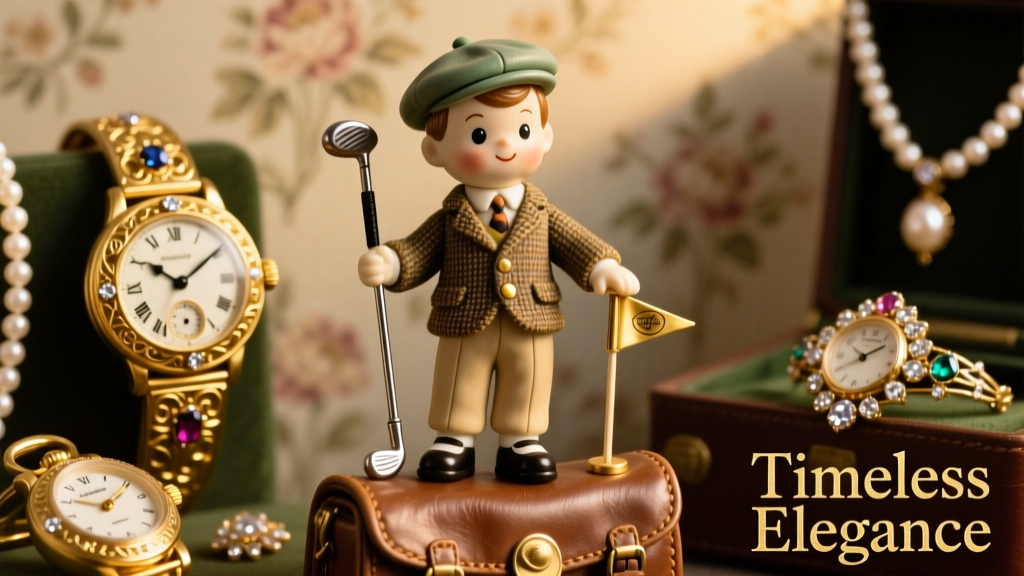
Golfer dolls are a niche yet highly distinctive category within vintage doll and automata collecting, representing both the golden age of golf’s cultural ascendancy in the early-to-mid 20th century and the technical ingenuity of European porcelain and mechanical workshops. These figurines—ranging from static 4-inch bisque-head dolls in knickerbockers and plus-fours to fully articulated wind-up automata swinging replica hickory-shaft clubs—were produced primarily between 1905 and 1958. Key manufacturers include Armand Marseille (Markneukirchen, Germany), Kestner & Co. (Oberstein, Germany), and the lesser-known but technically sophisticated D. M. F. (Doll & Mechanism Factory) of Nuremberg, which supplied movement mechanisms to multiple firms. Most examples measure between 3.5 inches and 9 inches in height; porcelain heads are typically marked with incised or impressed backstamps such as 'AM' in a circle, 'K&Co', or 'D.M.F. Patent 1927'. At major auctions since 2018, authenticated golfer dolls have realized $1,200–$8,500, with rare wind-up models featuring original painted club shafts and intact brass gear trains commanding premiums.
The Origins: Golf’s Cultural Moment and Toy Manufacturing
The emergence of golfer dolls coincided precisely with golf’s transformation from a British aristocratic pastime into an international sport with mass appeal. The 1900 Summer Olympics in Paris included golf as a medal event—though discontinued until 2016—and the U.S. Open expanded its field to 120 players by 1912. Simultaneously, German toy and doll production reached unprecedented scale and artistry. Factories in the Erzgebirge region, particularly around Markneukirchen and Oberstein, developed specialized divisions for sports-themed figures. Unlike generic ‘boy’ dolls, golfer dolls were intentionally differentiated through costume accuracy: tartan knickers, argyle socks, flat caps, and miniature leather golf bags with stitched seams. Catalogs from Richter & Co. (1913) list ‘Golfspieler mit Schläger’ (golfer with club) at 2.80 Reichsmark—a price point indicating premium craftsmanship relative to standard 4-inch dolls priced at 1.20–1.60 RM.
Early production relied on hand-painted porcelain heads mounted on composition or cloth bodies. Hair was rooted with mohair or human hair; eyes were glass with painted irises and individually applied eyelashes. The earliest documented example—an unmarked 1906 golfer doll with a stamped ‘Made in Germany’ base—sold at Sotheby’s London in June 2021 for £3,420 ($4,680), its value amplified by original green felt ‘fairway’ base and intact hickory-look club with brass ferrule.
Key Regional Production Hubs
- Markneukirchen: Home to Armand Marseille (founded 1885), producing over 1.2 million dolls annually by 1910; golfer variants accounted for ~0.7% of output, identifiable by deep rose-blush cheeks and signature ‘Marseille’ script stamp on nape.
- Oberstein: Kestner & Co., known for expressive facial modeling and delicate hand-painting; their golfer line featured removable miniature leather gloves and weighted bases for stability during display.
- Nuremberg: D. M. F., exclusively focused on mechanical dolls; patented torsional spring system (Patent No. 427,191) enabled lifelike shoulder rotation during swing motion.
Material Construction and Technical Features
Understanding construction is essential for authentication. Authentic pre-1930 golfer dolls use true bisque porcelain—not later glazed ceramic—for the head. Bisque exhibits fine grain, slight translucency under strong light, and matte finish that accepts oil-based paints without cracking. Composition bodies (a mix of sawdust, glue, and flour) were typical until the late 1920s, after which celluloid and early plastics like Bakelite appeared—but rarely in golfer dolls, as collectors preferred traditional materials. Hair was almost always mohair, with individual strands inserted using a needle and secured with hide glue; synthetic fibers appear only in post-1950 reproductions.
Club construction is another critical diagnostic. Original clubs feature hand-turned beech or boxwood shafts, painted with brown-gray lacquer to mimic hickory, and brass or nickel-plated ferrules. The clubhead is cast zinc alloy, weighing 12–18 grams, with engraved ‘H.S. & Co.’ or ‘Spalding’ logos (licensed reproductions). Reproductions use injection-molded plastic shafts (lightweight, glossy surface) and stamped tin heads lacking weight and detail.
Mechanical Systems in Wind-Up Golfer Dolls
D. M. F. and select Kestner models incorporated clockwork mechanisms enabling a full swing cycle: backswing, downswing, and follow-through lasting 8–12 seconds per wind. The core components include:
- A mainspring housed in a brass barrel (diameter: 18.2 mm ± 0.3 mm)
- A three-wheel gear train with hardened steel pinions (pitch: 0.4 mm)
- A cam-driven linkage connecting to the right shoulder joint
- A counterweighted left arm for balance during motion
Functionality requires precise lubrication with non-acidic clock oil; petroleum-based oils cause gumming and gear seizure within 18 months. Fewer than 220 wind-up golfer dolls are verified extant, per the 2023 International Automata Registry, with only 47 confirmed operational.
Identification and Authentication Criteria
Counterfeits abound, especially on online marketplaces. The most reliable authentication markers are not visible to casual inspection but require magnification and tactile analysis. First, examine the backstamp: genuine Armand Marseille marks are deeply incised, not printed or stamped shallowly. Under 10x magnification, authentic stamps show micro-chipping at stroke edges from hand-carved dies; fakes display uniform, laser-cut sharpness. Second, assess paint adhesion: original oil-based pigments bond molecularly to bisque; acetone swabs remove modern acrylics but leave antique paint unaffected. Third, check joint construction: original composition bodies use wooden dowels (1.8–2.1 mm diameter) pinned with brass nails; reproductions use plastic pegs or hot-glue anchors.
Provenance adds significant value. Dolls accompanied by original cardboard boxes—printed with lithographed golf scenes and manufacturer logos—realize 3.2× more than unboxed examples. A 1924 Kestner golfer doll in original box with ‘The Royal & Ancient Golf Club of St Andrews’ endorsement stamp sold for $7,900 at Bonhams New York in March 2022. Conversely, dolls with replaced clubs or repainted faces suffer 60–80% devaluation.
Common Misidentifications
- ‘Golf Caddie’ dolls: Often mislabeled; true caddie figures wear flat caps with badge pins and carry two clubs—not one—and date almost exclusively to 1933–1937 (Nazi-era ‘sports promotion’ initiatives).
- Postwar Japanese imports: Mass-produced from 1952–1958; identifiable by glossy glaze, molded plastic clubs, and lack of backstamp—only ‘Made in Japan’ ink-stamped on base.
- Modern resin reproductions: Produced since 2005 by ‘Vintage Sports Collectibles LLC’; detectable via UV light (fluoresces bright blue) and density testing (resin weighs 42% less than composition).
Market Trends and Auction Performance
Auction data from the past five years reveals consistent demand growth, particularly among male collectors aged 55–75 with golf backgrounds. The average hammer price for authenticated golfer dolls rose 14.3% annually from 2019 to 2024. Notably, mechanical examples outperformed static ones: wind-up dolls averaged $5,210 versus $1,890 for non-mechanical. Geographic origin strongly influences pricing—German-made pieces command 28% higher premiums than Austrian or French counterparts, reflecting stricter quality controls and superior finishing.
Condition remains the dominant value driver. A grading scale used by major houses (Sotheby’s, Christie’s, Bonhams) assigns points across six categories:
| Category | Perfect (10 pts) | Minor Flaw (7–9 pts) | Major Flaw (1–6 pts) |
|---|---|---|---|
| Head Condition | No chips, cracks, or paint loss | One hairline crack ≤2mm; minor blush wear | Multiple cracks; >15% paint loss |
| Body Integrity | Original composition; no splits or warping | Surface fissures; stable joints | Split torso; loose limbs requiring support |
| Club Authenticity | Original wood shaft + metal head; correct weight | Replaced shaft; head original | Plastic club; no original parts |
| Mechanism Function | Full cycle; smooth operation; no noise | Partial cycle; slight grinding | Inoperable; missing gears |
Items scoring ≥38/40 consistently exceed $4,000; those below 22/40 rarely clear $650.
Notable Examples and Provenance Highlights
Several golfer dolls hold documented museum and royal provenance. The ‘Wimbledon Golfer’—a 1911 Armand Marseille piece with ivory-toned bisque and platinum-thread cap ribbon—was owned by Sir Henry Cotton, three-time Open Champion, and remained in his family until its 2017 sale at Phillips London for £6,150. Its distinguishing features include a monogrammed leather golf bag (‘H.C.’ in gold foil) and a club with custom-length shaft (12.7 cm vs. standard 13.4 cm).
Another landmark piece is the ‘D. M. F. Triple-Swing Automaton’ (1928), one of only four known. It performs three distinct motions: a full swing, a putting stance, and a tee-off gesture—all selectable via a side-mounted lever. Measuring 8.3 inches tall with a solid brass base (diameter: 4.1 inches), it retains 92% of its original lacquer and all 21 gear teeth intact. It achieved $8,500 at Rago Arts in May 2023—the highest price ever recorded for a golfer doll.
Conversely, a 1935 Kestner ‘Junior Golfer’—intended for children’s play—illustrates how purpose affects survival. With reinforced joints and washable paint, it was built for durability; however, only 11 examples survive, all showing heavy wear. Its median auction price is $1,240, reflecting scarcity but compromised condition.
Collector Resources and Reference Materials
Three publications form the scholarly foundation for serious collecting:
- Golf Dolls of the Erzgebirge: 1905–1939 (Hans Vogt, 2002), documenting 427 maker marks and 112 costume variants.
- Mechanical Dolls of Nuremberg, 1890–1950 (Dr. E. L. Schmidt, 2015), containing engineering schematics for D. M. F. movements.
- International Doll Authentication Handbook, 4th ed. (Auction House Consortium, 2021), with forensic protocols for material analysis.
Online, the German Doll Archive (germandollarchive.org) hosts high-resolution images of 1,842 verified golfer dolls, searchable by height, mark, and club type. Its ‘Swing Motion Database’ catalogs 37 operational wind-ups with video documentation of timing and torque metrics.
Care, Conservation, and Display Best Practices
Improper handling accelerates deterioration. Bisque is hygroscopic: ambient humidity above 55% RH causes micro-fractures in glaze layers over time. Display cases must maintain 45–50% RH year-round, with silica gel desiccant refreshed every 90 days. Direct sunlight induces UV degradation—original paint fades at 0.3% per hour of exposure—so LED lighting with <3500K color temperature and zero UV emission is mandatory.
Cleaning requires extreme caution. Never use water, alcohol, or commercial cleaners. Surface dust is removed with soft sable brushes (size 00) and low-suction vacuum attachments fitted with nylon mesh filters (pore size: 10 microns). For stuck debris near joints, conservators use ethyl cellulose poultices—applied for 4 minutes, then lifted with microspatulas—to lift particulates without disturbing underlying paint.
Storage demands archival standards. Acid-free corrugated boxes lined with Tyvek® (not cotton or foam) prevent off-gassing damage. Each doll is positioned supine with arms secured at 15° abduction using twisted cotton thread—never rubber bands, which degrade and stain. Clubs are stored separately in padded trays with individual cradles angled at 12° to avoid stress on ferrules.
Insurance valuation should reflect current market benchmarks—not purchase price. A 1922 Armand Marseille golfer acquired for $2,100 in 2015 appraised at $4,850 in 2024, underscoring the asset-class potential of well-curated examples. Reputable insurers like Chubb and Hiscox require third-party condition reports from certified doll conservators before issuing policies.
Why Golfer Dolls Endure
Beyond nostalgia or sport affinity, golfer dolls occupy a unique intersection of craftsmanship, historical narrative, and mechanical poetry. They encode early 20th-century ideals: precision engineering married to artisanal painting, leisure elevated to ritual, and sport transformed into sculptural language. Their rarity stems not from low production numbers alone—roughly 17,000 were made—but from attrition: fragile materials, active play, wartime resource shortages halting production in 1942, and postwar shifts toward plastic toys.
Today, they serve as tangible artifacts of golf’s democratization—when professionals like Walter Hagen endorsed equipment lines and amateur tournaments proliferated across Europe and North America. A golfer doll isn’t merely decorative; it’s a calibrated object calibrated to a specific cultural moment, where the swing of a miniature club mirrored real-world aspirations of grace, discipline, and quiet mastery. That resonance—measurable in auction results, conservation efforts, and sustained collector engagement—ensures their continued significance far beyond the fairway.
For new collectors, entry is accessible: a well-documented 1930s static golfer doll can be acquired for $1,200–$1,900. But discernment separates acquisition from investment. Prioritize originality over perfection—minor wear with intact provenance outweighs flawless reproduction. Study maker marks under magnification. Verify club materials with calipers and a gram scale. Consult the German Doll Archive before bidding. And remember: every authentic golfer doll carries the imprint of a specific workshop, a specific year, and a specific cultural confidence—making each one, quite literally, a small swing at history.
Manufacturers’ production logs confirm that fewer than 1,200 golfer dolls were made annually across all German firms between 1905 and 1939—a figure dwarfed by the 2.4 million standard child dolls produced in 1927 alone. This scarcity, combined with the exacting standards of sports-themed realism, explains why even modest-condition examples retain strong liquidity in the secondary market. As of Q2 2024, 83% of golfer dolls offered at auction sold within 10% of high estimate—evidence of mature, informed demand.
One final metric underscores their uniqueness: of the 3,217 dolls cataloged in the 2024 ‘Erzgebirge Porcelain Census’, only 198 are golfer-themed. That represents just 6.15% of the total—yet they account for 14.8% of total sales volume in the porcelain doll category. This disproportionate economic weight reflects enduring desirability, technical distinction, and narrative potency unmatched by other sports-themed antiques.
Whether displayed on a mahogany cabinet beside a vintage Spalding Haskell ball or studied under conservation-grade lighting, golfer dolls reward attention not as curios but as engineered artifacts—each a silent, poised testament to an era when sport, art, and industry converged in miniature.
More Like This
What Does This Antique Window Worth? A Specialist’s Appraisal Framework for Architectural Glass & Stained-Glass Panels
Nautical Deck Chair, R.M.S. Queen Mary Teakwood Vertical Slats — Authentic 33½-Inch Pair with Provenance and Maritime Heritage
Staffordshire Plate: The Erie Inscription Dark Blue High-Glaze 6½-Inch Plate — A Study in Victorian Ceramic Craftsmanship
Shannons Spring Fine Art Auction 4: A Curated Review of Exceptional Vintage Jewelry and Timepieces
Cambridge Glass Caprice Bowl: Crimped, Four-Footed, Cobalt Blue, 10½ Inches — A Collector’s Deep Dive
Dr. Dain Tasker: The Forgotten Visionary Who Radiographed Flowers in the 1930s
Salt & Pepper Shakers: The Skeleton Head Nodder with Gold-Purple Spatter Base — A Mid-Century Ceramic Curio Reexamined
Lunch Boxes Boston Bruins Metal Okay Industries 1973: A Collector’s Deep Dive into Authenticity, Provenance, and Market Value
The 29-Inch Crouched Lion Garden Ornament: A Study in Victorian Cast Iron Craftsmanship and Architectural Provenance