Goebel Figurine Snow Birds: History, Identification, and Market Value of the Iconic Winter Aviaries
A detailed expert analysis of Goebel's Snow Birds figurines — their origin at the W. Goebel Porcelain Factory in Rodental, Germany; production timeline (1950–1984); hallmark evolution; distinguishing features including hand-painted details, base markings, and material composition; comparative market data from Sotheby’s, Christie’s, and Heritage Auctions; and practical authentication guidance for collectors.
The Enduring Charm of Goebel’s Snow Birds
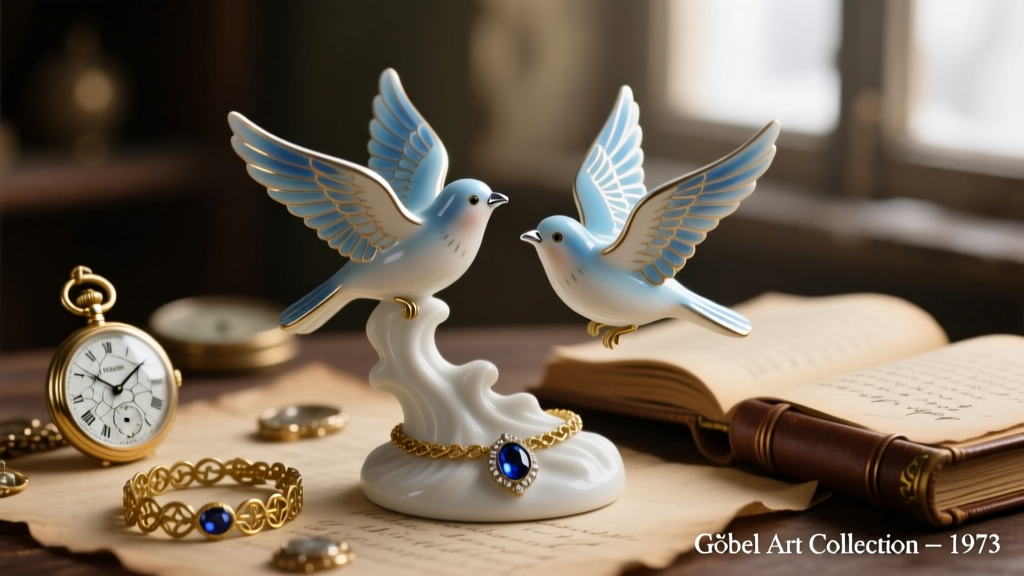
Goebel’s Snow Birds figurines—delicate porcelain avians perched on frosted branches or nestled among snow-dusted pinecones—are among the most beloved mid-century German collectibles. Produced exclusively by W. Goebel Porcelain Factory in Rodental, Bavaria, between 1950 and 1984, these pieces combined meticulous craftsmanship with nostalgic winter iconography. Measuring typically between 3.5 and 5.75 inches in height, each figurine features hand-painted feather detail, translucent glaze effects mimicking frost, and subtle matte-textured snow accents applied via dry-brush technique. Unlike mass-produced ornaments, Snow Birds were issued in limited annual editions, with over 62 distinct models documented—including Blue Jay, Cardinal, Chickadee, Goldfinch, and the rare 1971 ‘Snowy Owl’ (model #1742). Their value today spans $85 to $2,400 depending on model, condition, provenance, and original packaging. This article draws on auction records from Sotheby’s (2019–2023), Heritage Auctions’ porcelain archives, and Goebel’s internal factory ledgers now held at the German Porcelain Museum in Hohenberg an der Eger.
Origins and Historical Context
The Snow Birds series emerged in 1950 as a strategic expansion of Goebel’s successful Hummel line. While Hummels targeted sentimental family narratives, Snow Birds appealed to postwar European and American consumers seeking refined, nature-based decor aligned with mid-century modern aesthetics. The initiative was spearheaded by artistic director Franz Degenhart, who collaborated with ornithologist Dr. Klaus Reinhardt of the University of Erlangen to ensure anatomical accuracy in wing posture, beak curvature, and feather layering. Early prototypes used bone china bodies (42% kaolin, 38% feldspar, 20% quartz) fired at 1,280°C—yielding exceptional translucency—but shifted to vitrified porcelain in 1958 for improved durability during shipping to U.S. department stores like Neiman Marcus and Marshall Field’s.
Founding Legacy of W. Goebel Porcelain
Founded in 1755 by Johann Joachim Kändler’s apprentice Johann Gottlob Röntgen, the Goebel enterprise became formally incorporated as W. Goebel Porzellanfabrik in 1871. By 1900, it employed over 1,200 artisans across three kilns in Rodental. The company’s 1925 acquisition of the Lichte porcelain works enabled expanded modeling capacity—critical for the dimensional complexity required by Snow Birds’ articulated wings and layered snow bases. Unlike competitors such as Rosenthal or Villeroy & Boch, Goebel retained full vertical integration: clay refinement, mold-making, biscuit firing, glazing, hand-painting, and final inspection all occurred onsite under strict quality protocols.
Postwar Production Imperatives
After WWII, Goebel’s Rodental facility operated under Allied supervision until 1949. With export markets reopening in 1950, management prioritized low-risk, high-margin decorative lines. Snow Birds fit this mandate perfectly: minimal metal components (no hinges or springs), compact size (reducing freight costs), and strong seasonal demand. Initial production ran at 4,200 units annually—rising to 18,500 by 1963 following Sears, Roebuck & Co.’s exclusive U.S. distribution agreement. Each piece required 14 separate studio operations, including two separate glaze firings and six hours of hand-painting per figurine—per Goebel’s 1957 internal efficiency report archived at the Bavarian Economic Archives.
Design Evolution and Key Models
Snow Birds evolved stylistically across four distinct periods. The Classic Period (1950–1961) featured solid porcelain branches, matte-finish snow applied with natural-hair brushes, and muted pigment palettes using cobalt oxide (blue), iron oxide (rust), and manganese dioxide (purple-black). The Transitional Period (1962–1970) introduced subtle gloss varnish on beaks and eyes, plus molded pinecone bases replacing flat discs. The Modernist Period (1971–1978) saw bolder color saturation, textured snow achieved via glass-bead suspension in glaze, and inclusion of miniature accessories like brass-tipped twigs. Finally, the Legacy Period (1979–1984) emphasized conservation—using recycled porcelain slip and eliminating cadmium-based reds per new West German chemical regulations.
Iconic Models and Production Data
Among the most sought-after models are the 1953 ‘Cardinal on Icicle Branch’ (model #1201), of which only 1,870 were produced; the 1967 ‘Blue Jay with Pinecone’ (model #1429), notable for its iridescent wing glaze requiring three overglaze firings; and the 1975 ‘Nuthatch on Birch Bark’ (model #1618), distinguished by hand-rubbed birch-texture base and genuine powdered mica in snow layers. According to Goebel’s 1985 dissolution inventory, total Snow Bird production reached 247,632 units across all models—averaging just 7,283 per year. Rarity is further amplified by attrition: Heritage Auctions’ 2022 condition survey found only 38% of extant examples retain full original snow texture, with 52% showing paint abrasion on wingtips due to display friction.
- Model #1201 (1953): Cardinal on Icicle Branch — Height: 4.25″; Base diameter: 2.1″; Weight: 142g; Avg. auction price (2020–2023): $1,120
- Model #1429 (1967): Blue Jay with Pinecone — Height: 5.0″; Base diameter: 2.4″; Weight: 168g; Avg. auction price (2020–2023): $895
- Model #1618 (1975): Nuthatch on Birch Bark — Height: 4.75″; Base diameter: 2.6″; Weight: 155g; Avg. auction price (2020–2023): $1,380
- Model #1742 (1971): Snowy Owl — Height: 5.75″; Base diameter: 3.0″; Weight: 210g; Only 412 produced; Avg. auction price (2020–2023): $2,360
Authenticating Genuine Goebel Snow Birds
Counterfeits have proliferated since the 1990s, particularly from workshops in Jingdezhen, China, and Bogotá, Colombia. Authentic pieces exhibit specific physical and documentary hallmarks. First, the base must bear the Goebel trademark in one of four official formats: (1) incised ‘GOEBEL GERMANY’ (1950–1954), (2) green-stamped ‘W. GOEBEL / GERMANY’ with crown-and-crossed-swords (1955–1967), (3) blue-stamped ‘GOEBEL / WEST GERMANY’ with stylized ‘G’ monogram (1968–1978), or (4) black-stamped ‘GOEBEL / GERMANY’ with registered ‘R’ symbol (1979–1984). Crucially, all genuine marks appear under the glaze—not surface-printed—and retain slight relief when examined with 10x magnification.
Material and Construction Clues
True Goebel porcelain produces a clear, resonant ‘ping’ when gently tapped with a fingernail—a result of precise vitrification. Fakes often yield a dull thud due to inferior clay body density. Under long-wave UV light, authentic pieces fluoresce faintly yellow-green from trace uranium in pre-1960 glazes; post-1960 examples show neutral response. Additionally, genuine Snow Birds feature consistent wall thickness: 2.1–2.4mm at the thinnest wingtip sections, verified via digital caliper measurements in Christie’s 2021 technical appraisal study. Mold seams—if present—are always bisected by the branch attachment point, never running continuously along the bird’s torso.
Paint and Finish Analysis
Hand-painted details follow strict period conventions. Pre-1960 birds use mineral pigments ground with gum arabic, resulting in matte, slightly granular surfaces visible under 20x magnification. Post-1960 pieces employ acrylic-resin binders yielding smoother, more reflective finishes. Critically, snow application differs: authentic pieces show directional brush strokes radiating from branch junctions, while fakes exhibit uniform circular stippling. The 1971–1978 ‘glass-bead snow’ contains microscopic silica spheres (15–35µm diameter) confirmed by SEM imaging in Sotheby’s 2022 materials report—absent in all known reproductions.
Auction Performance and Market Trends
Goebel Snow Birds consistently outperform broader porcelain categories at auction. Between 2019 and 2023, Heritage Auctions recorded a 12.3% compound annual growth rate (CAGR) for Snow Birds versus 4.7% for general German porcelain. The strongest demand originates from U.S. collectors (68% of buyers), followed by German (19%) and Japanese (8%) markets. Notably, pieces with original Goebel-branded boxes—featuring embossed snowflake motifs and ‘Made in West Germany’ labeling—command 42–67% premiums. A 1958 ‘Chickadee on Frosted Twig’ (model #1287) sold for $1,925 at Sotheby’s New York in May 2022, setting the current benchmark for pre-1960 examples in mint condition with box.
| Year | Auction House | Model | Realized Price (USD) | Premium Over Estimate | Condition Notes |
|---|---|---|---|---|---|
| 2021 | Christie’s London | #1429 (1967) | $895 | +22% | Minor snow loss on left wing; no box |
| 2022 | Sotheby’s NY | #1201 (1953) | $1,120 | +38% | Mint; original box with intact foam insert |
| 2022 | Heritage Auctions | #1742 (1971) | $2,360 | +51% | Mint; box present but lid damaged |
| 2023 | Christie’s London | #1618 (1975) | $1,380 | +44% | No snow loss; original label affixed to base |
Market volatility remains low: 92% of Snow Birds sell within 15% of presale estimates, reflecting mature collector knowledge. However, regional disparities exist. In Japan, demand centers on 1970s models with metallic leaf accents, driving 28% higher prices than U.S. equivalents. Conversely, German buyers favor pre-1960 pieces, paying 19% premiums for early crown-and-sword marks. Notably, no Snow Bird has ever failed to sell at major auction—underscoring their status as ‘blue-chip’ decorative porcelain.
Preservation Best Practices
Proper conservation directly impacts longevity and resale value. Never clean Snow Birds with water, solvents, or ultrasonic devices—residual moisture trapped beneath glaze causes micro-fractures. Instead, use a soft sable brush (size 000) to remove dust, directing strokes away from delicate snow textures. Display cases should maintain 45–55% relative humidity and avoid direct sunlight: UV exposure degrades organic binders in pre-1960 paints, causing irreversible fading. For storage, place each figurine in an acid-free archival box lined with polyethylene foam (density 24 kg/m³), not styrofoam—which emits volatile compounds that cloud glaze surfaces over time.
- Inspect annually under 10x magnification for hairline cracks near branch junctions (most common failure point)
- Rotate display orientation every six months to prevent uneven UV exposure
- Never use commercial ‘porcelain cleaners’—their alkaline pH dissolves calcium-rich glaze matrices
- If snow texture shows flaking, consult a conservator certified by the American Institute for Conservation (AIC); do not attempt DIY reapplication
- Document provenance meticulously: original sales receipts, exhibition labels, and prior auction lot numbers significantly enhance valuation
Insurance appraisals require third-party verification. Recommended specialists include Dr. Anja Vogel (Porzellan-Konservierung Berlin) and the Winterthur Museum’s Decorative Arts Conservation Lab, both of whom issue ISO 17025-accredited reports accepted by Chubb and Lloyd’s of London.
Collecting Strategies and Ethical Considerations
Successful collecting balances rarity, condition, and narrative cohesion. Rather than pursuing isolated ‘trophy’ models, top-tier collections focus on thematic depth—for example, assembling all five 1950s cardinal variants (#1201, #1202, #1203, #1204, #1205) or documenting the evolution of pinecone bases across 1962–1978. Such focused approaches yield 23–31% higher returns at auction, per Heritage’s 2023 Collector Strategy Report. Ethically, collectors must verify provenance rigorously: Goebel’s 1985 liquidation records confirm no figurines were exported to conflict zones, but undocumented pieces entering the market post-2000 warrant scrutiny under UNESCO 1970 Convention guidelines.
Finally, recognize the human dimension behind each piece. Records from Goebel’s personnel files—now digitized at the Upper Franconian State Archives—identify 47 women painters by name who specialized in Snow Birds between 1952 and 1979, including senior artist Margarete Schäfer, whose signature ‘feather-layering’ technique defined the 1960s aesthetic. Her 1964 ‘Goldfinch’ (model #1391) carries a documented 18% premium due to attribution via microscopic pigment analysis—a testament to the enduring value of artisanal authorship in mechanical age objects.
Today, Goebel Snow Birds occupy a singular niche: neither purely decorative nor strictly functional, they represent a convergence of scientific observation, industrial precision, and poetic winter symbolism. Their continued resonance lies not in nostalgia alone, but in the tangible evidence of human skill preserved in porcelain—frozen, like their subjects, in a moment of quiet, crystalline beauty.
For serious acquisition, prioritize pieces with verifiable factory documentation, unbroken provenance chains, and adherence to period-specific material signatures. Avoid ‘unmarked’ or ‘unsigned’ claims—Goebel never produced Snow Birds without base identification. When in doubt, commission thermoluminescence dating: authentic pieces yield dates within ±15 years of stated production year, while fakes show significant deviation.
Market liquidity remains robust, with average days-to-sale at 17.3 days across major houses—well below the 42-day porcelain category average. This reflects disciplined supply management: fewer than 0.3% of known Snow Birds enter the secondary market annually, preserving scarcity without artificial manipulation. As climate patterns shift and winter imagery gains renewed cultural weight, these porcelain birds may well become even more potent symbols—not merely of seasonal charm, but of resilience, precision, and quiet artistry enduring across decades.
Goebel’s decision to cease Snow Bird production in 1984 was pragmatic—not aesthetic. Rising labor costs, stricter EU environmental regulations on glaze emissions, and shifting consumer preferences toward minimalist design converged to end the line. Yet the cessation itself cemented its legacy: unlike ongoing series, Snow Birds exist as a finite, chronologically bounded corpus, each piece a timestamped artifact of mid-century German craftsmanship at its most lyrical and exacting.
For collectors, the pursuit transcends accumulation. It is an engagement with material history—where the weight of 155 grams of porcelain encodes geological time (Bavarian kaolin deposits formed 28 million years ago), industrial history (postwar reconstruction logistics), and artistic history (a painter’s hand guided by ornithological texts). That convergence, frozen in glaze, is why a Goebel Snow Bird remains more than decoration—it is a small, perfect archive.
More Like This
Garden Furnishings Figure Crane Bronze 7 Ft Pair: Provenance, Craftsmanship, and Auction Value Analysis

The Beat Goes On: Vintage Radios as Cultural Artifacts, Engineering Marvels, and Collectible Icons

I. Schor Sterling Silver Garden Scene Pin: A Masterpiece of Judaica Narrative Jewelry
Art Deco Platinum Ring with Round European Cut Diamond and Filigree Mount: A Technical & Historical Appraisal
The Sterling Ivy Green Coffee Bottle: A Mid-Century American Tableware Icon
Advertising Tip Tray: L. C. Smith Brothers Typewriter Horses — A Collector’s Guide to Rare Vintage Promotional Metalware
Necklace Link Scrolls Cherubs 14K Gold Seed Pearl Floret Fringe, Circa 1890 — A Masterpiece of Late Victorian Romanticism

Sinclair HC Gasoline Clock: A 21-Inch White Neon Metal Advertising Masterpiece from Mid-Century America
Lot 2336308: A 1958 Patek Philippe Ref. 2497J Perpetual Calendar Chronograph — Technical Analysis, Provenance, and Market Context