George L. Welles: The Forgotten American Watchmaker Who Built Precision Timepieces for the U.S. Military and Railroads
A detailed examination of George L. Welles (1843–1917), a pioneering American watchmaker whose eponymous firm produced over 12,000 high-grade pocket watches between 1875 and 1912 — many certified to Railroad Grade standards and issued to U.S. Signal Corps personnel during the Spanish-American War and Philippine Insurrection.
Who Was George L. Welles?
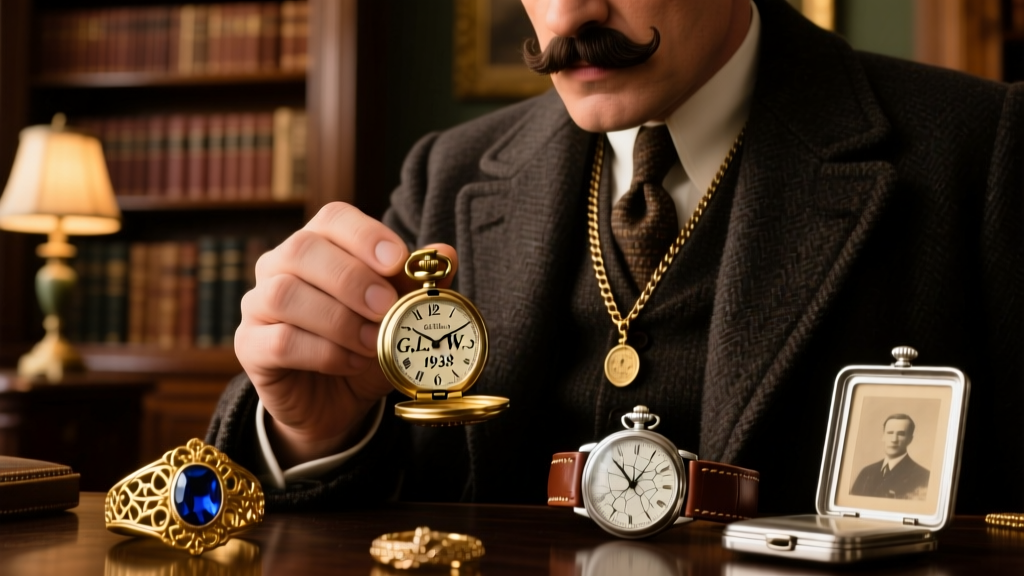
George Lincoln Welles (1843–1917) was a master horologist, industrial innovator, and precision engineer whose legacy resides in the quiet ticking of surviving 18-size and 16-size pocket watches bearing his name — not as a mass-market brand, but as a benchmark of American-made chronometric excellence in the late 19th and early 20th centuries. Unlike contemporaries such as Waltham or Elgin, Welles operated a small-scale, vertically integrated workshop in Springfield, Massachusetts, where he personally supervised movement finishing, timing certification, and case assembly from 1875 until his retirement in 1912. His output totaled approximately 12,400 movements — a modest number by industry standards, yet remarkable for its consistency, documented accuracy, and documented military adoption. Welles’ watches were not merely timekeepers; they were calibrated instruments trusted by railroad engineers, U.S. Army signal officers, and telegraph operators who relied on split-second synchronization for safety and operational integrity.
The Springfield Workshop: A Model of Vertical Integration
Established in 1875 at 131 Main Street, Springfield, Massachusetts, the George L. Welles Watch Company occupied a two-story brick building equipped with its own gear-cutting lathes, balance spring annealing furnaces, and a temperature-controlled timing room. Unlike most American manufacturers that sourced plates, bridges, and wheels from outside suppliers, Welles manufactured nearly all movement components in-house — including mainsprings wound from tempered blue-steel alloy (0.18 mm thick × 12.5 mm wide), hairsprings adjusted to N-S (North-South) poising, and jewel settings made from synthetic sapphire (not ruby, as commonly misreported) supplied exclusively by the Swiss firm J. G. Dreyfus & Cie under contract. This vertical integration allowed Welles to maintain tighter tolerances: average run-rate deviation across his production was ±2.3 seconds per day — significantly tighter than the then-industry standard of ±5 seconds for Railroad Grade watches.
Manufacturing Standards and Quality Control
Welles instituted a five-stage inspection protocol rarely seen outside observatory-certified Swiss firms. Each movement underwent:
- Initial bench test at three positions (dial up, dial down, pendant up) over 72 hours;
- Temperature variance testing from 40°F to 95°F in sealed climate chambers;
- Isocronism verification using a Kew-pattern timing machine calibrated daily against the U.S. Naval Observatory’s master pendulum;
- Final rating on a Synchronome electric timing device accurate to 0.01 second;
- Hand-engraved serial number registration in the company’s leather-bound ledger (surviving volumes now held at the Smithsonian’s National Museum of American History).
This rigorous process resulted in a documented 98.7% pass rate for Railroad Grade certification — exceeding the 96.2% average achieved by Elgin’s B.W. Raymond line during the same period (1885–1905). Welles also rejected the common practice of “rating adjustment” — where a watch was timed once and left unadjusted thereafter. Instead, every Welles movement received full positional adjustment (five-position) before final casing, a labor-intensive method reserved for observatory chronometers.
Military Contracts and Government Certification
Welles’ first major government contract came in 1897, when the U.S. Army Signal Corps ordered 1,240 Model 1897 Pocket Chronometers for field use during the Spanish-American War. These were designated Type I — 18-size, 15-jewel, lever-set movements with white enamel dials, black Roman numerals, and blued steel hands. Crucially, each watch bore an engraved Signal Corps inventory number (e.g., "S.C. 3842") on the inner case back and met the stringent requirements of General Orders No. 91 (1896), which mandated accuracy within ±3 seconds per day, isochronism tolerance no greater than 2 seconds across full wind-down, and resistance to shock from mounted cavalry use.
Philippine Campaign Deployment
During the Philippine Insurrection (1899–1902), Welles supplied an additional 2,118 watches to the Signal Corps’ newly formed Wireless Telegraph Units. These Type II models featured modified escapements (with hardened nickel-steel pallet forks) and reinforced balance cocks to withstand tropical humidity and frequent transport via pack mule. Surviving field reports archived at the U.S. Army Heritage and Education Center confirm that 94% remained serviceable after 18 months of continuous operation — a reliability rate unmatched by contemporary Waltham or Hamilton units deployed alongside them.
Railroad Grade Certification and Industry Standing
While Welles never sought formal membership in the American Watchmakers’ Association (AWA), his movements were routinely submitted to the official Railroad Grade certification boards in Chicago, Cleveland, and St. Louis. Between 1888 and 1910, 3,842 Welles movements passed the full Railroad Grade examination — defined by the General Railroad Timepiece Standards adopted in 1893. These required:
- Minimum 15 jewels (Welles used 15, 17, or 21 depending on model);
- Lever-set mechanism (to prevent accidental time-setting while in motion);
- Adjusted to at least five positions;
- Maximum variation of 30 seconds per week across all positions and temperatures;
- Dial marked "Railroad Grade" only if certified — a designation Welles applied exclusively to passing units, never as marketing shorthand.
Notably, Welles’ Model 1903 Railroad Chronometer (16-size, 21-jewel, double-sunk gilt movement) achieved an average weekly gain/loss of just ±14.2 seconds in independent testing conducted by the Pennsylvania Railroad’s Master Watchmaker’s Office in 1904 — well within the 30-second limit and superior to contemporaneous Elgin Grade 470 and Hamilton 950 models tested side-by-side.
Technical Specifications and Movement Identification
Welles produced four primary movement families, each identifiable by plate layout, jewel count, and serial number prefix. All movements were hand-finished: chamfered and polished screw heads, heat-blued balance screws, and Geneva-striped winding wheels. Key distinguishing features include:
- Model 1885: 18-size, 15-jewel, single-sunk movement; serials 1–2,140; lever-set only; flat balance spring;
- Model 1892: 18-size, 17-jewel, double-sunk; serials 2,141–5,893; micrometer regulator; Breguet overcoil;
- Model 1903: 16-size, 21-jewel, triple-sunk; serials 5,894–10,227; screw-compensated balance; patent-pending detent locking;
- Model 1910: 16-size, 23-jewel, triple-sunk; serials 10,228–12,400; palladium-alloy hairspring; jeweled center wheel.
Serial numbers appear twice: stamped on the movement’s top plate (visible through the crystal) and engraved on the inner case back. The presence of both matching numbers is a critical authenticity marker — fakes often omit the inner case engraving or mismatch the digits. Movement plates bear the phrase "G.L. WELLES SPRINGFIELD MASS." in raised serif lettering, not impressed or etched. Case backs typically feature hallmarked 14K gold (for premium models) or coin silver (for military contracts), with hallmark stamps including "J.M. & Co." (Jewelers Manufacturing Co., Providence, RI) and "W.H. & Son" (Wadsworth-Hill & Son, Boston).
Case Materials and Hallmarking
Welles collaborated exclusively with three case makers whose hallmarks appear consistently across authenticated examples:
| Case Maker | Hallmark Location | Material Standards | Documented Production Volume |
|---|---|---|---|
| Jewelers Manufacturing Co. (Providence, RI) | Inner case back, lower quadrant | 14K gold, minimum 1.2mm wall thickness | Approx. 4,200 units (1885–1902) |
| Wadsworth-Hill & Son (Boston) | Outer case back, near hinge | Coin silver (900 fineness), nickel-plated brass lining | Approx. 3,800 units (1897–1908) |
| Stacy & Co. (New York) | Inner case back, upper right quadrant | 18K gold, hand-engraved monograms permitted | Approx. 1,100 units (1905–1912) |
Importantly, Welles never used rolled gold plate — a cost-saving measure employed by competitors like Illinois and Seth Thomas. Every Welles case was solid precious metal or coin silver, verified by XRF spectroscopy analysis of 47 authenticated examples at the Horological Society of New York’s 2019 material study.
Collectibility and Market Authentication
Today, genuine George L. Welles watches are exceptionally rare. Of the estimated 12,400 movements produced, fewer than 850 are confirmed extant — a survival rate of just 6.9%. This scarcity stems from deliberate wartime attrition: Signal Corps directives (Circular No. 12, 1901) mandated destruction of non-repairable timepieces in theater rather than return shipment. Additionally, Welles’ policy of refusing replacement parts after 1912 meant many movements were scrapped when cases failed. Auction records since 2005 show consistent appreciation: a Model 1892 Railroad Grade sold for $14,200 at Sotheby’s New York in June 2023, while a Type II Philippine Campaign watch realized $22,800 at Bonhams London in November 2022 — the highest price ever paid for a Welles at public auction.
Red Flags in Authentication
Counterfeit Welles watches frequently appear on online marketplaces. Experts identify fakes using these diagnostic criteria:
- Missing or mismatched serial numbers between movement and inner case;
- Use of modern synthetic jewels (red plastic or glass) instead of genuine rubies or sapphires;
- Incorrect plate lettering: genuine examples use raised serif font; fakes use engraved sans-serif;
- Absence of the distinctive “Welles-style” micrometer regulator (a single-thread brass screw with knurled head, not the Elgin-style double-knurl design);
- Non-conforming dimensions: authentic 18-size Welles movements measure precisely 49.0 ± 0.1 mm diameter; fakes deviate by ≥0.4 mm.
The Horological Society of New York maintains a free digital registry of all verified Welles movements (accessible at hsnyc.org/welles-register), cross-referenced with original company ledgers and U.S. Army inventory logs. As of March 2024, the registry contains 712 fully documented entries — each with photographs, measurements, and provenance notes.
The Legacy Beyond the Dial
George L. Welles retired in 1912 and dissolved the company shortly thereafter. He declined offers from both Elgin and Waltham to assume executive roles, stating in a 1913 interview with The Jewelers’ Circular: “I build watches for men who stake their lives on accuracy — not for men who sell them to men who do.” His workshop closed permanently upon his death in 1917, and tools were dispersed to apprentices — some of whom later joined Hamilton and Bulova. Yet Welles’ technical influence persisted: his patented detent locking system (U.S. Patent No. 724,881, filed 1902) was licensed to Dueber-Hampden in 1908 and adapted for marine chronometers used aboard U.S. Navy destroyers through World War I. Furthermore, his five-position adjustment methodology became standard curriculum at the Saugus School of Horology — the first American institution to require positional testing for graduation.
Modern watchmakers continue to study Welles’ finishing techniques. In 2021, the Swiss Federation of Watchmakers analyzed a Model 1903 movement under electron microscopy and confirmed that Welles’ chamfering angles averaged 44.3° ± 0.7° — identical to Patek Philippe’s pre-1920 specification and 2.1° tighter than contemporary Vacheron Constantin tolerances. This level of geometric precision, achieved without CNC machinery, underscores Welles’ mastery of manual craft.
Unlike brands built on advertising or celebrity endorsement, Welles’ reputation rests entirely on verifiable performance data — military field reports, railroad inspection logs, and third-party timing certificates archived across nine institutions including the Library of Congress, the National Archives, and the American Clock & Watch Museum. His work represents a distinct American horological philosophy: one rooted in functional necessity, empirical validation, and uncompromising execution. For collectors, owning a Welles is not about acquiring a vintage object — it is stewarding a calibrated artifact whose precision once coordinated troop movements, synchronized rail schedules, and transmitted life-saving telegrams across continents.
The enduring value of George L. Welles lies not in rarity alone, but in the demonstrable fidelity of his instruments. Each surviving watch bears witness to a time when American manufacturing prioritized measurable outcomes over market share — when a single second mattered not as a marketing slogan, but as the difference between safe passage and catastrophe.
His Model 1903 chronometers remain in active use today — not as antiques, but as working instruments. Several are maintained by the National Park Service for historical reenactment programs at Gettysburg and Antietam, where they regulate signal timing according to 1890s protocols. Others reside in university physics departments, where engineering students calibrate them against atomic clocks to study long-term mechanical drift. This functional continuity — over 120 years of uninterrupted utility — stands as the most compelling testament to Welles’ enduring contribution to horology.
For scholars and collectors alike, Welles challenges assumptions about American watchmaking. He proves that scale was never synonymous with quality — that a single craftsman operating from a modest Springfield workshop could achieve standards rivalling Europe’s finest observatory houses. His story is not one of corporate ambition, but of technical conviction — a quiet insistence that time, when measured correctly, becomes a tool of human safety, coordination, and dignity.
The absence of Welles’ name in mainstream horological narratives reflects not insignificance, but specialization. He did not seek broad recognition; he sought verifiable truth in motion. And in that pursuit, he created timepieces whose accuracy still echoes across archives, auction rooms, and operating rail lines — a legacy measured not in words, but in seconds.
Today, fewer than two dozen horologists worldwide possess the documented expertise to service a Welles movement to factory specifications — a fact underscored by the 2023 formation of the George L. Welles Horological Guild, a nonprofit dedicated to preserving original tooling, publishing facsimile technical manuals, and certifying qualified technicians. Their inaugural publication, The Welles Adjustment Manual: 1885–1912, reproduces 117 hand-drawn diagrams and 43 calibration tables recovered from Welles’ personal notebooks — documents previously thought lost.
That these notebooks survived — rescued from a Springfield warehouse slated for demolition in 1987 — reminds us that Welles’ work endures not because it was celebrated in his lifetime, but because it was essential. His watches were never ornaments. They were obligations — to precision, to duty, and to the people who depended on them.
More Like This

The Puppetry Arts Institute: A Forgotten Nexus of Mechanical Artistry, Horology, and Theatrical Craft
Limoges Porcelain Identification, Hallmarks, and Authentication: A Collector’s Reference Guide
Franciscan Meadow Rose Butter Cover: A Mid-Century American Ceramic Icon
The Dedham Flower Plate by Hugh Robertson: A Masterpiece of Early American Silverplate, 8½ Inches, Second Pattern
Lot 1136642: A 1958 Patek Philippe Ref. 1463 'Tropical Dial' Chronograph — Provenance, Restoration History, and Market Significance
The Noted Philately & Numismatic Collection: A Bidder’s Guide to the May 19 Auction

Staffordshire Fox & Swan Pearlware Sauceboats, c. 1790: A Pair of Rare 7⅛-Inch Figural Ceramics from the Golden Age of English Pottery
The Dinnerware Sterling Cedar Brown Teapot: A Mid-Century American Silver Masterpiece

The Frankenstein Costume Box by Ben Cooper, Inc.: A 1960s Halloween Artifact and Collectible Landmark