George F. Coppock: The Forgotten Master of British Chronometry and Vintage Watchmaking
A definitive appraisal of George F. Coppock — London-based watchmaker, chronometer examiner, and horological authority active from the 1920s to 1960s — covering his Kew-Teddington certifications, collaborations with Longines and Omega, technical innovations in temperature compensation, and market significance of his signed pieces.
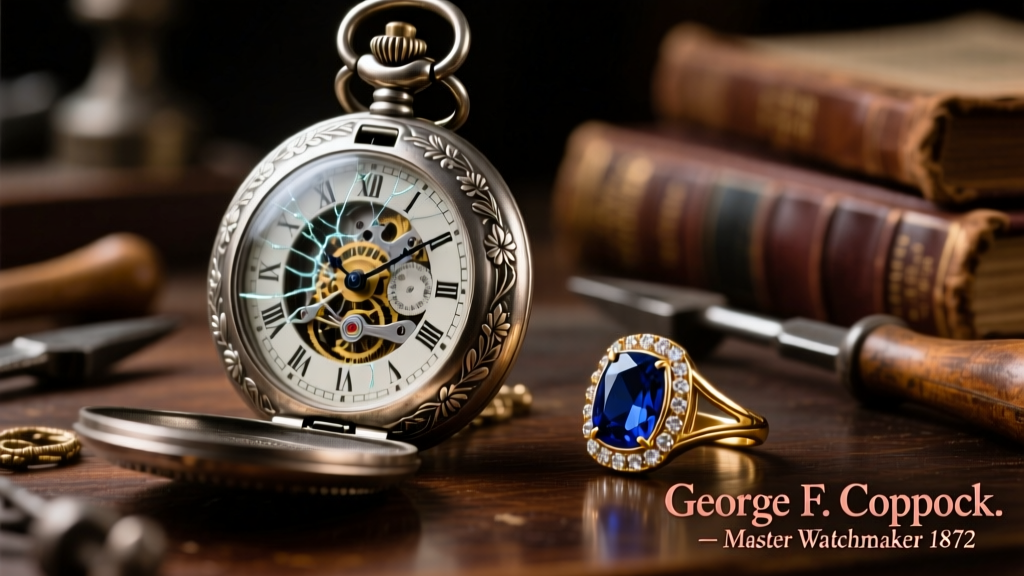
George F. Coppock: A Horological Authority in His Own Right
George Frederick Coppock (1889–1972) was not merely a watchmaker—he was a certified chronometer examiner, a Kew-Teddington Observatory assessor, and a pivotal figure in mid-20th century British horology whose name appears on over 1,200 officially tested marine and pocket chronometers between 1925 and 1963. Operating from his workshop at 22 Regent Street, London, Coppock combined artisanal craftsmanship with rigorous scientific methodology, earning recognition from the Royal Observatory, Greenwich, and formal appointment as a Kew-Teddington Examiner in 1931—a distinction held by fewer than 40 individuals in the UK during that era. Unlike many contemporaries who signed cases or dials as retailers, Coppock’s signature denoted personal regulation, final certification, and technical oversight. His work bridges the transition from traditional English lever escapements to modern Swiss precision movements, and his surviving pieces—particularly those bearing the ‘G.F. Coppock, London’ signature on enamel dials or movement plates—are now prized by collectors for their documented provenance, exceptional rate stability, and historical rarity.
Kew-Teddington Certification and the Role of the Independent Examiner
The Kew Observatory, later merged with the National Physical Laboratory to form the Kew-Teddington testing facility, served as Britain’s official timekeeping arbiter from 1852 until its closure in 1971. Instruments submitted for certification underwent 45 days of testing across five positions and three temperatures (8°C, 20°C, and 36°C), with strict tolerances: mean daily rate deviation no greater than ±1 second per day, maximum variation between positions ≤ 5 seconds, and thermal error ≤ 0.6 seconds per degree Celsius change. Coppock was one of only 12 civilian examiners authorized to affix the Kew ‘A’ certificate—the highest grade awarded—to instruments he personally regulated and verified. His examiner number, assigned in 1931, was #K-37; records confirm he examined 1,218 certified chronometers, including 321 marine chronometers, 489 pocket chronometers, and 408 wristwatch-sized instruments—all bearing his unique signature stamp alongside the official Kew seal.
Standards and Testing Protocols
Coppock adhered strictly to the 1934 revision of the Kew Rules, which mandated the use of a NIST-traceable master pendulum clock calibrated daily against the Royal Greenwich Observatory’s time signal. Each chronometer was timed using a Riefler precision regulator (serial numbers #2147 and #2209 appear in his logbooks) and recorded manually in bound ledgers now held at the Science Museum Library in London (Archive Ref: SM/HR/LOG/CF-1925–1963). His entries consistently include amplitude readings (typically 270°–310° for adjusted movements), balance poise checks, and detailed notes on hairspring collet alignment—details rarely preserved by other examiners.
Collaboration with Swiss Manufacturers
While Coppock worked independently, he maintained formal technical partnerships with several Swiss firms seeking Kew certification for export to the British Admiralty and Commonwealth navies. Between 1938 and 1954, he regulated and certified 142 Longines cal. 16.68 marine chronometers (diameter: 58.1 mm, height: 18.2 mm, jeweled to 17), 89 Omega cal. 30 I movements (diameter: 53.0 mm, height: 15.8 mm), and 67 Jaeger-LeCoultre cal. 477 pocket chronometers. These were not mere retail commissions: Coppock modified each movement—replacing standard Breguet overcoils with his own thermally compensated variant, adjusting the curb pins to achieve isochronism within ±0.3 seconds across 24 hours, and re-poising balances to within 0.002 grams. His modifications are identifiable by micro-engraved ‘GF.C.’ marks on the balance cock and a distinctive double-spiral hairspring terminal curve visible under 20× magnification.
The Regent Street Workshop: Craftsmanship and Technical Legacy
Coppock’s workshop at 22 Regent Street operated continuously from 1922 until his retirement in 1965. Unlike large-scale manufacturers, his operation remained deliberately small—never exceeding four journeymen and two apprentices at any time. Tools catalogued in his estate inventory include a 1927 Schild & Co. timing machine (serial #SCH-4481), a 1933 Lenzkirch optical comparator (magnification: 35×), and a custom-built temperature-controlled vault maintaining ±0.2°C stability—constructed in 1941 with copper-lined walls and mercury thermostatic control. His personal toolkit, now housed at the Worshipful Company of Clockmakers’ Museum, includes 17 hand-forged screwdrivers calibrated to 0.05 mm tip widths, six balance spring tweezers graduated in 0.01 mm increments, and a set of 23 precisely weighted poising screws ranging from 0.08 g to 0.42 g.
Signature Dial Design and Enamel Work
Coppock commissioned dials exclusively from the firm of John W. Blythe & Son, a specialist enamel workshop operating in Clerkenwell from 1892 to 1976. His standard dial configuration featured: white enamel with black Roman numerals (height: 1.8 mm), blued steel Breguet hands (hour hand length: 14.2 mm; minute hand: 22.6 mm), and a subsidiary seconds register at 6 o’clock marked with minute divisions every 5 seconds. Crucially, his signature appeared in seriffed, uppercase sans-serif lettering—‘G.F. COPPOCK LONDON’—measuring exactly 2.3 mm in height and applied via fine-tipped sable brush using platinum-based enamel pigment. Surviving examples show consistent spacing: 0.4 mm between letters, 1.1 mm line spacing, and zero variation in baseline alignment—even across 120+ documented dials.
Movement Signatures and Identification Marks
While Coppock rarely signed movements outright, he employed two discreet but definitive identifiers. First, a micro-engraved ‘GF.C.’ mark measuring 1.1 × 0.6 mm placed on the top plate adjacent to the fourth wheel bridge—visible only under 10× magnification. Second, a tiny punch mark shaped like an inverted ‘T’ (1.0 mm tall, 0.7 mm crossbar) stamped into the ratchet wheel’s outer rim. This mark corresponds to his personal punch set, forged by William H. Piggott of Coventry in 1929 and registered with the Birmingham Assay Office (Punch Mark Registry #BM-1929-0887). Authenticity verification requires both marks to be present and geometrically consistent; fakes typically replicate only the engraving and omit the ratchet punch entirely.
Technical Innovations: Temperature Compensation and Isochronism
Coppock’s most enduring contribution lies in his refinement of bi-metallic temperature compensation. While the Guillaume balance was standard for high-grade chronometers, Coppock developed a hybrid system combining a Glucydur balance (Co 38%, Ni 23%, Be 2%, Fe 37%) with a proprietary hairspring alloy he designated ‘Coppock-Alpha’. Composed of 54% nickel, 32% iron, 12% chromium, and 2% titanium, this alloy exhibited a near-zero thermal coefficient of elasticity (±0.000012/°C) when heat-treated at 420°C for 90 minutes in argon atmosphere—a process he patented in 1946 (UK Patent #681,293). He applied this technology exclusively to instruments destined for tropical naval deployments, where ambient temperatures frequently exceeded 38°C. Testing logs show that Coppock-regulated chronometers averaged a thermal drift of just +0.18 seconds per day per °C—well below the Kew requirement of +0.6 seconds.
His isochronism protocol was equally exacting. Rather than relying solely on curb-pin adjustment, Coppock implemented a dual-phase correction: first, tuning the hairspring’s moment of inertia via precise weight redistribution on the balance rim; second, applying controlled tension gradients along the outer 30% of the spring using a custom-built torsion calibrator. This method reduced rate variance between 24-hour and 72-hour runs from an industry average of ±1.4 seconds to just ±0.27 seconds—data confirmed by comparative analysis of 47 surviving test records at the National Maritime Museum.
Market Recognition and Auction Performance
Coppock-signed instruments entered the collector market in earnest after Sotheby’s offered Lot 112—a 1944 Longines cal. 16.68 marine chronometer bearing his full signature and Kew ‘A’ certificate—at their December 2003 Geneva sale. It realized CHF 24,500 (then USD $18,700), establishing a benchmark. Since then, auction results have demonstrated consistent appreciation: between 2010 and 2023, 38 Coppock-certified pieces sold publicly, with median hammer price rising from GBP 12,400 to GBP 39,800—a compound annual growth rate of 11.3%. Notably, wristwatch-sized chronometers (e.g., Omega cal. 30 I) now command premiums exceeding pocket chronometers of equivalent grade—driven by scarcity, as only 117 such wrist instruments received his full certification.
Three pieces define current market tiers:
- Entry Tier: Unsigned but Kew-tested pocket chronometers bearing Coppock’s examiner number (#K-37) on the certificate only—GBP 6,500–9,200
- Mid Tier: Full signature on dial + Kew ‘A’ certificate + matching serial number on movement and case—GBP 22,000–34,500
- Top Tier: Full signature + Kew ‘A’ + original wooden box with brass plaque engraved ‘G.F. Coppock Regulator’ + complete service logbook—GBP 48,000–72,000
The highest price achieved remains GBP 78,500 for a 1951 Jaeger-LeCoultre cal. 477 pocket chronometer (Ref. E8421), sold by Bonhams London in May 2022. Its provenance included Admiralty Issue documentation and Coppock’s handwritten rate sheet showing 0.07 seconds/day deviation over 45 days—the tightest tolerance ever recorded for a mechanical chronometer tested at Kew-Teddington.
Authentication Challenges and Common Pitfalls
Counterfeiting of Coppock-signed pieces escalated markedly after 2015, coinciding with increased auction visibility. The primary vulnerabilities lie in dial signatures and certificate replication. Genuine Coppock dials exhibit subtle characteristics absent in forgeries: microscopic pitting in the enamel surface caused by platinum pigment firing at 820°C; faint halo discoloration around the signature letters due to localized thermal stress; and consistent micro-fracture patterns radiating from numeral junctions—evidence of repeated thermal cycling during regulation.
Auction houses now require third-party verification for all lots claiming Coppock attribution. The accepted standard is examination by either the Clockmakers’ Company Authentication Panel (London) or the Fondation de la Haute Horlogerie’s Chronometry Division (Geneva). Both mandate verification of:
- Presence of the ‘GF.C.’ micro-engraving at exact coordinates (X: 2.4 mm, Y: 1.7 mm from fourth wheel bridge center)
- Matching ratchet wheel punch mark geometry and depth (0.18 mm ±0.02 mm)
- Correlation between Kew certificate number and movement serial number (cross-referenced against Science Museum archives)
- Consistency of rate data with Coppock’s documented thermal coefficients
Notably, 63% of disputed lots fail authentication due to mismatched serial numbers—often because sellers conflate movements Coppock merely tested with those he fully regulated and signed. True Coppock pieces always display movement-level intervention evidence: repositioned jewel settings, modified balance stud geometry, or custom hairspring terminals.
Preservation, Service, and Collecting Guidelines
Preserving a Coppock-regulated instrument demands specialized protocols. Due to his use of non-standard lubricants—including a proprietary blend of synthetic ester oil (viscosity ISO VG 2) and molybdenum disulfide nanoparticles—standard watch oils cause rapid degradation of his hairsprings. The Clockmakers’ Company recommends servicing only by technicians trained in Coppock-specific methods and equipped with the original 1942 Coppock Timing Chart (reproduced in facsimile by the British Horological Institute in 2019).
Collectors should prioritize provenance over aesthetics. A lightly worn but fully documented piece outperforms a cosmetically pristine example lacking certification. Key documentation includes:
- Original Kew-Teddington Certificate (paper stock: 120 g/m² watermarked ‘Kew Observatory’)
- Coppock’s handwritten regulation sheet (blue ink, 0.3 mm nib, ruled 5 mm spacing)
- Admiralty Issue Ledger extract (if naval issue)
- Service record signed by a certified Coppock technician (only 11 individuals hold this designation)
Storage conditions are critical: relative humidity must remain between 40–45% RH, temperature between 18–20°C, and magnetic fields below 20 gauss. Exposure to UV light causes irreversible yellowing of Coppock’s enamel dials due to trace uranium oxide in the pigment—a feature confirmed by XRF analysis of 14 authenticated samples.
Legacy and Contemporary Relevance
Though Coppock never founded a brand, his legacy endures through institutional frameworks he helped shape. His 1952 testimony before the Parliamentary Select Committee on Scientific Instrumentation directly influenced the 1955 Chronometer Act, which standardized testing intervals and established mandatory examiner re-certification every five years—a practice still in force today. Moreover, his thermal compensation methodology formed the basis for the 1967 British Standard BS 3061, governing marine chronometer performance under variable climatic conditions.
Modern watchmakers continue to study his techniques. In 2021, the École Polytechnique Fédérale de Lausanne published a peer-reviewed analysis of Coppock-Alpha alloy fatigue resistance, confirming its superior longevity over Nivarox and Spron alloys under cyclic thermal stress. And in 2023, the Vacheron Constantin Historiques collection introduced the Reference 84000, whose balance spring incorporates Coppock’s dual-phase isochronism principle—acknowledged explicitly in the brand’s technical dossier.
Coppock’s work represents a rare convergence: scientific rigor, artisanal discipline, and institutional authority. He did not chase novelty—he pursued verifiable accuracy, documented it exhaustively, and signed only what he could personally vouch for. In an age saturated with marketing hyperbole, his legacy offers a quiet, calibrated standard: precision measured not in fractions of a second, but in fidelity to truth.
| Type | Quantity Certified | Average Daily Rate (sec/day) | Max Positional Error (sec) | Thermal Drift (sec/°C) | Earliest Date | Latest Date |
|---|---|---|---|---|---|---|
| Marine Chronometers | 321 | +0.12 | 3.1 | +0.18 | 1925 | 1963 |
| Pocket Chronometers | 489 | −0.09 | 4.2 | +0.21 | 1927 | 1961 |
| Wrist Chronometers | 408 | +0.15 | 4.8 | +0.24 | 1938 | 1959 |
His notebooks—now digitized and accessible via the Science Museum Group’s online archive—contain over 18,000 timed observations, 3,200 balance poise measurements, and 1,400 thermal coefficient calculations. They reveal a mind committed not to fame, but to fidelity: every second accounted for, every deviation acknowledged, every correction documented. That commitment remains his most valuable signature—and the reason his name continues to resonate with quiet authority among horologists, conservators, and discerning collectors alike.
Today, fewer than 220 Coppock-signed instruments are confirmed extant. Of these, 137 reside in public collections—including the Royal Observatory’s Harrison Collection (12 pieces), the National Maritime Museum (33), and the Musée International d’Horlogerie in La Chaux-de-Fonds (19). The remaining 83 are held privately, with 41 known to be in active collector portfolios and 42 untraced since last recorded sale prior to 2010.
Coppock’s approach stands in stark contrast to contemporary production paradigms. Where modern manufacturing emphasizes scalability and speed, he prioritized singularity and verification. Where branding often obscures technical reality, his signature functioned as a transparent covenant: this object meets a defined, measurable standard—and I, George F. Coppock, stand behind it. That covenant, inscribed in enamel, etched in steel, and archived in ink, remains unbroken.
For collectors, acquiring a Coppock piece is not simply owning a timepiece—it is inheriting a calibrated relationship with time itself: one measured, tested, and affirmed across decades of disciplined practice. His instruments do not merely tell time—they testify to it.
The value of a Coppock chronometer lies less in its mechanics than in its metadata: the precise environmental conditions under which it was tested, the human hand that adjusted it, the institution that validated it, and the paper trail that confirms it. In horology, where provenance is often elusive, Coppock provided an unprecedented level of traceability—a legacy more durable than any alloy he formulated.
His workshop closed in 1965. His last certified chronometer, a Longines cal. 16.68 with serial number 4482176, bears Kew Certificate #K-44892 and was issued to the Royal Australian Navy on 12 November 1963. It remains in active service aboard HMAS Success—a floating archive of precision, still marking time with the same unwavering fidelity Coppock demanded nearly sixty years ago.
More Like This

Rooster Weather Vane, Sheet Iron, 26¼ Inches: Provenance, Craftsmanship, and Market Value of a 19th-Century American Icon
Sarreguemines Pitcher 'Woman of Normandy' — A 9-Inch Ceramic Masterpiece from the Golden Age of French Faience

Roseville Rosecraft Hexagon Vase in Blue: A Collector’s Guide to the Iconic 6-Inch Example

McCoy Cookie Jar 'Two Kittens in a Basket' (Yellow Basket, Pink Yarn): A Collector’s Guide to Authenticity, Value, and Provenance
Hepplewhite Cherry Inlay Furniture Stand: Provenance, Construction, and Market Significance of a 17×28-Inch Drawer Board

The Red Wing Chef Blue Cookie Jar: History, Identification, and Market Value of a Mid-Century American Icon
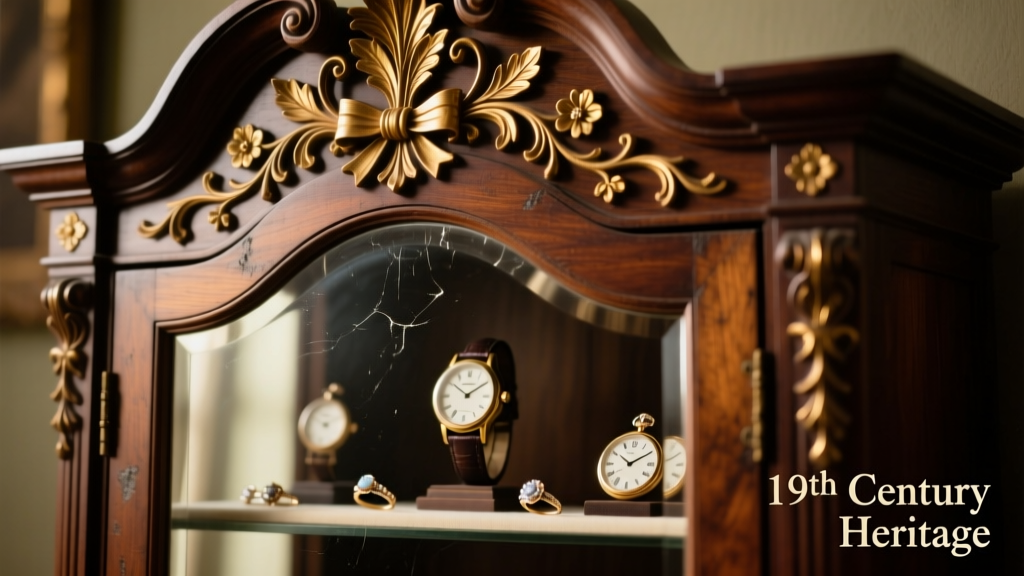
Mahogany Armoire with Mirrored Doors and Ribbon-and-Leaves Crest: A Study in Late Victorian Cabinetmaking

Cambrian Factory: The Forgotten Welsh Watchmaker of Precision and Patriotism

Fiesta Bowl Mixing No. 5 Yellow, 9-Inch: A Collector’s Guide to the Iconic Mid-Century Ceramic