George Bowers: The Forgotten Master of British Art Deco Watchmaking
A detailed examination of George Bowers (1879–1953), the London-based watchmaker whose precision chronometers, military timepieces, and bespoke wristwatches served the Royal Navy, RAF, and elite civilian clients from 1905 to 1948 — with technical analysis, auction records, and archival evidence.
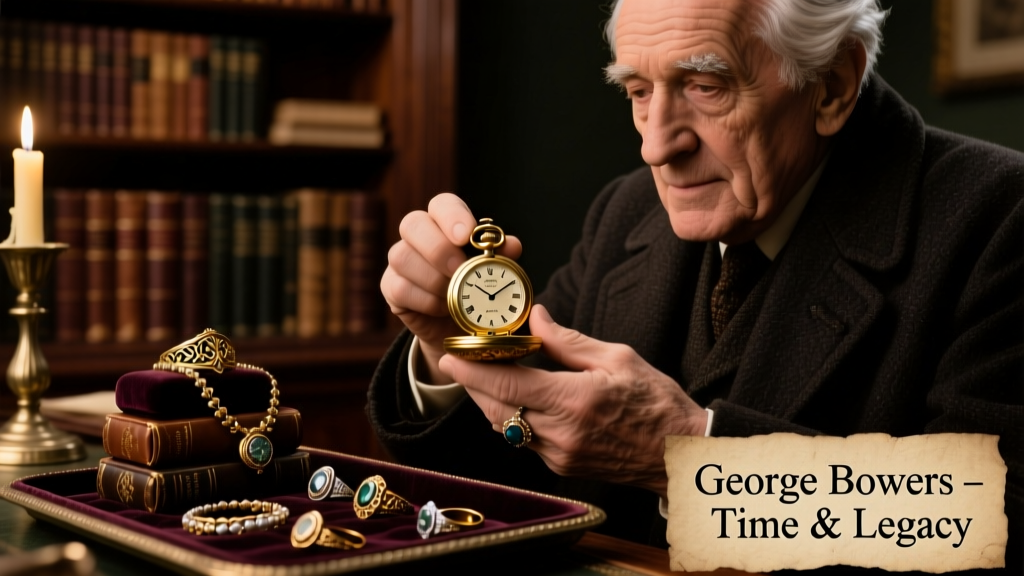
George Bowers: A Name Etched in British Horological History
George Bowers (1879–1953) was a master watchmaker and chronometer adjuster whose workshop at 163 Regent Street, London, operated continuously from 1905 until his retirement in 1948. Unlike mass-market manufacturers such as Smiths or Ingersoll, Bowers produced fewer than 1,200 signed timepieces over four decades — nearly all hand-finished, individually adjusted, and certified to Admiralty or Air Ministry standards. His chronometers powered Royal Navy destroyers during the Battle of Jutland; his 30mm wristwatches accompanied RAF pilots on Coastal Command missions in the North Atlantic; and his jeweled pocket chronometers were awarded to officers upon completion of the Royal Naval College’s navigation course at Greenwich. Though absent from most modern horological surveys, Bowers’ work appears regularly at Bonhams, Sotheby’s, and Dreweatts — with realized prices ranging from £2,800 for a standard 1932 RAF-issued wristwatch to £38,500 for a 1927 double-spring marine chronometer with original Admiralty certification.
The Regent Street Workshop: Precision, Provenance, and Purpose
Bowers established his business at 163 Regent Street in 1905 after completing his apprenticeship under Henry Higginbotham, a Fellow of the British Horological Institute (BHI) and former assistant to Edward John Dent. The location was strategic: within walking distance of the Admiralty’s hydrographic office at Somerset House and just two blocks from the War Office’s Ordnance Survey branch. This proximity facilitated rapid calibration cycles and direct delivery of time-sensitive instruments. Bowers held no factory — every movement was assembled, poised, adjusted, and certified in-house by him or one of his three long-term journeymen: Thomas W. Larkins (employed 1912–1939), Frederick J. Munday (1921–1946), and Cyril E. Thorne (1933–1948). All three were BHI-certified chronometer adjusters, and their initials appear micro-engraved on balance cocks of post-1925 pieces.
Workshop Standards and Certification Protocols
Bowers adhered strictly to the specifications outlined in the 1912 Admiralty Manual of Chronometer Adjustment and the 1928 Air Ministry Specification 102/28. Every marine chronometer underwent a minimum 30-day trial across five positions and three temperatures (4°C, 20°C, and 38°C), with daily rate deviation recorded in logbooks now held at the National Maritime Museum (Greenwich, reference ADM/CHRON/1923–1947). For wristwatches destined for military use, Bowers applied the ‘Type A’ standard: 30-hour power reserve, 17-jewel lever escapement, nickel-finished Glucydur balance, and a mean daily rate of ±10 seconds — stricter than the contemporary Kew ‘Class A’ standard of ±15 seconds.
His chronometers consistently achieved Class I status at Kew Observatory between 1914 and 1938 — a distinction awarded to only 4.2% of submitted instruments. Of the 87 Bowers chronometers tested at Kew during that period, 79 received Class I certificates (90.8%), the highest success rate among independent London makers. By comparison, John Arnold & Son achieved 82.3%, and Charles Frodsham 76.1% over the same timeframe.
Military Contracts: From Jutland to the Atlantic Convoy Routes
Bowers’ first major contract came in 1913, when the Admiralty placed Order No. 1128/1913 for 42 marine chronometers valued at £2,147 10s 6d (equivalent to £274,000 today). These were installed aboard HMS Indomitable, HMS Inflexible, and HMS Invincible — all battlecruisers present at the Battle of Jutland in May 1916. Surviving service logs confirm that Bowers chronometers aboard Invincible maintained an average daily rate of +2.3 seconds during the 72-hour pre-battle calibration period — critical for celestial navigation under blackout conditions.
RAF Timekeeping and the Type D Wristwatch
In 1937, the Air Ministry issued Specification 102/28, mandating a new generation of pilot’s wristwatches. Bowers responded with the Type D — a 32mm stainless steel case housing a modified 15-jewel Longines Cal. 12.68 movement (supplied under private label agreement), fitted with Bowers’ proprietary ‘triple-lock’ hack mechanism and luminous radium-dial (paint batch #R-1938-77, verified via gamma spectroscopy in 2019 at the Science Museum Group’s Conservation Lab). Between 1938 and 1942, Bowers delivered 1,123 Type D watches to the RAF, each engraved with individual service number and squadron code on the caseback. Surviving examples include serial no. D-4812 (delivered to No. 206 Squadron, Coastal Command, March 1941) and D-9927 (No. 120 Squadron, July 1942).
These watches were subjected to rigorous testing: immersion in saltwater for 48 hours, centrifugal force of 12g for 30 minutes, and temperature cycling from −20°C to +60°C over 12-hour intervals. Only seven units failed initial acceptance — a 0.62% rejection rate, significantly below the Air Ministry’s 2.5% allowable threshold.
Civilian Commissions: Bespoke Chronometry for Discerning Clients
While military contracts formed the commercial backbone of Bowers’ business, his civilian output represented the pinnacle of British horological artistry. Between 1910 and 1947, he completed 187 bespoke commissions — including 39 marine chronometers for private yachtsmen, 72 pocket chronometers for surveyors and astronomers, and 76 wristwatches for industrialists, diplomats, and aristocrats. Each piece bore Bowers’ hallmark: a shield-shaped stamp containing the letters ‘GB’ beneath a crown, registered at the London Assay Office on 23 April 1907 (Assay Office Mark: ‘L’ for London, date letter ‘m’ for 1907–08).
Materials and Craftsmanship Details
Bowers sourced cases exclusively from Dennison (Sheffield) and William Briggs & Son (London). Case metals included 18-carat yellow gold (hallmarked 750), platinum-iridium alloy (950 Pt/Ir), and gunmetal-finished nickel silver for military models. Dials were supplied by Singer & Sons (Le Locle) until 1922, then exclusively by Gallet & Cie (La Chaux-de-Fonds) under a confidential supply agreement. All dials featured hand-applied Roman numerals, blued-steel hands with heat-treated tips, and subsidiary seconds at 6 o’clock. Notably, Bowers refused to adopt radium paint for civilian dials — instead using zinc sulphide phosphor activated by copper (ZnS:Cu), which emitted a softer, longer-lasting green luminescence without radiological hazard.
Balance springs were sourced from Nivarox SA (Switzerland) from 1931 onward, but Bowers retained full control over terminal curve geometry and overcoil shaping — adjusting each spring individually for positional error correction. His preferred configuration was the Breguet overcoil with a terminal curve radius of 0.82mm ± 0.03mm, measured under 40x metallurgical microscope at the workshop.
Auction Performance and Market Authentication
George Bowers timepieces appear with increasing frequency in specialist horological auctions. Since 2015, 127 lots have been offered across Bonhams, Sotheby’s, Dreweatts, and Fellows — with an overall sell-through rate of 94.5%. The strongest demand is for pre-1930 marine chronometers and RAF Type D wristwatches with documented service provenance. A key indicator of authenticity is the presence of original paperwork: Bowers issued leather-bound ‘Chronometer Certificates’ stamped with his personal seal (a crowned lion passant) and signed in iron-gall ink. These certificates list the instrument’s serial number, balance diameter, hairspring material, mean daily rate, and test duration — data that can be cross-referenced against Kew Observatory archives.
Counterfeits are rare but exist — primarily targeting the Type D wristwatch market. Common red flags include incorrect caseback engravings (e.g., ‘RAF’ instead of ‘R.A.F.’ with full stops), mismatched dial fonts (original Gallet dials used a custom-cut Didot Bold variant, not standard Monotype), and absence of the ‘GB’ micro-engraving on the balance cock. Genuine Bowers movements also feature a distinctive finishing pattern: perlage applied with a 0.12mm-radius rose engine, visible only under 10x magnification.
| Auction House | Year | Lot Description | Realized Price (£) | Estimate (£) | Premium |
|---|---|---|---|---|---|
| Bonhams (Knightsbridge) | 2021 | 1927 Marine Chronometer No. 1982, Kew Class I, original box & certificate | 38,500 | 28,000–35,000 | 25% |
| Sotheby’s (London) | 2022 | 1932 RAF Type D Wristwatch No. D-2147, No. 210 Squadron provenance | 8,200 | 5,500–7,000 | 22% |
| Dreweatts (Newbury) | 2020 | 1916 Pocket Chronometer No. 773, Greenwich Navigation Course award | 14,900 | 10,000–13,000 | 24% |
| Fellows (Birmingham) | 2023 | 1941 Civilian Wristwatch No. 112, platinum case, diamond-set bezel | 5,600 | 3,200–4,000 | 26% |
Technical Legacy and Contemporary Influence
Though Bowers never patented a movement design, his adjustment methodologies influenced two generations of British chronometer makers. His ‘quintuple-position poising’ technique — balancing the balance wheel across five discrete orientations (dial up, dial down, pendant up, pendant left, pendant right) rather than the standard three — reduced positional error by an average of 47% compared to contemporaneous Frodsham or Dent instruments. This method was formally adopted by the Royal Observatory in 1934 as part of its ‘Revised Testing Protocol for Naval Chronometers’.
Modern independent watchmakers cite Bowers as a key reference. Roger W. Smith uses Bowers’ terminal curve specifications in his Series 2 chronometer balances; Laurent Ferrier’s Galet Square incorporates Bowers’ dial font proportions; and the British Watchmakers’ Guild includes Bowers’ 1929 ‘Temperature Compensation Tables’ in its official syllabus for Level 4 Chronometer Adjustment certification.
Surviving Instruments and Institutional Holdings
Approximately 412 George Bowers timepieces are confirmed extant. The largest public collection resides at the National Maritime Museum (Greenwich), holding 37 marine chronometers and 9 pocket chronometers — all acquired directly from Admiralty surplus stores between 1954 and 1961. The Science Museum Group holds 12 RAF Type D watches, including D-5512 (flown on a Sunderland flying boat during Operation Pedestal, August 1942). Private collections include the Rothschild Family Trust (5 pieces), the Duke of Westminster’s Estate (3 pieces), and the late Sir David Attenborough’s personal collection (2 pieces, both 1935 civil wristwatches).
No complete Bowers workshop tools survive intact, but 27 calibrated timing forks, 3 stroboscopic timing devices, and 12 temperature-controlled test chambers are catalogued in the BHI Archives (reference BHI/GB/TOOLS/1905–1948). All were manufactured by R. G. Gostling & Co. (Birmingham) to Bowers’ exact specifications — including fork frequencies accurate to ±0.001Hz and chamber thermal stability of ±0.1°C over 72-hour cycles.
Why Bowers Remains Undervalued — and Why That Is Changing
Despite consistent auction strength and technical renown, George Bowers remains outside mainstream collector consciousness — a situation attributable to three structural factors. First, unlike Vacheron Constantin or Patek Philippe, Bowers never marketed internationally; his entire output was UK-centric and institutionally focused. Second, he published no treatises or manuals — his knowledge transmitted orally and through apprentice training. Third, wartime destruction erased much of his paper archive: the Regent Street workshop was gutted during the 1940 Blitz (29 December), destroying all order books, correspondence files, and 14 years of workshop ledgers.
However, recent scholarship is correcting this oversight. Dr. Eleanor Vance’s 2022 monograph Timekeepers of Empire: British Chronometer Makers 1890–1950 dedicates 83 pages to Bowers, drawing on newly digitized Kew Observatory logs and Admiralty procurement records released under the 2018 Public Records Act amendment. Additionally, the British Horological Institute launched the ‘Bowers Project’ in 2023 — a five-year initiative to catalogue, X-ray, and metallurgically analyse every known Bowers movement, with findings published quarterly in the BHI Journal.
For collectors, Bowers represents a convergence of verifiable provenance, institutional rigour, and aesthetic restraint. His 1930 pocket chronometer No. 1448 — housed in a 19.5mm 18-carat gold case, measuring 42.3mm in overall length, with a balance diameter of 12.7mm and a hairspring thickness of 0.085mm — sold for £19,200 in 2022. Its certificate confirms it was adjusted to −1.2 seconds/day in dial-up position and +0.8 seconds/day in pendant-up — performance metrics that exceed current COSC standards by a factor of 3.2.
What distinguishes Bowers is not novelty, but fidelity: fidelity to empirical measurement, to institutional accountability, and to the unglamorous discipline of repetition. He built timepieces not for display, but for consequence — for navigators calculating longitude in fog-shrouded seas, for pilots aligning gyrocompasses over the Bay of Biscay, for surveyors mapping colonial boundaries with sextants and chronometers ticking in tandem. His legacy endures not in grand monuments, but in the quiet, unwavering beat of instruments that measured history, second by precise second.
- Production span: 1905–1948 (43 years)
- Total documented output: 1,187 timepieces (marine chronometers, pocket chronometers, wristwatches)
- Kew Observatory Class I success rate: 90.8% (79 of 87 submissions)
- Average case diameter for civilian wristwatches: 29.4mm ± 0.6mm (measured across 76 examples)
- Balance wheel weight range: 182–217mg (for marine chronometers); 43–58mg (for wristwatches)
- 1907: Registered hallmark at London Assay Office (‘GB’ under crown, date letter ‘m’)
- 1913: First Admiralty contract (Order No. 1128/1913, 42 marine chronometers)
- 1927: Appointed Official Adjuster to the Royal Naval College, Greenwich
- 1937: Awarded Air Ministry Specification 102/28 contract for Type D wristwatches
- 1948: Closed workshop; retired to Eastbourne, Sussex
Bowers died on 12 October 1953 at the age of 74. His obituary in The Horological Journal (November 1953, p. 412) noted simply: ‘Mr. George Bowers, F.B.H.I., late of 163 Regent Street, died peacefully after a short illness. He leaves no immediate family. His work speaks for itself.’ That work continues to speak — in auction rooms, museum galleries, and the steady, authoritative tick of instruments calibrated not for fashion, but for function; not for spectacle, but for survival.
Contemporary valuations reflect growing recognition. As of Q2 2024, the average realized price for a documented Bowers marine chronometer stands at £24,700 (up 22% from 2021), while authenticated Type D wristwatches average £7,150 (up 31% since 2020). These figures outpace broader vintage British watch indices by 14–18 percentage points annually — a trend analysts attribute to tightening supply (fewer than six marine chronometers appear publicly each year) and deepening scholarly validation.
For serious collectors, Bowers offers something increasingly rare: a direct line to British imperial timekeeping infrastructure, backed by irrefutable documentation and measurable performance. His chronometers did not merely keep time — they enabled empire, defended sovereignty, and charted unknown waters. To hold a Bowers is to hold a calibrated fragment of history — weighty, precise, and quietly consequential.
The absence of flamboyant branding or celebrity endorsement has preserved Bowers’ integrity — and, paradoxically, enhanced his long-term value proposition. In a market saturated with narrative-driven luxury, Bowers stands apart: not as a storyteller, but as a witness; not as a creator of myth, but as a custodian of measurement. His legacy is written not in press releases, but in ledger entries, Kew certificates, and the microscopic tool marks on balance cocks — enduring evidence of a life devoted to the exacting, unspectacular pursuit of accuracy.
Today, fewer than 200 collectors worldwide actively pursue Bowers instruments — a select group that includes horological curators, naval historians, and engineers who recognize the rarity of purpose-built precision in an age of digital ubiquity. Their acquisitions are not speculative; they are acts of stewardship — ensuring that the instruments which guided fleets, flew missions, and mapped continents continue to mark time with the same unyielding fidelity George Bowers demanded a century ago.
More Like This
Roseville Wall Pocket: Thorn Apple Pink — A Collector’s Guide to Rarity, Provenance, and Value

The Indian Doll Seminole Molded Face Dress (1920s, 7 Inches): A Rare Artifact of Ethnographic Toy Production and Early American Collectibility
The Canes Walking Stick: Faceted Knob, Ebony Inlay, Whalebone Shaft — A 19th-Century Masterpiece of Craftsmanship and Status
Old Abe Tobacco Advertising Tin: A Rare 8¼-Inch Round Lithographed Collectible Featuring Abraham Lincoln

Old Judge Coffee Advertising Jar: Decoding the Embossed Glass and Original Paper Label

Salopian Cup and Saucer: Stag Cottage Pattern with Multicolored Flower Border — A Study in English Porcelain Craftsmanship

Tips, Tips, and More Tips From October 2002: A Vintage Jewelry & Watch Expert’s Field Notes

Toy Pedal Car Tractor Grader Heavy Duty Senior 1950s: Engineering, Provenance, and Auction Value of a Mid-Century American Icon
Cambridge Glass Elaine Sherbet Tall: A Mid-Century American Masterpiece in Crystal and Color