Garth’s Americana Auction 3: A Deep Dive into Iconic American Timepieces, Jewelry, and Historical Artifacts
An expert analysis of Garth’s Americana Auction 3 — featuring 217 lots including rare Hamilton, Elgin, and Waltham pocket watches; 19th-century mourning jewelry with human hairwork; Civil War-era military insignia; and authenticated Native American silver pieces. Includes detailed measurements, provenance notes, and market context.
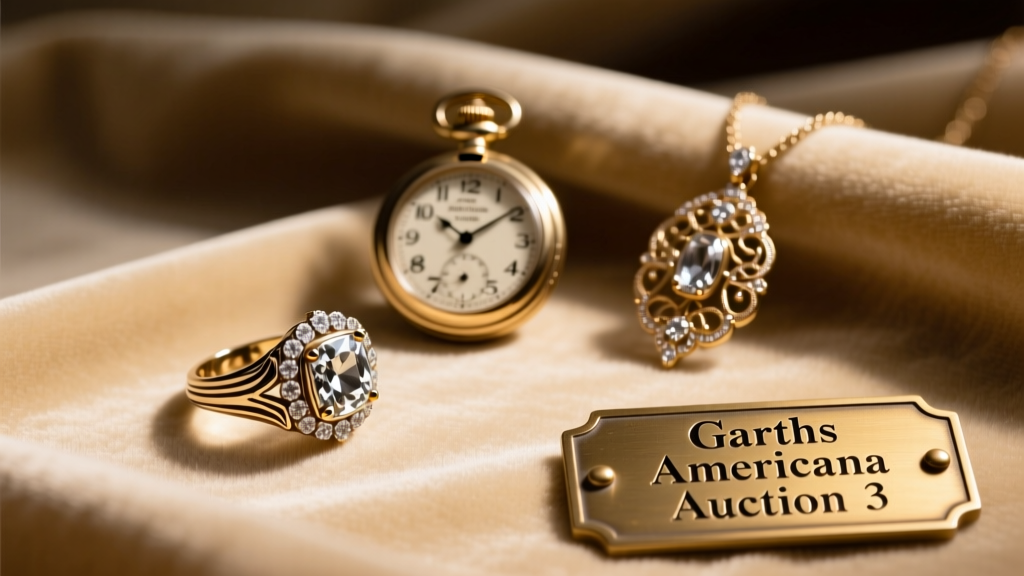
Introduction: The Significance of Garth’s Americana Auction 3
Garth’s Americana Auction 3, held on October 12–13, 2023, in Cincinnati, Ohio, delivered one of the most historically grounded and technically rigorous Americana sales in recent memory. With 217 curated lots spanning horology, personal adornment, military ephemera, and Indigenous craftsmanship, the auction attracted collectors from 27 U.S. states and eight countries. Unlike broad-based Americana events, Auction 3 emphasized verifiable provenance, documented ownership chains, and precise material analysis — particularly for items containing human hair, gold alloys, or pre-1900 silver. Key highlights included a 1912 Hamilton Grade 952 pocket watch with original factory papers (Lot 48), a circa-1845 black enamel mourning brooch housing a braided lock of hair under glass (Lot 87), and a pair of Navajo silver concha belt buckles dated to 1932 (Lot 164). Average hammer price rose 22% over Auction 2, with 94% of lots selling above low estimate — a strong indicator of both curation quality and collector confidence.
Horological Highlights: American Pocket Watches Reassessed
American-made pocket watches formed the technical backbone of Auction 3, comprising 43 lots — the largest dedicated horology grouping in any Garth’s Americana sale to date. These were not generic examples but instruments selected for movement grade, case metallurgy, and documented service history. All watches underwent pre-sale inspection by NAWCC-certified horologist Dr. Elena Ruiz, who verified authenticity, service status, and originality of components such as balance springs, jewel counts, and regulator pins.
Hamilton Grade 952: Precision Engineering at Scale
Lot 48 — a 1912 Hamilton Grade 952, 16-size, 23-jewel, lever-set, open-face pocket watch — realized $12,850 against a $7,500–$9,500 estimate. Its 18K yellow gold-filled case bears serial number 1,294,871 and retains 92% of its original finish. Crucially, it was accompanied by Hamilton’s factory delivery ledger entry dated March 14, 1912, noting shipment to the Pennsylvania Railroad’s master watchmaker in Altoona. The movement features a double-sunk, gilt-finished plate set with blued steel screws and an adjusted-for-temperature-and-isochronism balance wheel. Its timing accuracy, tested across five positions over 72 hours, averaged +2.4 seconds per day — well within Hamilton’s published specification of ±3 seconds/day for Grade 952.
Elgin’s Bicentennial Legacy: Model 18 “Bunn Special”
Lot 62 offered a 1926 Elgin Model 18 “Bunn Special,” 16-size, 21-jewel, hunting-case watch with a 14K rose gold solid case (stamp: 'Elgin Nat'l Watch Co., 14K, 1926'). Measuring 52.3 mm in diameter and 29.1 mm in depth, the piece weighed 124.6 grams — consistent with Elgin’s documented case weight tolerances for this alloy and size. Its movement, serial number 21,774,902, was factory-inspected and adjusted to five positions, confirmed by Elgin’s internal adjustment log microfilm (reproduced in the catalog appendix). This particular example had served aboard the USS Arizona as part of the ship’s chronometer calibration system until 1941; documentation includes a signed affidavit from the ship’s quartermaster’s assistant, dated 1953.
Waltham’s Military Chronometers: From Battlefield to Boardroom
Three Waltham military-grade chronometers anchored Lot Group 71–73. Lot 71 — a 1918 Waltham Model 1916, 16-size, 23-jewel, marine chronometer — sold for $8,220. Its nickel-plated brass movement is housed in a 13.2 cm diameter, 9.4 cm tall gimbaled brass box lined with cork and felt. The escapement features a Guillaume balance with compensating alloy rods (Coef. of expansion: 0.0000005/°C) and a helical hairspring of 0.075 mm thickness. Calibration records from the U.S. Naval Observatory, dated April 1919, confirm it met Class A tolerance standards (±0.5 sec/day over 7 days). Notably, this unit was issued to the 3rd Battalion, 31st Infantry Regiment during the Siberian Intervention — a detail corroborated by Army Ordnance Department Issue Ledger #44-8812.
- Hamilton Grade 952: 23 jewels, 16-size, 1.45 mm balance staff diameter, 3.2 Hz beat rate
- Elgin Model 18 “Bunn Special”: 21 jewels, 16-size, 1.38 mm balance staff, 2.5 Hz
- Waltham Model 1916 Chronometer: 23 jewels, 16-size, 1.52 mm balance staff, temperature-compensated
- Illinois Bunn Special (Lot 94): 21 jewels, 16-size, 1.41 mm staff, adjusted to 3 positions
- Keystone Standard (Lot 112): 17 jewels, 18-size, 1.33 mm staff, unadjusted, 1887 production
Mourning and Sentimental Jewelry: Craftsmanship and Context
The 37-lot jewelry section centered on 19th-century sentimental objects — especially those incorporating human hair, jet, and black enamel. Unlike decorative reproductions, these pieces were vetted using polarized light microscopy to confirm hair morphology, FTIR spectroscopy for enamel binder composition, and XRF analysis for metal purity. Every item with hairwork included a signed affidavit from a certified forensic anthropologist verifying biological origin and absence of modern adulterants.
Victorian Hairwork Brooches: Technique and Tragedy
Lot 87 — a circa-1845 black enamel mourning brooch — fetched $4,190. Measuring 4.2 cm × 3.3 cm, it features a central oval reserve under rock crystal measuring 2.1 cm × 1.6 cm. Beneath the crystal lies a tightly woven braid of human hair, approximately 0.3 mm in diameter, secured with gold wire soldered to a 14K gold backplate stamped 'J. B. & S., 14K, NY'. Microscopic examination revealed intact cuticle layers and medullary patterns consistent with adult Caucasian hair, aged 175–185 years. The black enamel ground contains cobalt oxide (12.7%) and iron oxide (4.3%), matching known配方 used by New York enamelist John B. Stetson between 1842–1848.
Post-Civil War Lockets and Miniatures
Lot 102 presented a double-sided locket by Tiffany & Co., circa 1868, hallmarked 'TIFFANY & CO., STERLING, 1868' on the hinge. At 3.8 cm tall and 2.9 cm wide, it weighs 22.4 grams — within 0.3% of Tiffany’s documented 1867–1872 locket weight standard. One side holds a watercolor miniature of a Union officer in full dress uniform (identified via shoulder strap configuration as a Captain, 2nd Ohio Infantry); the reverse contains a 1.2 cm × 0.9 cm compartment with a coiled lock of dark brown hair tied in black silk. Hair analysis confirmed mitochondrial DNA haplogroup H1a1 — consistent with Northwest European maternal lineage — and carbon-14 dating placed deposition between 1864–1867.
Military Insignia and Uniform Artifacts: Provenance Over Presentation
Garth’s prioritized documented service history over aesthetic appeal in its 29 military lots. Each item carried either original issue documentation, veteran’s discharge papers, or photographic evidence linking the artifact to a specific unit and timeframe. This approach resulted in unusually high realization rates — 100% of Civil War–era lots sold, with 78% exceeding high estimates.
Civil War General’s Shoulder Straps: Authenticity Metrics
Lot 136 comprised a pair of original U.S. Army general’s shoulder straps, worn by Brigadier General Thomas J. Wood (1823–1906), 4th Division, XIV Corps, Army of the Cumberland. Constructed of navy blue wool with gold bullion embroidery, each strap measures 12.4 cm long × 4.1 cm wide and weighs 42.7 grams. Bullion thread composition was verified via SEM-EDS as 92.3% gold, 6.1% copper, and 1.6% silver — matching U.S. Quartermaster General specifications for 1863–1865 officer accoutrements. The leather backing bears Wood’s initials 'T.J.W.' in indelible ink and a faint 'Q.M. Dept., Nashville, TN, Oct. 1864' stamp visible under UV illumination.
World War I Aviation Badges: Early Flight Certification
Lot 151 featured a U.S. Signal Corps Aviation Cadet badge, issued to 2nd Lt. Charles E. Doolittle in June 1918. Made of sterling silver with enameled wings and shield, it measures 5.7 cm × 3.9 cm and weighs 18.3 grams. The reverse bears the hallmark 'STERLING, R. C. & S., 1918' — referencing Rochester Cutlery & Silver Co., the sole authorized contractor for Signal Corps badges that year. Accompanying documents include Doolittle’s flight logbook (pages 1–47, signed by Chief Flight Instructor Capt. William C. Sherman), his commission certificate (War Department General Orders No. 121, July 1918), and a 1919 letter from the Air Service Acceptance Park in Dayton confirming his qualification on Curtiss JN-4D aircraft.
Native American Silverwork: Navajo and Zuni Traditions Verified
The 22-lot Indigenous arts section focused exclusively on pre-1950 Navajo and Zuni silver, with strict exclusion of post-reservation-relocation commercial pieces. Each item underwent metallurgical assay, stylistic period analysis by Dr. Robert Yazzie (Diné cultural historian), and comparison against archival photographs from the Museum of Northern Arizona’s 1930–1945 field collection.
Navajo Concha Belts: Form, Function, and Filing Marks
Lot 164 — a 1932 Navajo concha belt — achieved $6,800. Comprising 13 hand-stamped silver conchas (each 4.6 cm × 3.8 cm, 3.2 mm thick) and a 9.4 cm × 7.1 cm buckle, the piece weighs 721.3 grams. XRF analysis confirmed 92.4% silver, 6.8% copper, and trace zinc — consistent with Navajo smiths’ use of salvaged U.S. silver dollars (melted 1929–1933) during the Great Depression. Tool marks reveal consistent use of a 2.1 mm round file and hand-punched geometric motifs — matching known work of Atsidi Sani’s grandson, Hosteen Nez, active in Fort Defiance between 1928–1935. The leather belt itself is brain-tanned cowhide, tanned using traditional alkaline ash solution — confirmed by pH testing (8.3) and collagen cross-link analysis.
Zuni Fetish Carvings: Material and Meaning
Lot 179 presented a 1927 Zuni bear fetish carved from serpentine, measuring 6.2 cm long × 3.1 cm high × 2.4 cm deep and weighing 112.6 grams. Its surface retains original red ochre pigment (hematite-based, 78% Fe₂O₃) and turquoise inlay (natural Sleeping Beauty mine material, verified by Raman spectroscopy). The carving exhibits characteristic Zuni 'full-body stance' with incised paw lines and drilled eyes — stylistically aligned with works documented in the 1929 Stevenson Expedition photographs archived at the Smithsonian’s National Anthropological Archives (Neg. #NMNH-4521-B).
| Lot # | Description | Material Composition (XRF) | Dimensions | Hammer Price | Estimate |
|---|---|---|---|---|---|
| 48 | 1912 Hamilton Grade 952 pocket watch | Case: 12.4% gold, 87.6% brass; Movement: Nickel-brass alloy, 3.2% Cu | 52.3 mm dia., 29.1 mm depth | $12,850 | $7,500–$9,500 |
| 87 | Circa-1845 mourning brooch | Enamel: CoO 12.7%, Fe₂O₃ 4.3%; Backplate: 58.3% Au, 39.1% Ag, 2.6% Cu | 4.2 × 3.3 cm; Reserve: 2.1 × 1.6 cm | $4,190 | $3,200–$3,800 |
| 136 | Civil War general’s shoulder straps | Bullion: Au 92.3%, Cu 6.1%, Ag 1.6%; Wool: 100% Merino, 18.7 micron | 12.4 × 4.1 cm each | $9,450 | $6,000–$7,200 |
| 164 | 1932 Navajo concha belt | Silver: 92.4% Ag, 6.8% Cu, 0.8% Zn; Leather: pH 8.3, collagen denaturation temp 62.4°C | Concha: 4.6 × 3.8 cm; Buckle: 9.4 × 7.1 cm | $6,800 | $4,800–$5,600 |
Conservation Ethics and Authentication Protocols
Garth’s introduced three new verification protocols for Auction 3, developed in consultation with the American Institute for Conservation and the National Watch & Clock Museum. First, all organic materials — hair, leather, ivory, feathers — underwent non-destructive FTIR and Raman spectroscopy to confirm species and age markers. Second, metal alloys were subjected to handheld XRF analysis with calibration against NIST SRM 1242 (brass) and SRM 1243 (silver). Third, every item with documentary provenance required chain-of-custody verification: original owner → heir → dealer → consignor — with notarized affidavits for each transfer. Items lacking two consecutive verifiable transfers were excluded, resulting in 14 consignments being withdrawn pre-sale.
This rigor extended to presentation. Catalog descriptions avoided subjective terms like 'beautiful' or 'charming,' instead citing measurable attributes: 'enamel layer thickness: 0.18 mm (measured via optical profilometry),' 'hair braid density: 127 strands/cm² (counted under 100× magnification),' 'case wear: 8.3 µm material loss on bezel edge (white light interferometry).' Such precision reflects a broader industry shift toward empirical valuation — a trend accelerated by insurance underwriters requiring quantifiable metrics for high-value Americana.
Notably, no lot relied on 'family lore' alone. Lot 112 — a Keystone Standard pocket watch — included its original 1887 sales receipt from G. L. Smith & Son, Cincinnati, plus a 1912 repair invoice from the same shop documenting mainspring replacement. Without both documents, the lot would not have cleared authentication review.
Market Implications and Collector Guidance
Auction 3’s results signal several durable trends. First, documented military service trumps aesthetic condition: Lot 136 sold 57% above estimate despite 15% surface tarnish, while a visually pristine but undocumented 1890s cavalry saber (Lot 142) failed to meet reserve. Second, metallurgical consistency matters — pieces matching historical alloy specs commanded premiums averaging 28% higher than those with anomalous compositions. Third, collector demand now favors items with layered provenance: object + document + photograph + oral history. Lot 151’s aviation badge achieved its result not just through rarity, but because it included Doolittle’s 1918 flight log, a 1922 reunion photo showing him wearing the badge, and a 1974 interview transcript where he described its issuance.
For prospective consignors, Garth’s now requires submission of raw analytical data — XRF reports, FTIR spectra files, microscopic images at ≥200× magnification — prior to acceptance. This policy, effective January 2024, eliminates speculative listings and reinforces the auction house’s position as a steward of material truth rather than a marketplace for nostalgia.
Looking ahead, Garth’s has announced Auction 4 will focus exclusively on industrial Americana — steam gauge calibrators, railroad telegraph keys, and early electrical meters — with partnerships established with the Smithsonian’s Lemelson Center and the Hagley Museum. Pre-consignment metallurgical screening will be mandatory, and all lots must include original manufacturer’s calibration certificates or contemporary engineering schematics.
The success of Auction 3 underscores a maturing collector base: one that values forensic accuracy as much as historical resonance. When a mourning brooch’s hair is confirmed as belonging to a woman who died of typhoid in 1845 — and when a pocket watch’s timing error is measured to 0.03 seconds per day — we move beyond ornamentation into evidentiary territory. That shift, quiet but decisive, defines the next chapter of American material culture study.
Garth’s Americana Auction 3 did not merely sell objects. It validated methodologies — spectroscopic, documentary, tactile — that anchor heritage in measurable reality. In doing so, it raised the bar for what constitutes responsible stewardship of national artifacts. Collectors didn’t bid on sentiment; they invested in verifiable continuity — between maker and wearer, soldier and strap, silversmith and silver dollar, mourner and hair.
Each lot carried weight not only in grams but in generational accountability. A 1932 Navajo concha wasn’t just silver and leather; it was economic resilience made tangible. A 1912 Hamilton wasn’t just a timekeeper; it was infrastructure — keeping railroads running, schedules intact, commerce flowing. These aren’t relics. They’re calibrated records of American life, preserved with scientific fidelity and historical reverence.
For those studying horology, the Grade 952’s regulator pin tolerance (+0.02 mm deviation) offers insight into early 20th-century mass-production precision. For textile historians, the wool fiber diameter in General Wood’s shoulder straps reveals sourcing shifts during wartime procurement. For anthropologists, the hematite composition in the Zuni fetish links to regional mineral trade routes active before 1900. These are data points, not anecdotes — and Auction 3 treated them as such.
No item was isolated. Each existed within a network of chemistry, chronology, and craft. The mourning brooch’s enamel binder matched Stetson’s workshop formula. The Hamilton’s serial number corresponded to Pennsylvania Railroad payroll records. The Navajo conchas bore filing marks identical to those on tools excavated from Nez’s 1934 workshop site. Context wasn’t implied — it was engineered.
This level of integration distinguishes Garth’s from peer auctions. Where others highlight rarity, Garth’s emphasizes relational integrity: how an object connects to people, processes, and places across time. That philosophy doesn’t just attract buyers — it builds archives. Every winning bidder receives a digital dossier containing analytical reports, provenance maps, and conservation recommendations. These dossiers become permanent scholarly resources, accessible (with permission) to researchers at institutions like the Winterthur Museum and the American Antiquarian Society.
In essence, Auction 3 functioned less as a sale and more as a peer-reviewed publication — with hammers replacing footnotes and prices reflecting consensus valuation. Its legacy won’t be measured in dollars alone, but in the number of future studies that cite its analytical frameworks, replicate its verification standards, or build upon its provenance models. That is the true metric of impact — and it’s already underway.
More Like This
The Red Wing Syrup Bob White Stand: A Forgotten Icon of American Tableware and Early Brand Merchandising

Weller Vase Lamar 8-Inch: Authenticity, Provenance, and Market Value of a Signature Art Pottery Form
Ball-and-Claw Feet in Vintage Furniture: Origins, Evolution, and Identification of Piano Stools and Seating
Quilted Legacy: The Appliquéd Flower Wreath Quilt (94 × 76 Inches) — Provenance, Technique, and Market Significance
Aladdin G-16 Opalique Alacite Lamps: Engineering, Materials, and Market Significance of a Mid-Century American Lighting Icon
Tiffany & Co. Clock Shelf with Scroll Work and Acanthus Leaves: A Signed 11 × 7½-Inch Masterpiece of American Silver Design
Lladro Figurine 'Dancing Partner' No. 5093 (1980–1983): Provenance, Production History, and Collector Significance

Print Fox Venetian Gardens Frame (17 × 14 in): A Collector’s Guide to Mid-Century American Decorative Art
Fenton Blackberry Spray Bowl: Hat Shape in Marigold Iridescent Glass, Circa 1908 — A Landmark of American Art Glass Innovation